Two minutes into the basketball game’s second half visiting Old Dominion led Virginia Commonwealth by 12 points. The sold-out Siegel Center crowd of 7,694 could sense that VCU’s then unbeaten-in-the-conference record was in real jeopardy. The shots weren’t falling for the Rams. Breaks didn’t seem to be going their way.
ODU was the first CAA team VCU had faced with a winning record in the league. Those in the room pulling for the Monarchs may have thought they were witnessing the overdue comeuppance for the overachieving Rams, a team thought to be strictly middle-of-the-pack by the preseason experts.
Today, those ODU fans were as wrong as the preseason experts: VCU 80, ODU 75.
Led by point guard Eric Maynor’s play down the stretch -- he finished with 23 points, six assists and five boards -- the Rams outplayed the Monarchs until the final buzzer to seal the victory. Shooting guard B.A. Walker’s 19 points, five boards and three assists were key, as well.
“I tell [Maynor],” said VCU head coach Anthony Grant, “our team is going to go how he goes.”
Coach Grant also spoke proudly of his team’s gritty play in the second half of what was truly a tough game. The Monarchs came to play and they did just that. They handled the Rams’ full-court pressure better than any team I’ve seen this season. This was a first class college basketball game between longtime rivals. Both school’s players gave it their all.
Which leads to having to report that I heard only one person say anything to take away from the high-level tone of the action. In the media room, after Grant, Maynor and Walker answered questions and left, ODU head coach Blaine Taylor made his appearance. He should have skipped it.
Taylor promptly went into a solid five-minute whine about the way the referees called the game. He spoke of how his team had “earned” its 12-point second-half lead. Then he asserted: “...the lead was taken away from them, for whatever reasons.”
It was a rather strange show of no class by a coach I‘ve not seen act that way before. Oh, I’ve seen other coaches go off on the refs after a game, but I can’t remember seeing it quite so unjustified. Taylor credited most of Maynor’s crowd-pleasing success late in the game to bad calls. From what I could tell, no one else in the room saw any credence to his charges.
Plus, Taylor was speaking in front of the CAA’s commissioner, Tom Yeager, who was standing in the back of the crowded room. So, I suppose we’ll just see if any of Taylor’s unseemly crying crossed the line of how far a CAA coach can go with casting aspersions on the integrity/competence of the officials hired by Yeager’s office.
VCU (16-3, 8-0 in CAA) remains atop the CAA’s standings, one game ahead of Hofstra (14-5, 7-1). The Rams will hit the road on Wednesday, to play at George Mason (11-7, 5-3), an outfit that has won five straight games, at 7 p.m.

Since 1985, in various formats, SLANT -- an independent voice based in the heart of Richmond, Virginia -- has offered its readers original commentary on politics and popular culture. Warning: Occasionally, that means wiseass cartoons and satirical content. Naturally, all rights are reserved.
Saturday, January 20, 2007


Friday, January 19, 2007
BYRD is the word
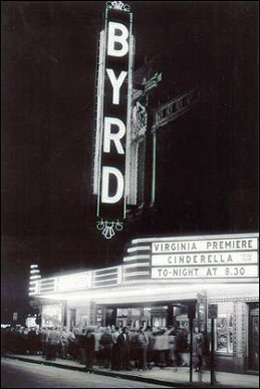 The BYRDistheword blog has been established to facilitate a new project of mine -- writing a book about the Byrd Theatre, a genuine 1928 movie palace. In the last couple of years, in writing a couple of articles about the theater, I have come to believe that a full telling of the way the Byrd came to be, what it has meant to the community and how it has survived, needs to be created and left for the record.
The blog will be used as a tool to stimulate interest in the project and to attract those folks who may have some helpful information. By going online in this way, it makes it easy to find me -- either by email or leaving comments -- and to share stories about the Byrd with others who cherish that old theater, others who would like to see its story documented in a proper fashion.
Click here to visit BYRDistheword.
And, thanks in advance to both the press and the blogging community of Richmond, and beyond, for whatever assistance they will give to this undertaking by helping to spread the word about this blog’s existence and purpose.
Thursday, January 18, 2007
Too much Pellot-Rosa sinks Seahawks
 Jesse Pellot-Rosa is ready on defense
Pellot-Rosa didn’t really have an obvious position. Lacking a consistent jump shot and not exactly a deft ball-handler, was he a guard or forward, or a defensive specialist, or what?
At the Siegel Center last night, senior swingman Pellot-Rosa, 6-4, 195, played 30 minutes of complete basketball, in pacing VCU to a hard-won victory over UNC Wilmington: VCU 74, UNC-W 65.
In short, Pellot-Rosa’s game was “complete” because he did exactly what his team needed every one of those minutes on the floor. Need a deflection or a gritty play in the paint? He was there. Stats? He scored 24 points, a career high. He also grabbed five rebounds. Throw in two assists with no turnovers.
Moreover, Pellot-Rosa’s performance was a clinic in how to balance finesse with power, intensity with control and leadership with role-playing.
When the Rams needed a three-point shot, Pellot-Rosa was there with five of them on six attempts. His trey with 4:04 remaining in the game dramatically stiff-armed a scary Seahawks rally and gave the Rams the lead for good, at 60-57.
After the game, first-year VCU head coach Anthony Grant lamented the fact he’ll only have one season to coach Pellot-Rosa, whose leadership he praised.
Now a force in the Colonial Athletic Association who has arrived, it says here there may not be a better all-around basketball player -- not just a scorer -- in the league right now than the homegrown Mr. Pellot-Rosa.
VCU (15-3, 7-0 in CAA) will host its longtime rival ODU (12-6, 5-2 in CAA) on Saturday night at the Siegel Center. Don’t wait to get your tickets, this one should sellout well before its 5:30 p.m. tip-off time.
Update (from VCU’s sports information office): The men’s basketball game between VCU and ODU, scheduled for Sat., Jan. 20, at 5:30 p.m. at the Stuart C. Siegel Center, is sold out. The game will be televised regionally on Comcast SportsNet-Mid-Atlantic.
Photo: SLANT
Monday, January 15, 2007
Blog links for beginners
For SLANTblog’s readers who have become curious about the “blogosphere” but still don’t know much about the various political blogs in Virginia, or even know how to find them, this post may help you. With more news about blogging in the mainstream press every day, and bloggers themselves moving from self-publishing to staff positions within the two political parties, folks who have heretofore ignored the blogging trend must be wondering what’s going on.
Here are some links to get such a reader started:
Waldo’s Virginia Political Blogroll is best known aggregating site for political blogs. It features posts it has grabbed from blogs across the Virginia landscape, from left to right, and links to the blogs themselves. Click here to go there.
Shaun Kenney’s blog is hosting the Virginia Blog Carnival this week. A blog carnival features specific posts from a variety of blogs, both submitted by bloggers and selected by the host. Next week’s Virginia carnival will be hosted by another volunteer host. Click here to go there.
And, here are eight more links to Richmond-based blogs that I recommend looking over. Some are focused entirely on political matters, others on a variety of concerns.
RVA blogs (a local aggregator, any style blog)
Barticles
Buttermilk & Molasses
J’s Notes
Richmond Democrat
Richmond Sunlight (New web page on the General Assembly's work)
River City Rapids
Save Richmond
Here are some links to get such a reader started:
Waldo’s Virginia Political Blogroll is best known aggregating site for political blogs. It features posts it has grabbed from blogs across the Virginia landscape, from left to right, and links to the blogs themselves. Click here to go there.
Shaun Kenney’s blog is hosting the Virginia Blog Carnival this week. A blog carnival features specific posts from a variety of blogs, both submitted by bloggers and selected by the host. Next week’s Virginia carnival will be hosted by another volunteer host. Click here to go there.
And, here are eight more links to Richmond-based blogs that I recommend looking over. Some are focused entirely on political matters, others on a variety of concerns.
RVA blogs (a local aggregator, any style blog)
Barticles
Buttermilk & Molasses
J’s Notes
Richmond Democrat
Richmond Sunlight (New web page on the General Assembly's work)
River City Rapids
Save Richmond
City in Denial
Note: With Martin Luther King Day upon us, I want to recycle another of my Back Page pieces for STYLE Weekly. “City in Denial” ran in February of 2002; it drew more comment, pro and con, than most of the other OpEds I’ve done for STYLE. How much in Richmond has changed since it was published is for the reader to say.
City in Denial
by F.T. Rea
Thinking of black history calls my attention to certain renowned black Richmonders -- Maggie Walker, Oliver Hill, Arthur Ashe -- and it always reminds me of what I know about Richmond and race. Rather than mince words, here it is: Richmond’s woeful lack of progress on matters racial has been its worst problem for a long time.
At its heart, Richmond has a tastefully restrained style about nearly everything it does. Those of us who know this town from the inside out probably take some of its enduring physical charm for granted. Yet, we do so knowing that our fair city’s pretty surface has an ugly story beneath it.
Richmond’s best-known street, Monument Avenue, with its stately mansions and row of statues, has been a lightning rod for acrimony in recent years, stemming largely from Richmond’s knee-jerk uneasiness with racial issues.
One hundred thirty-seven years after the end of the Civil War one is left to wonder what it would take to convince Richmonders on the two sides of Broad Street’s imaginary divide to recognize their common ground and let their dry-rotted expectations go. Perhaps, in the long run, absorbing the tragedy of 9/11 will eventually have that effect on us. Then again, around here if you bet on stubborn habits to win again tomorrow the odds will be with you.
In the late ’50s and early ’60s, when honest people of the Deep South saw the stark pictures -- in national magazines and on television -- of the shocking violence associated with desegregation, the hideous truth hit them in the face. For those who could manage it, change must have seemed vastly preferable to posing for more pictures of hell on earth.
Apprehensive white people who had been brought up as bigots had to agree with their restless black neighbors that change was inevitable and necessary. They might not have become pals overnight but they, blacks and whites, must have seen that they just couldn’t keep having riots in their streets.
However, in Richmond more restraint was evidenced. While that surely seemed like a blessing at the time, it may have come with a price.
Although the local white establishment stood fast in the shadow of the banner of Massive Resistance, it was less bombastic than it might have been in that time of stirred passions. Meanwhile, the determined black reform movement pinned its hopes on building a political organization with real clout -- the Crusade for Voters; formed in 1956.
Typical of Richmond, both camps weren’t as demonstrative and overtly confrontational as their counterparts in other areas. Thus Richmond got through the volatile Civil Rights era without having to witness, firsthand, a lot of bloodshed in its streets. The most telling public confrontation was an orderly economic boycott, rather than a nightstick-wielding and open-fire-hose melee over access to schools or transportation.
Downtown lunch counters in the five-and-dimes and the big department stores actually had set policies in those days that denied service to blacks. Amazingly, this they did while inviting the very same people to shop freely in the rest of the store.
In 1960 a group of 34 black citizens -- many were students -- was busted for having the temerity to ask to be served lunch at Thalhimers’ lunch counter. The action was called a “sit-down strike” in the vernacular of the times. The group was charged with trespassing.
Subsequently, a picket line was thrown up around Thalhimers, organized by the Richmond Citizens Advisory Committee, a group working under the NAACP’s auspices. After months of stalemate, the store caved in and downtown lunch counters 86ed their whites-only policy.
Perhaps the success and civility of that boycott deluded Richmonders into thinking that they didn’t need to search their own hearts and minds for the prejudices that cloud vision. Although official policies were changed by the Thalhimers boycott, ironically, it may have failed to clearly dramatize the genuine need for people in Virginia’s capital city to go out of their way to see the other guy’s point.
A few years after the boycott, Virginia’s elections began to be watched over by the federal government because of the Voting Rights Act. Court-ordered busing soon followed. Eventually district politics, also ordered by the federal courts, took root in Richmond in 1977. But with the nine districts came the narrow vision of the ward heeler, as well.
Those developments did little to soothe ruffled feathers because the changes were being dictated from the outside. Members of the City Council, always split along racial lines, bickered constantly over minutia throughout the ’80s. With payback being heaped upon payback, progress didn’t stand a chance.
Now, every time a controversy that touches on race pops up the oh-so-familiar cries are heard: “Oh Gawd! Let’s hope this business dies down before it makes the national news.”
Like a dysfunctional family in denial, we don’t want the rest of the country to catch on that Richmond is still trapped in yesteryear’s snare. Well, take it from me dear reader -- they already know. Everybody knows. Even in other parts of Virginia they know Richmond is frozen in time when it comes to race.
The negative expectations that linger in so many quarters, like bad air, simply have to be identified and challenged. This would certainly mean that Richmond’s leaders -- political, community, church and business -- should be taken to task whenever they fan the embers of old grudges for their own short-term gain.
Perhaps the simmering debate over public art is the perfect platform for having meaningful discussions -- group therapy? -- that could help clear the air. Rather than trying to muffle the headline-making rhubarbs over old statues and proposals for new ones, people of different backgrounds ought to take turns listening to one another.
Let’s hash it out; put the debate on television every week for a year, however long it takes. When the dust settles, let’s put some new statues on Monument Avenue that don’t ask the viewer to pick sides in the Civil War.
How about banking pioneer Maggie Walker and Supreme Court Justice Lewis F. Powell Jr. to get it started? Richmond has a wealth of history that has little or nothing to do with the events of the 1860s.
Let’s look for the best in ourselves and we may find it.
City in Denial
by F.T. Rea
Thinking of black history calls my attention to certain renowned black Richmonders -- Maggie Walker, Oliver Hill, Arthur Ashe -- and it always reminds me of what I know about Richmond and race. Rather than mince words, here it is: Richmond’s woeful lack of progress on matters racial has been its worst problem for a long time.
At its heart, Richmond has a tastefully restrained style about nearly everything it does. Those of us who know this town from the inside out probably take some of its enduring physical charm for granted. Yet, we do so knowing that our fair city’s pretty surface has an ugly story beneath it.
Richmond’s best-known street, Monument Avenue, with its stately mansions and row of statues, has been a lightning rod for acrimony in recent years, stemming largely from Richmond’s knee-jerk uneasiness with racial issues.
One hundred thirty-seven years after the end of the Civil War one is left to wonder what it would take to convince Richmonders on the two sides of Broad Street’s imaginary divide to recognize their common ground and let their dry-rotted expectations go. Perhaps, in the long run, absorbing the tragedy of 9/11 will eventually have that effect on us. Then again, around here if you bet on stubborn habits to win again tomorrow the odds will be with you.
In the late ’50s and early ’60s, when honest people of the Deep South saw the stark pictures -- in national magazines and on television -- of the shocking violence associated with desegregation, the hideous truth hit them in the face. For those who could manage it, change must have seemed vastly preferable to posing for more pictures of hell on earth.
Apprehensive white people who had been brought up as bigots had to agree with their restless black neighbors that change was inevitable and necessary. They might not have become pals overnight but they, blacks and whites, must have seen that they just couldn’t keep having riots in their streets.
However, in Richmond more restraint was evidenced. While that surely seemed like a blessing at the time, it may have come with a price.
Although the local white establishment stood fast in the shadow of the banner of Massive Resistance, it was less bombastic than it might have been in that time of stirred passions. Meanwhile, the determined black reform movement pinned its hopes on building a political organization with real clout -- the Crusade for Voters; formed in 1956.
Typical of Richmond, both camps weren’t as demonstrative and overtly confrontational as their counterparts in other areas. Thus Richmond got through the volatile Civil Rights era without having to witness, firsthand, a lot of bloodshed in its streets. The most telling public confrontation was an orderly economic boycott, rather than a nightstick-wielding and open-fire-hose melee over access to schools or transportation.
Downtown lunch counters in the five-and-dimes and the big department stores actually had set policies in those days that denied service to blacks. Amazingly, this they did while inviting the very same people to shop freely in the rest of the store.
In 1960 a group of 34 black citizens -- many were students -- was busted for having the temerity to ask to be served lunch at Thalhimers’ lunch counter. The action was called a “sit-down strike” in the vernacular of the times. The group was charged with trespassing.
Subsequently, a picket line was thrown up around Thalhimers, organized by the Richmond Citizens Advisory Committee, a group working under the NAACP’s auspices. After months of stalemate, the store caved in and downtown lunch counters 86ed their whites-only policy.
Perhaps the success and civility of that boycott deluded Richmonders into thinking that they didn’t need to search their own hearts and minds for the prejudices that cloud vision. Although official policies were changed by the Thalhimers boycott, ironically, it may have failed to clearly dramatize the genuine need for people in Virginia’s capital city to go out of their way to see the other guy’s point.
A few years after the boycott, Virginia’s elections began to be watched over by the federal government because of the Voting Rights Act. Court-ordered busing soon followed. Eventually district politics, also ordered by the federal courts, took root in Richmond in 1977. But with the nine districts came the narrow vision of the ward heeler, as well.
Those developments did little to soothe ruffled feathers because the changes were being dictated from the outside. Members of the City Council, always split along racial lines, bickered constantly over minutia throughout the ’80s. With payback being heaped upon payback, progress didn’t stand a chance.
Now, every time a controversy that touches on race pops up the oh-so-familiar cries are heard: “Oh Gawd! Let’s hope this business dies down before it makes the national news.”
Like a dysfunctional family in denial, we don’t want the rest of the country to catch on that Richmond is still trapped in yesteryear’s snare. Well, take it from me dear reader -- they already know. Everybody knows. Even in other parts of Virginia they know Richmond is frozen in time when it comes to race.
The negative expectations that linger in so many quarters, like bad air, simply have to be identified and challenged. This would certainly mean that Richmond’s leaders -- political, community, church and business -- should be taken to task whenever they fan the embers of old grudges for their own short-term gain.
Perhaps the simmering debate over public art is the perfect platform for having meaningful discussions -- group therapy? -- that could help clear the air. Rather than trying to muffle the headline-making rhubarbs over old statues and proposals for new ones, people of different backgrounds ought to take turns listening to one another.
Let’s hash it out; put the debate on television every week for a year, however long it takes. When the dust settles, let’s put some new statues on Monument Avenue that don’t ask the viewer to pick sides in the Civil War.
How about banking pioneer Maggie Walker and Supreme Court Justice Lewis F. Powell Jr. to get it started? Richmond has a wealth of history that has little or nothing to do with the events of the 1860s.
Let’s look for the best in ourselves and we may find it.
-- 30 --
Saturday, January 13, 2007
VCU atop the CAA
 Led by Eric Maynor’s 22 points and six assists the VCU Rams defeated the visiting Towson Tigers at the Siegel Center: VCU 85, Towson 77.
This victory, along with other CAA action today -- Hofstra lost to Northeastern -- puts the Rams alone atop the conference standings, one game ahead of Hofstra (12-5, 5-1 in CAA) and Old Dominion (12-5, 5-1 in CAA). VCU (14-3, 6-0 CAA) has now won five in a row, and 12 of its last 13 games.
Towson’s Gary Neal, who entered the game with the fifth-highest scoring average in Division I, scored 33 points, but he had to work hard to get them. To Towson’s credit, the Tigers never quit and the game was still up for grabs in the last minute.
It was VCU’s Jesse Pellot-Rosa who hit eight consecutive free throws late in the game to seal the win. He finished with 16 points and a game-high seven rebounds for the Rams.
Asked after the game if he ever considered using a junk defense on Neal, Rams head coach Anthony Grant smiled and shook his head. Many coaches prefer not to use box-and-ones, or other such off-balance defenses.
“It was tempting,” said Grant. Then he smiled more widely as he shook hands with his happy boss, VCU president Dr. Eugene Trani (pictured above), who is a frequent visitor in the Siegel Center‘s media room.
Photo: SLANT
Friday, January 12, 2007
All Dick, all the time
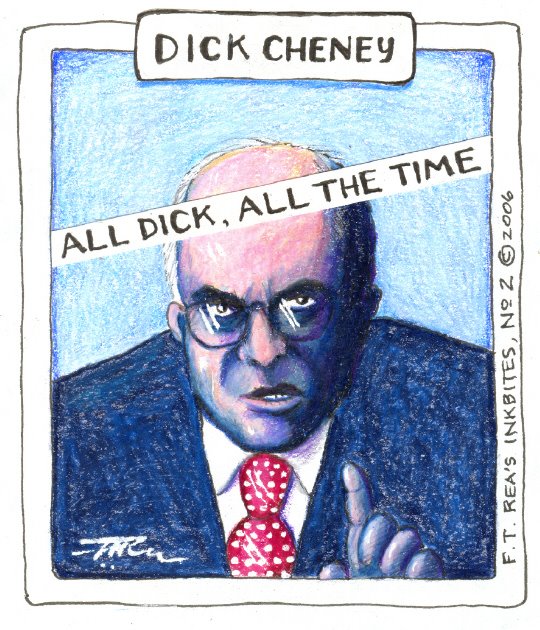 Cheney: Here’s the deal, Dubya, my boy, you give this speech. Hey, listen up, you’ve read it, right?
Bush: Of course I have, Dick, but who’s going to buy this, this business about a surge ...”
Cheney: Listen up. Congress will swell up, take the bait, and move to block funding for the surge. A few traitor Republicans will throw in with the Democrats. We’ll take care of them later.
Bush: You’re right, Dick, this is a surly new bunch that’s come in, especially that Webb. How in hell did he win?
Cheney: Shut up!
Bush: Right.
Cheney: Don’t you see, we want the Democrats to pull this. They will be trying to tie the hands of a valiant Commander-in-Chief, during wartime. The Average Joe will hate that. Our Christian conservatives will...
Bush: Oh, I like it. I bet Karl thought of this.
Cheney: Shut up! Listen. That will create a first-class feeding frenzy of a Constitutional Crisis, because you’re still the one and only Commander-in-Chief -- during a war -- and you’ll jolly well do as you see fit. Eventually, it will take the Supreme Court to settle it.
Bush: Dick, what about the ... what about the technicality that there’s been no declaration of war, from...
Cheney: Shut up! Dubya, please stop trying to think. You know that only makes you want to catch a buzz. Just listen...
Bush: Oh, I bet this little ... this little plan of Karl’s, and yours, too ... it could tie up the whole town for a couple of years.
Cheney: Very good, Dubya, that is the point.
Bush: Right, Dick ... I get it.
*
Art (and text) by F.T. Rea.
Click here to see how to the same All Dick image on a T-shirt
Note: The transcript of the scene above may have been leaked to SLANTblog by imbedded White House, fly-on-the-wall sources that must remain anonymous. They may have risked lives to spirit it out. However, in order to publish this material -- in good faith -- it must be said there’s more than a small chance the aforementioned sources never existed. So, we did the best we could, anyway.
Click here to see how to the same All Dick image on a T-shirt
Note: The transcript of the scene above may have been leaked to SLANTblog by imbedded White House, fly-on-the-wall sources that must remain anonymous. They may have risked lives to spirit it out. However, in order to publish this material -- in good faith -- it must be said there’s more than a small chance the aforementioned sources never existed. So, we did the best we could, anyway.
Wednesday, January 10, 2007
Webb on PBS
Sen. Jim Webb’s refreshing/sharp comments on PBS, responding to President George Bush’s boilerplate, same-’ol, same-’ol speech on staying-the-folly in Iraq, were just what I’ve hoped to one day hear from a Virginia senator. It felt so satisfying ...
Thanks, Jim.
Thanks, Jim.
Deatched and Within
fiction by F. T. Rea
June 3, 1959: Roscoe Swift, a lean boy with sandy hair and clear blue eyes, lived with his mother’s parents in their roomy stucco home in Dogtown, a suburb of Richmond, Virginia. His mother lived in her studio apartment over the garage, next to the breezeway, thirty yards from the house. She was a sometime commercial artist, who hadn’t ventured far from her studio/sanctuary in over a year. As a rule, she wouldn’t answer the door before noon.
When Roscoe was almost three-years-old his overly Southern mother, who was “rather delicately balanced” -- according to his grandmother -- left his father. As he never saw him again, Roscoe couldn’t remember much about the man, who went back in the Army and died fighting in Korea a couple of years after the separation. As his mother refused to speak of him, most of what Roscoe knew about his lost parent -- the body was never found -- came from his grandparents. That, and the peculiar look in his mother’s fretful brown eyes, which told him she was off, dwelling on what she had lost.
School was easy for Roscoe; when he could manage it, he took pride in being able to do the work as well as any other boy, but faster. But it was baseball that mattered to him more than anything else. He calculated and committed to memory the up-to-date batting averages of his favorite Major League players before he went to school, everyday.
At this point in his life, Roscoe’s only trouble at school was that his bad temper got him into fist fights, which not only earned him many a bloody nose, but it kept him from getting good grades in conduct.
For as long as Roscoe could remember, he had been in training to be a hero. He had tested his nerve with many a daredevil stunt and could throw a rock better than any boy in the neighborhood; any boy his age, anyway. At summer camp the year before, he had been the top rifle marksman in the whole camp, any age. Plus, he had listened attentively to all of his grandfather’s baseball yarns and coaching instructions.
Then came the day for his first true test -- it was, what was then, the biggest at-bat of the biggest game of his career.
The situation: Men were on first and third; one out; two runs behind in the bottom of the last inning. Taking his practice swings, Roscoe reminded himself of what the moment called for, baseball-fundamentals-wise.
“No grounder, no double play,” he thought, as he knocked red clay dust off his sneakers with the bat. “Drive it out of the infield.”
It was the last game of the season. Two of the school’s four fifth-grade classes had finished the year tied, forcing a playoff game to decide the championship. Following lunch, all the fifth-graders at Gittes Creek Elementary had been given the afternoon to watch the two teams settle the issue. Students with no taste for baseball had the option of watching a documentary film about Jamestown’s 350th anniversary.
Thus, there was a pretty good crowd for the title game.
A group of men, about a dozen of them, showed up. There were a couple of Little League coaches in the bunch, one of them had played Double A ball in his day. Several girls from the two classes involved were acting as cheerleaders. This was the first game Roscoe had ever played in that had cheerleaders.
Baseball, even fifth-grade baseball, was important business in Dogtown.
Roscoe stood in the batter’s box on the first base side of home-plate. A natural right-hander, Roscoe had decided that if the best hitter in the game -- Ted Williams -- batted left-handed, so would he. For a month he had been practicing swinging left-handed, almost exclusively, in neighborhood pickup games.
Finally, he had to test it in a game that mattered.
His best friend Finn Daley, standing on first base, cheered him on. Several of his teammates implored him from the bench to bat right-handed, as usual in so-called real games, since the season was on the line. Butterflies the size of eagles disquieted Roscoe’s stomach.
Stepping out of the box, the batter adjusted the dark blue wool baseball cap he wore when playing for his Little League team. He took three additional practice swings. He looked at the crowd on the third base line.
The cheerleaders were chanting, “Roscoe, Roscoe, he’s our man. If he can’t do it, nobody can.”
His architect grandfather, who had taken the afternoon off without it being an emergency -- for the first time in Roscoe’s memory -- stood in the shade of a large oak tree with three other men. Narrowing his gray eyes beneath the flat brim of his straw hat, the old man watched the batter’s body language as only he could.
On the first base line, his opponents and their fans booed and hooted at Roscoe. He decided to go far within himself, to dig in, to ignore them all.
However, there was a particular girl, with a strawberry-blonde ponytail and lively green eyes, cheering for the other team. Her name was Susie Ryan.
Roscoe always noticed Susie. This time was no exception. The best thing to say to her never came to mind when she was near. She made him nervous. So he watched her from a distance, mostly, with a sense of longing he couldn’t understand. Although Susie was calling for his downfall, Roscoe’s sharpshooter’s eyes followed her gestures. He was glad she was there.
Back in the box, Roscoe shifted his weight to his back foot and turned his front foot thirty degrees toward first base. Relaxing his fingers, he squinted his eyes and squared his jaw.
The pitcher threw the first pitch outside and in the dirt. It got by the catcher but the no-stealing ground rule didn’t allow the base-runners to advance.
Sure the next pitch would be across the plate, Roscoe prepared to cut the ball in half. The pitcher went into his stretch as the infielders behind him chattered encouragement.
Roscoe took a big roundhouse swing. Whoosh!
The ball disappeared in mid-air. Holding the baseball aloft, the catcher taunted, “Hey man ... looking for this?” Then he fired it back to the grinning pitcher.
Roscoe heard the collective laughter from his opponents and their classmates. Nonetheless, he didn’t look at anyone on either baseline. He knew he had shut his eyes while swinging the bat.
The batter’s cheeks flushed as he pulled his cap’s brim down on his brow.
“It only takes one to hit it!” Bellowed his grandfather through cupped hands.
Looking at the catcher’s signal, the pitcher nodded. Working from an exaggerated full stretch, he confidently cut loose with the same pitch -- a fastball.
Swinging from the heels, Roscoe rolled his wrists and tagged the ball: Cah-rack!
Traveling over the second baseman’s glove the sphere left the infield with dispatch. It was still rising when it split the seam between the right and center fielders. They chased it across the grass, then down the slope and all the way into the little trickle of a creek that bordered the school yard.
By far, it was the most solidly Roscoe had ever hit a baseball, and he knew it. The utter perfection of the bat’s perfectly-timed kiss on the horsehide’s sweet spot had resonated through his body -- it was a righteous sensation.
Circling the bases, Roscoe heard the growing furor. He ran like a monster was chasing him, rounding third, until he almost caught up with Finn.
“Slow down, Number Nine ... they haven’t even found it yet,” Finn advised with a laugh.
Roscoe’s euphoric classmates were jumping around wildly. His grandfather beamed as he waved his straw hat. Teammates, suddenly champions, were pounding him on his back as he neared home. Meanwhile, his capacity to comprehend the moment was red-lining.
He looked at Susie on the quiet side of the field. The way her head tilted to the side, the angle of her limbs, something about her backlit outline pulled him into a spell. When she stomped her foot it made everything he saw and felt become more intense, more vivid.
It was as though he was viewing the event from several different angles. Roscoe felt both inside and outside the scene, at its heart and yet detached. His mind raced and the rest of the world seemed to slow down. He strained to pull all the pictures together.
He alone heard the explosion ... boom!
For the first time in his eleven and a half years on the planet, all of life seemed perfectly in focus when Roscoe crossed home plate. His spirit was in flight. It was soaring, free of gravity, above his dogged fears.
It hadn’t occurred to him to lope around the bases, a la Ted Williams. He’d been too excited for such restraint. More importantly, he had remembered to make no showboating, hat-tipping gesture to the crowd. If the real Number Nine never tipped his cap to the public during his home run trot, well, that was more than good enough for Roscoe.
A genuine hero doesn’t have to tip his cap.
June 3, 1959: Roscoe Swift, a lean boy with sandy hair and clear blue eyes, lived with his mother’s parents in their roomy stucco home in Dogtown, a suburb of Richmond, Virginia. His mother lived in her studio apartment over the garage, next to the breezeway, thirty yards from the house. She was a sometime commercial artist, who hadn’t ventured far from her studio/sanctuary in over a year. As a rule, she wouldn’t answer the door before noon.
When Roscoe was almost three-years-old his overly Southern mother, who was “rather delicately balanced” -- according to his grandmother -- left his father. As he never saw him again, Roscoe couldn’t remember much about the man, who went back in the Army and died fighting in Korea a couple of years after the separation. As his mother refused to speak of him, most of what Roscoe knew about his lost parent -- the body was never found -- came from his grandparents. That, and the peculiar look in his mother’s fretful brown eyes, which told him she was off, dwelling on what she had lost.
School was easy for Roscoe; when he could manage it, he took pride in being able to do the work as well as any other boy, but faster. But it was baseball that mattered to him more than anything else. He calculated and committed to memory the up-to-date batting averages of his favorite Major League players before he went to school, everyday.
At this point in his life, Roscoe’s only trouble at school was that his bad temper got him into fist fights, which not only earned him many a bloody nose, but it kept him from getting good grades in conduct.
For as long as Roscoe could remember, he had been in training to be a hero. He had tested his nerve with many a daredevil stunt and could throw a rock better than any boy in the neighborhood; any boy his age, anyway. At summer camp the year before, he had been the top rifle marksman in the whole camp, any age. Plus, he had listened attentively to all of his grandfather’s baseball yarns and coaching instructions.
Then came the day for his first true test -- it was, what was then, the biggest at-bat of the biggest game of his career.
The situation: Men were on first and third; one out; two runs behind in the bottom of the last inning. Taking his practice swings, Roscoe reminded himself of what the moment called for, baseball-fundamentals-wise.
“No grounder, no double play,” he thought, as he knocked red clay dust off his sneakers with the bat. “Drive it out of the infield.”
It was the last game of the season. Two of the school’s four fifth-grade classes had finished the year tied, forcing a playoff game to decide the championship. Following lunch, all the fifth-graders at Gittes Creek Elementary had been given the afternoon to watch the two teams settle the issue. Students with no taste for baseball had the option of watching a documentary film about Jamestown’s 350th anniversary.
Thus, there was a pretty good crowd for the title game.
A group of men, about a dozen of them, showed up. There were a couple of Little League coaches in the bunch, one of them had played Double A ball in his day. Several girls from the two classes involved were acting as cheerleaders. This was the first game Roscoe had ever played in that had cheerleaders.
Baseball, even fifth-grade baseball, was important business in Dogtown.
Roscoe stood in the batter’s box on the first base side of home-plate. A natural right-hander, Roscoe had decided that if the best hitter in the game -- Ted Williams -- batted left-handed, so would he. For a month he had been practicing swinging left-handed, almost exclusively, in neighborhood pickup games.
Finally, he had to test it in a game that mattered.
His best friend Finn Daley, standing on first base, cheered him on. Several of his teammates implored him from the bench to bat right-handed, as usual in so-called real games, since the season was on the line. Butterflies the size of eagles disquieted Roscoe’s stomach.
Stepping out of the box, the batter adjusted the dark blue wool baseball cap he wore when playing for his Little League team. He took three additional practice swings. He looked at the crowd on the third base line.
The cheerleaders were chanting, “Roscoe, Roscoe, he’s our man. If he can’t do it, nobody can.”
His architect grandfather, who had taken the afternoon off without it being an emergency -- for the first time in Roscoe’s memory -- stood in the shade of a large oak tree with three other men. Narrowing his gray eyes beneath the flat brim of his straw hat, the old man watched the batter’s body language as only he could.
On the first base line, his opponents and their fans booed and hooted at Roscoe. He decided to go far within himself, to dig in, to ignore them all.
However, there was a particular girl, with a strawberry-blonde ponytail and lively green eyes, cheering for the other team. Her name was Susie Ryan.
Roscoe always noticed Susie. This time was no exception. The best thing to say to her never came to mind when she was near. She made him nervous. So he watched her from a distance, mostly, with a sense of longing he couldn’t understand. Although Susie was calling for his downfall, Roscoe’s sharpshooter’s eyes followed her gestures. He was glad she was there.
Back in the box, Roscoe shifted his weight to his back foot and turned his front foot thirty degrees toward first base. Relaxing his fingers, he squinted his eyes and squared his jaw.
The pitcher threw the first pitch outside and in the dirt. It got by the catcher but the no-stealing ground rule didn’t allow the base-runners to advance.
Sure the next pitch would be across the plate, Roscoe prepared to cut the ball in half. The pitcher went into his stretch as the infielders behind him chattered encouragement.
Roscoe took a big roundhouse swing. Whoosh!
The ball disappeared in mid-air. Holding the baseball aloft, the catcher taunted, “Hey man ... looking for this?” Then he fired it back to the grinning pitcher.
Roscoe heard the collective laughter from his opponents and their classmates. Nonetheless, he didn’t look at anyone on either baseline. He knew he had shut his eyes while swinging the bat.
The batter’s cheeks flushed as he pulled his cap’s brim down on his brow.
“It only takes one to hit it!” Bellowed his grandfather through cupped hands.
Looking at the catcher’s signal, the pitcher nodded. Working from an exaggerated full stretch, he confidently cut loose with the same pitch -- a fastball.
Swinging from the heels, Roscoe rolled his wrists and tagged the ball: Cah-rack!
Traveling over the second baseman’s glove the sphere left the infield with dispatch. It was still rising when it split the seam between the right and center fielders. They chased it across the grass, then down the slope and all the way into the little trickle of a creek that bordered the school yard.
By far, it was the most solidly Roscoe had ever hit a baseball, and he knew it. The utter perfection of the bat’s perfectly-timed kiss on the horsehide’s sweet spot had resonated through his body -- it was a righteous sensation.
Circling the bases, Roscoe heard the growing furor. He ran like a monster was chasing him, rounding third, until he almost caught up with Finn.
“Slow down, Number Nine ... they haven’t even found it yet,” Finn advised with a laugh.
Roscoe’s euphoric classmates were jumping around wildly. His grandfather beamed as he waved his straw hat. Teammates, suddenly champions, were pounding him on his back as he neared home. Meanwhile, his capacity to comprehend the moment was red-lining.
He looked at Susie on the quiet side of the field. The way her head tilted to the side, the angle of her limbs, something about her backlit outline pulled him into a spell. When she stomped her foot it made everything he saw and felt become more intense, more vivid.
It was as though he was viewing the event from several different angles. Roscoe felt both inside and outside the scene, at its heart and yet detached. His mind raced and the rest of the world seemed to slow down. He strained to pull all the pictures together.
He alone heard the explosion ... boom!
For the first time in his eleven and a half years on the planet, all of life seemed perfectly in focus when Roscoe crossed home plate. His spirit was in flight. It was soaring, free of gravity, above his dogged fears.
It hadn’t occurred to him to lope around the bases, a la Ted Williams. He’d been too excited for such restraint. More importantly, he had remembered to make no showboating, hat-tipping gesture to the crowd. If the real Number Nine never tipped his cap to the public during his home run trot, well, that was more than good enough for Roscoe.
A genuine hero doesn’t have to tip his cap.
* * *
All rights reserved by the author.
This story is dedicated to Emily, my ten-year-old granddaughter
All rights reserved by the author.
This story is dedicated to Emily, my ten-year-old granddaughter
Tuesday, January 09, 2007
...the best disinfectant
The General Assembly is back in session. In Richmond, while that might sound like business as usual -- the regular showboat drunks in certain bars -- this year there is something new to do with that particular pack of elected officials. Created by Waldo Jaquith, it is the brand new RichmondSunlight web site, which will give the public a snazzy new tool with which to interact with the GA.
Here’s an info blurb from the RichmondSunlight front page:
“Lobby your senator, keep up with your delegate, find out what bills could affect your life and make your voice heard. It’s easy, it’s fast, and it’s fun. Fully buzzword compliant, Richmond Sunlight demystifies the often-baffling process of how a bill becomes law, giving you a say in it, every step of the way. This year's General Assembly session begins on January 10, and is slated to run through February 24. Legislators are currently prefiling bills in advance of the session.”
Click here to read Jaquith's intro to RichmondSunlight.
Here’s an info blurb from the RichmondSunlight front page:
“Lobby your senator, keep up with your delegate, find out what bills could affect your life and make your voice heard. It’s easy, it’s fast, and it’s fun. Fully buzzword compliant, Richmond Sunlight demystifies the often-baffling process of how a bill becomes law, giving you a say in it, every step of the way. This year's General Assembly session begins on January 10, and is slated to run through February 24. Legislators are currently prefiling bills in advance of the session.”
Click here to read Jaquith's intro to RichmondSunlight.
Swordfish of '76
On Saturday, May 6, 2006 another Kentucky Derby Day softball reunion was held. Anyone who ever played on the now defunct team was welcome, plus their families, friends, etc. The annual parties began in 1980, when the Biograph Theatre’s softball team was one of the cars attached to a runaway train known as the Fan District Softball League (1975-94). At the reunion a few innings of softball were played in splendid weather without anyone hobbling off the field, or worse -- being carried off. A fine picnic spread was laid out and consumed. Cold beer flowed as the same stories were stretched, again. The horse race was watched on a little battery-powered TV.
Several of the guys at this year’s gathering were teammates of mine in 1976, when I was the manager of the Biograph, a repertory cinema that was located at 814 West Grace Street. It was the first summer of Biograph softball. We called ourselves the Swordfish, after a joke in a Marx Brothers movie. That year we played a schedule that was not set; we challenged other teams, which played in organized leagues (mostly Fan League teams), to play us for a keg of beer.
The Biograph Swordfish won 15 games (that were scheduled and umpired) of the 17 we played that initial season. In spite of having few experienced softball players on a roster, which included two French guys (friends of one of the cinema’s cashiers) -- they had never seen a softball, or baseball -- we probably won half of them by coming from behind in late innings.
Typically, our opponents saw themselves as more experienced and athletically superior, which only made it more fun when they bumbled their way into handing us the victory.
It was uncanny. Every time, those supposedly better teams seemed to be willing to overplay their hands. Now, having played and observed a lot of organized softball, I know that first Swordfish squad was absolutely charmed. Moreover, it was the loosest and luckiest team I’ve ever been associated with, bar none.
The Swordfish’s two losses were in extreme situations. The first was the championship game of one of the two tournaments we entered. The other was played inside the walls of the old state penitentiary.
Located at Belvidere and Spring Streets, the fortress prison loomed over the rocky falls of the James River for nearly 200 years (it was demolished in the early-1990s). As it happened the guy in charge of recreation at the pen frequented J.W. Rayle, a popular bar of the era, located at Pine and Cary. In that bar, during a conversation, he asked me if the Biograph team -- I played outfield and served as the coach -- would consider taking on the prison’s team on a Saturday afternoon.
As it turned out the first date he set up was cancelled, due to something about a small riot.
OK.
A couple of weeks later the Swordfish entered the Big House. To get into the prison yard we had to go through a process, which included a cursory search. As I recall, we had been told to bring nothing in our pockets. Thus, we had our softball equipment and that was it.
As we worked our way through the ancient passageways, sets of bars were unlocked and then locked behind us. Each of us got a stamp on our hands that could only be seen under a special light. Someone asked what would happen if the ink got wiped off, inadvertently, during the game. He was told that was not a good idea.
OK.
The game itself was like all softball games, in ways, and rather unusual in others. The fence in leftfield was the same high brick wall that ran along Belvidere Street. It was only about 225 to 240 feet from home plate. Yet, because of its height, maybe 30 feet, a lot of hard-hit balls caromed off of it. What would have been a routine fly ball on most fields was a home run there. It was a red brick version of Boston’s Green Monster.
The prison team, known as the Raiders, was quite good at launching softballs over that towering brick wall. They seemed to have an unlimited budget for softballs, too. Under the supervision of watchful guards hundreds of other prisoners, seated in stands, cheered for the home team to vanquish the visiting Swordfish.
During a conversation with a couple of my teammates behind the backstop, I referred to the home team as “the prisoners.” Our opponents’ coach stepped toward me. He, like his teammates, had on a typical softball uniform of that era -- it was a maroon and gray polyester affair, with “Raiders” printed across the chest and a number on the back.
In contrast, we just had identical blue hats with a “B” on them. About half of us wore one of two different Biograph T-shirts models.
“Call us the Raiders,” he advised, sternly, as he pointed to a mural on the prison wall that said “Home of the Raiders.”
I realized I’d made a faux pas, right away.
“While we are on the field, we’re not The Prisoners,” he said with conviction, “we’re the Raiders.”
“Raiders,” I said. “Right.”
“All our games are home games,” he deadpanned.
We all laughed, grateful the tension had been broken. He thanked us for being there, for agreeing to play them.
The Raiders won, in a tight, high-scoring affair. Afterward, I was glad we’d met the Raiders. And, I was even more glad to leave that place.Now, I’m so glad that prison is no longer there. Located in the middle of Richmond, it was a nightmare in so many ways.
This yarn was a small part of a sepia-toned softball season so long ago it seems like a dream now. The Biograph teams that followed never saw anything like such raw success, again. Now I truly wonder how we did it.
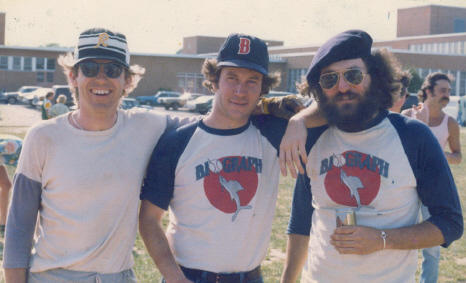
Fan District Softball Leaguers Chuck Wrenn, Terry Rea and Larry Rohr
Photo: Danny Brisbane (circa 1977)Several of the guys at this year’s gathering were teammates of mine in 1976, when I was the manager of the Biograph, a repertory cinema that was located at 814 West Grace Street. It was the first summer of Biograph softball. We called ourselves the Swordfish, after a joke in a Marx Brothers movie. That year we played a schedule that was not set; we challenged other teams, which played in organized leagues (mostly Fan League teams), to play us for a keg of beer.
The Biograph Swordfish won 15 games (that were scheduled and umpired) of the 17 we played that initial season. In spite of having few experienced softball players on a roster, which included two French guys (friends of one of the cinema’s cashiers) -- they had never seen a softball, or baseball -- we probably won half of them by coming from behind in late innings.
Typically, our opponents saw themselves as more experienced and athletically superior, which only made it more fun when they bumbled their way into handing us the victory.
It was uncanny. Every time, those supposedly better teams seemed to be willing to overplay their hands. Now, having played and observed a lot of organized softball, I know that first Swordfish squad was absolutely charmed. Moreover, it was the loosest and luckiest team I’ve ever been associated with, bar none.
The Swordfish’s two losses were in extreme situations. The first was the championship game of one of the two tournaments we entered. The other was played inside the walls of the old state penitentiary.
Located at Belvidere and Spring Streets, the fortress prison loomed over the rocky falls of the James River for nearly 200 years (it was demolished in the early-1990s). As it happened the guy in charge of recreation at the pen frequented J.W. Rayle, a popular bar of the era, located at Pine and Cary. In that bar, during a conversation, he asked me if the Biograph team -- I played outfield and served as the coach -- would consider taking on the prison’s team on a Saturday afternoon.
As it turned out the first date he set up was cancelled, due to something about a small riot.
OK.
A couple of weeks later the Swordfish entered the Big House. To get into the prison yard we had to go through a process, which included a cursory search. As I recall, we had been told to bring nothing in our pockets. Thus, we had our softball equipment and that was it.
As we worked our way through the ancient passageways, sets of bars were unlocked and then locked behind us. Each of us got a stamp on our hands that could only be seen under a special light. Someone asked what would happen if the ink got wiped off, inadvertently, during the game. He was told that was not a good idea.
OK.
The game itself was like all softball games, in ways, and rather unusual in others. The fence in leftfield was the same high brick wall that ran along Belvidere Street. It was only about 225 to 240 feet from home plate. Yet, because of its height, maybe 30 feet, a lot of hard-hit balls caromed off of it. What would have been a routine fly ball on most fields was a home run there. It was a red brick version of Boston’s Green Monster.
The prison team, known as the Raiders, was quite good at launching softballs over that towering brick wall. They seemed to have an unlimited budget for softballs, too. Under the supervision of watchful guards hundreds of other prisoners, seated in stands, cheered for the home team to vanquish the visiting Swordfish.
During a conversation with a couple of my teammates behind the backstop, I referred to the home team as “the prisoners.” Our opponents’ coach stepped toward me. He, like his teammates, had on a typical softball uniform of that era -- it was a maroon and gray polyester affair, with “Raiders” printed across the chest and a number on the back.
In contrast, we just had identical blue hats with a “B” on them. About half of us wore one of two different Biograph T-shirts models.
“Call us the Raiders,” he advised, sternly, as he pointed to a mural on the prison wall that said “Home of the Raiders.”
I realized I’d made a faux pas, right away.
“While we are on the field, we’re not The Prisoners,” he said with conviction, “we’re the Raiders.”
“Raiders,” I said. “Right.”
“All our games are home games,” he deadpanned.
We all laughed, grateful the tension had been broken. He thanked us for being there, for agreeing to play them.
The Raiders won, in a tight, high-scoring affair. Afterward, I was glad we’d met the Raiders. And, I was even more glad to leave that place.Now, I’m so glad that prison is no longer there. Located in the middle of Richmond, it was a nightmare in so many ways.
This yarn was a small part of a sepia-toned softball season so long ago it seems like a dream now. The Biograph teams that followed never saw anything like such raw success, again. Now I truly wonder how we did it.
It's time to come home; enough is enough
Apparently, the Commander in Chief is going to tell the American public that he has “decided” to escalate the war in Iraq, in that he intends to send in yet more troops. Rather than write a longer piece, anticipating the thrust of President Bush’s televised address tomorrow night, this post will only dwell on one point. Without rehashing all the terrible decisions Bush has made, to do with Iraq, he has surely run out of time for pursuing his “stay the course” strategy/slogan.
Bush has run out of time because this mission-not-accomplished has lasted way too long -- longer than America’s participation in World War II. History tells us the longer this occupation goes on, the more resourceful the resisters to it will become. He has run out of time because of disturbing revelations about how much he and Vice President Cheney tortured the truth in their manipulative buildup to the war. And, the president has run out of time because the utter failure of his hubris-driven effort to stabilize the Middle East, by overthrowing a heavy-handed dictator, is exacting a more bitter price in American blood and treasure every week.
This time, I'll skip the harm it has done to others.
The permit has expired for the campaign Bush launched on Mar. 20, 2003. No doubt, that was a good part of the message voters were sending him in the most recent election. Yes, and now it’s time for a whole new strategy that gets America out of Iraq, pronto -- that’s pretty much the rest of the message about Iraq, sent from the people.
Now, if Bush goes on TV and says here’s the new deal:
We have talked some of Iraq’s neighbors and some of our traditional allies into helping out in a new way. Under a UN flag, or a NATO flag, or some ad hoc international flag, they will cooperate with us in facilitating America’s withdrawal from Iraq. They will send in 50,000 or 75,000 of their troops to combine with 20,000 more of our troops, to help us clean out a few stubborn trouble spots. Then, in a couple of months, we will ask the UN to work with the various sects/tribes to “decide” how many countries Iraq ought to be split into, and where the borders ought to be. Then we will come home. Maybe Baghdad will have to be nervously policed by an international force for years.
If he says something along those lines, then I’d say a temporary “surge” in the number of American troops in Iraq might not be such a bad idea.
But if The Decider says this:
We were dead right to have started this war, and I just don’t care who says different. Yes, it’s been more difficult to bring democracy and peace to Iraq than we had hoped, but now, all we need to do is put more Americans in harm’s way, and you’ll see it will all work out, just fine. Hey, if we don’t fight the terrorists in Iraq -- 9/11, 9/11, 9/11 -- there’s no question but that they will soon be at our doorstep. So, this is a war we just can’t afford to lose. There is no substitute for victory.
If Bush spouts that crap, again, he deserves to be stiff-armed by Congress. That means Democrats and whatever Republicans must block any specific funding for this so-called “surge.” Then our legislators must set a firm deadline for Bush to bring our troops home, using the tools the system gives them.
Please know that until now I’ve been against a rigid published deadline. Until now, I’ve agreed that it would tie our military’s hands in a way we might regret.
Now, the message to The Decider is plain -- Sir, enough is enough!
During the years in which America’s involvement in the Vietnam War steadily escalated to more than a half-million troops, each escalation was sold as the solution to the problem. Now we know those increases were folly. Thousands of Americans died long after it was known at the heart of the Pentagon we would never win, at least not in any way like we had been told in the beginning, or to justify the many increases in troops.
As a man who remembers the lies and the lessons of Vietnam, it is incredibly exasperating/depressing to see it all happening again.
Enough is enough.
Without rehashing all the terrible decisions Bush has made, to do with Iraq, he has surely run out of time for pursuing his “stay the course” strategy/slogan.Bush has run out of time because this mission-not-accomplished has lasted way too long -- longer than America’s participation in World War II. History tells us the longer this occupation goes on, the more resourceful the resisters to it will become. He has run out of time because of disturbing revelations about how much he and Vice President Cheney tortured the truth in their manipulative buildup to the war. And, the president has run out of time because the utter failure of his hubris-driven effort to stabilize the Middle East, by overthrowing a heavy-handed dictator, is exacting a more bitter price in American blood and treasure every week.
This time, I'll skip the harm it has done to others.
The permit has expired for the campaign Bush launched on Mar. 20, 2003. No doubt, that was a good part of the message voters were sending him in the most recent election. Yes, and now it’s time for a whole new strategy that gets America out of Iraq, pronto -- that’s pretty much the rest of the message about Iraq, sent from the people.
Now, if Bush goes on TV and says here’s the new deal:
We have talked some of Iraq’s neighbors and some of our traditional allies into helping out in a new way. Under a UN flag, or a NATO flag, or some ad hoc international flag, they will cooperate with us in facilitating America’s withdrawal from Iraq. They will send in 50,000 or 75,000 of their troops to combine with 20,000 more of our troops, to help us clean out a few stubborn trouble spots. Then, in a couple of months, we will ask the UN to work with the various sects/tribes to “decide” how many countries Iraq ought to be split into, and where the borders ought to be. Then we will come home. Maybe Baghdad will have to be nervously policed by an international force for years.
If he says something along those lines, then I’d say a temporary “surge” in the number of American troops in Iraq might not be such a bad idea.
But if The Decider says this:
We were dead right to have started this war, and I just don’t care who says different. Yes, it’s been more difficult to bring democracy and peace to Iraq than we had hoped, but now, all we need to do is put more Americans in harm’s way, and you’ll see it will all work out, just fine. Hey, if we don’t fight the terrorists in Iraq -- 9/11, 9/11, 9/11 -- there’s no question but that they will soon be at our doorstep. So, this is a war we just can’t afford to lose. There is no substitute for victory.
If Bush spouts that crap, again, he deserves to be stiff-armed by Congress. That means Democrats and whatever Republicans must block any specific funding for this so-called “surge.” Then our legislators must set a firm deadline for Bush to bring our troops home, using the tools the system gives them.
Please know that until now I’ve been against a rigid published deadline. Until now, I’ve agreed that it would tie our military’s hands in a way we might regret.
Now, the message to The Decider is plain -- Sir, enough is enough!
During the years in which America’s involvement in the Vietnam War steadily escalated to more than a half-million troops, each escalation was sold as the solution to the problem. Now we know those increases were folly. Thousands of Americans died long after it was known at the heart of the Pentagon we would never win, at least not in any way like we had been told in the beginning, or to justify the many increases in troops.
As a man who remembers the lies and the lessons of Vietnam, it is incredibly exasperating/depressing to see it all happening again.
Enough is enough.
Toon by F.T. Rea
Motordrive Kitty
 In the spring of 1985 I visited New York City for a few days. While there I bought a new 35mm Nikon, to replace a camera that had been stolen the year before, and I bought something I'd wanted for a long time -- a motordrive.
For the first month or so back in Richmond, I took the Nikon, with the motordrive attached to it, along with me all the time. These two almost identical prints of a sleepy cat in a storefront window on Main Street, taken a fraction of a second apart, probably made better use of the rapid fire capability than most of the snapshots I created in that period.
Monday, January 08, 2007
VCU Rams remain undefeated in CAA
 Playing at the Siegel Center on West Broad Street, following a lackluster first half, VCU’s brutal defense squeezed visiting Northeastern to death: VCU 64, Northeasthern 44.
The Rams attack was paced by senior guard/forward Jesse Pellot-Rosa, who scored 13 points and grabbed six rebounds in 25 minutes on the floor. With a game at William & Mary on Wednesday night, VCU head coach Anthony Grant wisely rested his starters more in this game than recent previous outings, using 11 players in the doing.
As a result of tonight’s hoops action, VCU (12-3, 4-0 in CAA) moved into a three-way tie for first place in the Colonial Athletic Association with Hofstra and Drexel. Playing at home, Hofstra (11-4, 4-0 in CAA) defeated ODU (10-5, 3-1 in CAA) by a score of 70 to 58. And, Drexel (12-2, 4-0 in CAA) won at James Madison (4-10, 1-3 in CAA) by a score of 65 to 54.
Update: For more on the CAA, read my sports column, The Bounce, at Richmond.com
Photo by SLANT
Saturday, January 06, 2007
The Case of Gus the Cat
Though cynical people like to say, “All cats are gray in the dark,” the difference between this and that counts with me. Thus, if for no other purpose than to satisfy my own curiosity, I set out to find the truth about Gus, the cat that had long presided over lower Carytown from his display window roost.
The mystery began in January of 2000 during the course of a casual conversation about re-makes of old movies. Film buff Ted Salins, a regular among the society of conversationalists who gather at the tables on the sidewalk in front of Coffee & Co., tossed out that the cat living next door in Carytown Books is not the “original” Gus.
Since I’ve known Salins, a writer/filmmaker/house-painter, for a long time, I suspected his charge was a setup for a weak joke. To give him room to operate I asked, “So, this Gus is an impostor?”
 Gus the Cat, perhaps
“Just like Lassie, several cats have played the role of Gus over the years,” Salins said matter-of-factly.
Until that moment it hadn’t occurred to me that Gus, someone else’s cat, had slowly become important to me over the years. In the past I’ve been told that he’s over 15, maybe pushing 20. Who can say what that is in cat years? He still has a few teeth left.
“You see, in ‘91 I had lost my beloved Skinkywinkydinky in a separation,” Salins went on, as if revealing a dark conspiracy. “When I first saw Gus, I took to him because he reminded me of Skinky. That Gus wouldn't let you touch him. But, this Gus…”
“Ted, this is absolutely the most off-the-wall nonsense you’ve come up with yet,” I accused.
“The place has changed hands a few times since then,” Salins smugly offered. “The problem is each owner falls in love with the cat and keeps it. But since Gus has become an institution in Carytown, each set of new owners has to find another cat that looks like Gus. The switch is made at night in order to preserve the secret. I’ve seen it.”
Before I could say “horsefeathers,” another member of the Carytown intelligentsia, who had just walked up, spoke: “Salins, as usual you’re all wet,” said artist Jay Bohannan. “That is not only the same cat, but Gus is, let’s see, yes, he’s nearly 70. That particular cat is probably the oldest cat this side of the island of Lamu.”
I laughed at Bohannan’s crack and excused myself from the table to let them hash it out. The two of them have been arguing good-naturedly since their VCU art school days in the early ‘70s.
Walking toward my car, Ted’s suggestion of a fraud having been perpetrated on the public bothered me. I felt certain that if somebody had actually installed a faux Gus in the bookstore it would have been all over the street the next day. As I tried to imagine people spiriting nearly identical cats in and out of the back door, in the dead of night, the matter wouldn’t rest.
So I turned around and went into Carytown Books. The shop’s manager, Kelly Justice, who has worked there for six years under three editions of ownership, scoffed at Salins’ charge.
“Anyone who knows Ted, knows he’s a nitwit,” said Ms. Justice with a wry smile. “More likely than not, this is an attempt to raise funds for another one of his documentaries.”
When I told her about Bohannan’s equally outrageous suggestion that Gus was almost a septuagenarian, Justice laughed out loud. “Perhaps Jay and Ted are both trying to hitch their wagons to Gus’s star,” she suggested playfully.
Back outside, Salins and Bohannan were both gone. So I walked east on the block to Bygones, the collectable clothing and memorabilia store known for its artful window displays. Since Maynee Cayton, the shop’s proprietor, is an unofficial historian for the neighborhood, I decided to see what she knew about Gus.
Cayton, who has been at that location for 16 years, said she had some pictures of the block from the ’30s and ‘40s, but she didn’t think she had any shots of a bookstore cat. However, she did remember that when she was a child she saw a gray and white cat in the window of what was then the Beacon Bookstore.
“It was in the late ’60s, I think it was 1967,” she said, raising an eyebrow. “And I’d say it was a young cat. Either way, I can’t believe the feline impersonator story, so maybe it was Gus.”
The next day, Bohannan called on the phone to tell me he had something I needed to see right away. He was mysterious about it and wouldn’t explain what he was talking about, except to say that it was proof of his claim about Gus the Cat.
Unable to let it go, I told him I’d stop by his place to see what proof he had.
Bohannan’s apartment, located between Carytown and the Virginia Museum of Fine Arts, was an escape from the modern world altogether. It’s furnished in a pleasant mix of practical artifacts and curiosities from yesteryear. The heavy black telephone on his desk was almost as old as Jay. Next to the desk was a turn-of-the-century gramophone. Bohannan, himself, dressed like a character who just stepped out of a Depression-era RKO film, reached into a dog-eared manila folder and pulled out a photograph. When I asked him where he had gotten the picture, purportedly from about 1930, he shrugged.
In such a setting, his evidence of Gus’ longevity took on an eerie authenticity. Sitting in one of Bohannan’s ancient oak chairs, surrounded by his own paintings of scenes from Virginia’s past, I thought I could see the cat he claimed was depicted in the storefront’s window. Why, it even looked like Gus.
Jay told me I could keep the photo, it was just a copy. What a scoop!
Later, when I looked at the grainy picture at home, I could hardly even see a cat. The next day, back in Carytown, I spoke with several people who hang out or work in the neighborhood. A few actually thought Bohannan’s bizarre contention could be true. Others agreed with Salins.
One man, who refused to be quoted, said he was sure the original Gus was an orange cat. A woman looked up from her crossword puzzle to note that Bohannan's evidence was at least as good as what she'd seen on the Loch Ness Monster.
Then the whole group of chatty know-it-alls went off on the general topic of conspiracy theories and hoaxes. At the next table a woman in a straw hat started sketching the sidewalk scene.
A few days later, I saw Ted Salins holding court in front of the coffee shop. I told him what Kelly had said about his claim and I showed him Jay’s so-called proof that Gus is ancient.
Ted said mockingly, “The next thing you’re going to tell me is Shakespeare actually wrote all those plays. Look - it’s not the same cat. Live with it. This Gus is a ringer, maybe three years old.”
Turning around I looked through the storefront’s glass at good old Gus in his usual spot. He looked comfortable with a new electric heater under the blanket in his basket. It dawned on me that there was a time when Gus used to avoid me, as well. Now he seems happy for me to pet him, briefly.
Pulled back into the spell of the mystery, I wondered, had Gus changed or had I? Gus stared back at me and blinked. Like one of his favorite authors, J. D. Salinger, Gus wasn’t talking.
Gus was smiling as only a cat can; a smile that suggests equal parts of wisdom-of-the-ages and dumb-as-a-bag-of-hammers. The truth about Gus the Cat was that he had grown accustomed to having a public.
Note: On June 19, 2001 a gray and white cat alleged to be the authentic Gus was found dead in Carytown Books. The piece above was published about 18 months before that date.
The mystery began in January of 2000 during the course of a casual conversation about re-makes of old movies. Film buff Ted Salins, a regular among the society of conversationalists who gather at the tables on the sidewalk in front of Coffee & Co., tossed out that the cat living next door in Carytown Books is not the “original” Gus.
Since I’ve known Salins, a writer/filmmaker/house-painter, for a long time, I suspected his charge was a setup for a weak joke. To give him room to operate I asked, “So, this Gus is an impostor?”
Gus the Cat, perhapsUntil that moment it hadn’t occurred to me that Gus, someone else’s cat, had slowly become important to me over the years. In the past I’ve been told that he’s over 15, maybe pushing 20. Who can say what that is in cat years? He still has a few teeth left.
“You see, in ‘91 I had lost my beloved Skinkywinkydinky in a separation,” Salins went on, as if revealing a dark conspiracy. “When I first saw Gus, I took to him because he reminded me of Skinky. That Gus wouldn't let you touch him. But, this Gus…”
“Ted, this is absolutely the most off-the-wall nonsense you’ve come up with yet,” I accused.
“The place has changed hands a few times since then,” Salins smugly offered. “The problem is each owner falls in love with the cat and keeps it. But since Gus has become an institution in Carytown, each set of new owners has to find another cat that looks like Gus. The switch is made at night in order to preserve the secret. I’ve seen it.”
Before I could say “horsefeathers,” another member of the Carytown intelligentsia, who had just walked up, spoke: “Salins, as usual you’re all wet,” said artist Jay Bohannan. “That is not only the same cat, but Gus is, let’s see, yes, he’s nearly 70. That particular cat is probably the oldest cat this side of the island of Lamu.”
I laughed at Bohannan’s crack and excused myself from the table to let them hash it out. The two of them have been arguing good-naturedly since their VCU art school days in the early ‘70s.
Walking toward my car, Ted’s suggestion of a fraud having been perpetrated on the public bothered me. I felt certain that if somebody had actually installed a faux Gus in the bookstore it would have been all over the street the next day. As I tried to imagine people spiriting nearly identical cats in and out of the back door, in the dead of night, the matter wouldn’t rest.
So I turned around and went into Carytown Books. The shop’s manager, Kelly Justice, who has worked there for six years under three editions of ownership, scoffed at Salins’ charge.
“Anyone who knows Ted, knows he’s a nitwit,” said Ms. Justice with a wry smile. “More likely than not, this is an attempt to raise funds for another one of his documentaries.”
When I told her about Bohannan’s equally outrageous suggestion that Gus was almost a septuagenarian, Justice laughed out loud. “Perhaps Jay and Ted are both trying to hitch their wagons to Gus’s star,” she suggested playfully.
Back outside, Salins and Bohannan were both gone. So I walked east on the block to Bygones, the collectable clothing and memorabilia store known for its artful window displays. Since Maynee Cayton, the shop’s proprietor, is an unofficial historian for the neighborhood, I decided to see what she knew about Gus.
Cayton, who has been at that location for 16 years, said she had some pictures of the block from the ’30s and ‘40s, but she didn’t think she had any shots of a bookstore cat. However, she did remember that when she was a child she saw a gray and white cat in the window of what was then the Beacon Bookstore.
“It was in the late ’60s, I think it was 1967,” she said, raising an eyebrow. “And I’d say it was a young cat. Either way, I can’t believe the feline impersonator story, so maybe it was Gus.”
The next day, Bohannan called on the phone to tell me he had something I needed to see right away. He was mysterious about it and wouldn’t explain what he was talking about, except to say that it was proof of his claim about Gus the Cat.
Unable to let it go, I told him I’d stop by his place to see what proof he had.
Bohannan’s apartment, located between Carytown and the Virginia Museum of Fine Arts, was an escape from the modern world altogether. It’s furnished in a pleasant mix of practical artifacts and curiosities from yesteryear. The heavy black telephone on his desk was almost as old as Jay. Next to the desk was a turn-of-the-century gramophone. Bohannan, himself, dressed like a character who just stepped out of a Depression-era RKO film, reached into a dog-eared manila folder and pulled out a photograph. When I asked him where he had gotten the picture, purportedly from about 1930, he shrugged.
In such a setting, his evidence of Gus’ longevity took on an eerie authenticity. Sitting in one of Bohannan’s ancient oak chairs, surrounded by his own paintings of scenes from Virginia’s past, I thought I could see the cat he claimed was depicted in the storefront’s window. Why, it even looked like Gus.
Jay told me I could keep the photo, it was just a copy. What a scoop!
Later, when I looked at the grainy picture at home, I could hardly even see a cat. The next day, back in Carytown, I spoke with several people who hang out or work in the neighborhood. A few actually thought Bohannan’s bizarre contention could be true. Others agreed with Salins.
One man, who refused to be quoted, said he was sure the original Gus was an orange cat. A woman looked up from her crossword puzzle to note that Bohannan's evidence was at least as good as what she'd seen on the Loch Ness Monster.
Then the whole group of chatty know-it-alls went off on the general topic of conspiracy theories and hoaxes. At the next table a woman in a straw hat started sketching the sidewalk scene.
A few days later, I saw Ted Salins holding court in front of the coffee shop. I told him what Kelly had said about his claim and I showed him Jay’s so-called proof that Gus is ancient.
Ted said mockingly, “The next thing you’re going to tell me is Shakespeare actually wrote all those plays. Look - it’s not the same cat. Live with it. This Gus is a ringer, maybe three years old.”
Turning around I looked through the storefront’s glass at good old Gus in his usual spot. He looked comfortable with a new electric heater under the blanket in his basket. It dawned on me that there was a time when Gus used to avoid me, as well. Now he seems happy for me to pet him, briefly.
Pulled back into the spell of the mystery, I wondered, had Gus changed or had I? Gus stared back at me and blinked. Like one of his favorite authors, J. D. Salinger, Gus wasn’t talking.
Gus was smiling as only a cat can; a smile that suggests equal parts of wisdom-of-the-ages and dumb-as-a-bag-of-hammers. The truth about Gus the Cat was that he had grown accustomed to having a public.
*
Note: On June 19, 2001 a gray and white cat alleged to be the authentic Gus was found dead in Carytown Books. The piece above was published about 18 months before that date.
Modern photo of Gus: Stacy Warner/Richmond.com. Old Cary Street scene by Jay Bohannan
Tuesday, January 02, 2007
Virginia Civil Rights monument in the making
The Richmond Democrat, published by J.C. Wilmore, has recently been proposing that new public art be created to honor some overlooked Virginians.
“A few days ago I proposed that the time had at last come to honor Virginia’s Unionists -- Virginians who had stayed loyal to the United States during the American Civil War. My proposal is based on the simple premise that Virginians who render heroic service to the United States are deserving of some recognition in the form of a monument or monuments...”
The original post for that notion has brought him some reaction -- surprise! -- from a warmed-over apologist for the Lost Cause.
So, to cheer J.C. up, and to encourage him to keep on keeping on, I want to direct him and my readers, in general, to a web site about an ongoing project that should be of some interest. It is The Virginia Civil Rights Commission's site, and you may find some encouragement there.
Not about the Civil War, this is about the long overdue honoring of some brave Virginians from another era. Below are some excerpts from the copy on display at that site:
“A few days ago I proposed that the time had at last come to honor Virginia’s Unionists -- Virginians who had stayed loyal to the United States during the American Civil War. My proposal is based on the simple premise that Virginians who render heroic service to the United States are deserving of some recognition in the form of a monument or monuments...”
The original post for that notion has brought him some reaction -- surprise! -- from a warmed-over apologist for the Lost Cause.
So, to cheer J.C. up, and to encourage him to keep on keeping on, I want to direct him and my readers, in general, to a web site about an ongoing project that should be of some interest. It is The Virginia Civil Rights Commission's site, and you may find some encouragement there.
Not about the Civil War, this is about the long overdue honoring of some brave Virginians from another era. Below are some excerpts from the copy on display at that site:

- In 2005, the Governor and the Virginia General Assembly established a memorial commission to select a monument for Capitol Square in honor of the struggle for full civil rights for Virginia's African American citizens. The Virginia Civil Rights Memorial Commission, comprised of elected and civic leaders, has met over the last several months to select a subject for the memorial, a site and an artist. The memorial will honor the student protest at the Robert Russa Moton High School in Farmville, Virginia.”
- In 1951, a walk-out and demonstration -- led by a 16-year-old student named Barbara Johns -- was held by the students of the Robert R. Moton School to protest the intolerable conditions at the school. Legal action followed the protest and led to the federal court case, Davis v. County School Board of Prince Edward County (1952), where the students were represented by noted civil rights attorneys Oliver Hill and Spottswood Robinson. Their case was eventually joined with four other cases and argued before the Supreme Court as Brown vs. Board of Education of Topeka , which culminated in one of the most pivotal decisions ever rendered by the U.S. Supreme Court.”
- “The Commision’s selection of the Moton School protest was in part motivated by the hope that the tens of thousands of students who visit Capitol Square every school year will be particularly drawn to, and moved by, the story of what happened there. The eventual success of these students and their protest has much to teach us today.”
- “The Commission chose sculptor Stanley Bleifeld based on his initial concept design for the memorial. Bleifeld is an internationally known artist who has exhibited all over the world at many prestigious galleries and museums. He also has extensive experience with public commissions. Stanley Bleifeld has been an artist in the public eye since the 1950’s. In 1967, the Bridgeport Sunday Post art critic wrote, ‘The name Stanley Bleifeld and sculpture are synonymous.’”
Art from The Virginia Civil Rights Commission
Monday, January 01, 2007
NRBQ at HOTH 11 poster
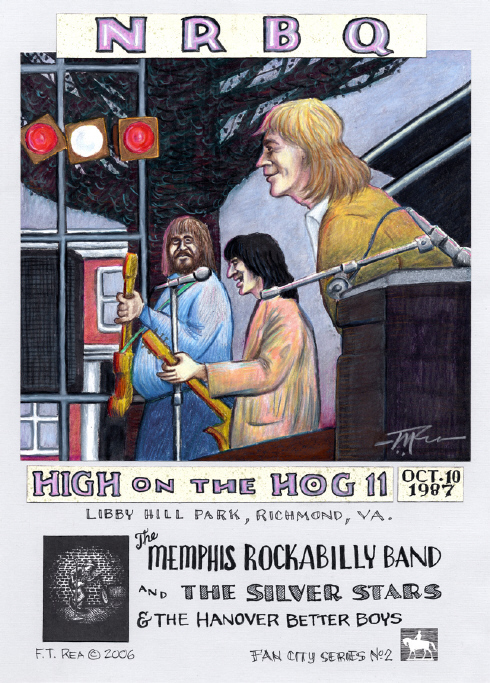 Calling all intrepid NRBQ fans.
The art above, done by yours truly, is a reduced scan of "NRBQ at High on the Hog" -- a 13" x 19" print of an ink and pencil original, which comes on archival paper with a matte finish. Not a copy of an old handbill, this is new art. (Click on the image to enlarge it.)
It is one of three images that begin a new art-selling venture for me in 2007 -- the Fan City Series. There are more to come. I can't say how delighted I am with the splendid quality of this printing process. It has spawned a whole new wave of creativity. A spicey tribute to Soble's is on the drawing board now. All of the posters in this new series are going to be the same size. Each run of posters will be limited to only 45 prints, which will all be signed and numbered.
The NRBQ prints cost $45.00 (plus $5.00 handling, if you want me to put one in a mailing tube and send it to you). Email me (ftrea9@yahoo.com) to be sure to get yours before they are gone. More posters drawn from some of Richmond's favorite pop culture events and much-missed saloons are in the works. Stay tuned for more info.
Art by F.T. Rea
Five favorite photos of 2006
My five favorite photographs of people doing things, no poses, that I shot during 2006 are below.
 George Mason’s Jai Lewis grabs a rebound at the CAA tournament in March.
 Opening day for the R-Braves at The Diamond in April.
 George Mason’s Jai Lewis grabs a rebound at the CAA tournament in March.
 Opening day for the R-Braves at The Diamond in April.
Bruce Olsen (left) and Buzz Montsinger (seated) at the GiveLoveToBuzz benefit in July.
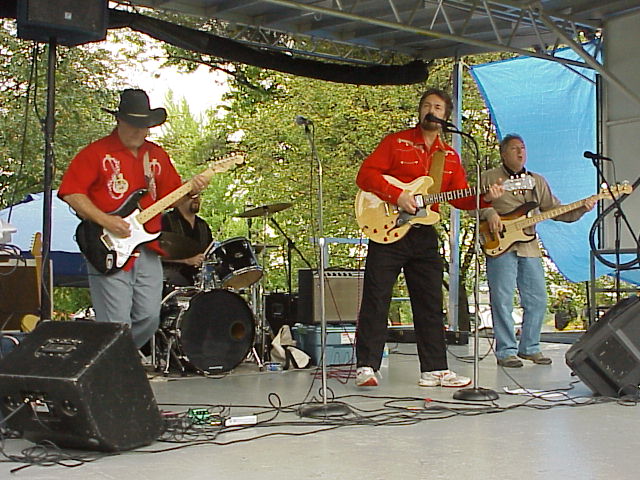
Memphis Rockabilly Band onstage at the wet and windy High on the Hog 30 in October.
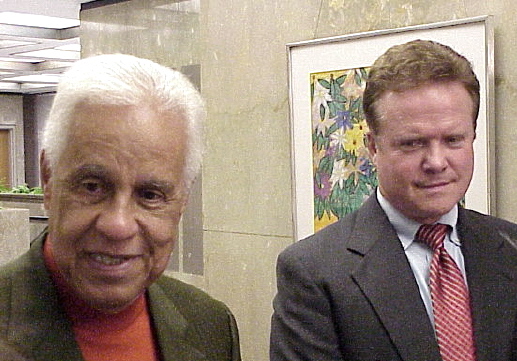
Wilder and Webb face the working press at City Hall in October.
Subscribe to:
Posts (Atom)