Thursday, January 18, 2007

Too much Pellot-Rosa sinks Seahawks

Jesse Pellot-Rosa is ready on defense
After a year at Fork Union Military Academy pursuing football, following what had been a stellar three-sport career at Richmond’s George Wythe High, Jesse Pellot-Rosa decided to play basketball at VCU. While he brought plenty of heart and athletic ability with him, as a freshman Division I basketball player Jesse was a work-in-progress.

Pellot-Rosa didn’t really have an obvious position. Lacking a consistent jump shot and not exactly a deft ball-handler, was he a guard or forward, or a defensive specialist, or what?

At the Siegel Center last night, senior swingman Pellot-Rosa, 6-4, 195, played 30 minutes of complete basketball, in pacing VCU to a hard-won victory over UNC Wilmington: VCU 74, UNC-W 65.

In short, Pellot-Rosa’s game was “complete” because he did exactly what his team needed every one of those minutes on the floor. Need a deflection or a gritty play in the paint? He was there. Stats? He scored 24 points, a career high. He also grabbed five rebounds. Throw in two assists with no turnovers.

Moreover, Pellot-Rosa’s performance was a clinic in how to balance finesse with power, intensity with control and leadership with role-playing.

When the Rams needed a three-point shot, Pellot-Rosa was there with five of them on six attempts. His trey with 4:04 remaining in the game dramatically stiff-armed a scary Seahawks rally and gave the Rams the lead for good, at 60-57.

After the game, first-year VCU head coach Anthony Grant lamented the fact he’ll only have one season to coach Pellot-Rosa, whose leadership he praised.

Now a force in the Colonial Athletic Association who has arrived, it says here there may not be a better all-around basketball player -- not just a scorer -- in the league right now than the homegrown Mr. Pellot-Rosa.

VCU (15-3, 7-0 in CAA) will host its longtime rival ODU (12-6, 5-2 in CAA) on Saturday night at the Siegel Center. Don’t wait to get your tickets, this one should sellout well before its 5:30 p.m. tip-off time.

Update (from VCU’s sports information office): The men’s basketball game between VCU and ODU, scheduled for Sat., Jan. 20, at 5:30 p.m. at the Stuart C. Siegel Center, is sold out. The game will be televised regionally on Comcast SportsNet-Mid-Atlantic.
Photo: SLANT

Monday, January 15, 2007

Blog links for beginners

For SLANTblog’s readers who have become curious about the “blogosphere” but still don’t know much about the various political blogs in Virginia, or even know how to find them, this post may help you. With more news about blogging in the mainstream press every day, and bloggers themselves moving from self-publishing to staff positions within the two political parties, folks who have heretofore ignored the blogging trend must be wondering what’s going on.

Here are some links to get such a reader started:

Waldo’s Virginia Political Blogroll is best known aggregating site for political blogs. It features posts it has grabbed from blogs across the Virginia landscape, from left to right, and links to the blogs themselves. Click here to go there.

Shaun Kenney’s blog is hosting the Virginia Blog Carnival this week. A blog carnival features specific posts from a variety of blogs, both submitted by bloggers and selected by the host. Next week’s Virginia carnival will be hosted by another volunteer host. Click here to go there.

And, here are eight more links to Richmond-based blogs that I recommend looking over. Some are focused entirely on political matters, others on a variety of concerns.

RVA blogs (a local aggregator, any style blog)
Barticles
Buttermilk & Molasses
J’s Notes
Richmond Democrat
Richmond Sunlight (New web page on the General Assembly's work)
River City Rapids
Save Richmond
Note: This post was updated at 9:50 p.m., same day.

City in Denial

Note: With Martin Luther King Day upon us, I want to recycle another of my Back Page pieces for STYLE Weekly. “City in Denial” ran in February of 2002; it drew more comment, pro and con, than most of the other OpEds I’ve done for STYLE. How much in Richmond has changed since it was published is for the reader to say.

City in Denial
by F.T. Rea


Thinking of black history calls my attention to certain renowned black Richmonders -- Maggie Walker, Oliver Hill, Arthur Ashe -- and it always reminds me of what I know about Richmond and race. Rather than mince words, here it is: Richmond’s woeful lack of progress on matters racial has been its worst problem for a long time.

At its heart, Richmond has a tastefully restrained style about nearly everything it does. Those of us who know this town from the inside out probably take some of its enduring physical charm for granted. Yet, we do so knowing that our fair city’s pretty surface has an ugly story beneath it.

Richmond’s best-known street, Monument Avenue, with its stately mansions and row of statues, has been a lightning rod for acrimony in recent years, stemming largely from Richmond’s knee-jerk uneasiness with racial issues.

One hundred thirty-seven years after the end of the Civil War one is left to wonder what it would take to convince Richmonders on the two sides of Broad Street’s imaginary divide to recognize their common ground and let their dry-rotted expectations go. Perhaps, in the long run, absorbing the tragedy of 9/11 will eventually have that effect on us. Then again, around here if you bet on stubborn habits to win again tomorrow the odds will be with you.

In the late ’50s and early ’60s, when honest people of the Deep South saw the stark pictures -- in national magazines and on television -- of the shocking violence associated with desegregation, the hideous truth hit them in the face. For those who could manage it, change must have seemed vastly preferable to posing for more pictures of hell on earth.

Apprehensive white people who had been brought up as bigots had to agree with their restless black neighbors that change was inevitable and necessary. They might not have become pals overnight but they, blacks and whites, must have seen that they just couldn’t keep having riots in their streets.

However, in Richmond more restraint was evidenced. While that surely seemed like a blessing at the time, it may have come with a price.

Although the local white establishment stood fast in the shadow of the banner of Massive Resistance, it was less bombastic than it might have been in that time of stirred passions. Meanwhile, the determined black reform movement pinned its hopes on building a political organization with real clout -- the Crusade for Voters; formed in 1956.

Typical of Richmond, both camps weren’t as demonstrative and overtly confrontational as their counterparts in other areas. Thus Richmond got through the volatile Civil Rights era without having to witness, firsthand, a lot of bloodshed in its streets. The most telling public confrontation was an orderly economic boycott, rather than a nightstick-wielding and open-fire-hose melee over access to schools or transportation.

Downtown lunch counters in the five-and-dimes and the big department stores actually had set policies in those days that denied service to blacks. Amazingly, this they did while inviting the very same people to shop freely in the rest of the store.

In 1960 a group of 34 black citizens -- many were students -- was busted for having the temerity to ask to be served lunch at Thalhimers’ lunch counter. The action was called a “sit-down strike” in the vernacular of the times. The group was charged with trespassing.

Subsequently, a picket line was thrown up around Thalhimers, organized by the Richmond Citizens Advisory Committee, a group working under the NAACP’s auspices. After months of stalemate, the store caved in and downtown lunch counters 86ed their whites-only policy.

Perhaps the success and civility of that boycott deluded Richmonders into thinking that they didn’t need to search their own hearts and minds for the prejudices that cloud vision. Although official policies were changed by the Thalhimers boycott, ironically, it may have failed to clearly dramatize the genuine need for people in Virginia’s capital city to go out of their way to see the other guy’s point.

A few years after the boycott, Virginia’s elections began to be watched over by the federal government because of the Voting Rights Act. Court-ordered busing soon followed. Eventually district politics, also ordered by the federal courts, took root in Richmond in 1977. But with the nine districts came the narrow vision of the ward heeler, as well.

Those developments did little to soothe ruffled feathers because the changes were being dictated from the outside. Members of the City Council, always split along racial lines, bickered constantly over minutia throughout the ’80s. With payback being heaped upon payback, progress didn’t stand a chance.

Now, every time a controversy that touches on race pops up the oh-so-familiar cries are heard: “Oh Gawd! Let’s hope this business dies down before it makes the national news.”

Like a dysfunctional family in denial, we don’t want the rest of the country to catch on that Richmond is still trapped in yesteryear’s snare. Well, take it from me dear reader -- they already know. Everybody knows. Even in other parts of Virginia they know Richmond is frozen in time when it comes to race.

The negative expectations that linger in so many quarters, like bad air, simply have to be identified and challenged. This would certainly mean that Richmond’s leaders -- political, community, church and business -- should be taken to task whenever they fan the embers of old grudges for their own short-term gain.

Perhaps the simmering debate over public art is the perfect platform for having meaningful discussions -- group therapy? -- that could help clear the air. Rather than trying to muffle the headline-making rhubarbs over old statues and proposals for new ones, people of different backgrounds ought to take turns listening to one another.

Let’s hash it out; put the debate on television every week for a year, however long it takes. When the dust settles, let’s put some new statues on Monument Avenue that don’t ask the viewer to pick sides in the Civil War.

How about banking pioneer Maggie Walker and Supreme Court Justice Lewis F. Powell Jr. to get it started? Richmond has a wealth of history that has little or nothing to do with the events of the 1860s.

Let’s look for the best in ourselves and we may find it.

-- 30 --

Saturday, January 13, 2007

VCU atop the CAA

Led by Eric Maynor’s 22 points and six assists the VCU Rams defeated the visiting Towson Tigers at the Siegel Center: VCU 85, Towson 77.

This victory, along with other CAA action today -- Hofstra lost to Northeastern -- puts the Rams alone atop the conference standings, one game ahead of Hofstra (12-5, 5-1 in CAA) and Old Dominion (12-5, 5-1 in CAA). VCU (14-3, 6-0 CAA) has now won five in a row, and 12 of its last 13 games.

Towson’s Gary Neal, who entered the game with the fifth-highest scoring average in Division I, scored 33 points, but he had to work hard to get them. To Towson’s credit, the Tigers never quit and the game was still up for grabs in the last minute.

It was VCU’s Jesse Pellot-Rosa who hit eight consecutive free throws late in the game to seal the win. He finished with 16 points and a game-high seven rebounds for the Rams.

Asked after the game if he ever considered using a junk defense on Neal, Rams head coach Anthony Grant smiled and shook his head. Many coaches prefer not to use box-and-ones, or other such off-balance defenses.

“It was tempting,” said Grant. Then he smiled more widely as he shook hands with his happy boss, VCU president Dr. Eugene Trani (pictured above), who is a frequent visitor in the Siegel Center‘s media room.
Photo: SLANT

Friday, January 12, 2007

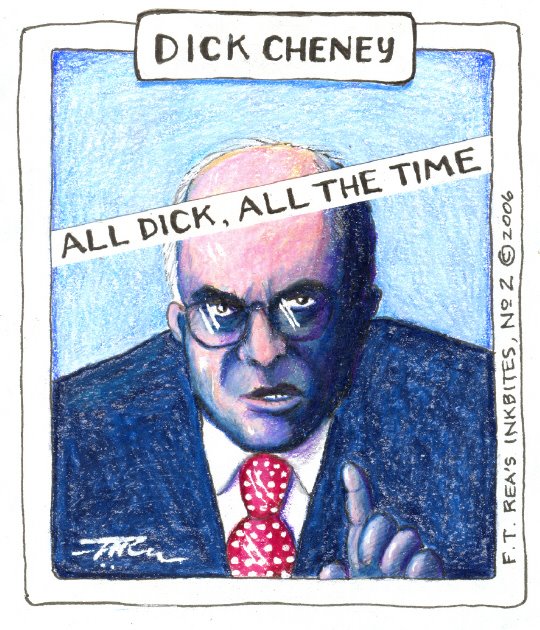
All Dick, all the time

Cheney: Here’s the deal, Dubya, my boy, you give this speech. Hey, listen up, you’ve read it, right?

Bush: Of course I have, Dick, but who’s going to buy this, this business about a surge ...”

Cheney: Listen up. Congress will swell up, take the bait, and move to block funding for the surge. A few traitor Republicans will throw in with the Democrats. We’ll take care of them later.

Bush: You’re right, Dick, this is a surly new bunch that’s come in, especially that Webb. How in hell did he win?

Cheney: Shut up!

Bush: Right.

Cheney: Don’t you see, we want the Democrats to pull this. They will be trying to tie the hands of a valiant Commander-in-Chief, during wartime. The Average Joe will hate that. Our Christian conservatives will...

Bush: Oh, I like it. I bet Karl thought of this.

Cheney: Shut up! Listen. That will create a first-class feeding frenzy of a Constitutional Crisis, because you’re still the one and only Commander-in-Chief -- during a war -- and you’ll jolly well do as you see fit. Eventually, it will take the Supreme Court to settle it.

Bush: Dick, what about the ... what about the technicality that there’s been no declaration of war, from...

Cheney: Shut up! Dubya, please stop trying to think. You know that only makes you want to catch a buzz. Just listen...

Bush: Oh, I bet this little ... this little plan of Karl’s, and yours, too ... it could tie up the whole town for a couple of years.

Cheney: Very good, Dubya, that is the point.

Bush: Right, Dick ... I get it.
*
Art (and text) by F.T. Rea.
Click here to see how to the same All Dick image on a T-shirt


Note: The transcript of the scene above may have been leaked to SLANTblog by imbedded White House, fly-on-the-wall sources that must remain anonymous. They may have risked lives to spirit it out. However, in order to publish this material -- in good faith -- it must be said there’s more than a small chance the aforementioned sources never existed. So, we did the best we could, anyway.

Wednesday, January 10, 2007

Webb on PBS

Sen. Jim Webb’s refreshing/sharp comments on PBS, responding to President George Bush’s boilerplate, same-’ol, same-’ol speech on staying-the-folly in Iraq, were just what I’ve hoped to one day hear from a Virginia senator. It felt so satisfying ...

Thanks, Jim.

Deatched and Within

fiction by F. T. Rea

June 3, 1959: Roscoe Swift, a lean boy with sandy hair and clear blue eyes, lived with his mother’s parents in their roomy stucco home in Dogtown, a suburb of Richmond, Virginia. His mother lived in her studio apartment over the garage, next to the breezeway, thirty yards from the house. She was a sometime commercial artist, who hadn’t ventured far from her studio/sanctuary in over a year. As a rule, she wouldn’t answer the door before noon.

When Roscoe was almost three-years-old his overly Southern mother, who was “rather delicately balanced” -- according to his grandmother -- left his father. As he never saw him again, Roscoe couldn’t remember much about the man, who went back in the Army and died fighting in Korea a couple of years after the separation. As his mother refused to speak of him, most of what Roscoe knew about his lost parent -- the body was never found -- came from his grandparents. That, and the peculiar look in his mother’s fretful brown eyes, which told him she was off, dwelling on what she had lost.

School was easy for Roscoe; when he could manage it, he took pride in being able to do the work as well as any other boy, but faster. But it was baseball that mattered to him more than anything else. He calculated and committed to memory the up-to-date batting averages of his favorite Major League players before he went to school, everyday.

At this point in his life, Roscoe’s only trouble at school was that his bad temper got him into fist fights, which not only earned him many a bloody nose, but it kept him from getting good grades in conduct.

For as long as Roscoe could remember, he had been in training to be a hero. He had tested his nerve with many a daredevil stunt and could throw a rock better than any boy in the neighborhood; any boy his age, anyway. At summer camp the year before, he had been the top rifle marksman in the whole camp, any age. Plus, he had listened attentively to all of his grandfather’s baseball yarns and coaching instructions.

Then came the day for his first true test -- it was, what was then, the biggest at-bat of the biggest game of his career.

The situation: Men were on first and third; one out; two runs behind in the bottom of the last inning. Taking his practice swings, Roscoe reminded himself of what the moment called for, baseball-fundamentals-wise.

“No grounder, no double play,” he thought, as he knocked red clay dust off his sneakers with the bat. “Drive it out of the infield.”

It was the last game of the season. Two of the school’s four fifth-grade classes had finished the year tied, forcing a playoff game to decide the championship. Following lunch, all the fifth-graders at Gittes Creek Elementary had been given the afternoon to watch the two teams settle the issue. Students with no taste for baseball had the option of watching a documentary film about Jamestown’s 350th anniversary.

Thus, there was a pretty good crowd for the title game.

A group of men, about a dozen of them, showed up. There were a couple of Little League coaches in the bunch, one of them had played Double A ball in his day. Several girls from the two classes involved were acting as cheerleaders. This was the first game Roscoe had ever played in that had cheerleaders.

Baseball, even fifth-grade baseball, was important business in Dogtown.

Roscoe stood in the batter’s box on the first base side of home-plate. A natural right-hander, Roscoe had decided that if the best hitter in the game -- Ted Williams -- batted left-handed, so would he. For a month he had been practicing swinging left-handed, almost exclusively, in neighborhood pickup games.

Finally, he had to test it in a game that mattered.

His best friend Finn Daley, standing on first base, cheered him on. Several of his teammates implored him from the bench to bat right-handed, as usual in so-called real games, since the season was on the line. Butterflies the size of eagles disquieted Roscoe’s stomach.

Stepping out of the box, the batter adjusted the dark blue wool baseball cap he wore when playing for his Little League team. He took three additional practice swings. He looked at the crowd on the third base line.

The cheerleaders were chanting, “Roscoe, Roscoe, he’s our man. If he can’t do it, nobody can.”

His architect grandfather, who had taken the afternoon off without it being an emergency -- for the first time in Roscoe’s memory -- stood in the shade of a large oak tree with three other men. Narrowing his gray eyes beneath the flat brim of his straw hat, the old man watched the batter’s body language as only he could.

On the first base line, his opponents and their fans booed and hooted at Roscoe. He decided to go far within himself, to dig in, to ignore them all.

However, there was a particular girl, with a strawberry-blonde ponytail and lively green eyes, cheering for the other team. Her name was Susie Ryan.

Roscoe always noticed Susie. This time was no exception. The best thing to say to her never came to mind when she was near. She made him nervous. So he watched her from a distance, mostly, with a sense of longing he couldn’t understand. Although Susie was calling for his downfall, Roscoe’s sharpshooter’s eyes followed her gestures. He was glad she was there.

Back in the box, Roscoe shifted his weight to his back foot and turned his front foot thirty degrees toward first base. Relaxing his fingers, he squinted his eyes and squared his jaw.

The pitcher threw the first pitch outside and in the dirt. It got by the catcher but the no-stealing ground rule didn’t allow the base-runners to advance.

Sure the next pitch would be across the plate, Roscoe prepared to cut the ball in half. The pitcher went into his stretch as the infielders behind him chattered encouragement.

Roscoe took a big roundhouse swing. Whoosh!

The ball disappeared in mid-air. Holding the baseball aloft, the catcher taunted, “Hey man ... looking for this?” Then he fired it back to the grinning pitcher.

Roscoe heard the collective laughter from his opponents and their classmates. Nonetheless, he didn’t look at anyone on either baseline. He knew he had shut his eyes while swinging the bat.

The batter’s cheeks flushed as he pulled his cap’s brim down on his brow.

“It only takes one to hit it!” Bellowed his grandfather through cupped hands.

Looking at the catcher’s signal, the pitcher nodded. Working from an exaggerated full stretch, he confidently cut loose with the same pitch -- a fastball.

Swinging from the heels, Roscoe rolled his wrists and tagged the ball: Cah-rack!

Traveling over the second baseman’s glove the sphere left the infield with dispatch. It was still rising when it split the seam between the right and center fielders. They chased it across the grass, then down the slope and all the way into the little trickle of a creek that bordered the school yard.

By far, it was the most solidly Roscoe had ever hit a baseball, and he knew it. The utter perfection of the bat’s perfectly-timed kiss on the horsehide’s sweet spot had resonated through his body -- it was a righteous sensation.

Circling the bases, Roscoe heard the growing furor. He ran like a monster was chasing him, rounding third, until he almost caught up with Finn.

“Slow down, Number Nine ... they haven’t even found it yet,” Finn advised with a laugh.

Roscoe’s euphoric classmates were jumping around wildly. His grandfather beamed as he waved his straw hat. Teammates, suddenly champions, were pounding him on his back as he neared home. Meanwhile, his capacity to comprehend the moment was red-lining.

He looked at Susie on the quiet side of the field. The way her head tilted to the side, the angle of her limbs, something about her backlit outline pulled him into a spell. When she stomped her foot it made everything he saw and felt become more intense, more vivid.

It was as though he was viewing the event from several different angles. Roscoe felt both inside and outside the scene, at its heart and yet detached. His mind raced and the rest of the world seemed to slow down. He strained to pull all the pictures together.

He alone heard the explosion ... boom!

For the first time in his eleven and a half years on the planet, all of life seemed perfectly in focus when Roscoe crossed home plate. His spirit was in flight. It was soaring, free of gravity, above his dogged fears.

It hadn’t occurred to him to lope around the bases, a la Ted Williams. He’d been too excited for such restraint. More importantly, he had remembered to make no showboating, hat-tipping gesture to the crowd. If the real Number Nine never tipped his cap to the public during his home run trot, well, that was more than good enough for Roscoe.

A genuine hero doesn’t have to tip his cap.

* * *
All rights reserved by the author.
This story is dedicated to Emily, my ten-year-old granddaughter

Tuesday, January 09, 2007

...the best disinfectant

The General Assembly is back in session. In Richmond, while that might sound like business as usual -- the regular showboat drunks in certain bars -- this year there is something new to do with that particular pack of elected officials. Created by Waldo Jaquith, it is the brand new RichmondSunlight web site, which will give the public a snazzy new tool with which to interact with the GA.

Here’s an info blurb from the RichmondSunlight front page:

“Lobby your senator, keep up with your delegate, find out what bills could affect your life and make your voice heard. It’s easy, it’s fast, and it’s fun. Fully buzzword compliant, Richmond Sunlight demystifies the often-baffling process of how a bill becomes law, giving you a say in it, every step of the way. This year's General Assembly session begins on January 10, and is slated to run through February 24. Legislators are currently prefiling bills in advance of the session.”

Click here to read Jaquith's intro to RichmondSunlight.

Swordfish of '76

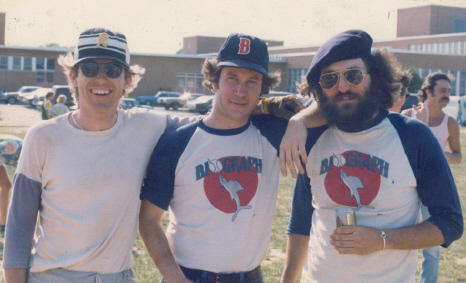
On Saturday, May 6, 2006 another Kentucky Derby Day softball reunion was held. Anyone who ever played on the now defunct team was welcome, plus their families, friends, etc. The annual parties began in 1980, when the Biograph Theatre’s softball team was one of the cars attached to a runaway train known as the Fan District Softball League (1975-94).
Fan District Softball Leaguers Chuck Wrenn, Terry Rea and Larry Rohr
Photo: Danny Brisbane (circa 1977)
At the reunion a few innings of softball were played in splendid weather without anyone hobbling off the field, or worse -- being carried off. A fine picnic spread was laid out and consumed. Cold beer flowed as the same stories were stretched, again. The horse race was watched on a little battery-powered TV.

Several of the guys at this year’s gathering were teammates of mine in 1976, when I was the manager of the Biograph, a repertory cinema that was located at 814 West Grace Street. It was the first summer of Biograph softball. We called ourselves the Swordfish, after a joke in a Marx Brothers movie. That year we played a schedule that was not set; we challenged other teams, which played in organized leagues (mostly Fan League teams), to play us for a keg of beer.

The Biograph Swordfish won 15 games (that were scheduled and umpired) of the 17 we played that initial season. In spite of having few experienced softball players on a roster, which included two French guys (friends of one of the cinema’s cashiers) -- they had never seen a softball, or baseball -- we probably won half of them by coming from behind in late innings.

Typically, our opponents saw themselves as more experienced and athletically superior, which only made it more fun when they bumbled their way into handing us the victory.

It was uncanny. Every time, those supposedly better teams seemed to be willing to overplay their hands. Now, having played and observed a lot of organized softball, I know that first Swordfish squad was absolutely charmed. Moreover, it was the loosest and luckiest team I’ve ever been associated with, bar none.

The Swordfish’s two losses were in extreme situations. The first was the championship game of one of the two tournaments we entered. The other was played inside the walls of the old state penitentiary.

Located at Belvidere and Spring Streets, the fortress prison loomed over the rocky falls of the James River for nearly 200 years (it was demolished in the early-1990s). As it happened the guy in charge of recreation at the pen frequented J.W. Rayle, a popular bar of the era, located at Pine and Cary. In that bar, during a conversation, he asked me if the Biograph team -- I played outfield and served as the coach -- would consider taking on the prison’s team on a Saturday afternoon.

As it turned out the first date he set up was cancelled, due to something about a small riot.

OK.

A couple of weeks later the Swordfish entered the Big House. To get into the prison yard we had to go through a process, which included a cursory search. As I recall, we had been told to bring nothing in our pockets. Thus, we had our softball equipment and that was it.

As we worked our way through the ancient passageways, sets of bars were unlocked and then locked behind us. Each of us got a stamp on our hands that could only be seen under a special light. Someone asked what would happen if the ink got wiped off, inadvertently, during the game. He was told that was not a good idea.

OK.

The game itself was like all softball games, in ways, and rather unusual in others. The fence in leftfield was the same high brick wall that ran along Belvidere Street. It was only about 225 to 240 feet from home plate. Yet, because of its height, maybe 30 feet, a lot of hard-hit balls caromed off of it. What would have been a routine fly ball on most fields was a home run there. It was a red brick version of Boston’s Green Monster.

The prison team, known as the Raiders, was quite good at launching softballs over that towering brick wall. They seemed to have an unlimited budget for softballs, too. Under the supervision of watchful guards hundreds of other prisoners, seated in stands, cheered for the home team to vanquish the visiting Swordfish.

During a conversation with a couple of my teammates behind the backstop, I referred to the home team as “the prisoners.” Our opponents’ coach stepped toward me. He, like his teammates, had on a typical softball uniform of that era -- it was a maroon and gray polyester affair, with “Raiders” printed across the chest and a number on the back.

In contrast, we just had identical blue hats with a “B” on them. About half of us wore one of two different Biograph T-shirts models.

“Call us the Raiders,” he advised, sternly, as he pointed to a mural on the prison wall that said “Home of the Raiders.”

I realized I’d made a faux pas, right away.

“While we are on the field, we’re not The Prisoners,” he said with conviction, “we’re the Raiders.”

“Raiders,” I said. “Right.”

“All our games are home games,” he deadpanned.

We all laughed, grateful the tension had been broken. He thanked us for being there, for agreeing to play them.

The Raiders won, in a tight, high-scoring affair. Afterward, I was glad we’d met the Raiders. And, I was even more glad to leave that place.Now, I’m so glad that prison is no longer there. Located in the middle of Richmond, it was a nightmare in so many ways.

This yarn was a small part of a sepia-toned softball season so long ago it seems like a dream now. The Biograph teams that followed never saw anything like such raw success, again. Now I truly wonder how we did it.

It's time to come home; enough is enough

Apparently, the Commander in Chief is going to tell the American public that he has “decided” to escalate the war in Iraq, in that he intends to send in yet more troops. Rather than write a longer piece, anticipating the thrust of President Bush’s televised address tomorrow night, this post will only dwell on one point.Without rehashing all the terrible decisions Bush has made, to do with Iraq, he has surely run out of time for pursuing his “stay the course” strategy/slogan.

Bush has run out of time because this mission-not-accomplished has lasted way too long -- longer than America’s participation in World War II. History tells us the longer this occupation goes on, the more resourceful the resisters to it will become. He has run out of time because of disturbing revelations about how much he and Vice President Cheney tortured the truth in their manipulative buildup to the war. And, the president has run out of time because the utter failure of his hubris-driven effort to stabilize the Middle East, by overthrowing a heavy-handed dictator, is exacting a more bitter price in American blood and treasure every week.

This time, I'll skip the harm it has done to others.

The permit has expired for the campaign Bush launched on Mar. 20, 2003. No doubt, that was a good part of the message voters were sending him in the most recent election. Yes, and now it’s time for a whole new strategy that gets America out of Iraq, pronto -- that’s pretty much the rest of the message about Iraq, sent from the people.

Now, if Bush goes on TV and says here’s the new deal:

We have talked some of Iraq’s neighbors and some of our traditional allies into helping out in a new way. Under a UN flag, or a NATO flag, or some ad hoc international flag, they will cooperate with us in facilitating America’s withdrawal from Iraq. They will send in 50,000 or 75,000 of their troops to combine with 20,000 more of our troops, to help us clean out a few stubborn trouble spots. Then, in a couple of months, we will ask the UN to work with the various sects/tribes to “decide” how many countries Iraq ought to be split into, and where the borders ought to be. Then we will come home. Maybe Baghdad will have to be nervously policed by an international force for years.

If he says something along those lines, then I’d say a temporary “surge” in the number of American troops in Iraq might not be such a bad idea.

But if The Decider says this:

We were dead right to have started this war, and I just don’t care who says different. Yes, it’s been more difficult to bring democracy and peace to Iraq than we had hoped, but now, all we need to do is put more Americans in harm’s way, and you’ll see it will all work out, just fine. Hey, if we don’t fight the terrorists in Iraq -- 9/11, 9/11, 9/11 -- there’s no question but that they will soon be at our doorstep. So, this is a war we just can’t afford to lose. There is no substitute for victory.

If Bush spouts that crap, again, he deserves to be stiff-armed by Congress. That means Democrats and whatever Republicans must block any specific funding for this so-called “surge.” Then our legislators must set a firm deadline for Bush to bring our troops home, using the tools the system gives them.

Please know that until now I’ve been against a rigid published deadline. Until now, I’ve agreed that it would tie our military’s hands in a way we might regret.

Now, the message to The Decider is plain -- Sir, enough is enough!

During the years in which America’s involvement in the Vietnam War steadily escalated to more than a half-million troops, each escalation was sold as the solution to the problem. Now we know those increases were folly. Thousands of Americans died long after it was known at the heart of the Pentagon we would never win, at least not in any way like we had been told in the beginning, or to justify the many increases in troops.

As a man who remembers the lies and the lessons of Vietnam, it is incredibly exasperating/depressing to see it all happening again.

Enough is enough.
Toon by F.T. Rea

Motordrive Kitty

In the spring of 1985 I visited New York City for a few days. While there I bought a new 35mm Nikon, to replace a camera that had been stolen the year before, and I bought something I'd wanted for a long time -- a motordrive.

For the first month or so back in Richmond, I took the Nikon, with the motordrive attached to it, along with me all the time. These two almost identical prints of a sleepy cat in a storefront window on Main Street, taken a fraction of a second apart, probably made better use of the rapid fire capability than most of the snapshots I created in that period.

Monday, January 08, 2007

VCU Rams remain undefeated in CAA

Playing at the Siegel Center on West Broad Street, following a lackluster first half, VCU’s brutal defense squeezed visiting Northeastern to death: VCU 64, Northeasthern 44.

The Rams attack was paced by senior guard/forward Jesse Pellot-Rosa, who scored 13 points and grabbed six rebounds in 25 minutes on the floor. With a game at William & Mary on Wednesday night, VCU head coach Anthony Grant wisely rested his starters more in this game than recent previous outings, using 11 players in the doing.

As a result of tonight’s hoops action, VCU (12-3, 4-0 in CAA) moved into a three-way tie for first place in the Colonial Athletic Association with Hofstra and Drexel. Playing at home, Hofstra (11-4, 4-0 in CAA) defeated ODU (10-5, 3-1 in CAA) by a score of 70 to 58. And, Drexel (12-2, 4-0 in CAA) won at James Madison (4-10, 1-3 in CAA) by a score of 65 to 54.

Update: For more on the CAA, read my sports column, The Bounce, at Richmond.com
Photo by SLANT

Saturday, January 06, 2007

The Case of Gus the Cat

Though cynical people like to say, “All cats are gray in the dark,” the difference between this and that counts with me. Thus, if for no other purpose than to satisfy my own curiosity, I set out to find the truth about Gus, the cat that had long presided over lower Carytown from his display window roost.

The mystery began in January of 2000 during the course of a casual conversation about re-makes of old movies. Film buff Ted Salins, a regular among the society of conversationalists who gather at the tables on the sidewalk in front of Coffee & Co., tossed out that the cat living next door in Carytown Books is not the “original” Gus.

Since I’ve known Salins, a writer/filmmaker/house-painter, for a long time, I suspected his charge was a setup for a weak joke. To give him room to operate I asked, “So, this Gus is an impostor?”
Gus the Cat, perhaps
“Just like Lassie, several cats have played the role of Gus over the years,” Salins said matter-of-factly.

Until that moment it hadn’t occurred to me that Gus, someone else’s cat, had slowly become important to me over the years. In the past I’ve been told that he’s over 15, maybe pushing 20. Who can say what that is in cat years? He still has a few teeth left.

“You see, in ‘91 I had lost my beloved Skinkywinkydinky in a separation,” Salins went on, as if revealing a dark conspiracy. “When I first saw Gus, I took to him because he reminded me of Skinky. That Gus wouldn't let you touch him. But, this Gus…”

“Ted, this is absolutely the most off-the-wall nonsense you’ve come up with yet,” I accused.

“The place has changed hands a few times since then,” Salins smugly offered. “The problem is each owner falls in love with the cat and keeps it. But since Gus has become an institution in Carytown, each set of new owners has to find another cat that looks like Gus. The switch is made at night in order to preserve the secret. I’ve seen it.”

Before I could say “horsefeathers,” another member of the Carytown intelligentsia, who had just walked up, spoke: “Salins, as usual you’re all wet,” said artist Jay Bohannan. “That is not only the same cat, but Gus is, let’s see, yes, he’s nearly 70. That particular cat is probably the oldest cat this side of the island of Lamu.”

I laughed at Bohannan’s crack and excused myself from the table to let them hash it out. The two of them have been arguing good-naturedly since their VCU art school days in the early ‘70s.

Walking toward my car, Ted’s suggestion of a fraud having been perpetrated on the public bothered me. I felt certain that if somebody had actually installed a faux Gus in the bookstore it would have been all over the street the next day. As I tried to imagine people spiriting nearly identical cats in and out of the back door, in the dead of night, the matter wouldn’t rest.

So I turned around and went into Carytown Books. The shop’s manager, Kelly Justice, who has worked there for six years under three editions of ownership, scoffed at Salins’ charge.

“Anyone who knows Ted, knows he’s a nitwit,” said Ms. Justice with a wry smile. “More likely than not, this is an attempt to raise funds for another one of his documentaries.”

When I told her about Bohannan’s equally outrageous suggestion that Gus was almost a septuagenarian, Justice laughed out loud. “Perhaps Jay and Ted are both trying to hitch their wagons to Gus’s star,” she suggested playfully.

Back outside, Salins and Bohannan were both gone. So I walked east on the block to Bygones, the collectable clothing and memorabilia store known for its artful window displays. Since Maynee Cayton, the shop’s proprietor, is an unofficial historian for the neighborhood, I decided to see what she knew about Gus.

Cayton, who has been at that location for 16 years, said she had some pictures of the block from the ’30s and ‘40s, but she didn’t think she had any shots of a bookstore cat. However, she did remember that when she was a child she saw a gray and white cat in the window of what was then the Beacon Bookstore.

“It was in the late ’60s, I think it was 1967,” she said, raising an eyebrow. “And I’d say it was a young cat. Either way, I can’t believe the feline impersonator story, so maybe it was Gus.”

The next day, Bohannan called on the phone to tell me he had something I needed to see right away. He was mysterious about it and wouldn’t explain what he was talking about, except to say that it was proof of his claim about Gus the Cat.

Unable to let it go, I told him I’d stop by his place to see what proof he had.

Bohannan’s apartment, located between Carytown and the Virginia Museum of Fine Arts, was an escape from the modern world altogether. It’s furnished in a pleasant mix of practical artifacts and curiosities from yesteryear. The heavy black telephone on his desk was almost as old as Jay. Next to the desk was a turn-of-the-century gramophone. Bohannan, himself, dressed like a character who just stepped out of a Depression-era RKO film, reached into a dog-eared manila folder and pulled out a photograph. When I asked him where he had gotten the picture, purportedly from about 1930, he shrugged.

In such a setting, his evidence of Gus’ longevity took on an eerie authenticity. Sitting in one of Bohannan’s ancient oak chairs, surrounded by his own paintings of scenes from Virginia’s past, I thought I could see the cat he claimed was depicted in the storefront’s window. Why, it even looked like Gus.

Jay told me I could keep the photo, it was just a copy. What a scoop!

Later, when I looked at the grainy picture at home, I could hardly even see a cat. The next day, back in Carytown, I spoke with several people who hang out or work in the neighborhood. A few actually thought Bohannan’s bizarre contention could be true. Others agreed with Salins.

One man, who refused to be quoted, said he was sure the original Gus was an orange cat. A woman looked up from her crossword puzzle to note that Bohannan's evidence was at least as good as what she'd seen on the Loch Ness Monster.

Then the whole group of chatty know-it-alls went off on the general topic of conspiracy theories and hoaxes. At the next table a woman in a straw hat started sketching the sidewalk scene.

A few days later, I saw Ted Salins holding court in front of the coffee shop. I told him what Kelly had said about his claim and I showed him Jay’s so-called proof that Gus is ancient.

Ted said mockingly, “The next thing you’re going to tell me is Shakespeare actually wrote all those plays. Look - it’s not the same cat. Live with it. This Gus is a ringer, maybe three years old.”

Turning around I looked through the storefront’s glass at good old Gus in his usual spot. He looked comfortable with a new electric heater under the blanket in his basket. It dawned on me that there was a time when Gus used to avoid me, as well. Now he seems happy for me to pet him, briefly.

Pulled back into the spell of the mystery, I wondered, had Gus changed or had I? Gus stared back at me and blinked. Like one of his favorite authors, J. D. Salinger, Gus wasn’t talking.

Gus was smiling as only a cat can; a smile that suggests equal parts of wisdom-of-the-ages and dumb-as-a-bag-of-hammers. The truth about Gus the Cat was that he had grown accustomed to having a public.

*

Note: On June 19, 2001 a gray and white cat alleged to be the authentic Gus was found dead in Carytown Books. The piece above was published about 18 months before that date.
Modern photo of Gus: Stacy Warner/Richmond.com. Old Cary Street scene by Jay Bohannan

Tuesday, January 02, 2007

Virginia Civil Rights monument in the making

The Richmond Democrat, published by J.C. Wilmore, has recently been proposing that new public art be created to honor some overlooked Virginians.

“A few days ago I proposed that the time had at last come to honor Virginia’s Unionists -- Virginians who had stayed loyal to the United States during the American Civil War. My proposal is based on the simple premise that Virginians who render heroic service to the United States are deserving of some recognition in the form of a monument or monuments...”

The original post for that notion has brought him some reaction -- surprise! -- from a warmed-over apologist for the Lost Cause.

So, to cheer J.C. up, and to encourage him to keep on keeping on, I want to direct him and my readers, in general, to a web site about an ongoing project that should be of some interest. It is The Virginia Civil Rights Commission's site, and you may find some encouragement there.

Not about the Civil War, this is about the long overdue honoring of some brave Virginians from another era. Below are some excerpts from the copy on display at that site:
  • In 2005, the Governor and the Virginia General Assembly established a memorial commission to select a monument for Capitol Square in honor of the struggle for full civil rights for Virginia's African American citizens. The Virginia Civil Rights Memorial Commission, comprised of elected and civic leaders, has met over the last several months to select a subject for the memorial, a site and an artist. The memorial will honor the student protest at the Robert Russa Moton High School in Farmville, Virginia.”
  • In 1951, a walk-out and demonstration -- led by a 16-year-old student named Barbara Johns -- was held by the students of the Robert R. Moton School to protest the intolerable conditions at the school. Legal action followed the protest and led to the federal court case, Davis v. County School Board of Prince Edward County (1952), where the students were represented by noted civil rights attorneys Oliver Hill and Spottswood Robinson. Their case was eventually joined with four other cases and argued before the Supreme Court as Brown vs. Board of Education of Topeka , which culminated in one of the most pivotal decisions ever rendered by the U.S. Supreme Court.”
  • “The Commision’s selection of the Moton School protest was in part motivated by the hope that the tens of thousands of students who visit Capitol Square every school year will be particularly drawn to, and moved by, the story of what happened there. The eventual success of these students and their protest has much to teach us today.”
  • “The Commission chose sculptor Stanley Bleifeld based on his initial concept design for the memorial. Bleifeld is an internationally known artist who has exhibited all over the world at many prestigious galleries and museums. He also has extensive experience with public commissions. Stanley Bleifeld has been an artist in the public eye since the 1950’s. In 1967, the Bridgeport Sunday Post art critic wrote, ‘The name Stanley Bleifeld and sculpture are synonymous.’”
This most worthy project has been spearheaded by Lisa Collis, former First Lady of Virginia. Click here to read more about it. I can't wait to see this sculpture installed on the grounds in Capitol Square.
Art from The Virginia Civil Rights Commission

Monday, January 01, 2007

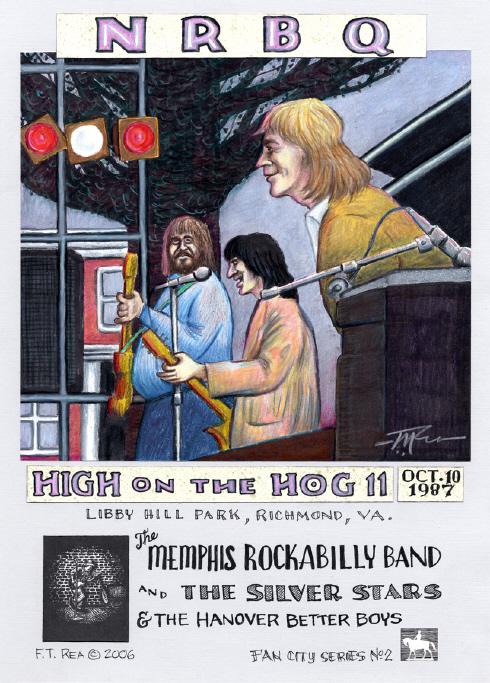
NRBQ at HOTH 11 poster

Calling all intrepid NRBQ fans.

The art above, done by yours truly, is a reduced scan of "NRBQ at High on the Hog" -- a 13" x 19" print of an ink and pencil original, which comes on archival paper with a matte finish. Not a copy of an old handbill, this is new art. (Click on the image to enlarge it.)

It is one of three images that begin a new art-selling venture for me in 2007 -- the Fan City Series. There are more to come. I can't say how delighted I am with the splendid quality of this printing process. It has spawned a whole new wave of creativity. A spicey tribute to Soble's is on the drawing board now. All of the posters in this new series are going to be the same size. Each run of posters will be limited to only 45 prints, which will all be signed and numbered.

The NRBQ prints cost $45.00 (plus $5.00 handling, if you want me to put one in a mailing tube and send it to you). Email me (ftrea9@yahoo.com) to be sure to get yours before they are gone. More posters drawn from some of Richmond's favorite pop culture events and much-missed saloons are in the works. Stay tuned for more info.
Art by F.T. Rea

Five favorite photos of 2006

My five favorite photographs of people doing things, no poses, that I shot during 2006 are below.
George Mason’s Jai Lewis grabs a rebound at the CAA tournament in March.
Opening day for the R-Braves at The Diamond in April.
Bruce Olsen (left) and Buzz Montsinger (seated) at the GiveLoveToBuzz benefit in July.
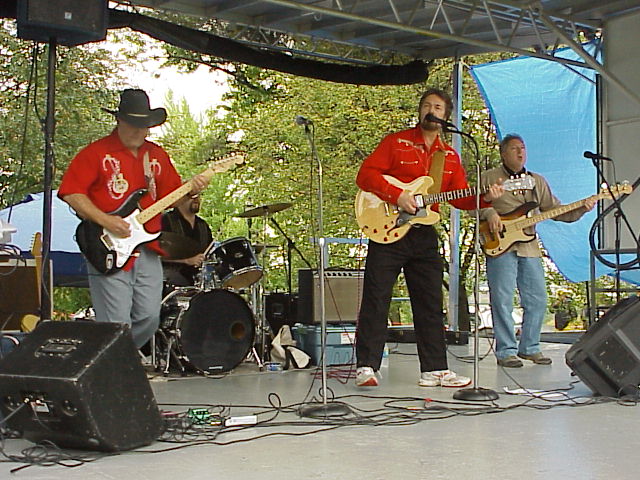
Memphis Rockabilly Band onstage at the wet and windy High on the Hog 30 in October.
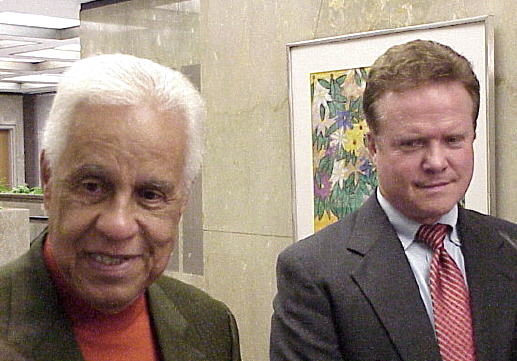
Wilder and Webb face the working press at City Hall in October.

Sunday, December 31, 2006

Top story in review: Webb upsets Allen

Senator-elect Jim Webb

Note: Easily the most-covered story at SLANTblog during 2006 was Jim Webb’s march from a late blooming dark horse to unseating incumbent George Allen. My first post of 2006 on this story was on New Year’s Day. Who knew where it would lead?

What follows are selected excerpts/highlights of the meandering yarn of how Webb stumped the so-called experts and delivered control of the U.S. Senate to the Democrats, as told by SLANTblog, on the fly:

Jan. 1: ...A web site devoted to boosting James Webb, a former Secretary of the Navy, into running against Sen. George Allen has been launched. Webb, a one-time Republican who is now an outspoken critic of the Bush war policy in Iraq, could make for an interesting player in Virginia politics.

Note: In February the cartoon riots roiled in Europe and Vice President Dick Cheney shot one of his hunting companions in Texas. President George Bush was busy as hell denying he even knew Jack Abramoff. So, a lot of people didn’t notice that a writer in Virginia had apparently changed his mind about running for office.

Feb. 8: ...In what runs contrary to a rumor that flashed across the Lefty Blogs [headlines] on Jan. 30, a rumor that passed for a few days as expert inside information, James Webb announced yesterday that he will seek the Democratic nomination to challenge Republican incumbent George Allen for his Senate seat.

Feb. 22: ...Meanwhile, Allen is the same affable, go-along-to-get-along rightwing senator he’s been all along. Yet, with the Bush administration spinning out of control, Allen’s role as a Bush/Cheney cheerleader probably won’t be much of a plus with most Virginia voters. Yes, with bad vibes all around him, Allen is likely to be campaigning this time around on his own personality and record, for what that’s worth.Looking back on it, in a way he's never been tested. In statewide elections Allen defeated Mary Sue Terry and Chuck Robb; in both instances he benefited from having opponents whose political careers had peaked and begun to ebb.

Note: With March Madness in the air, George Mason stunned sports fans coast-to-coast with their four victories that put them in the Final Four. Mark Warner’s strangely “retouched” photo appeared on the cover of the New York Times Magazine. And, the contest for the Virginia Democratic senatorial nomination was starting to heat up.

Mar. 11: ...Yet, if one took seriously the catty chatter from some purebred Democrats -- who see themselves as way-more-donkey-than-thou -- newcomers can't necessarily be full members right away. No doubt they see Webb’s maverick streak as a threat, instead of an asset. They have recently sought to undermine his campaign with silly distractions that smell faintly of a swift boat-like strategy.

Well, it says here that if candidate Harris Miller wants a future in Virginia politics, beyond just being a well-connected guy, he should put the kibosh on this sort of thing, pronto! Chalk it up to bad advice, fire somebody and swear off such tactics from here on. Show some class.

Mar. 14: ...Wanting to know more about Harris Miller and having noted from Lefty Blogs that the candidate has a new web site, I clicked on the link. The first thing I saw was a head-scratching, boring blurb in bold type at the top of the page: “We Can Fix Washington.” Then this: “Together, we can clean up Washington and refocus our government on the right priorities.” Without going any further, I cringed and wondered: who in the world would put such banal, vague copy up as the most important thing for a viewer to see?

Was it a joke?


Note: In April, Bush created a new word -- “decider” -- to defend his Sec. of Defense Donald Rumsfeld. “I hear the voices, and I read the front page, and I know the speculation. But I’m the decider, and I decide what is best...” In Virginia an aggregator for political blogs was launched by Waldo Jaquith, just in time to make the Webb vs. Miller race more interesting.

May 22: ...Miller’s staff has a predicament, in that they have to be hoping for a low turnout in the primary. They think their strong suit is mostly longtime party regulars. So, the more the general public notices the contest, the more likely it is to be drawn to the more attractive individual with a more interesting resume. If independents vote, and they can, it's hard to imagine they would be Miller backers.

Miller is what? 

A behind-the-scene guy. A lobbyist. A wealthy businessman. Webb, once Secretary of the Navy, writes books that become movies. Finally, I’m surprised anyone with any real experience in the political game ever told Harris Miller he ought to run for public office.

May 29: ...Perhaps Webb’s strong suit is the powerful sense of dignity he projects. That’s something you can’t buy. Few politicians today have that.Note: In June a brouhaha over a flier mocking Harris Miller erupted in the days before the primary, which Webb won, only to be instantly declared the hopeless underdog against Allen.

June 6: ...Perhaps the most bogus thing I’ve read repeatedly on political blogs is about their trump card, their “passion.” Oh yes, “passion” is dripping from their sleeves. “Passion” is their reason, and it’s their all-purpose monkey wrench of an excuse. Many of the Democrats’ busiest bloggers this season haven’t really been dealing with ideas, so much as they have personalities. In this era they prefer seeing elected officials as celebrities. They want their favorite politicians, even their paid staffers, to be “rock stars.”

To that notion I say this: A pack of celebrity worshippers drunk on cheap passion, poured from a screw-top bottle, singing along with the radio, turned up way too loud, may have lots of fun at the party. Then comes the hangover ... the lost wallet... the trouble from what you said that you don’t remember.

June 10: ...Yes, given the chance to say “no comment” to a question about the offending flier Miller whimpered to enlarge the story. It seems the Miller camp believes that pointing an accusatory finger at Webb’s camp over this rather juvenile piece of propaganda, in order to extend its life as a concocted issue, is benefiting their candidate. They don’t mind if someone sees that stance as similar to the position of the Muslim zealots who called for the death of any cartoonist who draws a picture of The Prophet.

June 15: ...Well, I’m absolutely delighted that Webb won. My short take on his success is that Webb represented change and hope to the disillusioned. Furthermore, his candidacy said there are honest Republicans and other moderate conservatives who have finally given up on denial. They have wised up -- too much Iraq, Katrina and sleaze -- and if that trend picks up steam it threatens to scald the incumbent, George Allen.

Note: In July it still seemed to many following the Webb vs. Allen race that Webb’s lack of money and inability to unite the Democratic Party spelled doom. There was much speculation that Allen would hardly need to campaign in Virginia in the fall, so he could continue to concentrate on Iowa and New Hampshire. Then on Aug. 11 a video recording made by Webb volunteer S.R. Sidarth changed the campaign.

Aug. 18: ...The best way to keep the Macaca gaffe story churning -- and helping Webb -- is not to continue to throw racist charges at George Allen, as if he had just burned a cross on Richmond civil rights hero Oliver Hill’s front lawn. Plus, by using old racial terms that have a lot of baggage -- words you may see as the most attention-getting equivalent of what Allen said -- you may be getting a lot of hits on your counters, but that doesn’t automatically mean you’re making new friends for your candidate.

The story now is the goofy series of denials from Allen’s camp. It’s Allen’s other awkward moves to make the story go away. It’s the silly contortions his defenders have twisted themselves into, in order to defend their man. It’s the stupidity of his acting like a bully, in the first place, demeaning an opponent’s volunteer -- while that volunteer is rolling tape in a video camera.

Aug. 21: ...Then, as the Macaca story morphed from concern and outrage over the racist aspects of his loutish remarks at Breaks Interstate Park -- by midweek -- something else began to bubble to the surface: Perhaps George Allen’s aw-shucks, nice guy, poor man’s Ronald Reagan persona has been, and remains, just about as phony as it gets.

Perhaps that video tape showed much more than a mere slip of the tongue by a closet racist. It may have also revealed a bullying personality that serves to undermine the entire easy-to-like Southern gentleman act Allen has been affecting for his entire career in Virginia politics.

Aug. 24: ...As a media expert, [Dick] Wadhams has looked more like a rube than a guy who really knows how to play the game. He’s actually done almost as much as his boss -- a clumsy ex-jock who got caught slurring his faux good-ol'-boy party attitude -- to keep this story at the top of the news. Which has kept the Allen campaign in total damage-control mode.

As long as Wadhams, the high-priced spin doctor, casts Allen as the victim in this scenario the feeding frenzy isn’t going to stop. He doesn’t seem to know another way to play it.

Sept. 3: ...Time will tell. For a match-up that was supposed to be a cakewalk for the incumbent, Allen, the polls now rate the contest a toss-up. Still, the role the Internet played as pro-Jim Webb bloggers spread the juicy news of the tape’s existence and ready availability -- via YouTube.com -- is something that political pros all over the country are studying right now.We now live in a post-Macaca world.

Actually watching the one-minute video offered the viewer something more than a brief glimpse at a racially insensitive blunder -- as would a short newspaper article -- it revealed a glowering insider, Sen. George Allen, lording it over a perceived outsider.

Sept. 12: ...As I recall it, [Sen. Benny] Lambert was opposed to the strong-mayor to be elected by a citywide vote concept that carried Richmond three years ago by an overwhelming margin. In that stance he stood with Sen. Henry Marsh and broke with Mayor Doug Wilder, the man who spearheaded the change in Richmond’s City Charter, and who then went on to be elected mayor in the next year. Wilder carried all nine districts in Richmond. Thus, it should be noted that Lambert’s influence over voters in Richmond is not at all what it once was.

Sept. 17: ...On a zero-to-ten scale Jim Webb gets a six for his solid performance. George Allen earned a four, at best, for his.

Moreover, Webb’s camp won’t have to release a bunch of post-debate spin to control the damage. That, while George Allen’s apologists are going to be as busy as bees for the next few days trying to explain away his waffling on the biggest question of the debate -- do you stand with Sen. John Warner, Sen. John McCain and Sen. Lindsey Graham, or do you stand with President George Bush? On which side of the torture chasm do you stand?

Sept. 19: ...For a little over five weeks, now, Republican Sen. George Allen has been shooting at his political opponent, Democrat Jim Webb, and mostly hitting his own cowboy boots. Allen has blown so many holes in his footwear it’s a wonder the man could stand up after yesterday’s headline-making debate in McLean.

The pattern started on Aug. 11 with his use of the word “macaca” in a telling (perhaps drunken?) episode that was caught on video tape and widely viewed. Since then Allen’s various explanations of his bullying behavior, especially the meaning of the unusual word, have been spectacularly unconvincing. Yesterday, during the debate, the pattern continued with his strange reaction to a sudden question about his ancestry.

Sept. 21: ...Today Allen admits he knew that his mother’s father was Jewish when the question was asked. At the same time, he also had to know it had been speculated in print over the years that he'd been hiding his Jewish roots. So Allen knew that question was coming, his bluster was an obvious stalling maneuver.

But because Allen simply didn’t want to answer it, the question was too personal? While that stance is strong on chutzpah, it’s fatally weak on finesse.

During the week the Allen camp has awkwardly played every angle of this business it can see. Yet, other than his professional apologists, groupies and hardcore following, I just don’t know who is going to buy this “victim” pose. As a strategy, it seems much more likely to earn Allen another batch of late-night TV jokes at his expense.

Sept. 24: ...Today’s penalty flag must be thrown on the A-Team blog, which is trying to give us a bogus history lesson on European political art, in order to muddy the water surrounding Sen. George Allen’s awkward performance this past week, to do with his Jewish roots. Today, on Rosh Hashanah, the inflammatory name of Julius Streicher was invoked by the A-Team to try to score some cheap points on Allen’s opponent, Jim Webb.

Sept. 30: ...On top of that Allen’s aggressive-only strategists have seemed blind to the trouble for Allen their galling blame-the-other-guy strategy is causing. It is drying up the reservoir of good will Allen had built up over his political career. It is flushing old grudges out of the woodwork because now some who held back before can imagine Allen, the longtime bully, losing this race.

To cast all that as something the Webb camp has orchestrated, as part of a conspiracy with the mainstream media, is preposterous. Has Mr. Wadhams come to Virginia to try to make us believe the conservative Richmond Times-Dispatch is in on that conspiracy?

Oct. 1: ...When you’re the Republican incumbent who’s just lost 16 percentage points in the latest opinion poll, then both the Sons of Confederate Veterans and Saturday Night Live come after you in the same week, well ... that could strip a gear.

SNL’s season-opener featured a rollicking George Allen sequence during the Weekend Update, which mocked him for his recent run of bad publicity -- macaca a made-up word; ham sandwiches; deer head in the mailbox. No doubt, this amusing development, which will surely spawn more popular videos to be viewed on the Internet, will have the sinking senator’s spinners working overtime.

Oct. 25: ... [Mayor Doug] Wilder spoke of the billions being spent in Iraq “every week,” then brought up the fact that FEMA just recently turned down calls to offer aid to flood victims in Richmond’s soggy lower Battery Park neighborhood. The implication seemed to be that the federal government would have money for such problems were it not for the quagmire in Iraq.

Both men are decorated veterans: Wilder served in Korea; Webb in Vietnam.

Wilder was asked why he did not wait until the 11th hour -- the election is still 13 days away -- to make his endorsement of Webb, as he did for Governor Tim Kaine in the gubernatorial contest last year. Wilder laughed, saying it had come somewhat later than what Webb’s camp might have wanted. The room laughed with him.

Webb got the bigger laugh by cracking that it was more like “a 10:30 endorsement.” 

Oct. 28: ...In what has become a gritty, no-holds-barred style fight for Sen. George Allen’s seat in the U.S. Senate the candidates’ raw character is being revealed in the crucible of the last round. Allen’s first punch thrown -- “Allen blasts Webb over his novels” -- came up from the floor to land well below his opponent’s belt. With the fight tied on the scorecards Allen’s surprise bolo punch drew a big reaction from the crowd.

Jim Webb’s supporters in the lathered up audience cried, “Foul! Low-blow!

Webb, who until this moment in the long campaign had punched and blocked punches with a steady, practiced restraint, gathered himself to respond.

Saturday afternoon at a rally in Annandale, Webb cut loose with his sharpest counterpunch of the entire fight. This time his full weight was behind the blow.

Nov. 4: ...Allen’s ubiquitous television commercials are now claiming Webb’s writings are “deviant” and that they “demean” women. Well, it’s no wonder Allen’s handlers want him to focus on fiction. In the last 12 weeks reality has been awfully tough on Allen’s supposedly easy run to win a second term in the U.S. Senate.

In reality, Allen’s record as a senator stands in obedient compliance with the Bush administration’s woefully unpopular positions on many issues, including the war in Iraq and stem cell research. Reality now has Allen trailing in the most recent polls, having dropped over 10 points in the last month.

Reality now has Allen’s heretofore useful image as an aw-shucks Southern gentleman in tatters. Reality also has comedians poking fun at Allen as a buffoon, a total phony.

It was in the real world that a youthful Jim Webb survived combat missions as a marine in Vietnam. That experience served as the foundation for his career, both as a writer and in public service as an expert on military matters in the Reagan administration. In the real world Jim Webb has a built a resume that testifies to his many accomplishments. Webb has won widespread praise for his fiction, as well as his reportage on international politics. 
Attacking an award-winning writer for his body of work is an extreme measure. In truth, only desperation or stupidity would make a political campaign do it, because the professional spin doctors know full well that the press -- with writers at the heart of it -- is not going to like such a tactic much, no matter whether they lean to the left or the right.

So, Allen’s attack on Webb’s profession -- a lurch backward into the bad old days of book-burning -- is the surest sign we’ve seen that Allen knows he’s behind Webb and time is running out.

Nov. 8: ...In Virginia, as much as I applaud Jim Webb’s apparent victory, I have to say that George Allen did more to hurt himself than anything anyone opposing him did. History will probably say Allen was the first thought-to-be-invincible politician to defeated by the Internet, by way of the famous “Macaca” YouTube video.

Then, once Allen’s gaffes let his rather politically inexperienced opponent into the race, Webb swelled up and managed to make himself into a better campaigner than a lot of people had thought he could.

Nov. 9: ...Shortly after 3 p.m. today in Alexandria, after being introduced by Sen. John Warner, who spoke of Sen. George Allen’s “bright future,” Allen threw a football into the crowd, caught it when it was thrown back to him, conceded that Jim Webb had won the election and announced he would not be seeking a recount.

Allen thanked God, his wife, his children, his mother, his staff and campaign volunteers. Saying there is a “time and place for everything,” Allen added, “we live to fight another day.” Then the ex-quarterback threw the football back and forth one last time, at least for today.

Nov. 22: ...The Virginia political blogosphere has been getting a lot of scrutiny this fall. And, deservedly so. Without the busy blogosphere’s input Jim Webb’s upset of George Allen would surely not have happened as it did, if it would have happened at all.

Then again, without Allen’s own videotaped gaffes and botched damage control, the tireless work of Webb’s blogging hired hands, and his many more blogging amateurs, probably wouldn’t have mattered all that much.

Still, when Allen did begin to meltdown in August, the bloggers for Webb were already in place. Moreover, they were practiced and poised to bury Allen, which they did quite effectively. Watching the mainstream media covering the blogosphere’s role in exacerbating the Allen campaign’s meltdown was fascinating.

Note: That’s it. A look back at the making of a political upset that was felt across the nation. It was the top story for 2006 in Virginia. And, the best part is -- it had a happy ending, not unlike a Frank Capra movie.

Happy New Year!
Art by F.T. Rea

Saturday, December 30, 2006

Something strange in Staunton's water supply?

In the Daily Progress veteran political writer Bob Gibson zeroes in on the role that Rep. Virgil Goode’s now infamous anti-Muslim letter is playing in Virginia’s real world of politics, and in a somewhat distorted reflection of that world -- Virginia’s teaming blogosphere.

“...Goode’s unapologetic comments about cutting off immigration from the Middle East and warning against more Muslims in the Congress capture a spirit of anti-immigrant fervor generally popular among rank-and-file Republicans. More moderate Republicans from U.S. Sen. John W. Warner, R-Alexandria, to Rep. Thomas M. Davis III, R-Fairfax County, don’t speak for that large segment of the GOP faithful. Goode is carrying the ball for a lot of people in the economically distressed southern half of his sprawling rural district.”

Then Gibson turns his sights on a parallel brouhaha that has splattered from one edge of the blogosphere to the other over the holidays:

“...Waldo Jaquith, a prolific Charlottesville blogger on the left side of the political spectrum, drew the line at a few graphic images one of the pro-Goode, anti-Muslim bloggers posted depicting the beheading of an American in Iraq by Islamic terrorists. He removed the offending images and the blogger from his well-read political blog aggregator. Jaquith runs one of the few aggregators that shows every blog entry on about 170 Virginia political blogs - left, right, center or out there -- offering a political commons for discussion and well-rounded reading.

“Formerly known as the Virginia Political Blogs, Jaquith’s commons now appears as Waldo’s Virginia Political Blogroll, born last week after a 132-part discussion about his decision to delist the blogger who thought photos of a beheaded American added heft to his point of view.

“A few right-wing blogs named after donkeys and dogs have taken themselves out of the commons, or have been tossed out, presumably to go where grass is greener and debate is leaner, or more one-sided.”

Click here to read the entire Gibson piece.

It seems the Boycott Waldo movement was mostly centered in the Staunton area. I don’t know how many different people it really involved, but I'm left to wonder why Republicans in that part of Virginia seem so different than others?

Or, could there be a hidden reason beyond clashing brands of conservatism for a clique of rightwing bloggers to have turned on Jaquith, then their fellow Republican bloggers in the ODBA. What would make them do that?

Well, I don’t know what sort of plots may have been really been behind this situation. But maybe there’s a bizarre reason for all this bizarre behavior, a reason no one has thought of.

Maybe it’s even something as off-the-wall as this: There’s a Werner Herzog film called “Heart of Glass” (1976) that is supposedly drawn from a true story in which a whole village in Eastern Europe wigged out because a natural hallucinogen was contaminating the water supply. It put the entire population in a zombie-like trance. Sounds a little like some parties I almost remember in the 1970s, but I digress...

It’s said that director Herzog actually hypnotized the actors in order to get them to perform as strangely as they do in this movie.

So, maybe something weird has gotten into the water out there in the part of Virginia where Interstate 64 intersects with Interstate 81?

And, if some nefarious somebody did slip a mickey into the public water supply for those bloggers that Gibson mentioned -- named after donkeys and dogs -- who in hell would do such a thing?

Lefty bloggers? Communists, or maybe Muslims?