Tuesday, November 17, 2020

Update from VCU on Seating Capacity at The Stu

 From Chris Kowalczyk,

Assistant A.D. for Athletics Communications at VCU: 

VCU Athletics will begin basketball season with a capacity of 250 spectators inside the Stuart C. Siegel Center. Tuesday’s capacity adjustment was made in accordance with new COVID-19 safety guidance from the Commonwealth of Virginia, announced last week.

Should the State issue new guidance in the future, VCU Athletics will adjust accordingly.

A limited number of tickets will be made available to VCU students and guests of student-athletes. Approximately 175 seats will be reserved for season ticket holders.

Season ticket holders will receive notice by Wednesday, Nov. 18 if they qualify for the new limited capacity model.

Monday, November 16, 2020

VCU 2020/21 Men's Basketball Schedule

From Chris Kowalczyk, Assistant A.D. for Athletics Communications at VCU:

Non-conference road contests at Tennessee, Penn State and LSU, as well as a loaded 18-game Atlantic 10 Conference slate, highlight VCU’s 2020-21 men’s basketball schedule, released Monday.

Click here to see the full schedule.


VCU will open the 2020-21 campaign against Charlotte on Thanksgiving, Thursday, Nov. 26, at Thompson-Boling Arena in Knoxville, Tenn. The Rams will take on host Tennessee, which it battled last season in the Emerald Coast Classic, on Friday, Nov. 27. The Volunteers are ranked No. 12 in the Associated Press’ Preseason Top 25 Poll.


The Rams will also make December non-conference road trips to Penn State (Dec. 2) and LSU (Dec. 22). VCU topped LSU 84-82 last season at the Stuart C. Siegel Center. VCU and Penn State have never met.


VCU will open the home portion of its schedule on Saturday, Dec. 5 when it hosts Mount St. Mary’s at the Siegel Center. The Rams will also welcome North A&T (Dec. 9), longtime rival Old Dominion (Dec. 12), Western Carolina (Dec. 15) and Louisiana (Dec. 18) in non-conference match-ups.


Twelve of VCU’s 18 Atlantic 10 Conference games will be broadcast on national television. Home-and-home league match-ups with cross-town rival Richmond, Dayton, Rhode Island, George Mason and Davidson await the Rams.


VCU will head to the Robins Center to take on the Spiders on Jan. 16 in a contest that will be televised nationally by CBS Sports Network. Richmond will return the game on Feb. 12 at the Siegel Center, a tilt that will air on the ESPN family of networks.


The Rams will also host Fordham, UMass La Salle and Saint Louis in league action. VCU will head out for additional road contests at Saint Joseph’s, George Washington, Duquesne and St. Bonaventure. VCU will close out regular season play on March 3 at Dayton on CBS Sports Network.


The 2021 Atlantic 10 Conference Championship Tournament is scheduled for March 10-14 at Barclays Center in Brooklyn, N.Y.


Additional TV information for games outside of the A-10 package will be available soon.


VCU is coming off an 18-13 campaign, its 20th consecutive winning season. The Rams welcome six newcomers, including transfers Brendan Medley-Bacon (Baltimore, Md.) and Levi Stockard III (St. Louis, Mo.) from Coppin State and Kansas State, respectively. The Rams return a number of regulars, including A-10 All-Rookie selection Nah’Shon “Bones” Hyland (Wilmington, Del.), who was named to the league’s preseason Third Team Tuesday.

Wednesday, November 11, 2020

VCU Basketball Capacity Set at 1,000 Spectators

From: Chris Kowalczyk, Assistant A.D. for VCU Athletics Communications


VCU will begin its 2020-21 men’s and women’s basketball seasons with a capacity of 1,000 inside the Stuart C. Siegel Center, Vice President and Director of Athletics Ed McLaughlin announced today (Nov. 11, 2020). The decision mirrors current guidelines set by the Commonwealth of Virginia for sporting events. If guidance from the Commonwealth changes throughout the 2020-21 season, VCU Athletics will adjust accordingly.


'We regret that we cannot have our usual full capacity to start the men’s basketball season,' McLaughlin said. 'Our loyal, dedicated fans make our home games the best environment in college basketball and we will miss everyone who cannot attend in person. We will continue to work with all parties in an effort to maximize capacity beyond the current guidelines as the season progresses.'


VCU Athletics will limit seating to the arena bowl in a socially-distanced manner, with a buffer zone around the court to prevent contact between fans and participants. Courtside seating and the Tommy J. West Club will be closed. Ticket holders in those areas will have the opportunity to sit in the bowl area.


VCU Athletics will determine access to season tickets based on giving level and rank within each giving level, consistent with the Seat Equity model. Ticket allocations for student-athlete guests, coaches’ guests and students will leave approximately 650 for season ticket holders. VCU Athletics has created protocols to make unused tickets available to Ram Athletic Fund members on a single-game basis.


Season ticket holders will receive notification by Tuesday, Nov. 17, if they qualify for the current limited-capacity model. Ticket holders who do not meet the limited capacity qualifications will have a variety of options, including the ability to transfer their season ticket donation to a Ram Athletic Fund gift for 2021-22 or a refund.

Update: 

Jalen DeLoach (Savannah, Ga./The Skill Factory) and Nick Kern (St. Louis, Mo./Vashon) have signed National Letters of Intent with VCU, Rams Head Coach Mike Rhoades announced Wednesday.

A versatile, 6-foot-9, 190-pound forward, DeLoach is currently averaging 17 points, 10.3 rebounds, 5.2 assists and 1.5 blocks per game, while shooting 64 percent from the floor, for The Skill Academy, a prep school in Atlanta, Ga. He starred at Berkmar High School in Lilburn, Ga. last year, where he posted 18 points, 12 rebounds and three blocks per game. He is a standout product of the Team Huncho AAU program.


DeLoach, rated the 19th-best prospect in the State of Georgia by recruiting service 247Sports, chose VCU over interest from South Carolina, Georgia, Ole Miss and Texas Southern.


'We are excited to have Jalen and his family join our program,' Rhoades said. 'He is exactly what we want in a player for our style of play.  Jalen is super versatile with great length, mobility and instincts. He has a great feel with lots of potential. Jalen was a top target for our staff due to the combination of playing in winning programs, a great foundation set by his parents, Rob and Ivy, and a great fit in our VCU family. He is having a great year of growth playing at The Skill Factory under Rob Johnson. We are looking forward to having Jalen on campus as a Ram.'


Fast fact: DeLoach comes from an athletic family. His sister is a senior on the Ohio State Track & Field team, while his brother is a sophomore linebacker on the football team at Florida State.


A 6-6 guard, Kern is rated the No. 7 recruit in Missouri by 247Sports. He was named First Team All-State and First Team All-Conference in 2019-20 after averaging 12.1 points, 5.6 rebounds, 1.9 assists and 1.0 blocks for Vashon High School and Coach Tony Irons. Kern has also starred for the TruVision and Brad Beal Elite AAU programs.


Kern committed to VCU after receiving interest from DePaul, Saint Louis, TCU and others.


'We are fired up to have Nick Kern and his family as a part of our program,' said Rhoades. 'His commitment gives us a versatile and aggressive guard that we all like around here. Nick fits our style tremendously with his skill, length and aggressive approach. Nick comes from a very successful high school program playing for Head Coach Tony Irons and knows what it will take to succeed at VCU. He will impact our program in so many ways. We are looking forward to getting Nick on campus and watching him grow as a Ram.'

Fast fact: Kern attends the same high school as current VCU senior forward Levi Stockard III.

Tuesday, November 10, 2020

Dignity

Suddenly, it dawned on Rebus what must have mattered to many voters. After all, Trump is driven to humiliate people, especially those who naturally demonstrate they have something he can't buy or steal -- dignity. 

Given our current troubles, many of last week's voters may get COVID-19. They may go broke. Nonetheless, I think plenty of folks voted with preserving their dignity -- preserving our collective dignity -- on their minds. It's a factor that doesn't get much mention.

Monday, November 09, 2020

The Cheaters

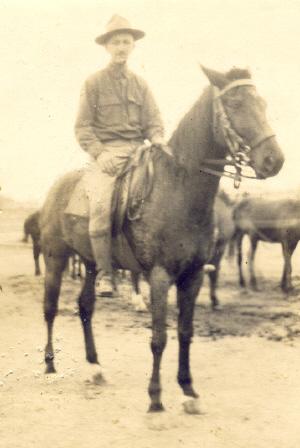
This 1916 photograph of my grandfather, Frank W. Owen (1893-1968), was shot when he was in the Richmond Light Infantry Blues. At the time he was stationed in Brownsville, Texas, as part of a contingent called up, converted into a calvary unit and assigned to protect the border. Mexican revolutionary/bandit Pancho Villa had been crossing over to raid small towns ... or so it was said. The next year the Richmond Blues were thrown into WWI in France. 

The piece below is about my grandfather and his method for teaching me a lesson about playing by the rules. Always. The story is set in the summer of 1959. 

Please note: I wrote it originally some 30 years ago for SLANT. So I was still playing basketball regularly. Then 10 years later an edited/scaled down version of it, this one, was published as a Back Page commentary in STYLE Weekly in 2000. 

The Cheaters

by F.T. Rea

Having devoted countless hours to competitive sports and games of all sorts, nothing in that realm is quite as galling to this grizzled scribbler as the cheater’s averted eye of denial, or the practiced tones of his shameless spiel.
In the middle of a pick-up basketball game, or a friendly Frisbee-golf round, too often, my barbed outspokenness over what I have perceived as deliberate cheating has ruffled feathers. Alas, it's my nature. I can't help it any more than a watchful blue jay can resist dive-bombing an alley cat.

The reader might wonder about whether I'm overcompensating for dishonest aspects of myself, or if I could be dwelling on memories of feeling cheated out of something dear.

OK, fair enough, I don't deny any of that. Still, truth be told, it mostly goes back to a particular afternoon's mischief gone wrong.

*

A blue-collar architect with the Chesapeake & Ohio Railway for decades, my maternal grandfather, Frank Wingo Owen was a natural entertainer. Blessed with a resonant baritone/bass voice, he began singing professionally in his teens and continued performing, as a soloist and with barbershop quartets, into his mid-60s.

Shortly after his retirement, at 65, the lifelong grip on good health he had enjoyed failed; an infection he picked up during a routine hernia surgery at a VA hospital nearly killed him. It left him with no sense of touch in his extremities. Once he got some of his strength back, he found comfort in returning to his role as umpire of the baseball games played in his yard by the neighborhood's boys. He couldn't stand up behind home plate, anymore, but he did alright sitting in the shade of the plum tree, some 25 feet away.

This was the summer he taught me, along with a few of my friends, the fundamentals of poker. To learn the game we didn’t play for real money. Each player got so many poker chips. If his chips ran out, he became a spectator.

The poker professor said he’d never let us beat him, claiming he owed it to the game itself to win if he could, which he always did. Woven throughout his lessons on betting strategy were stories about poker hands and football games from his cavalry days, serving with the Richmond Blues during World War I.

As likely as not, the stories he told would end up underlining points he saw as standards: He challenged us to expose the true coward at the heart of every bully. "Punch him in the nose," he'd chuckle, "and even if you get whipped he'll never bother you again." In team sports, the success of the team trumped all else. Moreover, withholding one’s best effort in any game, no matter the score, was beyond the pale.

Such lazy afternoons came and went so easily that summer there was no way then, at 11, I could have appreciated how precious they would seem looking back on them.

On the other hand, there were occasions he would make it tough on me. Especially when he spotted a boy breaking the yard's rules or playing dirty. It was more than a little embarrassing when he would wave his cane and bellow his rulings. For flagrant violations, or protesting his call too much, he barred the guilty boy from the yard for a day or two.

F. W. Owen’s hard-edged opinions about fair play, and looking directly in the eye at whatever comes along, were not particularly modern. Nor were they always easy for know-it-all adolescent boys to swallow.

Predictably, the day came when a plot was hatched. We decided to see if artful subterfuge could beat him at poker just once. The conspirators practiced in secret for hours, passing cards under the table with bare feet and developing signals. It was accepted that we would not get away with it for long, but to pull it off for a few hands would be pure fun.

Following baseball, with the post-game watermelon consumed, I fetched the cards and chips. Then the four card sharks moved in to put the caper in play.

To our amazement, the plan went off smoothly. After hands of what we saw as sly tricks we went blatant, expecting/needing to get caught, so we could gloat over having tricked the great master. Later, as he told the boys' favorite story -- the one about a Spanish women who bit him on the arm at a train station in France -- one-eyed jacks tucked between dirty toes were being passed under the table.

Then the joy began to drain out of the adventure. With semi-secret gestures I called the ruse off. A couple of hands were played with no shenanigans but he ran out of chips, anyway.

Head bowed, he sighed, “Today I can’t win for loosing; you boys are just too good for me.” Utterly dependent on his cane for balance he slowly walked into the shadows toward the back porch. It was agonizing.

The game was over; we were no longer pranksters. We were cheaters.

As he carefully negotiated the steps, my last chance to save the day came and went without a syllable out of me to set the record straight. It was hard to believe that he hadn’t seen what we were doing, but my guilt burned so deeply I didn't wonder enough about that, then.

*

My grandfather didn’t play poker with us again. He went on umpiring, and telling his salty stories afterwards over watermelon. We tried playing poker the same way without him, but it didn’t work; the value the chips had magically represented was gone. The boys had outgrown poker without real money on the line.

Although I thought about that afternoon's shame many times before he died nine years later, neither of us ever mentioned it. For my part, when I tried to bring it up, to clear the air, the words always stuck in my throat.

Eventually, I grew to become as intolerant of petty cheating as F.W. Owen was in his day, maybe even more so. And, as it was for him, the blue jay has always been my favorite bird.
-- 30 --

Wednesday, October 28, 2020

The Worst in Our Past is Today's Monster

Although millions of Trumpists in the USA might not care, it appears a lot of people in the rest of the world think President Donald Trump has failed to make America great again. Next week we expect to all see what voters in this country think of Trump's performance in his pursuit of greatness. 

We also expect to see what the USA collectively thinks about a president selling the notion that it was only in our best interests that he lied continuously about a health crisis, a pandemic that has now killed over a quarter million people in the country and crushed the economy. We expect to see what the nation's voters think about a president who, as part of his low-road effort to win reelection, would sabotage the operation of the United States Postal Service. We expect to see what the voters think about a president who openly encourages hate groups to don military get-ups and carry firearms in the public way to intimidate Americans calling for racial justice.

Of course, the list of Trump's instances of willful malfeasance, while in office goes on ... and on ... but by now I trust most patient readers have gotten my drift.

Yet, it's also fair to say that all of the bad things that have happened since January 20, 2017, supposedly in the name of "conservatism," can't be blamed on Trump alone. So this screed isn't just about the loathsome and dangerous stuff Citizen Trump has done to benefit himself however he pleases. It's also about citing the so-called "conservatives" in Congress, cowed members of the Republican Party who have stooped to carry out Trump's orders, no matter how immoral. 

Oh, and let's not leave out the millions of Americans whose support for Trump apparently hasn't wavered -- people who continue to turn a blind eye on Trump's mountain of malfeasance. At this time I won't try to analyze their motives, but next week we expect to find out how many of them are still blithely swallowing "alternative facts," cooked up in a parallel universe.

Nonetheless, I will say this to today's devoted Trumpists: Like it or not, the rest of the real world is not ignoring what the hell has happened to the USA since Trump took office. So historians probably will not see the practiced patter of the cult's members as a legitimate continuation of the conservative movement's principles, as once espoused by its icons, such as William F. Buckley, Barry Goldwater and Ronald Reagan. My prediction is that historians will view what we now call "Trumpism" as an anti-liberal form of populism and a cult of personality.

Moreover, the rough beast slouching toward Bethlehem that the facilitators of the Trump's corrupt agenda have set loose on the landscape has nothing to do with American greatness, now or any other time. Today's slouching monster has been conjured up from the worst in America's past. Trump's time in the White House will surely be remembered as a dark period as long as there are decent people somewhere in the world, good people who care about the truth, the whole truth and nothing but the truth. 

In the meantime, six days before the vote-counting in America starts, hope still exists and voting is...

-- 30 -- 

-- Art and words by F.T. Rea

Wednesday, October 21, 2020

Antifa in the Eyes of a Beholder

Well, since I don't know much about it, firsthand, I'm going to guess at what the nature of Antifa is. First: I have to say that it seems most of the people who opine about this subject on social media probably don't have credentials any better than mine. So here goes:

Second: Perhaps the plain truth about Antifa is somewhat like what it is with beauty, in that it probably depends on the eye of the beholder. Consequently, the same goes with how much of a true threat Antifa poses to everyday people, folks who mind their own business. And, how much of a threat Antifa poses to the agenda of armed Neo-Nazis stomping around in public in self-styled military get-ups. 

Third: most of the people who have been viewed by outsiders as Antifa “operatives” could be more accurately described as “sympathizers.” That, because they weren't really part of an organized group taking orders from higher-ups. Instead, they were acting in conjunction with a handful of like-minded friends, mostly young people, who agreed in a general sense with what they perceived are Antifa's goals. 

Fourth: whatever hardcore insider operatives that exist under the Antifa banner are not acting in such a way as they can be easily discovered online. They probably don't issue orders that can be intercepted by just anyone. Some have probably watched “The Battle of Algiers” (1966) more than once. So they know better than to set up a hierarchy that can busted, unraveled and then simply be rounded up. 

Fifth: Thus, all that said, I think Antifa looks like more of a movement than an organization with a chain of command. Still, since it is surely opposed to fascism that puts it totally at odds with white nationalists, the Ku Klux Klan, the Proud Boys, etc. And, it more or less aligns Antifa with a progressive movement such as Black Lives Matter. 

However, since some Antifa sympathizers have been willing to physically battle opposing groups in the street, Antifa cannot be seen as a force strictly for nonviolent protests. For a historical reference, maybe think Malcolm X, rather than Dr. Martin Luther King. Of course, I could be wrong, but that's how it looks to this geezer.

Note: To watch "The Battle of Algiers" click on the link. To see English subtitles click on settings and scroll down and click on it.

Sunday, October 18, 2020

What It Is Ain't

Fiction by F.T. Rea


Jan. 24, 1991: Bright sunlight lit up the thin coating of freezing rain that had painted the city the evening before. In the crisp air, Roscoe Swift, a slender middle-aged man, a freelance artist/writer, walked at a careful but purposeful pace on the tricky sidewalk.

The ice-clad trees along the street were dazzling, as seen through Swift's trusty Ray-Bans. The woolly winter jacket his girlfriend, Sally, had given him for Christmas felt good.

Since the freelancer couldn’t concentrate on his reading of the morning’s Richmond Times-Dispatch, he left half a mug of black coffee and a dozing cat on his desk to walk to the post office. He hoped the overdue check from a magazine publisher was waiting in his post office box.

Anxiously, Swift opened the box with his key. It was empty. He shrugged. An empty box had its upside, too -- there were no cut-off notices in it. With his last 20 bucks in his pocket, the freelancer hummed a favorite Fats Domino tune, “Ain’t That a Shame,” as he headed home.

Before the end of the workday Roscoe had to finish an 800-word OpEd piece and drop it all off on an editor’s desk in Scott's Addition. With the drum beat for war in the air he wanted to focus on the inevitable unintended consequences of any war. Yet, with the clock ticking on his deadline he was still at a loss for an angle.

The country was still mired in an economic recession. With the national debt climbing an invasion of Iraq was looming. War seemed all but inevitable. Pondering what demons might be spawned by an all-out war in Iraq he detoured a couple of blocks, to pick up a Washington Post and a fresh cup of coffee.

Approaching the 7-Eleven store Roscoe noticed a lone panhandler standing off to the left of the front doors. The tall man was thin and frail. He wore a lightweight denim jacket over a hooded sweatshirt. Snot was frozen in his mustache. The whites of his heavy-lidded eyes were an unhealthy shade of pink.

When Roscoe had run the Fan City Cinema, in the '70s, he had determined his policy should be to never in any way encourage panhandlers to hang around on the sidewalk in the neighborhood surrounding the theater. The rigid policy had lingered well after the comfortable job had faded into the mists.

On this cold day it wasn’t easy for Roscoe to avert his eye from the poor soul’s trembling outstretched hand. Not hearing the desperate man’s hoarse plea for food money was impossible. When there are always so many lives to be saved in our midst, Roscoe wondered, why do we have to go to the Middle East to save lives?

Inside the busy store Roscoe poured himself a large coffee. Black. Fretting profusely, he snapped the cup’s lid in place. It was one of those times when the little Roscoe with horns was standing on one of his shoulders, while his opposite, the one with the halo, was on the other; both were offering counsel.

Roscoe's longtime "policy" caved in seconds later. Still, he decided to give the freeloader food, rather than hand over cash to perhaps finance a bottle of sweet wine. It might change my luck, he thought as he smiled.

Trying to max out the bang-for-the-buck aspect of his gesture, Roscoe settled on a king-sized hot dog, with plenty of free stuff on it -- mustard, chopped onions, relish, jalapeno peppers, chili and some gooey cheese-like product. Not wanting to push it too far, he passed on the ketchup and mayonnaise.

Outside the store, Roscoe found the starving panhandler had vanished. Roscoe looked up and down Cary Street but saw no sign of the poor soul.

So, the crestfallen philanthropist took the meal-on-a-bun with him as he walked, softly singing a Buffalo Springfield song, “For What It’s Worth.” With his strides matching the beat he kept to the sunny street, to avoid the sidewalk in the shade.

There’s somethin’ happening here,
What it is ain’t exactly clear.
There’s a man with a gun over there,
Tellin’ me I gotta beware.
I think it’s time we stop, children, what's that sound,
Everybody look, what's going down.
A line from that song’s last verse -- “paranoia strikes deep” -- suddenly snapped an idea for the OpEd into place, which launched an instant mini-mania. The freelancer picked up his pace and began whistling a jazzy version of “For What It’s Worth.”

Back in his office/studio, rather than waste money, he tore into the feast he had prepared for a beggar. It seemed the food scared, or perhaps offended, the cat, who fled. Between sloppy bites the freelancer wiped his hands off.

About an hour later the heartburn started. Eventually, it got brutal. Roscoe pressed on. He wrote about the way propaganda always works to sell war -- every war -- as glorious and essential to the everyday people, who risk their lives. That while the wealthy, who rarely take a genuine risk on anything, urge the patriots on and count their profits.

Thinking of the war in Vietnam that thinned his generation out, he wrote:
After the war the veterans were largely ignored, even scorned.
Roscoe lamented the popular culture having gone wrong, so there was no longer a place for anti-war protest songs. Feeling righteous, he asked:
Where are today’s non-conformists? Today's questioners of authority?
With time to spare, the freelancer finished the job and turned in his work at 4:20 p.m. He even managed to pick up the overdue check for $200 he was owed. An hour or so later his sour and noisy stomach began to calm down during his second beer at the Bamboo Cafe.

Sally showed up with a smile and joined the group gathered at the elbow of the marble bar. When Roscoe recounted the tale of breaking his rule and buying the stuffed frankfurter he got a laugh. He explained how the old Buffalo Springfield song gave him an idea for his OpEd piece.

Roscoe's small audience groaned on cue when he finished it off with, “Sometimes it's a thin line that separates heartburn and inspiration ... for what it’s worth.”

* * *

All rights reserved by the author.

Thursday, October 15, 2020

Our Third Revolution?

The following quote comes from John Adams' letter to Thomas Jefferson, dated August 24, 1815. 

What do we mean by the revolution? The war? That was not part of the revolution; it was only an effect and consequence of it. The revolution was in the minds of the people, and this was effected from 1760-1775, in the course of fifteen years, before a drop of blood was shed at Lexington. The records of thirteen legislatures, the pamphlets, newspapers in all the Colonies ought be consulted, during that period, to ascertain the steps by which the public opinion was enlightened and informed concerning the authority of Parliament over the Colonies.

I agree with Adams that the "revolution" began well before the shooting started, so I'll defer to his judgment and take his word for choosing 1760. Nonetheless, I have to include the war, itself, in what I see as what made for the American Revolution. Accordingly, for my purpose with this piece, I think the best beginning and ending dates to put on it would be 1760-1788. The reason for choosing 1788 is that it is the year in which the U.S. Constitution was ratified and adopted. 

Thus, I see the Revolution to include the dismantling the old system and the establishment of the new one. However, what I also want to say here is this: it was just the first revolution in this country. 

The second revolution, perhaps I should call it Revolution 2.0, occurred in the mid-1800s, which should include the abolition of slavery, the bloodshed of the Civil War and the Reconstruction Era that ended in 1877. When the second revolution started is harder to pin down, but this time I'll opt for 1854, because that's the year the notorious Kansas-Nebraska Act was passed. Many see that move by Congress as what made the Civil War's start inevitable in 1861, in that it expanded slavery in wicked defiance of the burgeoning Abolition Movement. Plus, it should be noted that England, France and other European nations had already abolished slavery. 

Now I'll briefly explain why I believe the U.S.A. is about to go through an ordeal, which, in this context, might be viewed as part of Revolution 3.0. Using my characterizations of our first two revolutions as models, in October of 2020 we already have the two essential elements in place: 

The Trump presidency, a time in which great flaws in our system have been revealed and underlined, has been the equivalent to the 15-year period Adams described that led up to the Revolutionary War. Likewise, the last four years of reactions to the abuses of Trumpism -- The Resistance, the demonstrations for racial justice, etc. -- could also be compared to the turbulent period of reexamination of the institution of slavery the nation went through between 1854 and when the Civil War started seven years later.  

The second revolution-making element in 2020 is the staggering death toll of the COVID-19 pandemic. A war-like national suffering greatly exacerbated by the Trump administration's policies and lack thereof. At this writing the number of deaths surely calls out for more than thoughts and prayers; the number of deaths and total infections calls out for something better than "herd immunity." 

The transformational COVID-19 numbers call out for radical cultural and political change!  

Some time after November 3rd -- a day later, or a week, or a month -- either Trump or Biden will be declared the winner. Yet, after the election Black Lives Matter isn't going away and its influence is probably going to grow. In Richmond, those Confederate statues aren't going back up and the Lee Monument is eventually coming down. Moreover, the Proud Boys and their ilk aren't going to fade into the mists, either. The daunting problems spawned by white nationalism and guns will be with us no matter who the president is.

So, the spectrum of political movements already demanding considerable changes are poised to seriously rock the boat after the election like nothing the U.S.A. has seen in a long time; maybe since its first two revolutions. Then, there's COVID-19 and its still raging ability to kill people and sink the economy. And, of course, climate change is not likely to magically stop being the global problem that overshadows all of our other vexations. 

One lesson from history may offer a wee glimmer of hope. Adams, who was the country's the second president, and Jefferson, who was the third president, became bitter political foes during their combined 12 years as president. Which was sad for both men, who had once been prominent figures in the American Revolution and good friends.

Then, as grizzled ex-presidents, Adams and Jefferson eventually became pen pals and reestablished what had once been a close friendship. They even died the same day: July 4, 1826.   

-- 30 -- 

-- Art and words by F.T. Rea

Tuesday, October 13, 2020

Doing Right by Ashe


With regard to what happened in Richmond over the summer, concerning statues of Confederate heroes on Monument Avenue, this may be a good time to think about what to do with the Arthur Ashe statue (and pedestal) now standing at the intersection of Roseneath Ave. and Monument Ave. First, here's a quote from Arthur Ashe's widow, Jeanne Moutoussamy-Ashe, via Tennis.com:
It was never an idea of Arthur’s to be on Monument Avenue. You have your white Confederates there, and then you have a Black favorite son. It felt divisive, and Arthur wasn’t divisive.

For Moutoussamy-Ashe, that apparently still remains true, even today, with most of the Confederate memorials kaput. The recently-published article in Tennis.com is worth reading. It provides plenty of good background material. 

Next, here's a little more background, from my point of view: In 1996 I was working as a freelance videographer and I took an interest in the Arthur Ashe Monument controversy that surrounded the decision to place an Ashe sculpture at the intersection of Roseneath and Monument. Then there was the aesthetic controversy about the art, itself. It seemed then that some folks in Richmond, including some art critics, of a sort, weren't all that fond of sculptor Paul DiPasquale's depiction of Ashe.

Since Ashe, a fellow Richmonder, was a hero of mine, I decided to assemble a video report of the situation. Accordingly, I taped dozens of interviews of random passers-by opining at the site of the memorial. And, I sought out a few people, in particular, to get their views. Among those I sought out was Tom Chewning, who had been one of the most significant fundraisers for the project.

At the time, Chewning was an top shelf executive with Dominion Energy. He was a prominent tennis player as a teenager, so I remembered him from Thomas Jefferson High School. (He was three years ahead of me and Tom was kind enough to pretend he remembered me, too.) More important, in 1960 he became friends with Ashe. They met at a tennis tournament in West Virginia.

When I asked Chewning about his opinion of the art he laughed and ducked the question. Basically, he said he would leave that part of it to others; he was focused on the fundraising and seeing to it the monument became a real thing. So I asked him why it mattered so much to him. His answer bowled me over.

After telling me about meeting Ashe and becoming friends with him, he told me a story. It seems he was addressing a group of teenagers about Ashe, sometime not long after Arthur's death. Chewning explained how while he and Ashe were both top flight local tennis players, when they were in high school, Ashe wasn't allowed to play in the boys' city championship tournaments in Richmond.

Then one of the kids in the audience asked Chewning a question: If you and Arthur were friends, why didn't you boycott the tournaments he was banned from playing in, simply because he was black?

Chewning was flabbergasted. He tried to explain how different it was in Richmond then. How it wouldn't have changed anything. He told the kids it just never occurred to him…

After his awkward struggle to answer that simple question, Chewning knew he had not satisfied his polite audience. Thinking about it later, he knew he had to do something to put it right. Eventually, that realization became a mission to raise whatever money it took to erect a statue to remember the friend maybe he should have stood by, all those years ago.

Debt paid. 
 
The people who raised money and worked to make it possible to put the Ashe statue on Monument Avenue surely meant well. No doubt, DiPasquale meant well. And since Ashe is a hero of mine I was, and remain, glad he is being honored with a memorial placed in the public way. Still, I recognize it might have originally been placed elsewhere and, yes, perhaps there was a better place. But in 1996 former-Governor Doug Wilder wanted it to go exactly where it is now. 
 
Wilder had his reasons. And it seems to me, that was that. 
 
In 2020, if we Richmonders have learned anything about this sort of thing, it's that public art is something that needs to be considered carefully. And, that includes the matter of who should make the decisions about what it ought to look like and where it should be placed. 
 
So, going forward, I'm not saying Jeanne Moutoussamy-Ashe's opinion is the only one that should be considered. Nonetheless, I am saying it should be considered and from what I've gathered, it was not given proper deference in 1996. 

-- Image from Tennis.com

Sunday, October 11, 2020

Fan District Softball League Hall of Fame


The Fan District Softball League (1975-94) established its Hall of Fame in 1986. The first class was elected by the 12-team outfit’s designated franchise representatives. To be eligible then one had to have retired from play and considered to be among the founders. Ten names were selected as the first class of Hall-of-Famers. The plaque, which has not aged gracefully, is pictured above.

The same rule held true in 1987, when six new names were put on the plaque. However, by 1988, a few of those who had been inducted into the Hall had un-retired. So, in 1988, eligibility to the Hall was opened up to anyone who seemed deserving. Those already in got to vote, as well. Nine new members were selected. The voting process was probably no more twisted than any hall of fame’s way of choosing new names.

For 1989 six additional names were added. The class of ‘90 included seven names, and in ‘92 the last five names were tacked on. In all, 41 players and two umpires were tapped.

The men who were inducted into the FDSL’s Hall are as follows: Ricardo Adams, Herbie Atkinson, Howard Awad, Boogie Bailey, Yogi Bair, Jay Barrows, Otto Brauer, Ernie Brooks, Hank Brown, Bobby Cassell, Jack Colan, Willie Collins, Dickie deTreville, Jack deTreville, Henry Ford, Danny Gammon, Donald Greshham, James Jackson, Dennis Johnson, Mike Kittle, Leo Koury, Jim Letizia, Junie Loving, Tony Martin, Kenny Meyer, Cliff Mowells, Buddy Noble, Randy Noble, Henry Pollard, Artie Probst, Terry Rea, John Richardson, Jerry Robinson, Larry Rohr, Billy Snead, Jim Story, Hook Shepherd, Pudy Stallard, Durwood Usry, Jumpy White, Barry Winn, Chuck Wrenn. 

At this writing, by my count (which, of course, could be wrong), 13 guys on the list above have died. Their names are seen in bold italics.   

Given its ways, that the league, itself, lasted 20 years is truly amazing. 


Friday, September 25, 2020

Questions About Kentucky Justice

The justice system in Louisville surely failed Breonna Taylor. Nonetheless, because we still lack important information about before the shooting started, during the incident and after, what crimes the three cops who fired rounds may have committed isn't clear to me. 

Questions:

To start with, I need to understand more about why those cops were there with a battering ram and why they wore no body cameras. Do the laws in Kentucky really allow for all that?

At the minimum it appears the bar for obtaining a no-knock warrant was woefully low. Why would such extreme tactics for a raid be allowed with such flimsy evidence to justify their use?

Why should we believe the cops (pictured above) when it seems they probably lied on the initial reports? When there's a shooting, especially when people are injured, shouldn't it be some sort of crime in itself to willfully tell falsehoods on official reports? 

Why would the city pay out $12 million if there really was no wrong-doing? Were any members of the grand jury aware of that payment? 

And, yes, once again, we have to ask what role did race have on any and all of above? 

-- Photos from ABC News.


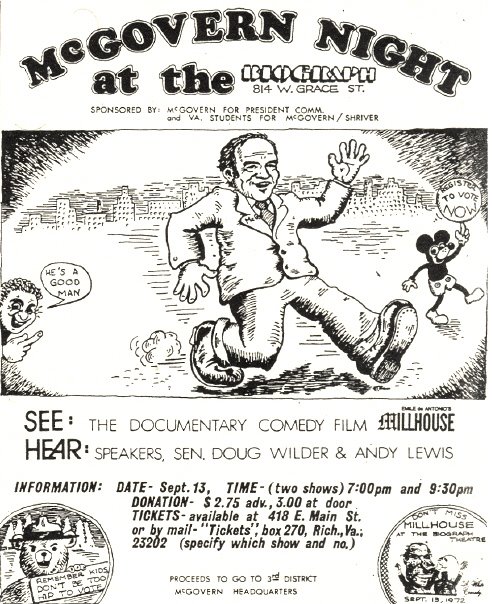
McGovern Night at the Biograph

 
This is a handbill I did for a McGovern fundraiser on Sept. 13, 1972, at the Biograph Theatre, a Fan District repertory cinema I managed, 1972-83. I was 24 at that time. By the way, with my McGovern caricature I was deliberately imitating R. Crumb's keep-on-truckin' guy style, trying to appeal to hippies. Shamelessly, I also appropriated Smokey the Bear to help out, too.

Of course I received plenty of advice that it would be a mistake to stage this event, because a movie theater should not take part in politics. Well, for one thing, my bosses in Georgetown totally backed my decision. They were accustomed to linking the Biograph up there with lefty causes. 

Plus, this was only eight months into our operation in the Fan District and most of those who were offering me (helpful?) advice to steer clear of politics still didn't understand how much the new Biograph would be different from Richmond's other cinemas. Time would tell.

Now, 48 years later, looking at this handbill and thinking of how hopeful I was in 1972, I have to chuckle ... and sigh. 

Monday, September 14, 2020

Black Athletes Who Won't 'Shut Up'

LeBron James

Infamously, a couple of years ago Laura Ingraham told LeBron James to “shut up and dribble.” At the time talking head Ingraham was chiming in to join the chorus of indignant voices criticizing well known athletes for speaking out about politics, especially politics to do with race. Recently we’ve heard similar criticisms meant to muzzle other professional athletes, especially if they are black. 

As most people know, the leader of the chorus of those calling fouls on the restrained protest gestures of LeBron James, Colin Kaepernick, et al, was President Donald Trump. In 2020, the NBA, NFL, etc., have changed their tunes ... but not Trump.

Closer to home, via the Internet, some local VCU basketball fans have hurled their own versions of “shut up and dribble” at Rams players, coaches and even at sports writers who have one way or another publicly supported the Black Lives Matter protests in Richmond and elsewhere. Those who are bashing the BLM supporters would have us believe that when America was supposedly "great" -- perhaps in the middle of the 20th century -- there was a wall separating politics and sports; especially politics to do with race.

Well, let's fire up the Wayback Machine and look briefly at just a few examples that expose that claim about a wall of separation to be utter bullshit.

In 1966 the NCAA men’s basketball championship was won by an underdog Texas Western team with an all-black starting lineup. The betting favorites, Kentucky, featured an all-white lineup with an unabashed racist coach, Adolph Rupp. Without framing it with the race-related context, you can’t tell that story of what was then the biggest upset ever in a NCAA final game. To say it changed college basketball for good is an understatement.

Nor can you tell the story of just two of America’s greatest sports heroes without mentioning the importance of the confluence of race and politics that washed over their entire careers. They are: heavyweight boxing champ, Muhammad Ali, and Hall of Fame baseball player, Jackie Robinson. Of course in their glory days, plenty of sports fans rooted against them and wished their amazing accomplishments had not been celebrated on front pages of sports sections. 

Nonetheless, both of them persisted in spite of long odds and plenty of death threats. Moreover, in spite of what the likes of Laura Ingraham might say, today's outspoken black athletes are bravely following in a great tradition.

There were many more athletes who could be listed here, but I hope my point has already been made. Bottom line: Saying “shut up and dribble” is tantamount to saying “go back to the plantation and obey your master.” 

-- Image from The Guardian

Thursday, September 10, 2020

Left to Speculate

"All governments lie, but disaster lies in wait for countries whose officials smoke the same hashish they give out."
-- I.F. Stone

In the immediate aftermath of the first revelations from Bob Woodward’s new book, “Rage,“ questions are popping  up like mushrooms. Let’s start with two that loom over all others, so far: 

In the crucial early months of this year, why did Trump choose to “play down” what experts told him back in January and February about the threat of COVID-19? Why did he then call its threat a "hoax" cooked up by Democrats?

Given Trump’s initial reactions to questions raised by Woodward‘s bombshell book, we still don’t know why Trump hid the alarming news of such vital discoveries behind a wall of disinformation. In a nutshell, today Trump’s position is that he didn’t say what we've heard him say on tape, but if he did, it was because he wanted to avoid widespread panic. 

Of course, since we know Trump regularly sows the seeds of panic, to do with immigrant invasions, Black Lives Matter protestors, voter fraud, etc., that silly alibi is just a bad joke. Thus, at this point, we, the people, are left to speculate about Trump‘s motives to play down COVID-19‘s threat.  

Which is nothing new. After all, leaving us all to speculate about his motives has been at the heart of his power-grabbing strategy since the get-go. By, “us all,” I mean his supporters, his detractors and especially the media. It’s a strategy that spawns endless speculation about why Trump says and does you-name-it. Significantly, it boosts us all into finding pretty much whatever the hell we're looking for. Moreover, it keeps everybody chattering about him endlessly.

OK, maybe Trump was simply believing, as he frequently does, that he could shape the truth simply by applying the force of his all-powerful personality. In other words, it's sort of like what the great independent journalist, I.F. Stone, was talking about in the quote from him the precedes this piece. 

Then, speaking of speculation, we have the brewing controversy over what were Woodward’s responsibilities, once he uncovered what Trump knew about COVID-19 months ago. Surely Woodward, the legendary journalist, knew that he was sitting on information that would make big news. He also must have known some folks would say that in the national interest he should have made the tapes public sooner. 

Maybe last month? Maybe in June or July? Maybe when? 

Since Woodward’s interviews with Trump took place over several months, the question of when he should have blown the whistle is bound to get amplified in the coming days. Then again, if he had done it in February or March, before Trump had spent crucial weeks lying to the public, before the infections and death numbers got to be as alarming as they became in May, I’m not so sure how much impact it would have had. 

Plus, Woodward obviously wanted to continue the interview process, hoping to get more info. After all, he was gathering it for a book, not for a news story.   

Looking back on Woodward’s decision, and weighing the events of the last six months, it's easy to see he has been riding on the horns of a dilemma for a good while. His thorough explanation to answer some difficult questions about his own decisions ought to come soon. In fairness, this much we already know: The duties of journalists -- to reveal what they discover, pronto, or to never reveal it -- have been argued about for a long time, especially during times of war or crisis. 

Nonetheless, some people are already saying Woodward is just as guilty as Trump, which to me seems to be a rush to overreact. Going forward, we'll see how long Woodward's guilt for not being a whistle-blower is a big part of the story. And, we're bound to be left to speculate aplenty about the next stop-the-presses revelation, then the next and so on, between now and election day.

 Me? 

I'm still wondering how many Republicans in the U.S. Senate would go on record to scold Trump, roundly, should he shoot one of his enemies on 5th Avenue and then brag about what a damn good marksman he is.

-- Art and words by F.T. Rea

Saturday, August 15, 2020

The Dogtown Hero

Ted Williams
Fiction by F.T. Rea


June 3, 1959: A lean boy with sandy hair and blue-gray eyes, 11-year-old Roscoe Swift lived in a nine-room stucco house with his mother's parents. The 40-year-old house was in Dogtown, south of Richmond proper.

Roscoe's grandfather was an architect. His grandmother taught children to play the piano. Their yard had two apple trees, a cherry tree, a plum tree and three grape vines in it.   

His mother lived in her studio apartment over a garage that accommodated two cars and his grandfather's seldom used workshop. It was about 30 yards from the house. She was a sometime freelance commercial artist who preferred to work at night and sleep in the day. No one referred to her drinking ways as "alcoholism." When the weather didn't suit her she wouldn't venture outside what she called her "carriage house."

Everybody else called it a "garage." There were spells when Roscoe wouldn’t see his mother for the better part of a week. 

When Roscoe was two years old his mother and father had split up. His father went back in the Army and subsequently died in a helicopter crash somewhere in Korea. Since his mother refused to talk about his father -- she had destroyed all photographs of him right after their separation -- the boy's blurry picture of the dead man had been pulled out of the air.

When his mother wasn't within earshot his grandmother would sometimes say, "Your dad had a wonderful smile." His grandfather had told him his father had been a "pretty damn good outfielder" when he was Army, which had frequently gotten him preferential treatment from the brass.

Two or three times Roscoe had heard his grandfather say with a chuckle, "Don't know much about what else your father did during the war, but he played on the same baseball field with some pros."

When he imagined his father, rather than in a military uniform, Roscoe usually saw him in a Depression Era baseball uniform, like what he'd seen Lou Gehrig and Dizzy Dean wearing in newsreels.

For as long as he could remember Roscoe had been in training to be a hero. It wasn’t something he talked about much, but it was usually close to the heart of his striving. He was a strong reader and had already inhaled many a biography and adventure story about heroic figures. To steel his nerves he had tested himself with daredevil stunts. He wasn't one to back down from a fistfight. At camp the summer before he had won a National Rifle Association Sharpshooter patch, which he kept with other treasures in a cigar box, hidden where nobody would find it.

On this day the most significant test of Roscoe's mettle had arrived: he was playing the biggest baseball game of his career. Remembering the lucky Ted Williams baseball card he’d slipped into his back pocket before he’d left for school, Roscoe looked at the blue sky and smiled ever so slightly.

Mostly, school was easy for Roscoe. He took pride in being able to turn in a paper first and get every question right. His difficulties in school stemmed from his class clown inclinations and his quick temper. Good grades in conduct weren't a given.

He liked reading about history and he enjoyed drawing, especially cartoons. But Roscoe hated being indoors in good weather. Baseball was mattered most to him. During baseball season, using the box scores in the morning newspaper, he routinely calculated the up-to-date batting averages of his favorite Major League players before he went to school.

Two of the fifth-grade classes had finished the season tied, forcing a playoff game to decide the championship. Following lunch, all four fifth-grade classes at Gittes Creek Elementary had been given the afternoon to watch the two teams settle the issue. Which was a treat, because all the previous games had been played during recess.

Students with no taste for baseball had the option of watching a black and white 16 mm documentary film about Jamestown's 350th anniversary. Thus, there was a pretty good crowd for the title game.

With one out, Roscoe's side was two runs down. As he took his practice swings, he reminded again himself of the situation -- bottom of the last inning, men on first and third. "No grounder," he said to himself, as he knocked red dust off his canvas sneakers with the bat ... as if they were baseball spikes.

A group of some 20 men, fathers, uncles and a couple of former minor league ballplayers from the surrounding neighborhood added a measure of authenticity to the crowd. Girls from the two classes in the championship game were acting as cheerleaders. No one could remember that ever happening before, but it suited Roscoe just fine.

In 1959 baseball was still unquestionably America's National Pastime. In Dogtown even fifth-grade baseball in the last week of school was important.

Swift stood in the batter's box on the first base side of home-plate. Originally trained as a right-hander, he had decided that if Ted Williams -- the best hitter in the game -- batted left-handed that was good enough for him. Besides, to Roscoe, for some reason a good southpaw swing looked better. He’d been practicing batting left-handed for a couple of months in neighborhood pickup games. Finally, the switch had to be tested in a situation with something more on the line.

Standing crouched and barely touching first base, Roscoe’s best friend on the team, Bake, cheered him on. "Pick out a good one. Hit your pitch, Number 9."

Even though the boys weren't wearing uniforms with numbers on them, during games most of the starters on Roscoe's team called one another by the numbers they would be wearing. Since Bake's favorite player was Willie Mays, he was called Number 24.   

However, a couple of Roscoe's teammates were imploring him from the bench to bat right-handed, like usual, since everything was at stake. Butterflies the size of eagles disquieted Roscoe's stomach, but he had made up his mind to take the chance.

Stepping out of the box, the Roscoe took three slow and deliberate practice swings. He looked at the crowd standing along the third base line. The cheerleaders for his side were chanting, "Ros-coe, Ros-coe, he's our man. If he can't do it, nobody can!"

His grandfather, who had taken the afternoon off for the first time in Roscoe's memory, stood in the shade of an ancient oak tree with the other men. Peering under the flat brim of his straw hat Rocsoe's first baseball coach stoically watched the action, as only he could.

The other team's cheerleaders and classmates booed and hooted at Roscoe from the first base line. He dug in and did his best to put them out of his mind. However, there was a particular girl with a strawberry-blonde ponytail and lively blue-green eyes cheering for the other team. Her name was Susie and he never failed to notice her.

The best thing to say to Susie never came to mind when she was near. Sometimes she made him feel short of breath. So Roscoe watched her from a distance ... frequently with a sense of longing that baffled him. Although Susie was calling for his team to lose, that very second, he was sure glad she was there.

Back in the box, Roscoe shifted most of his weight to his back foot and turned his front foot thirty degrees toward first base. Relaxing his hands, he jutted his chin out and squinted like he was aiming a 22 rifle.

The pitcher threw the first pitch outside and in the dirt. It got by the catcher. But the ground rules didn't allow stealing bases, so the guys on base stayed where they were. Sure the next pitch would be across the plate, Roscoe leaned back and prepared to cut the ball in half.

With the infielders behind him chattering like magpies, the hurler went into his stretch and fired the ball. Roscoe liked the pitch and took a big roundhouse swing.

Whoosh!

He nearly lost his balance as the sudden explosion of laughter from his opponents and their classmates pierced Roscoe's armor of concentration. Nonetheless, he didn't look at anyone on either baseline. He knew he'd shut his eyes as he'd swung the bat.

Roscoe felt his cheeks flush as he pulled his baseball cap's brim down on his brow. Again, he relaxed his wrists and fingers.

"It only takes one to hit it!" Bellowed his grandfather through cupped hands.

Roscoe leaned away from the pitcher, to put more weight on his back foot. He remembered to take a deep breath, which he let out slowly as the pitcher confidently cut loose with another fastball. Swinging from his heels, Roscoe rolled his wrists just exactly as his weight shifted toward the pitch. The batter tagged the ball sweetly.

Cah-rack!

The ball left the infield with dispatch. After clearing the leaping second baseman's glove by two feet it took a sharp nosedive and evenly split the closing distance between the right and center fielders. The pair frantically chased the top-spinning sphere down the grassy slope.

The utter perfection of the bat’s perfectly timed kiss on the horsehide's sweetest spot resonated through his body. The sudden furor Roscoe heard seemed like it was far away. He ran like a monster was chasing him. As he made his turn toward third base the ball plopped into the trickle of a creek that bordered the schoolyard. Rounding third, he caught up with Bake.

"Slow down, man," Bake advised over his shoulder with a sarcastic chuckle. "Those goons haven't even found it yet."

Roscoe's euphoric classmates were jumping around wildly. His grandfather beamed as he waved his hat back and forth over his head. Teammates, suddenly champions, were pounding him on his back as he crossed home plate.

Meanwhile, Roscoe's capacity to comprehend the intensity of the moment was red-lining. He looked at Susie on the quiet side of the field. The way her head tilted to the side, the position of her limbs, something about her stance, or gesture, made him feel disoriented. It was as though he was viewing the event from a number of different angles, simultaneously. He felt both inside and outside the scenario.

Roscoe's mind raced as everything seemed to be moving in slow motion. Straining to pull all the elements together, to grasp all he was sensing, he heard an explosion.

Boom!

Then he felt a strange calm. All he surveyed seemed vivid and in its place.

As Roscoe crossed home plate, it occurred to him that he hadn’t loped around the bases, a la Teddy Ballgame. Maybe he could have, but he'd been far too excited to feign nonchalance. More importantly, Roscoe had remembered to not tip his cap. If the batting king and ace fighter pilot of the Korean War, Ted Williams, never tipped his cap to the public on his home run trot -- which he never did -- that was good enough for Roscoe, too.

Roscoe felt like he was soaring, somewhere up above all of his dark doubts. He was in a place where heroes don't have have to tip their caps to anyone. Meanwhile, Susie had vanished.

Later on, Roscoe realized no one else had heard the explosion. Although that made no sense to him he promptly dropped the subject and stashed that mystery in the same hidden space with an accumulating stack of guilty haunts and some developing theories.

Still, the moment's hero believed the memory of just how it felt when he hit that baseball perfectly would never leave him.

*

Note: "The Dogtown Hero" is part of a series of stories called "Detached."

Wednesday, August 12, 2020

Dan Rather on Joe Biden's Pick

It's easy to see why right-wingers and Trumpists like to bash Dan Rather. He makes way too much sense. Here's what Rather wrote last night about former-Vice President Joe Biden's selection of Sen. Kamala Harris as his running mate:
For most of my life, candidates on major party presidential tickets tended to look like, and had similar backgrounds to, Joe Biden. It was so unremarkable that it was hard to imagine anything different. No one looked like or had the background of Kamala Harris, not by a long shot. That may go without saying, but it deserves to be said. Boy does it ever.
Ours is a representative government, but for too long in America our leadership wasn't representative of the people as a whole. Not in gender or race. But here's the thing about representation, once walls of the status quo are broken, the imagination of the electorate changes.

Let's take the Senate. It still is in many ways an "Old Boys Club" and one that has about as much racial diversity as a mid-20th Century country club. But there was a time, not that long ago, when that was essentially all that it was. In recent years, that has changed considerably. And now the idea of a woman senator, from either party, seems a natural state of affairs. We sadly have further to go with Black senators. That is not to say that women still don't face many, many more hurdles than men.

They do. But with each woman elected to office, as with governors, mayors, and state representatives, the idea of a "typical" political leader begins to change. And it's easier for those who follow.

So representation matters, and it's not just politics. In occupations from the military, to first responders, to astronauts, to athletes, to scientists, to all the other places in society that were once almost always the exclusive domain of men, and often white men, the breaking of barriers redefines what society in all its diversity thinks is possible.

There will be challenges for reporters covering this campaign. And there should be. Kamala Harris deserves to be vetted, and she expects this. But as we saw in 2016, what some might call vetting can also be shameful exercises in false equivalence, shaped by centuries of bias and systemic impediments to women and ethnic minorities, no matter the talents they possess.

Pioneers are judged, and judged harshly. They are judged on scales weighted against people that look like them. It's perfectly acceptable for a reporter to explore how Senator Harris may help turn out the vote, or inspire her political opposition. But that has to be framed alongside the injustices of American society.

"Electability" is really a standard for judging the American people and not her. Her record in office can be scrutinized. But wondering whether she is "qualified" is really a far-from-subtle code word for race and gender. How she speaks, looks, the tone of her voice, we can't ignore that these things will enter the political discourse. But they are all subjective qualities that are shaped by what our society and history books have taught us a president or vice president is supposed to look like and sound like. It is time these norms are shattered.

As any scientist will tell you, human beings are by our basic nature, biased creatures. Biases, especially when they are subconscious, help us make sense of a complicated world. What do we fear? What do we understand? What challenges our sense of comfort? But bias leads us astray. Biases close us to new opportunities. But often, if we let ourselves, we can break down these biases. We can see the world through new eyes.

Kamala Harris does that. She is a vote for the America of today. Her story is every bit that of the American dream as the tales we look back at from a century ago with sepia-toned nostalgia. Many of those people were also the children of immigrants, different in language, ethnicity and religion from what privileged America thought the country should be . They were also judged, harshly.

That Senator Harris is a representative for Black America makes this moment all the more poignant. Her path though an historically Black university is a path that echoes the founding injustices of this nation, and the long and winding path to hope.

This campaign is far from over. The choice of a vice presidential candidate rarely moves needles much. But whatever happens American politics represents more of America tonight.

Monday, August 10, 2020

Remembering Glenn Pavone


Ten years ago guitar virtuoso Glenn Pavone died.

Richmonders may remember him from his two noteworthy appearances with Billy Price and the Keystone Rhythm Band at High on the Hog (1983 and 1985), as well as his touring with the Bill Blue Band. Glenn also played briefly with Chuck Wrenn's early-'80s band, the Megatonz.

Those who knew Glenn personally remember him as an usually modest and thoroughly nice guy. The video clip above is a rough transfer to-digital of Billy's Price's band performing at High on the Hog 9 in 1985 from a 16-minute documentary that I directed.

Click here to visit the Glenn Pavone Tribute page on Facebook. 

RIP, Glenn.