On Mon., Oct. 22, the third presidential debate took place on the Lynn University campus in Boca Raton, Florida. The topics covered were supposed to be about foreign policy.
Perhaps some Mitt Romney supporters would say otherwise, but I suspect it will be remembered as the Horses and Bayonets Debate.
After each of his three debate moderator predecessors were much criticized for their performances, Bob Schieffer of CBS News did a solid job as the questioner and referee. He allowed both debaters to wander, which included forays into what sounded like domestic policy areas, but Schieffer eventually called time on them, to change subjects when it seemed appropriate.
As a 15-round boxing match, roughly with 15 questions, I scored it this way: Barack Obama won seven rounds, Romney won two rounds, with six rounds even.
The two instant polls I've looked at today found in Obama’s favor, too: CBS had it Obama 53 percent, Romney 23 percent; CNN had it Obama 48 percent, Romney 40 percent.
Romney landed some punches on Pakistan and future threats. But his decision to agree with so many of his opponent’s policies didn’t earn him better than a draw in too many rounds. Romney even broke some news, along those lines: He now supports the 2014 deadline for troop withdrawal from Afghanistan. After all his previous criticism of the strategy of announcing an end date, who knew?
At times Romney looked decidedly uncomfortable, too, which is never a good thing in a presidential debate. In this category, Romney looked about as bad as Obama did in the first debate, but in a different way.
In Denver, Obama appeared passive and aloof. In Boca Raton, Romney looked like he had eaten a bad clam.
Obama scored well on Libya, America’s role in the world, Israel, Iran, bin Laden and the auto industry. At times Obama schooled his opponent. For instance, when Romney chided Obama about the Navy having fewer ships than in World War I that’s when Obama lowered the boom:
“Governor,” said Obama, “we also have fewer horses and bayonets.”
Then the president went on to point out how the modern Navy’s capability hasn’t got much to do with having more or less ships than 95 years ago. In other words, comparing the power of nuclear submarines to WWI class battleships is strictly apples and oranges.
The exchange made Romney look particularly foolish. Obama obviously enjoyed twisting the bayonet.
Obama stunned Romney when he brought up the president's “apology tour,” suggesting that Obama's popularity abroad is a sign of weakness. Obama promptly labeled that assertion the “biggest whopper” of the campaign.
Which brought to mind the utter strangeness of modern Republican thinking that would have us believe that it’s a strength for an American president to be seen as arrogant and out of touch in as many countries as possible.
Maybe Romney went into this third debate scared of making a gaffe and believing he had a lead to protect. Because rather than hit back when Obama tagged him with sharp jabs, Romney complained about how his opponent was “attacking” him, rather than offering solutions.
Anyway, in several respects Romney was less forceful this time around. Whether it was according to plan or not, Obama was the more aggressive player in the last debate.
Whether winning the last debate will change any minds, at this late date, is debatable.

Since 1985, in various formats, SLANT -- an independent voice based in the heart of Richmond, Virginia -- has offered its readers original commentary on politics and popular culture. Warning: Occasionally, that means wiseass cartoons and satirical content. Naturally, all rights are reserved.
Tuesday, October 23, 2012


Remember Freedom Fries?
New Millennium Republicans seem to believe that it’s a strength to have the populations of most other countries in the world disliking the president of the USA. They view Obama's popularity abroad as a sign of weakness, rather than a boon to the spirit of cooperation.
In the days leading up to America’s invasion of Iraq, when millions protested in the streets of cities around the world, Bush sneered that he wouldn’t be paying any heed to the advice of “focus groups.” Romney seems to want to carry on with the same air of indifference to what foreigners think.
In the debate last night, with his malarkey about Obama’s “apology tour,” now Romney -- ever the frat house bully -- would have us believe he can simply change the minds of the world’s violent religious fanatics.
On Day One of his presidency, Mitt, the Supreme Poobah, will take time away from his other Day One duties, to order every anti-American mullah in the Middle East to be held down and given a rude haircut. No apologies, either.
If Romney is elected, would he take us back to the days of bashing Canada and France? Remember Freedom Fries?
In the days leading up to America’s invasion of Iraq, when millions protested in the streets of cities around the world, Bush sneered that he wouldn’t be paying any heed to the advice of “focus groups.” Romney seems to want to carry on with the same air of indifference to what foreigners think.
In the debate last night, with his malarkey about Obama’s “apology tour,” now Romney -- ever the frat house bully -- would have us believe he can simply change the minds of the world’s violent religious fanatics.
On Day One of his presidency, Mitt, the Supreme Poobah, will take time away from his other Day One duties, to order every anti-American mullah in the Middle East to be held down and given a rude haircut. No apologies, either.
If Romney is elected, would he take us back to the days of bashing Canada and France? Remember Freedom Fries?
Monday, October 22, 2012
Believe what you like, Earth is still round
When it comes to politics, a lot of grumbling old conservatives are scoffing at blogs, Facebook, etc., believing/hoping they won't actually matter in this election. Many of the same Luddites also have little sense of how much the influence of newspapers has declined in the last 15 or 20 years.
Rushing into the resulting information void, talk radio was shaping a lot of political thinking at one time. That trend favored the Republicans. But trends rise and fall. More recently, it seems Democrats have been better at blogging and using Facebook.
The talk radio fans I know seem baffled, but they're still as pissed off as ever.
Then again, for decades many of the same conservatives have been carping so relentlessly about how the American press leans to the left that more Flat-Earth Republicans believe that flaky conspiracy theory than believe the moon landing was faked by the government.
When folks can accept that science is a bunch of opinions, stuff made up by godless elites, it certainly makes other handy conspiracy theories easier to believe.
What I’ve never heard explained is this: with the obvious exception of talk radio -- and Fox News, of course -- how in the world did a bunch of sneaky socialists and Yellow Dog Democrats manage to take over the mammoth corporations that control the mainstream media in the USA?
As mock pundit Stephen Colbert once lamented, "Reality has a well-known liberal bias."
Rushing into the resulting information void, talk radio was shaping a lot of political thinking at one time. That trend favored the Republicans. But trends rise and fall. More recently, it seems Democrats have been better at blogging and using Facebook.
The talk radio fans I know seem baffled, but they're still as pissed off as ever.
Then again, for decades many of the same conservatives have been carping so relentlessly about how the American press leans to the left that more Flat-Earth Republicans believe that flaky conspiracy theory than believe the moon landing was faked by the government.
When folks can accept that science is a bunch of opinions, stuff made up by godless elites, it certainly makes other handy conspiracy theories easier to believe.
What I’ve never heard explained is this: with the obvious exception of talk radio -- and Fox News, of course -- how in the world did a bunch of sneaky socialists and Yellow Dog Democrats manage to take over the mammoth corporations that control the mainstream media in the USA?
As mock pundit Stephen Colbert once lamented, "Reality has a well-known liberal bias."
Sunday, October 21, 2012
George McGovern, RIP
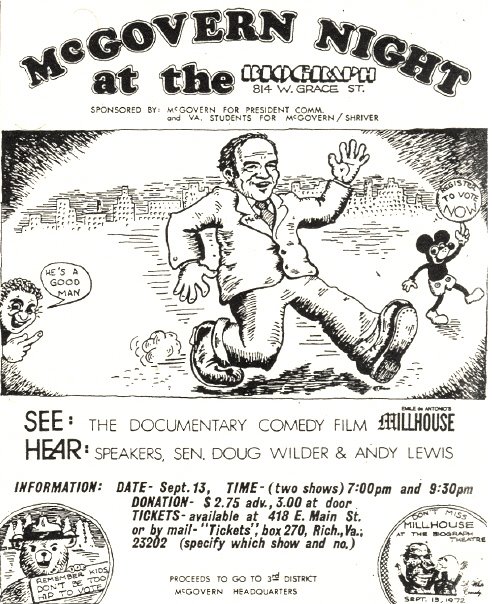
This is a handbill I did for a McGovern fundraiser at the Biograph Theatre, a Fan District repertory cinema I managed, 1972-83. With the McGovern caricature I deliberately imitated R. Crumb's keep-on-truckin' guy style, trying to appeal to hippies.
Looking back on that election and my support for McGovern, I've never been happier to vote for a presidential candidate.
Friday, October 19, 2012

Thursday, October 18, 2012
Scoring the Second Debate
On Tues., Oct. 16, the second presidential debate took place on the
Hofstra University campus in Hempstead, N.Y. It will likely be
remembered for the tense confrontation over Libya, when both the
Republican Mitt Romney and the Democrat Barack Obama plainly revealed
what scant admiration they have for one another.
Both men were well aware they could not allow the viewing audience to perceive from their words or demeanor that they were being dominated by the other guy. At times that prickly aspect of the hour-and-a-half of questioning, answering and posturing put the moderator, Candy Crowley, in a position something like that of a put upon referee for an athletic competition.
Depending on one’s point of view, Crowley either did a good job with a tough assignment, or the CNN political reporter overstepped her bounds as moderator.
As a 15-round boxing match, roughly with 15 questions, I had it scored with Obama winning nine rounds, Romney winning three rounds, with three rounds even.
The instant polls I've seen today found in Obama’s favor, too: Reuters had it Obama 48 percent, Romney 33 percent; CBS had it Obama 37 percent, Romney 30 percent; CNN had it Obama 46 percent, Romney 39 percent.
The debate’s noteworthy Libya moment had Romney saying Obama and his administration waited a couple of weeks to label the killing of Ambassador Chris Stevens and three other Americans on Tues., Sept. 11, as a terrorist act.
Obama pounced on the opportunity and corrected Romney. In his defense Obama pointed to his own comments on the day after the incident: “The United States condemns in the strongest terms this outrageous and shocking attack ... no acts of terror will ever shake the resolve of this great nation."
Nonetheless, Romney challenged the veracity of his opponent and then Crowley spoke up to say the president was right about what he had said, even if at the time there was still considerable confusion about actually happened in Benghazi.
Obama also bristled at Romney’s suggestion that politics somehow had played into the scenario, and he chastised the former Massachusetts governor that it was “offensive” for him to make such insinuations.
Romney never explained why it is so important for the White House to rush to label every act of violence in the world as terrorism, or something else, before all the facts have been studied.
Both candidates ducked some questions. Both candidates milled around uncomfortably on their feet. At times the stage didn’t seem big enough for both of them.
Romney’s best moments were spent talking about the need to create more jobs, energy policy and tax cuts.
Obama’s best moments were spent talking about saving the automobile industry, equality for women in the workplace and foreign policy.
Complaining about how bad a ref was is what sports fans who are disappointed with the results of a game do. The fans of the winners of the game don't usually have much to say about referees.
Both men were well aware they could not allow the viewing audience to perceive from their words or demeanor that they were being dominated by the other guy. At times that prickly aspect of the hour-and-a-half of questioning, answering and posturing put the moderator, Candy Crowley, in a position something like that of a put upon referee for an athletic competition.
Depending on one’s point of view, Crowley either did a good job with a tough assignment, or the CNN political reporter overstepped her bounds as moderator.
As a 15-round boxing match, roughly with 15 questions, I had it scored with Obama winning nine rounds, Romney winning three rounds, with three rounds even.
The instant polls I've seen today found in Obama’s favor, too: Reuters had it Obama 48 percent, Romney 33 percent; CBS had it Obama 37 percent, Romney 30 percent; CNN had it Obama 46 percent, Romney 39 percent.
The debate’s noteworthy Libya moment had Romney saying Obama and his administration waited a couple of weeks to label the killing of Ambassador Chris Stevens and three other Americans on Tues., Sept. 11, as a terrorist act.
Obama pounced on the opportunity and corrected Romney. In his defense Obama pointed to his own comments on the day after the incident: “The United States condemns in the strongest terms this outrageous and shocking attack ... no acts of terror will ever shake the resolve of this great nation."
Nonetheless, Romney challenged the veracity of his opponent and then Crowley spoke up to say the president was right about what he had said, even if at the time there was still considerable confusion about actually happened in Benghazi.
Obama also bristled at Romney’s suggestion that politics somehow had played into the scenario, and he chastised the former Massachusetts governor that it was “offensive” for him to make such insinuations.
Romney never explained why it is so important for the White House to rush to label every act of violence in the world as terrorism, or something else, before all the facts have been studied.
Both candidates ducked some questions. Both candidates milled around uncomfortably on their feet. At times the stage didn’t seem big enough for both of them.
Romney’s best moments were spent talking about the need to create more jobs, energy policy and tax cuts.
Obama’s best moments were spent talking about saving the automobile industry, equality for women in the workplace and foreign policy.
Complaining about how bad a ref was is what sports fans who are disappointed with the results of a game do. The fans of the winners of the game don't usually have much to say about referees.
Friday, October 12, 2012
Technology and Moving Pictures

Click here to read “E Street and Bethesda Row Theaters Convert to All-Digital Projection.”
Yes, the distinct sound of a strip of film winding its way through a projector’s gears, past the light source, past the sound head, is becoming a thing of the past. With digital movies there are no reels of film. Which reminds me of another change that was underway in movie theater booths from coast-to-coast, some 40 years ago.
In the fall of 1974 Richmond's Biograph Theatre, which I managed at the time, closed down for a month to be converted into a twin cinema. With construction workers toiling 24 hours a day that accomplishment remains a story of extremes, all to itself. Some of them were gobbling up white crosses like they were Sno-Caps or Jujyfruits. The middle-of-the-night Liar's Poker games with 15 guys playing were outrageous.
After the construction work was completed, with two booths and a hallway between them, automating the change-overs from one 35mm projector to the other was essential to controlling costs. Among other things that necessitated switching to Xenon lamps -- high intensity bulbs that could be ignited by switches -- to replace our out-of-date, manually-operated carbon arc lamps.
On the day the exchange was made I got to see the same scene projected onto the screen with the two light sources. The light from the old system, which used two burning carbon rods, was whiter and gave the picture more depth and sparkle. The Xenon light was slightly yellow and had a flattening effect on the image.
So when cranky old folks tell you the movies looked better in their salad days, don’t roll your eyes. There’s actually a good reason for making that claim.
Once again, technology is in the process of changing the film exhibition business. In theory, by cutting costs in the long run, it's going to save some movie houses. That, while this change will surely force the shuttering of others that won't be able to keep up with the trend.
Same as it ever was ... the show must go on.
Wednesday, October 10, 2012
First Big Bird, then what?

But remember, lots of Republicans also regard CBS, NBC and ABC as tools of the left; Reuters and the Associated Press are seen through a similar prism. So defunding PBS is more than just a craving to muzzle another voice that doesn’t adhere to rightwing dogma.
Stifling Big Bird is also about seeing public education itself as a liberal institution dominated by socialists.
Underlying that narrow-minded perspective, it's about wanting to force-feed the proper ideology and religion into what's taught to children. That, at the expense of an education based on truth and reality. At the visceral level, it's also about hating unionized teachers and hating the science of elitists.
Many Republicans today don’t want to pay a nickel for the education of other citizens’ children, because they don’t believe in universal public education. The push for vouchers that would facilitate parents sending their children to private schools, by taking their tax money out of the system, has been part of a concerted effort to siphon off funding for public education.
After all, public education is pure socialism.
What's next?
The end of public parks? Private roads for everyone? No more publicly owned fire departments?
Monday, October 08, 2012
All Shook Up

“Well, I think you hit a reset button for the fall campaign,” Fehrnstrom said. “Everything changes. It's almost like an Etch-A- Sketch. You can kind of shake it up and we start all over again.”
Much to the delight of the press, in the course of the first presidential debate Romney shook it up.
In doing so, Romney pivoted toward the center, much as Fehrnstrom told us he would. To his credit, Romney’s salesmanship of his new talking points was on the money. Post-debate polls suggest some undecided voters may have bought what he was selling. Maybe that's true, for the time being. What his salesmanship surely did was stoke Republicans' enthusiasm.
On the other hand, Barack Obama’s presentation was lackluster, at best. Whether he was flabbergasted by his opponent’s sudden changes in his positions, or he and his strategists had decided in advance not to attack Romney -- either way -- the president’s performance didn’t serve his cause.
The Romney from the Republican debates and the campaign trail was not much in evidence in Denver. October's Romney didn’t try to bet Obama $10,000. This time Romney didn't say: “No one’s ever asked to see my birth certificate.” He didn’t say: “I like being able to fire people.” He didn’t say: “Corporations are people, my friend … of course they are.” And, he certainly didn’t say: “I was a severely conservative Republican governor.”
But a condescending Romney stood behind a podium, faced Obama and did say: “Look, I have five boys, I'm used to people saying something that isn't always true and keep on saying it hoping ultimately I will believe it.”
After Romney’s debate-winning, Etch-A-Sketching denial of his longstanding tax plan and much of what he had been repeating on the campaign trail for months, we know more about how his five sons came by their penchant for telling lies.
Romney’s debate strategy was a gamble aimed at undecided voters. It had two prongs: Romney figured the ultra conservatives now have nowhere else to go, so they won‘t abandon him for abruptly changing a few positions at this late date. Secondly, he figured most undecided voters haven’t been paying much attention, so they wouldn’t notice that he was flip-flopping, once again.
Moreover, the day after the debate, Romney guessed that undecideds wouldn’t care so much if Democrats and left-leaning pundits call him out on his latest flip-flopping episode, because to the undecideds it would sound like more boring spin doctor noise ... like, so what?
Romney couldn’t have counted on Obama’s passiveness on stage in Denver. That must have been a welcomed bonus. But it was one debate. If Obama repeats that same bemused reaction to what Romney says on stage on October 16 in Hempstead, N.Y., then the president’s bid for reelection will be in a lot more trouble than it is today.
Romney has now demonstrated he is a good salesman. For the time being, he has halted what had the appearance of a death spiral. We already knew Obama is a good writer, which has been largely responsible for his wordsmith reputation. Before October runs its course, we'll have a better idea which candidate is actually the better debater.
On Election Day, November 6, we'll find out how much that matters to all the eligible voters who vote.
-- Words and art by F.T. Rea
Saturday, October 06, 2012
My All-Time All-Star Baseball Team

Ted Williams
Last night, playing on their home field, the Atlanta Braves lost Major League Baseball’s first-ever Wild Card Playoff Game. The St. Louis Cardinals won it by a score of 6-to-3. Who knew about baseball's outfield fly rule?
Yes, much has been/will be said about that game, which seemed at times like an episode of Twilight Zone. And, that’s all I have to say about Chipper Jones' last game in a Braves uniform.
Instead, I’m going to make a list of my favorite all-time team. It includes a player at each defensive position and two pitchers -- one righthander and a southpaw. None of them are active players. I saw all of them play on television. Those on my list were great players, but the reason they made the cut, over others perhaps just as deserving, is that I liked their style, the way they carried themselves as they played the game.
The 10 men on the list aren’t being offered as model citizens, or even nice guys. Hey, they were baseball players! They are simply my favorites at their positions.
LHP: Sandy Koufax
RHP: Greg Maddux
C: Yogi Berra
1B: Eddie Murray
2B: Ryne Sandberg
3B: Eddie Mathews
SS: Ozzie Smith
LF: Ted Williams
CF: Willie Mays
RF: Roberto Clemente
-- Hat-tip to Mac Calhoun for "outfield fly rule."
Thursday, October 04, 2012
Presidential Debate Analysis
Whatever metaphor you prefer, you have to remember that winning a debate is not the ultimate goal. Winning the election is.
However, in the debate in Denver, Mitt Romney was facing a mission quite different from that of his opponent. After a summer of stumbles and gaffes that concluded with a convention that fizzled, in September Romney’s campaign looked to be falling into a circling pattern indicative of a death spiral. The recent release of his telling 47 percent tape only tightened the nose-diving spiral.
In desperation, on October 3rd Romney knew he had to do something to change the momentum. He had to take a big chance with some freshly scripted lines ... perhaps pivoting-to-the-middle lines that could outrage his most strident Tea Party backers.
In contrast, Barack Obama's mission was to avoid making a big mistake by falling for a gambit.
As it played out last night, Romney obviously wanted to tie Obama up with calling out his Etch-A-Sketch lies, which would have left little time for anything else. Romney wanted to force Obama to call him a liar, or a flip-flopper. Obama was smart not to take the bait that could have made him look like a scolding negative campaigner.
Instead, Obama played the game like a guy who was way ahead on points, and would be content to let the Thursday morning quarterbacks and outraged pundits do the fact-checking and hyperventilating.
That Obama allowed his opponent to be the aggressor and perhaps breathe new life into his campaign was disappointing to many Democrats. Notably, MSNBC’s primetime roster of lefty pundits acted like they had been abruptly jilted, left alone and in tears at the alter.
If Romney wins the election, no doubt, his miracle comeback will be traced back to winning the first presidential debate. If he loses, the bad reviews of Obama's performance will rate no more than a short paragraph in the history of the Romney vs. Obama horse race across the nation's metaphorical countryside.
Satisfying all the Chris Matthews and Rachel Maddow fans who expected to see Romney’s ears get pinned back was not a priority for the front-running incumbent. It's not important to the president whether cable news channels get the ratings-enhancing, nose-to-nose horse race they crave.
Obama is smart enough to know he doesn't have to say everything that ought to be said about Romney's tactics. That will become more obvious in the days ahead.
If this was a championship boxing match Obama had a comfortable lead and Romney needed an 11th- or 12th-round knockout to win. Last night was not a knock out.
So, Democrats who are worried about the sky falling should take a dose of whatever medicine they use to soothe their roiling anxiety. And, they should stand aside to let the Republicans crow and strut their premature jubilation. After all, politics-wise, it's the first good day they've had in a while.
If it was a large-stakes poker game, Obama deliberately lost a hand with a small pot, in order to set up a chump for a subsequent hand, when all the chips will be on the line.
-- 30 --
Monday, September 24, 2012
That familiar smelling purpose
History will cast a shameful light on the GOP’s coast-to-coast effort to suppress the vote in 2012. After the books are published that will document who exactly launched the campaign, who financed it and under whose auspices it was coordinated, the low-road strategy’s chief sponsors will be appreciated in the historical context they deserve.
Among other things they are the racist Dixiecrats of today, trying to suppress the voting of ethnic groups they know their white constituents fear and despise. The ghost of flinty Strom Thurmond walks in our midst.
Beyond that level of skullduggery, today’s rank and file Republicans, who are parroting rightwing talking points about preventing widespread voter fraud -- a phenomenon that plainly doesn’t exist -- will find themselves being compared to their counterparts in the Jim Crow Era, too.
Same as it ever was: It’s still about race and class.
Its familiar smelling purpose is to hold onto power in a country that is changing too fast to please today‘s throwbacks, who happily turn their deaf ears to the better angels of our times.
Among other things they are the racist Dixiecrats of today, trying to suppress the voting of ethnic groups they know their white constituents fear and despise. The ghost of flinty Strom Thurmond walks in our midst.
Beyond that level of skullduggery, today’s rank and file Republicans, who are parroting rightwing talking points about preventing widespread voter fraud -- a phenomenon that plainly doesn’t exist -- will find themselves being compared to their counterparts in the Jim Crow Era, too.
- The white folks who took picnic lunches to a public lynching.
- The white citizens who watched approvingly from Southern sidewalks, as white cops bludgeoned and fire-hosed black civil rights demonstrators in the streets.
- The white parents all over the commonwealth who yanked their children out of public schools, when Gov. J. Lindsay Almond couldn’t deliver on his campaign promise to prevent desegregation from being imposed on public education on Virginia.
Same as it ever was: It’s still about race and class.
Its familiar smelling purpose is to hold onto power in a country that is changing too fast to please today‘s throwbacks, who happily turn their deaf ears to the better angels of our times.
Friday, September 21, 2012
Gaffes, Lies and Expectations
The year started with high expectations for Republicans. After their gains in 2010, they expected 2012 would be another good a year for GOP candidates. Emboldened by the continuing gloomy forecasts about the economy, they expected to capture both the U.S. Senate and the White House.
Then came the cold weather primaries with too many debates. Every other week Mitt Romney, the frontrunner, was assailed by his opponents. Although Romney survived the primary process, owing greatly to his war chest, as spring bloomed it became clear that he was not the first choice for at least two-thirds of his own party.
After crushing each of his fellow clown-car occupants, one by one, then came Romney’s summertime campaign, with him driving said car. That became a slow motion disaster, based largely on torturing the truth, and marked repeatedly by gaffes.
To finish off the season, the GOP staged its convention in Tampa. That confab will be remembered mostly for having a theme based on yet another out-of-context prevarication -- We Built It -- and the Eastwood empty chair skit, which was so strange it created a whole new category of campaign blundering.
What happened to the Republicans' sure thing in 2012?
Could it be that the public has noticed that when it comes to politics, the shape-shifting Romney seems to have no scruples or core beliefs? Could it be that voters in several states have noticed that their Republican-controlled legislatures have been pursuing a coordinated war on women, unions, seniors, students, gays, immigrants and the environment?
With a little over five weeks until Election Day, Romney’s campaign appears to be in the early wide turns of a death spiral. This trend seems to be affecting the races in the states, too.
Although it is still possible for something to come along and change that momentum, because in politics almost anything is possible, at this writing it’s an understatement to say that Republicans have stepped on their own dangling hubris and inflicted injuries upon themselves.
Speaking of expectations, could it be that in 2012 dark money can’t necessarily buy a presidency?
Then came the cold weather primaries with too many debates. Every other week Mitt Romney, the frontrunner, was assailed by his opponents. Although Romney survived the primary process, owing greatly to his war chest, as spring bloomed it became clear that he was not the first choice for at least two-thirds of his own party.
After crushing each of his fellow clown-car occupants, one by one, then came Romney’s summertime campaign, with him driving said car. That became a slow motion disaster, based largely on torturing the truth, and marked repeatedly by gaffes.
To finish off the season, the GOP staged its convention in Tampa. That confab will be remembered mostly for having a theme based on yet another out-of-context prevarication -- We Built It -- and the Eastwood empty chair skit, which was so strange it created a whole new category of campaign blundering.
What happened to the Republicans' sure thing in 2012?
Could it be that the public has noticed that when it comes to politics, the shape-shifting Romney seems to have no scruples or core beliefs? Could it be that voters in several states have noticed that their Republican-controlled legislatures have been pursuing a coordinated war on women, unions, seniors, students, gays, immigrants and the environment?
With a little over five weeks until Election Day, Romney’s campaign appears to be in the early wide turns of a death spiral. This trend seems to be affecting the races in the states, too.
Although it is still possible for something to come along and change that momentum, because in politics almost anything is possible, at this writing it’s an understatement to say that Republicans have stepped on their own dangling hubris and inflicted injuries upon themselves.
Speaking of expectations, could it be that in 2012 dark money can’t necessarily buy a presidency?
Wednesday, September 19, 2012
Diradour vs. Samuels: About Arts and Entertainment
One of the liveliest contests in local politics this fall is playing out
in Richmond’s Second District councilmanic race. The district includes
most of the Fan District, all of Scott’s Addition, some near-in aspects
of Northside and most of the artsy blocks
of the official Arts and Cultural District.
The incumbent is Charles Samuels, 36, an attorney. The challenger is Charlie Diradour, 48, a real estate developer/landlord.
Both men are members of the Democratic Party. Both have been active in the Fan District Association. Both have had a lot to say about Richmond’s arts and entertainment scene. Both have raised enough money to conduct serious campaigns, no one should be surprised if the race stays close all the way.
In August, via telephone and email, the two busy candidates agreed to answer questions about local government’s interaction with arts and entertainment.
Question: Are you happy or unhappy with the City of Richmond’s current laws that seek to control noise emanating from entertainment venues, restaurants, happenings at art galleries, etc.? Please explain what you plan to do about this issue, if anything, should you be elected.
Diradour: The noise ordinance is a great concept. The ordinance, however was poorly written. In fact the first ordinance as passed by Council was deemed unconstitutional. For a city as alive as RVA, we need to consider that noise is part of life in an active social community.
If I am elected, I will bring business owners, residents, The Richmond Police Department, and attorneys together to craft a new ordinance that better reflects the needs of our community. Noise pollution is one thing, but stifling arts and entertainment is quite another.
Samuels: As the member of Council who drafted and introduced the measure to limit noise, I feel it is about the best that we could do in terms of balancing the quality of life rights of all parties, specifically the right to have fun and the right to the peaceful enjoyment of your home.
Noise emanating from commercial and business establishments are not governed by the current noise ordinance (unless they are heard inside multi-unit dwellings or on residential single unit dwellings). However, there have been zoning laws on the books for decades that regulate noise from businesses in some zones. As we learned during the drafting process of the current sound control ordinance, there are always ways to improve ordinances like this, but I’m proud that community leaders, stakeholders and residents came together to make it work in the end. I am certainly open to tweaking it if it can be improved.
Analysis: Diradour seems to get it when he says “noise is part of life” in the city. How he might get “business owners, residents,” etc., to all agree on where to draw the line on what’s acceptable in the way of noise is another matter. No doubt, Samuels was trying to do something along those lines, but then it got complicated…
There are many quiet neighborhoods in Richmond. Others less so. Most Fan District residents, who’ve lived with its shops, offices, schools, busy sidewalks and streets, and its bars, have grown accustomed to what noise routinely exists in their neighborhood. Trying to make the Fan or the Arts and Cultural District as quiet as Windsor Farms won’t improve Richmond.
Noise has to be judged in context. A city cop ought to be able to determine whether an offensive noise constitutes disorderly conduct within the moment’s context. A noise patrol searching for bad decibels isn’t going to make Richmond a better city, either.
Question: Are you in favor of abolishing Richmond’s seven percent admissions tax? If “yes,” what is wrong with the tax? If, “no,” why should it remain on the books? If elected, what, if anything, do you plan to do about this issue next year?
Diradour: The 7% admissions tax is punitive in it's nature, in that it keeps small businesses from opening and, in fact, may indeed be a reason for some to have closed. Often, one hears the argument that the tax is borne by those who come from outside RVA's boundaries and is therefore a tax that doesn't effect city dwellers. I would make the argument, that lost revenue due to what amounts to a doubling down of the gross receipts tax is weighing down our arts and entertainment communities. I would vote to abolish it.
Samuels: Yes, but local government revenues are down substantially due to significant cutbacks in state funding and declining real estate revenues. I am not convinced we can afford to cut one source of revenues without replacing those dollars from another source. The admissions tax is much like the City’s meals tax. Only customers of entertainment venues pay it. Yes, it adds to the total cost of the experience, but it is not paid by the host or promoter, it is part of the ticket cost paid by guests. Interestingly, the City may provide a lower rate for non-government owned civic centers, stadiums or amphitheaters, but there is no authority regarding movie theaters, theaters or other venues. I am also considering returning to the General Assembly to lobby to address this issue.
How much does it actually account for? The admissions tax city wide accounts for .4% of tax revenue for 16 cities. Richmond is below the median and collects approximately 1.2 – 2 million from this tax. The median admissions tax rate for cities in Virginia is 7.5% with a maximum of 10% in 7 of those cities.
Analysis: Diradour says he will vote to abolish the admissions tax. Yet, while he seems to know it should go, it’s less clear by his answer why he thinks so.
When Samuels says the admissions tax is “much like the meals tax,” he reveals a lack of understanding of how those two very different taxes work. As it actually plays out, in effect, the hosts and promoters do pay the tax.
The public is mostly unaware that an admissions tax has been included in the price of a ticket. With the meals tax the customers can see the tax on their checks, it isn’t built into the price listed on the menu.
Taxes on meals are collected in all jurisdictions, the percentage varies. Samuels doesn’t mention that the surrounding counties, Chesterfield and Henrico, don’t have an admissions tax, which puts their theaters at a marked advantage over theaters in the city.
If a theater in Henrico and one in Richmond take in the same amount on a day’s gross receipts at the box office -- where the ticket price was the same -- the venue in the city yields seven percent less to its owner and the movie’s distributor.
Charlottesville doesn’t have such an admissions tax, either. Which is a significant reason why that particular city’s live music scene is thriving.
Note: In conversations prior to receiving this set of questions, Diradour seemed much more interested in finding a way to get rid of the admissions tax than did Samuels. The incumbent was less impressed with the notion that doing away with that one tax would spawn new streams of revenue for the City, to more than make up for what is now being collected on ticket sales.
Question: Beyond what’s already been covered, what do you think City Hall ought to do to help those who work in Richmond’s entertainment industry to make a better living? And, what measures can the next council take to encourage more privately-financed show biz venues to open in this city, initiatives that you will support?
Diradour: If anything, The City needs to support artists by creating tax incentivized live/work spaces in The Arts District. The creative class will help bring RVA back. According to Richard Florida, Author of The Rise Of The Creative Class, 40 million Americans create for a living. Creativity is found in the sciences, arts, trades, and a broad spectrum of other financial endeavors. The creative class has an immense impact on cities, as they choose to live and work in an environment that fosters their best opportunity for success.
Samuels: I was active in lobbying the General Assembly to win approval for localities to create more than one Arts & Culture Districts and I wrote the City’s initial Arts & Culture District ordinance. I am pleased that the expanded district that was ultimately approved includes my original boundaries as its core, with increased incentives to encourage private sector initiatives and development.
Aside from reducing City government waste, I want to focus on ways the City can encourage job creation. We have the ability to create additional Arts & Culture District and to use that a template to create Tourism District(s). I also want to pursue exempting new qualifying businesses from the BPOL taxes in revenue neutral way. That would certainly benefit newcomers to our entertainment industry and all industries. Job creation is key.
But in addition to the Art and Culture ordinance I drafted, I also wrote and introduced the nightclub licensing paper that was approved by my colleagues last year.
Admittedly, Council got some push-back on this issue, but after a string of violent crimes and deaths near clubs in our City, something had to be done. The deaths of young people that just went out to have a good time is not an appealing part of a nightclub area – it actually discourages many from going there. I’m not opposed to nightlife. I’m trying to stop night death.
And this ordinance has worked. Violent crime is down around these previously dangerous areas in the Bottom, and I am further convinced that this measure has forced nightclubs to take better responsibility for their patrons as they leave their premises. Having safer streets and better accountability can only further enhance the entertainment industry in Richmond.
Analysis: Both guys see the need for crafting a better noise ordinance, while they may disagree on where to draw the line for too loud.
Samuels seems more interested in having the local government closely monitoring the nightlife scene than does Diradour. One has to wonder whether “nightclub licensing” will really have the long-term positive effect on Richmond’s crime rate that Samuels suggests it has, to date. What such oversight could do to address any of the violence embedded in today’s culture isn’t clear.
Samuels wants to wait for the economy to improve before trying to do away with the admissions tax. But in good times, over the last 40 years, nobody in City Hall has talked much about getting rid of that tax.
Samuels shrugs off what show business insiders say about how more shows of all kinds would come to Richmond without that tax in place. They say Richmond needs to wise up to what cities like Nashville and Austin already know -- admission taxes are bad business, because they stifle the growth of an entertainment scene. Those insiders aren’t saying all taxes are bad, or too high; their complaint is just about one bad tax.
Diradour’s mention of Dr. Richard Florida will please some of the people who have had a direct hand in establishing Richmond’s Arts and Cultural District -- the pioneers/the creative class.
Samuels’ mention of lobbying the General Assembly to help the Arts and Cultural District will be seen in a favorable light by the developers who are investing in the area’s future -- the second wave/the money.
To be located at Belvidere and Broad Sts., VCU’s new Institute for Contemporary Art will surely have a positive ripple effect on the surrounding neighborhood, especially the Arts and Cultural District to the east. Adding to what’s already going on in that area, the new galleries, shops, theaters and restaurants currently in various planning stages will eventually open to bring more tourists into the middle of the city.
Now City Hall is on the arts and entertainment bandwagon and next year either Diradour or Samuels will be trying to speak on behalf of the best hopes for the Arts and Cultural District’s future.
The winner of their contest will have a lot to say about whether the new bandwagon stays on the road to brighter days for Downtown Richmond, or it breaks an axle on a familiar pothole.
The incumbent is Charles Samuels, 36, an attorney. The challenger is Charlie Diradour, 48, a real estate developer/landlord.
Both men are members of the Democratic Party. Both have been active in the Fan District Association. Both have had a lot to say about Richmond’s arts and entertainment scene. Both have raised enough money to conduct serious campaigns, no one should be surprised if the race stays close all the way.
In August, via telephone and email, the two busy candidates agreed to answer questions about local government’s interaction with arts and entertainment.
Question: Are you happy or unhappy with the City of Richmond’s current laws that seek to control noise emanating from entertainment venues, restaurants, happenings at art galleries, etc.? Please explain what you plan to do about this issue, if anything, should you be elected.
Diradour: The noise ordinance is a great concept. The ordinance, however was poorly written. In fact the first ordinance as passed by Council was deemed unconstitutional. For a city as alive as RVA, we need to consider that noise is part of life in an active social community.
If I am elected, I will bring business owners, residents, The Richmond Police Department, and attorneys together to craft a new ordinance that better reflects the needs of our community. Noise pollution is one thing, but stifling arts and entertainment is quite another.
Samuels: As the member of Council who drafted and introduced the measure to limit noise, I feel it is about the best that we could do in terms of balancing the quality of life rights of all parties, specifically the right to have fun and the right to the peaceful enjoyment of your home.
Noise emanating from commercial and business establishments are not governed by the current noise ordinance (unless they are heard inside multi-unit dwellings or on residential single unit dwellings). However, there have been zoning laws on the books for decades that regulate noise from businesses in some zones. As we learned during the drafting process of the current sound control ordinance, there are always ways to improve ordinances like this, but I’m proud that community leaders, stakeholders and residents came together to make it work in the end. I am certainly open to tweaking it if it can be improved.
Analysis: Diradour seems to get it when he says “noise is part of life” in the city. How he might get “business owners, residents,” etc., to all agree on where to draw the line on what’s acceptable in the way of noise is another matter. No doubt, Samuels was trying to do something along those lines, but then it got complicated…
There are many quiet neighborhoods in Richmond. Others less so. Most Fan District residents, who’ve lived with its shops, offices, schools, busy sidewalks and streets, and its bars, have grown accustomed to what noise routinely exists in their neighborhood. Trying to make the Fan or the Arts and Cultural District as quiet as Windsor Farms won’t improve Richmond.
Noise has to be judged in context. A city cop ought to be able to determine whether an offensive noise constitutes disorderly conduct within the moment’s context. A noise patrol searching for bad decibels isn’t going to make Richmond a better city, either.
Question: Are you in favor of abolishing Richmond’s seven percent admissions tax? If “yes,” what is wrong with the tax? If, “no,” why should it remain on the books? If elected, what, if anything, do you plan to do about this issue next year?
Diradour: The 7% admissions tax is punitive in it's nature, in that it keeps small businesses from opening and, in fact, may indeed be a reason for some to have closed. Often, one hears the argument that the tax is borne by those who come from outside RVA's boundaries and is therefore a tax that doesn't effect city dwellers. I would make the argument, that lost revenue due to what amounts to a doubling down of the gross receipts tax is weighing down our arts and entertainment communities. I would vote to abolish it.
Samuels: Yes, but local government revenues are down substantially due to significant cutbacks in state funding and declining real estate revenues. I am not convinced we can afford to cut one source of revenues without replacing those dollars from another source. The admissions tax is much like the City’s meals tax. Only customers of entertainment venues pay it. Yes, it adds to the total cost of the experience, but it is not paid by the host or promoter, it is part of the ticket cost paid by guests. Interestingly, the City may provide a lower rate for non-government owned civic centers, stadiums or amphitheaters, but there is no authority regarding movie theaters, theaters or other venues. I am also considering returning to the General Assembly to lobby to address this issue.
How much does it actually account for? The admissions tax city wide accounts for .4% of tax revenue for 16 cities. Richmond is below the median and collects approximately 1.2 – 2 million from this tax. The median admissions tax rate for cities in Virginia is 7.5% with a maximum of 10% in 7 of those cities.
Analysis: Diradour says he will vote to abolish the admissions tax. Yet, while he seems to know it should go, it’s less clear by his answer why he thinks so.
When Samuels says the admissions tax is “much like the meals tax,” he reveals a lack of understanding of how those two very different taxes work. As it actually plays out, in effect, the hosts and promoters do pay the tax.
The public is mostly unaware that an admissions tax has been included in the price of a ticket. With the meals tax the customers can see the tax on their checks, it isn’t built into the price listed on the menu.
Taxes on meals are collected in all jurisdictions, the percentage varies. Samuels doesn’t mention that the surrounding counties, Chesterfield and Henrico, don’t have an admissions tax, which puts their theaters at a marked advantage over theaters in the city.
If a theater in Henrico and one in Richmond take in the same amount on a day’s gross receipts at the box office -- where the ticket price was the same -- the venue in the city yields seven percent less to its owner and the movie’s distributor.
Charlottesville doesn’t have such an admissions tax, either. Which is a significant reason why that particular city’s live music scene is thriving.
Note: In conversations prior to receiving this set of questions, Diradour seemed much more interested in finding a way to get rid of the admissions tax than did Samuels. The incumbent was less impressed with the notion that doing away with that one tax would spawn new streams of revenue for the City, to more than make up for what is now being collected on ticket sales.
Question: Beyond what’s already been covered, what do you think City Hall ought to do to help those who work in Richmond’s entertainment industry to make a better living? And, what measures can the next council take to encourage more privately-financed show biz venues to open in this city, initiatives that you will support?
Diradour: If anything, The City needs to support artists by creating tax incentivized live/work spaces in The Arts District. The creative class will help bring RVA back. According to Richard Florida, Author of The Rise Of The Creative Class, 40 million Americans create for a living. Creativity is found in the sciences, arts, trades, and a broad spectrum of other financial endeavors. The creative class has an immense impact on cities, as they choose to live and work in an environment that fosters their best opportunity for success.
Samuels: I was active in lobbying the General Assembly to win approval for localities to create more than one Arts & Culture Districts and I wrote the City’s initial Arts & Culture District ordinance. I am pleased that the expanded district that was ultimately approved includes my original boundaries as its core, with increased incentives to encourage private sector initiatives and development.
Aside from reducing City government waste, I want to focus on ways the City can encourage job creation. We have the ability to create additional Arts & Culture District and to use that a template to create Tourism District(s). I also want to pursue exempting new qualifying businesses from the BPOL taxes in revenue neutral way. That would certainly benefit newcomers to our entertainment industry and all industries. Job creation is key.
But in addition to the Art and Culture ordinance I drafted, I also wrote and introduced the nightclub licensing paper that was approved by my colleagues last year.
Admittedly, Council got some push-back on this issue, but after a string of violent crimes and deaths near clubs in our City, something had to be done. The deaths of young people that just went out to have a good time is not an appealing part of a nightclub area – it actually discourages many from going there. I’m not opposed to nightlife. I’m trying to stop night death.
And this ordinance has worked. Violent crime is down around these previously dangerous areas in the Bottom, and I am further convinced that this measure has forced nightclubs to take better responsibility for their patrons as they leave their premises. Having safer streets and better accountability can only further enhance the entertainment industry in Richmond.
Analysis: Both guys see the need for crafting a better noise ordinance, while they may disagree on where to draw the line for too loud.
Samuels seems more interested in having the local government closely monitoring the nightlife scene than does Diradour. One has to wonder whether “nightclub licensing” will really have the long-term positive effect on Richmond’s crime rate that Samuels suggests it has, to date. What such oversight could do to address any of the violence embedded in today’s culture isn’t clear.
Samuels wants to wait for the economy to improve before trying to do away with the admissions tax. But in good times, over the last 40 years, nobody in City Hall has talked much about getting rid of that tax.
Samuels shrugs off what show business insiders say about how more shows of all kinds would come to Richmond without that tax in place. They say Richmond needs to wise up to what cities like Nashville and Austin already know -- admission taxes are bad business, because they stifle the growth of an entertainment scene. Those insiders aren’t saying all taxes are bad, or too high; their complaint is just about one bad tax.
Diradour’s mention of Dr. Richard Florida will please some of the people who have had a direct hand in establishing Richmond’s Arts and Cultural District -- the pioneers/the creative class.
Samuels’ mention of lobbying the General Assembly to help the Arts and Cultural District will be seen in a favorable light by the developers who are investing in the area’s future -- the second wave/the money.
To be located at Belvidere and Broad Sts., VCU’s new Institute for Contemporary Art will surely have a positive ripple effect on the surrounding neighborhood, especially the Arts and Cultural District to the east. Adding to what’s already going on in that area, the new galleries, shops, theaters and restaurants currently in various planning stages will eventually open to bring more tourists into the middle of the city.
Now City Hall is on the arts and entertainment bandwagon and next year either Diradour or Samuels will be trying to speak on behalf of the best hopes for the Arts and Cultural District’s future.
The winner of their contest will have a lot to say about whether the new bandwagon stays on the road to brighter days for Downtown Richmond, or it breaks an axle on a familiar pothole.
-- 30 --
Saturday, September 15, 2012
Yesterday’s Certitudes
Using yesterday’s certitudes, too many Democrats and Republicans are still talking about who has been right all along about boilerplate issues. Neither side of such tedious arguments appears to be able to acknowledge the mistakes their own side made over the last quarter century. Mistakes that wasted opportunities and cost money and lives.
Consequently, today, too few voters seem to care about which candidates have learned something worthwhile from those mistakes.
Sorry folks, no matter how far you turn up the volume, merely restating outdated liberal or conservative hokum is not about solving problems. It's not about making a brighter future.
Consequently, today, too few voters seem to care about which candidates have learned something worthwhile from those mistakes.
Sorry folks, no matter how far you turn up the volume, merely restating outdated liberal or conservative hokum is not about solving problems. It's not about making a brighter future.

Tuesday, September 11, 2012
Conventions aren't irrelevant, they’re theater

Political conventions are different things to different people. Primarily, I see them as theater. On a Broadway stage or a Hollywood movie set none of the props are there by accident. Everything was put there for a purpose. The same goes for what the public sees of a national political convention.
You see, dear reader, I’ve been watching the political conventions since 1964, when I was a 16-year-old juvenile delinquent/would-be boy-wonder. I can vividly remember staring at a black-and-white TV and taking notes in a Spiral notebook, as I watched the Republican convention in San Francisco.
That convention took place in the days when such affairs were more fluid, much less scripted than what they‘ve become. Which meant that plenty of the best action in the hall took place in the wee hours. Eventually, Arizona’s Barry Goldwater won the nomination. His slogan was: “In your heart, you know he's right.”
My answer to the question above is, yes, conventions still matter. Beyond the predictable, meticulous polishing of the luster of the ticket, conventions still offer us a look at what both parties would like to believe are their best ideas, their most trustworthy leaders and their up-and-coming stars.
Those who watched the conventions saw what may have been Bill Clinton’s last great speech, perhaps his best ever. And, we surely saw what will be Clint Eastwood’s last appearance at a political convention. And, like all props, the now famous chair was put there for a purpose. We should expect to see the chair's encore on Saturday Night Live.
In one word descriptions, one might say the Republicans elected to present kitsch; the Democrats chose to present boilerplate.
In Tampa there was a list of Republicans who were quite conspicuous by their absence. Neither George W. Bush or Dick Cheney were there. Nor were significant players from the party’s recent past, such as Donald Rumsfeld, Colin Powell or even Sarah Palin (depicted above), which had to disappoint SNL's writers.
What you did have was a series of state governors who all had a personal story to tell about how they, themselves, built their own success; they had all risen up from difficult circumstances. What I took away from that collection of similar stories was that the convention’s theme -- We Built It -- was being reinforced by hungry politicians who, when given the chance, were all happy to brag about themselves.
Curiously, not much was said about Mitt Romney during this aspect of the programming, and the governors' success stories hardly rubbed off on Romney.
What did seem to be in the air was a collective sense of yearning for recapturing what was good about a previous time, certainly before Barack Obama became president. What was less clear is what period of time the Tampa Republicans actually had in mind. Clearly, it was not a call to return to the Bush presidency.
Skipping to the chase, I have to say the Republicans in Tampa were yearning to take the country back to something that never existed. What they seem to want is Ronald Reagan acting as president, but perhaps serving in the time before the start of World War I, when everyone knew their place -- including women -- and people didn't bellyache all the time about their lot in life.
Take-the-country-back Republicans seem to have left Tampa, still dwelling on a gaudy nostalgia that represents mostly imaginary stuff. They’re still pining away for a lost world of dungeons and wizards and flying monkeys, or maybe "The Rocky Horror Picture Show."
To me, this all suggests one word -- “kitsch.”
Moving on to Charlotte, viewers looking for a bold new vision for the future needed to change channels. What they got from the second convention was a thousand little ways in which Democrats are trying to solve real problems ... even if trying is about all they can do. For what it's worth, their slogan this year is "Forward."
What saved the convention for Team Donkey, and probably provided the lift in the polls Obama has received since then, was one huge factor -- the Clinton speech.
Take Clinton’s wonky but lyrical speech out of the middle of the Democratic convention and the main story coming out of Charlotte would have been about a missed opportunity. Without Clinton's words, defining what it is to be a modern Democrat, nothing said from the podium the following night would have saved the convention from being branded as a fizzler.
Still, on live television, anything can happen. So, the symbol of all the Republicans staged for primetime consumption will always be Eastwood’s empty chair. Whereas, the Democrats confab will be remembered for a flight of soaring rhetoric from a party elder.
Between now and November 6th, no amount of dark dollar TV ads can rewrite those snippets of political convention history. Too many viewers saw them unfold, so there isn't time for that much of a rewrite. Moreover, neither of those happenings would have mattered so much had they not taken place live, on stage, at the conventions.
Saturday, September 08, 2012
The dignity of labor and the lack thereof
In spite of what the Mitt Romey’s of the world might like us to believe, simply providing work doesn’t necessarily make the providing entity a glorious benefactor to society. Context matters. Dignity matters.
After all, in our nation’s past, Southern plantation owners provided jobs ... with some rather harsh conditions. In the early 1900’s the sweat shops that worked children all day were not only paying those kids, something -- not much! -- they were making sure those little workers couldn’t get an education, to one day maybe get a better job.
Whenever a job is so time-consuming and low-paying that it literally traps the poverty stricken worker into a brutal treadmill life -- without hope of improvement -- then that job is also a powerful instrument of social control. For some of today’s industries to have a steady supply of the kind of cheap labor they want, it calls for them to make sure there is a permanent starving underclass.
That’s part of what some gigantic corporations are still up to. The largest mining industry and agribusiness corporations come to mind, right away. Dignity for their workers hurts the bottom line.
What could be more at odds with the American Dream than deliberately stifling social mobility, by starving families into accepting that treadmill life? Among other considerations, this recession we're experiencing is about keeping the cost of labor down.
After all, in our nation’s past, Southern plantation owners provided jobs ... with some rather harsh conditions. In the early 1900’s the sweat shops that worked children all day were not only paying those kids, something -- not much! -- they were making sure those little workers couldn’t get an education, to one day maybe get a better job.
Whenever a job is so time-consuming and low-paying that it literally traps the poverty stricken worker into a brutal treadmill life -- without hope of improvement -- then that job is also a powerful instrument of social control. For some of today’s industries to have a steady supply of the kind of cheap labor they want, it calls for them to make sure there is a permanent starving underclass.
That’s part of what some gigantic corporations are still up to. The largest mining industry and agribusiness corporations come to mind, right away. Dignity for their workers hurts the bottom line.
What could be more at odds with the American Dream than deliberately stifling social mobility, by starving families into accepting that treadmill life? Among other considerations, this recession we're experiencing is about keeping the cost of labor down.
Subscribe to:
Comments (Atom)