Tuesday, August 05, 2008

1974: A year of 'change'

Part One

With good reason, there’s been lot of talk about “change” this year; it seems to be in the air. 1974 was a year of big changes. At the time, the most obvious of them had to be the resignation of President Richard Nixon. It took a few years of perspective to grasp that the whole culture actually shifted that year.

Tastes in music, clothes, politics, movies, drugs, and you-name-it, took off in new directions during 1974. Suddenly, social causes were out, socializing/partying was in. Going into the year, no one would have guessed the most popular gesture of group defiance on campus -- the protest march -- would morph into spontaneous gatherings to cheer on naked people as they ran by?

Yet, in the spring of 1974, streaking on college campuses became a national phenomenon.

Richmond’s police chief announced that his officers would not tolerate streakers -- students or not -- running around in the city’s streets, alleys, etc. The VCU police department said if it took place on campus it was a university matter and would be dealt with by its personnel.

Leading up to this point, there had been an escalating series of incidents on or near the VCU campus; police dogs had been set loose in crowds and city cops had been pelted with debris. But those incidents had ties to the subculture, in some ways they were to do with politics.

So, the City’s Finest and what might have been seen as the anti-establishment crowd based in the Fan District had some history leading up to what I saw happen on the 800 block of W. Franklin St., the night of Mar. 19, 1974.

A group of about 50 uniformed policemen stormed in on small motorbikes and in squad cars to arrest streakers. They ended up catching four streakers and then arresting 13 other people. Most of those others were taken from among the peaceful, decidedly apolitical crowd that had been watching the adventure from the sidewalk.

After a lull in the action the cops inexplicably charged from the street into the crowd of maybe 200. Bystanders were dragged into the street. One kid was knocked off of his bicycle and slammed repeatedly against the fender and hood of a police car. Others were beaten with clubs or flashlights. It was a riot -- a police riot.

At the time, I worked at the Biograph Theatre, a block away. While I’ve seen various clashes between policemen and citizens over the years at anti-war demonstrations and a few brawls, what happened that night on Franklin St. was the most violent and out of control behavior I've ever seen from that many uniformed officers of the law.

That’s probably because I didn’t go to the Cherry Blossom Music Festival that unfolded at City Stadium a month later of that year. More about the outdoor music fest that spawned a four-hour riot will appear in Part Two of 1974: A year of 'change.'

In the meantime, click here to read about the streaking incident on VCU's campus. Click here to read about the Cherry Blossom riot and to see a fantastic slideshow at inRich.

This year’s presidential campaign and the spike in the price of oil have been sweeping away many long-held notions. Maybe 2008 will yet launch a new style in cinema, something as startling as the French New Wave of the early ’60s was. Maybe it could set loose a new sound as fresh as bebop or rockabilly were when they were new.

In a year that might see a black man elected president of the United States, who knows what other changes will take place?

Support VPAP

VPAP recently processed its 750,000th transaction. VPAP organizes campaign finance information and makes it available -- free -- to the public. If you value this non-profit service, please consider making a tax-deductible investment in VPAP. Your financial support will help ensure that Virginia has the most transparent elections in the nation.

You can make an online donation with a credit card or send a check to the address below. A special thanks to the individuals and companies that support VPAP.

Please let us know if you have any questions, complaints or concerns. As always, let us know how we can make VPAP.org work better for you.

-- The information above was provided by David M. Poole of The Virginia Public Access Project

Saturday, August 02, 2008

Friday, July 25, 2008

The Handbill War

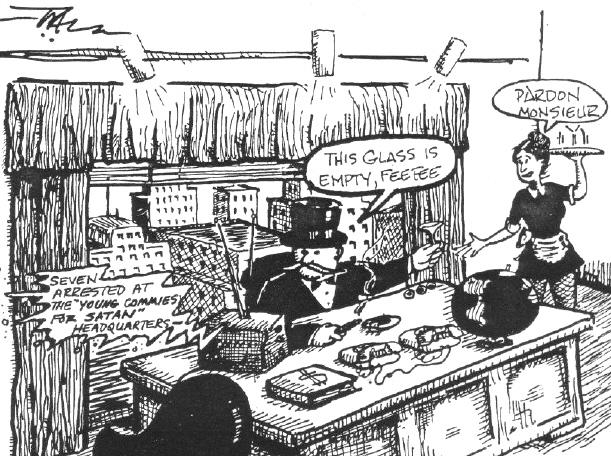
The pen and ink cartoon below was created in 1983 and first published as a handbill posted on utility poles in the commercial sections of the Fan District. Later it ran in SLANT in 1986. That single frame cartoon of mine was part of a five-year campaign waged to fight off the city's anti-handbill laws.

By keeping ordinary things like handbills, cohabitation, gambling, and other "victimless" crimes illegal, it means just about anybody can be harassed by the long arm of the law. But it's the ones with the unfashionable attitudes that feel the boot first.

As the Biograph Theatre's manager, when I was busted in 1982 for posting a handbill that promoted a midnight show ("Atomic Cafe"), it was a bust I deliberately provoked. I wanted to beat The City of Richmond in court.

Laws that the GRTC, politicians and yard sale promoters routinely ignored were suddenly getting guys in bands busted. Perhaps not so coincidently this crackdown happened when the band scene in the Fan District was at an all-time high.

After looking at a hundred choice flyers and listening to expert witnesses, the judge bought my defense and found me not guilty. (For an amusing account of an incident in that trial, click here.) For a while the cops left hand-billers alone.

Then the busts resumed in late-1984. In 1985, SLANT's first cause was to once again frame the battle with The City in a freedom-of-speech context, while insisting the pop scene depended on flyers being posted in such a way, on the people’s utility poles, to exist.

In 1986 an ad hoc group of Fan District artists and musicians formed to pepper The City with a propaganda campaign. In 1987 the local statutes governing handbill-posting in the public way were changed. Essentially, we won.

Freedom of speech prevailed.

Demonstration against war/for impeachement set

The notice below concerns serious matters and I'm pretty sure I agree with most of what the organizers of the event it describes are trying to put forth. But I must also say that staging an anti-war rally in front of Media General's offices seems to be a stretch. Maybe the organizers are hoping it will get them extra publicity if they take their case to the doorstep of the inky mainstream media.

In the past, demonstrations of this nature have been held in Monroe Park. Sometimes the demonstrators would march down to Capitol Square. Those are public places.

Other protests have targeted specific companies for specific grievances, to do with how they did business. So, while blocking the road to Dominion Power might get you arrested, it makes sense to go directly to the people who are making the decisions that the activists want to protest.

Targeting Richmond's local daily newspaper's reporting as the bulls-eye in this case does nothing to bolster the demonstrators calls for peace or impeachment. Instead it seems to be trying to harness a general sentiment against the Richmond Times-Dispatch for leaning to the right with most of what it prints on its Editorial and OpEd pages.

However, I'd rather see this event happen than not happen. So here is the information you need to know to participate/observe:
Notice: Richmond-area residents will gather outside the offices of the Richmond Times-Dispatch to demonstrate their opposition to an attack on Iran and to voice their outrage at the Media General newspaper’s increasingly incendiary stories and headlines about what it is projecting as a near-certain war with Iran.

Protesters will also call for an end to the occupation of Iraq and Afghanistan, as well as the impeachment of President Bush and Vice President Cheney – a move they see as essential to imposing a penalty for the illegal attack on Iraq and to discourage future attacks on Iran or elsewhere.

When: Saturday, July 26, at 1 p.m. (full crowd expected by 1:20 PM)

Where: Outside the offices of the Richmond Times-Dispatch at 300 E. Franklin St.

What: Protesters with signs, banners and noise-makers will call for “No War on Iran,” “Out of Iraq and Afghanistan” and “Impeach Bush and Cheney.” They will also demand the Richmond Times-Dispatch print news and not war propaganda. Speakers will discuss the impact of war on our community. In addition, they will present steps for citizens to take to help stop war and redirect needed resources to meet human needs. Participants will write messages to the media in chalk on the sidewalk.

Who: This rally was initiated by RVA4Peace and is being supported by the Defenders for Freedom, Justice & Equality and the Richmond Peace Education Center.
The information above was provided by RVA4Peace. For more info contact Chris Dorsey, RVA4Peace, (804)564-1491, Christopher.dorsey@verizon.net or Rain Burroughs, Virginia Anti-War Network (804) 240-4206 – rainmadeline@aol.com

Wednesday, July 23, 2008

The Top Five 'Where was Doug' locations?

Since we still don't know – nobody's talking, on the record -- what are the five most likely places Mayor Doug Wilder was on Monday, instead of at the Virginia Civil Rights Memorial unveiling at Capitol Square?

It seems Hizzoner was out of town, doing something his spokesperson Linwood Norman couldn't remember, when asked.

But it was a trip that had been planned for a long time, assured Norman.

Below the reader will find SLANTblog's top five guesses as to where Doug was when the words of Julian Bond and Nikki Giovanni rang out to celebrate the day that told Sen. Harry F. Byrd's statue to get used to its new neighbors on the grounds.

Where was Doug?:
  • In Fredericksburg having important discussions about the Slave Museum project, which can't seem to get off the back burner.
  • In his Charles City County home, Googling for dirt on the familiar list of names that he routinely refuses to appear in the same room with, no matter what the occasion.
  • In an undisclosed small town, talking with people who won't be quoted --- don't take a picture or they will have to break your camera -- about bringing a new minor league baseball team to Richmond.
  • In an undisclosed, Chiocca's-like neighborhood dive, in an undisclosed neighborhood, having a quiet lunch with Patricia Kluge, an old friend who has the dough to finance a righteous art project if she wanted to.
  • In an undisclosed artist's studio, posing for the speculative sketches to be used to make a bronze statue of him for the corner of Meadow St. and Monument Ave.
-- Words and photo by F.T. Rea

Want to change Richmond’s public schools?

Change, even in Richmond, is inevitable.

To back up that claim, one needs only to walk through Capitol Square to see the new Virginia Civil Rights Memorial that was dedicated on July 21, 2008.

The sculpture, by Stanley Bleifeld, is about change. Three of its sides recall of the heroism of those who walked around the Massive Resisters then in power, as they marched toward fair treatment and a better education. The fourth side’s figures suggest changes yet to come.

The 18 figures of the piece are not presented in heroic proportions. They are just slightly larger than life-size and they all stand on a low-rise platform, allowing viewers to stand along side them. In that way the art suggests everyday people, on the level with the rest of us, can be heroes, too.

In 1951, when Barbara Johns led the “walk-out” demonstration at Moton High in Farmville, which the sculpture recognizes, the kids were risking their lives for change. Some of them may not have felt that, as much of the worst violence of the Civil Rights Era was yet to come. Others may have been so caught up in the spirit of the moment, surfing a wave of hope, they didn’t sense how provocative their peaceful gesture might seem to the authorities.

In the presidential campaign now underway Sen. Barack Obama has adopted the word “change” as a one-word slogan. After mocking him, his opponents began to use the very same word in their speeches. It seems change is not only inevitable, sometimes it is more universally welcome than others.

Now everybody is for change, but not necessarily the same changes. Obama has been talking about changes that come from the bottom up. He casts himself as one who would facilitate the sort of improvements people on the bottom -- out of power -- need to have a better life. If he wins and lives up to his lofty campaign rhetoric, he can be expected to then try to affect change from the top down.

To make meaningful changes that get traction it usually takes simultaneous pressure from the top and the bottom. Too much heavy-handed, top downism is asking for a trouble with workers and the underclass, a revolution. Too much bottom up is a revolution.

Unless a sitting governor’s wife had not decided she wanted to put a memorial to Virginia’s Civil Rights heroes in Capitol Square, Bleifeld’s well-executed statement simply would not exist.

The Farmville students' call for change from the bottom up inspired a movement which inspired the artist. But the actual changes in public schools that have attempted to answer that righteous call had to have been made by those in power.

Likewise, the political push and fundraising for the memorial had to be done by those in power.

Back to schools, the extreme emphasis on test results that has loomed over public education in the last decade was a change from the top down. Before the Standards of Learning/No Child Left Behind era, parents weren’t calling for standardized testing to cure the ills of public education.

No, they were calling for better teachers and decent facilities. They still are.

Are our leaders in Richmond today listening to what parents and students say they need from public education? Or, are they busy driving their kids out to their private schools?

Richmond School Board member Carol A.O. Wolf asks, “What will it take to bring Richmond’s black and white middle class back into our public schools?

My best answer to her question is that it will take a sincere effort to change, both from the bottom up and the top down. And, it will take good leadership.

From the podium on Monday morning, before unveiling the monument, Gov. Tim Kaine recalled the photographs of his wife as a girl -- Virginia’s First Lady Anne Holton, with her father, then-Gov. Linwood Holton -- walking into a public school in Richmond. In its time that black and white image was an inspiration to millions looking for a sign of real change.

Now it’s time for Richmond’s political, business and religious leaders to send their children and grandchildren back to public schools. Instead of more studies, they need to be listening to their kids telling them what is really going on in public schools.

Fifty-four years after the Brown vs. Board of Education Decision, isn’t it time for Richmond’s government to guarantee that an honest effort will be made to offer a quality education to children in every neighborhood in town?

Can't we elect fellow citizens to office who will see to it that change becomes our friend?

What will it take? Indeed.

Tuesday, July 22, 2008

Where was Doug?

With all the smiling faces at the Civil Rights monument's unveiling in Capitol Square Monday morning, baking in the bright sunlight, one politician was rather conspicuous by his absence — the nation’s first black governor and Richmond’s lame duck mayor, Doug Wilder.

Hizzoner sure wasn't on the platform with the other elected officials and dignitaries.

Was Wilder watching the proceedings from an air-conditioned penthouse super box? Could he have been in Fredericksburg, tending to Slave Museum matters? Maybe he was in an undisclosed location having secret talks about a new baseball team in Richmond?

Where was Mayor Wilder?

*

Update: The Washington Post wondered, too, as Anita Kumar asked, "Where was Doug Wilder?"

But L. Douglas Wilder, the nation's first elected black governor, who now serves as Richmond's mayor, was noticebly [sic] absent.

"He wanted to be there,'' Wilder spokesman Linwood Norman said later. But, Norman said, Wilder was out of town on a long-planned trip.

Click here to read the entire article.

Norman says Wilder "wanted" to be there. But the Doug Wilder I know usually does what he wants to do, and little else. And, this important unveiling ceremony had been "long-planned," as well. Norman's weak alibi doesn't ring true.

So, I'm left to guess at what would keep Wilder away from the cameras and microphones. After all, he was all over the 1996 Arthur Ashe statue unveiling on Monument Ave. And, he wasn't even an office-holder at the time.

Why would Mayor Wilder blow off the most significant local, public art unveiling of a generation?

With Tobacco Avenue on vacation, who can we turn to for some answers?

Update II: STYLE Weekly also wonders about the missing mayor: Click here.

Monday, July 21, 2008

Civil Rights Memorial unveiling

Today the new Virginia Civil Rights Memorial was unveiled at Capitol Square.

The sculpture by Stanley Bleifeld (at the podium above) includes 18 bronze figures emerging from a block of granite. It sits on the ground, so people can touch it, so tourists and pilgrims can stand beside the figures to pose for photos, so children can play on it.

The ceremony itself was well attended. Poet Nikki Giovanni probably got the biggest applause when she finished her remarks. I hope to locate and publish the text of what she said, but it started with something like, “This is not a poem.” She concluded with “This is a rocket, let’s ride” (at the beginning of the video).

This $2.6 million project began in 2002 with a little girl -- former Gov. Mark Warner’s youngest daughter, Eliza -- asking her mother why there were no statues in Capitol Square honoring women, or the heroes of the Civil Rights Era.

Today the art itself honored the bravery of children in 1951, when a 16-year-old Barbara Johns led a “walk-out” demonstration, protesting the outrageously separate-but-unequal conditions at Moton High School in Farmville.

Warner’s wife, Lisa Collis, spoke today of how much the new monument was about, and for, children. It was Collis who spearheaded this magnificent effort. Looking at her smiling face today, it was hard to think of how she could have done a better job.

For background on this story click here.

Barbara Johns' quote, said of the 1951 students' demonstration, was carved in granite for all children to see -- "It was like reaching for the moon."

Update:

Click here to read Michael Paul Williams on the unveiling ceremony.

-- Words, photos and video by F.T. Rea

Update II:

Click here, then here to watch/listen to the speakers at the ceremony.

Saturday, July 19, 2008

As the R-Braves sink into the sunset

Playing on the road, the Richmond Braves lost to the Buffalo Bisons last night by a score of 16-3. If you really want to know more about that game click here to visit the R-Braves web site.

Writing for the Richmond Times-Dispatch John O'Connor looks at the possibilities for replacing the R-Braves, who are in the process of playing out their last season at The Diamond.
Minor League Baseball's executive vice president [Tim Purpura] said yesterday "about three or four" baseball franchises, all from Class AA and Class A, have filed applications to relocate to Richmond.
Click here to read more.

Also writing for the RT-D, Michael Paul Williams decries the lack of attendance at The Diamond for R-Braves games.

So far this season, the Braves are drawing 1,100 fewer fans than in 2007, when folks weren't exactly flocking to a 12,134-seat ballpark to see a championship team. At an all-time low average paid attendance of 3,875, the home team is last in the International League in attendance and similarly positioned in the hearts and minds of area residents.

Did you check out the fever chart in Thursday's paper on the team's attendance since 1985? Attendance has been in a free fall for much of the past decade. It's not the sort of chart you'd want at the foot of your hospital bed.

Early on this season, officials blamed wet weather for the slack attendance. It turns out ennui, not inclement weather, is keeping fans away in droves.

Click here to read the entire Williams piece.

Williams is right to challenge the Braves management's blaming wet weather for the low attendance numbers. What he missed was how disingenuous that statement was, and what that sort of a statement might indicate about the people behind it.

Let's cut to the chase: For some reason the R-Braves sourpuss general manager, Bruce Baldwin, has been getting a free pass when blame gets assigned for how it came to pass that Richmond lost its Triple A baseball team to an Atlanta suburb.

It was Baldwin who said a few weeks ago that the weather was keeping attendance down, more than it was a matter of disenchantment with the home team.

Well, if Baldwin is still claiming fans aren't staying away because some are unhappy about the team's lame duck status, perhaps his next job should be as a spin doctor for a politician about as popular as Jim Gilmore. Can't you hear Baldwin saying Gilmore is well-positioned to defeat Mark Warner?

Flashback: A few years ago, among other things, it was Baldwin's series of misleading statements about the possibilities of building a ballpark in Shockoe Bottom, and other locations, that helped pave the road to Gwinnett, Ga., where the R-, no make that the G-Braves will play next season.

Remember how, early on, Baldwin claimed he and the Braves had nothing to do with the baseball-in-The Bottom movement? Then, that morphed into total support for the move. In those days more questions needed to have been asked about how many hats Baldwin was wearing.

Remember when Baldwin tried to shift all the blame for the physical problems at The Diamond onto the Richmond Metropolitan Authority's Mike Berry? Baldwin knew better, but he did it anyway.

Don't get me wrong. If you want an answer to the question: Who is most to blame for losing the R-Braves?

At the top of the list is Mayor Doug Wilder. But as the Richmond Braves (42-57) sink into the sunset, there are other names that should be on that list.

Friday, July 18, 2008

Goldman's lack of traction and Wolf's write-in chances

As we enter the Dog Days of 2008’s summer, lazy, hazy, crazy ol’ Richmond is about to be all shook up by stumping candidates. Richmonders will have lots of choices to make when they cast their ballots on November 4.

In each of this city’s nine districts voters will be choosing their representatives on the School Board and City Council.

Of course, the citywide race to determine who will be Richmond’s new mayor is going to be stealing the show most of the time. No doubt, what role the sitting mayor might yet play will, from time to time, upstage even the most determined propagandistic efforts of the five mayoral candidates.

This piece will not endorse anyone, nor will it attempt to be comprehensive. There’s plenty of time for all that. I just want to make a few observations about what has stood out, to me, so far.

So, I’ll start with Paul Goldman, who seems to be in the process of morphing into a local Ralph Nader ... of a sort.

Goldman has gotten more news coverage than any of the five in the mayoral race. He’s been busy as a beaver making news. His admirers include some prolific bloggers, so, buzz-wise, Goldman might seem to have succeeded in putting himself on the same level as the perceived front-running threesome -- Robert Grey, Dwight Jones and Bill Pantele.

Yes, I am saying that at this point, Lawrence Williams, who had raised zero money through June 30, doesn’t seem to be a factor. Perhaps that will change.

Back to Goldman: With all of his publicity he only raised $3,500 through June 30. Through the same period, Jones took in $130,656, Pantele took in $129,477 and Grey took in $96,100. While an insurgent candidacy like Goldman’s may not need to match his well-heeled opponents, dollar for dollar, in this case the candidate just seems to be gaining no traction outside of his cadre of loyalists.

So, I’m not breaking any news when I say it looks like we’re in store for a three-man race to run City Hall, with Goldman acting as a Nader-like spoiler. If that’s true, the question becomes, who will Goldman hurt the most?

Well, I don’t know the answer.

Another good question is, can anybody carry five districts?

Remember, simply getting the most votes isn’t enough. If no candidate carries five of the nine districts, there will be a run-off.

Another person in the news who interests me is Carol A.O. Wolf, who presently represents the Third District on the School Board. Wolf had last-minute trouble with her petitions and didn‘t qualify to get on the ballot.

Thus, Norma Murdoch-Kitt is alone on the ballot, running unopposed for Wolf‘s seat on the Board. Maybe...

But Wolf is still mulling the possibility of waging a write-in campaign. It’s my understanding her decision is soon-to-come.

If she has been persuaded by the many calls for her to run and chooses to do so, it seems to me Wolf has what it takes to make such a bid viable. With her unvarnished style and the substance of her advocacy, Wolf has made some friends -- many of them parents of kids in public schools -- during her six years on the Board. She could probably put together a decent war chest and volunteer organization.

And, speaking of write-ins, it's hardly too late in the summer for Mayor Doug Wilder to have a squirrelly seizure -- “meet the new boss, same as the old boss” -- and begin hinting he, too, might run for reelection as a write-in candidate.

Thursday, July 17, 2008

On Obama's formative Chicago years

This week's The New Yorker magazine has caused quite a stir with its satirical cover (see above), which snickered at all the outrageous accusations some mischievous Obama bashers have hurled at the Democratic presumptive presidential nominee.

It's too bad the candidate and his staff didn't just laugh at what was an outstanding political cartoon. Instead, there was some huffing and puffing over how some people would inevitably not get the 'toon's joke and take it as more evidence of his Manchurian Candidate-like, secret alliance with Satanic forces.

Which, of course, created an unflattering story about the rather humorless and ill-advised pose being struck by the Obama camp. What is not getting enough play is the excellent in-depth article in that issue of The New Yorker about Obama's political training in Chicago.

"Making It," by Ryan Lizza, is a must-read for Obama's supporters, and for anyone else who has been going around saying they don't know enough about Obama to feel comfortable with him.

The article does nothing to perpetuate the myth that Barack Obama is somehow above the hurly-burly of real politics, or the fear he's so idealistic he doesn't have a grasp of what it takes to get something accomplished in that realm. What it does do is fill in a lot of blanks with well-researched background on a man who sometimes seems to have come out of nowhere.

Lizza's piece documents a remarkable rise to power in a city known for its no-holds-barred brand of politics, and, to some extent, it debunks the notion that Obama has suddenly lurched to the right to make himself more appealing to Independents and disillusioned Republicans.
Perhaps the greatest misconception about Barack Obama is that he is some sort of anti-establishment revolutionary. Rather, every stage of his political career has been marked by an eagerness to accommodate himself to existing institutions rather than tear them down or replace them. When he was a community organizer, he channelled his work through Chicago’s churches, because they were the main bases of power on the South Side. He was an agnostic when he started, and the work led him to become a practicing Christian. At Harvard, he won the presidency of the Law Review by appealing to the conservatives on the selection panel. In Springfield, rather than challenge the Old Guard Democratic leaders, Obama built a mutually beneficial relationship with them. “You have the power to make a United States senator,” he told Emil Jones in 2003. In his downtime, he played poker with lobbyists and Republican lawmakers. In Washington, he has been a cautious senator and, when he arrived, made a point of not defining himself as an opponent of the Iraq war.

Like many politicians, Obama is paradoxical. He is by nature an incrementalist, yet he has laid out an ambitious first-term agenda (energy independence, universal health care, withdrawal from Iraq). He campaigns on reforming a broken political process, yet he has always played politics by the rules as they exist, not as he would like them to exist. He runs as an outsider, but he has succeeded by mastering the inside game. He is ideologically a man of the left, but at times he has been genuinely deferential to core philosophical insights of the right.
Click here to read the entire piece in New Yorker.

Flashback: Larry's ride (Mar. 1, 1980)

A motorcycle in a movie theater? What's that all about?

Hint: Meatloaf was on the screen at the time. For the answer click here to visit the Biograph Archives.

-- Photo by Ernie Brooks

Wednesday, July 16, 2008

Flashback: Drizzling on the Parade

In January of 2001 Richmond.com asked me to write about President George Bush’s inauguration. At the time I had a regular gig writing from the left side on a weekly series called One-on-One. Robert Holland (former OpEd editor of the RT-D) was my opponent who wrote from the right side. The series lasted about a year and we covered all sorts of topics.

Occasionally, I made predictions in the course of trumpeting my side of the argument. And, when I hear a Bush defender talking about how nobody knew Bush was going to invade Iraq, and nobody knew how much of a mistake it would be, etc., I sometimes think of that piece I wrote about Bush’s first day in office.

The reader will find excerpts of that column below. To read it in its entirety click here.
“Drizzling on the Parade”
by F.T. Rea (1/22/01)

Under the gloomiest of skies, George W. Bush’s roster took to the field of play with its own brand of enthusiasm and its own ability to craft a way of life for a nation. Meanwhile, on this side of the beltway that surrounds the DeeCee sausage factory, we gird ourselves for a period of uncertainty.

As the proud Texan and his comely wife waved to the shivering crowd on Pennsylvania Avenue in the bitter drizzle, I admit it: Yes, I was among those wondering if the quick-to-smile George W. Bush could really be as uncurious and vacuous as his enemies have suggested.

...As far as what I think George Bush Part II will really be like, I'm no different than you. I'm hoping for the best and fearing the worst. Foreign policy-wise, I'm not at all sure what Bush's European policy will be.

But I've got a tip for Saddam Hussein: It's time to pack up the palace etchings and that mint-condition collection of Playboy magazines. This is a good time to stock up on those familiar essentials for sustained life in the deep-down deluxe bunker. You know the drill: potted meat, canned beer, plenty of batteries for the TV and boombox. It won't surprise me if America's new president wastes little time in finding a compelling reason to lob something more than words toward Baghdad.

My hunch is that mopping up that dangling bit of unfinished business is high on the Bush team's list of what-to-do ASAP.

Meanwhile, Bill Clinton seems to still have the Washington press corps on a short lease. His over-covered departure from Washington further blurred the already fuzzy distinction between news and entertainment. The Clinton farewell tour was funnier and more daring theater than most of the gibes from "Saturday Night Live" a few hours later...

Zogby: Obama by 5%, but VA still purple

Zogby has a map of the USA with each state colored red, blue or purple, according to their latest polling numbers for the presidential election. Then you can click on each state for its numbers.

Virginia is purple but they have Obama in the lead at this time (the poll was conducted during the last two weeks of June):
Obama - 44%
McCain - 39%
Barr - 5%
Nader - 1%
Someone else - 4%
Undecided - 6%
The national numbers, when seen as what they would ultimately mean in the Electoral College, are even better for Obama:
McCain (Red) - 160
Obama (Blue) - 273
Too close to call (Purple) - 105
To see the map click here.

Tuesday, July 15, 2008

Eliza's Question

jones350.jpg

Eliza asked her mother, “Where’s Rosa Parks?”

In January of 2002, Eliza’s investigation of the grassy rolling hills of the grounds of Capitol Square, which had recently become her yard, had aroused her curiosity.

The youngest daughter of Virginia’s 69th governor, Mark Warner, had noticed that among the six statues of people around what would be her home for the next four years, not only were there none honoring a female, there were none remembering the heroines/heroes of the Civil Rights Era.

“It started me thinking,” said Lisa Collis, Eliza’s mother and then Virginia’s First Lady.

Collis’ thinking eventually led her to consult with people who might help fill in the gap in Virginia’s history her daughter had innocently discovered in the statuary of Capitol Square.

*

On Monday a new monument for Capitol Square will be dedicated. The Virginia Civil Rights Memorial, a sculpture by Stanley Bleifeld, will commemorate a turning point in history -- a 1951 student demonstration which was led by a 16-year-old girl named Barbara Johns.

To protest the outrageously deplorable conditions in which they found themselves at Robert R. Moton, an all-black school in Prince Edward County, the students staged a “walk-out.” Although it was change they were seeking, those brave students had no way to know where their peaceful demonstration’s walk would lead. They took those first steps not knowing that much of the worst violence of the Civil Rights Era was still to come.

Eventually, those students’ cause was taken up by civil rights attorneys Oliver Hill and Spottswood Robinson. The Moton case was folded into four other similar cases to be argued before the Supreme Court as one. The result: The 1954 decision in Brown vs. Board of Education of Topeka ended the days in which separate-but-equal could be used as the underpinning for segregation in public schools.

*

During 2003 Collis held informal discussions with various people to explore the possibility of a creating a memorial to key civil rights heroes in Virginia’s history, how to raise the money, possible subjects, etc. In 2004 she put together an exploratory group that included: Chief Justice Leroy Hassell; Secretary of Administration Sandra Bowen; Sen. Henry Marsh; Del. Preston Bryant; Clarence Dunnaville; Mrs. C. Howell; Mrs. Robby Thompson; Mrs. Judy Anderson.

In January of 2005, Del. Bryant introduced a resolution in the House of Delegates calling for the establishment of a commission devoted to creating a memorial that would pay tribute in some way to Virginians who played significant roles during the fight for equal rights for all, known as the Civil Rights Era. His resolution was approved and Gov. Warner issued an executive order that established the Civil Rights Memorial Commission

When the Commission held its first meeting it was guided by an expert in the field, Joe Seipel (longtime chairman of VCU’s sculpture department, before taking a job in the university’s administration), to contact four particular sculptors to see if they would submit concept drawings. Of the three artists who complied, Stanley Bleifeld was selected.

Collis and Bleifeld visited the Robert R. Moton Museum in Farmville to see the site, look over the museum’s archives, and meet with some of the former Moton students, to get a firsthand perspective of the events the sculptor sought to represent.

In October 2005 the Capitol Square Civil Rights Memorial Foundation was established to raise the funds and manage the overall project. The fundraising goal was set at $2.6 million.

In November of 2006 the Commission approved of the final Bleifeld design with its 18 life-sized figures around a granite base and what inscriptions would appear on the memorial itself. Trips to Italy, where the individual figures were cast in bronze, ensued.

*

On July 21, 2008, at 10:30 a.m., millions of eyes -- not just in Richmond, but all over the world -- will be focused on Virginia’s Capitol Square. Among other things, they will see what good can flow from a parent trying to respond properly to a child’s question. The event will be the official unveiling of Bleifeld’s art, the Virginia Civil Rights Memorial. It honors the heroism of students, everyday people and famous civil rights attorneys -- Virginians who made their world a better place.

Furthermore, this time the process was done right. So don’t expect a lot of howling about the art being bad, or how the location is wrong, or any of that malarkey. No doubt, some will find fault with it. But this thing was put together by careful people who knew it had to be done right.

No doubt, the fact that Richmond was once the seat of the Confederate government will be mentioned in all the news reports. We're used to that being a part of any story about Richmond. This time it will be most appropriate.

While this one piece of sculpture hardly balances out the number monuments to the Lost Cause standing in Richmond, it does a beautiful job of representing how much has changed in this city since the last general was put atop a pedestal on Monument Ave.

*

Links:

Virginia Civil Rights Memorial web site.
Richmond Times-Dispatch article on the ceremony by Viola Baskerville.
Stanley Bleifeld's web site.
More information on Babara Johns is here.

*

The Members of the Civil Rights Memorial Commission are as follows:

Governor Timothy M. Kaine, Chair.
Lisa Collis, former First Lady of Virginia.
Leroy R. Hassell, Sr., Chief Justice of the Virginia Supreme Court.
Judith C. Anderson, former deputy secretary of the commonwealth.
Dr. Woody Holton, professor of history at the University of Richmond.
Rita O. Moseley, a 25-year employee with Prince Edward County High School.
Bill Bolling, Lieutenant Governor.
William J. Howell, Speaker of the House of Delegates.
Thomas K. Norment, Chairman of the Senate Committee on Rules.
Jennifer McClellan, Delegate in the Virginia House of Delegates.

*

-- Considerable help with the information presented in the piece was provided by Lou Arnatt Kadiri, the Foundation's Executive Director; The image is from the Commonwealth of Virginia;

-- 30 --

Friday, July 11, 2008

Bill Price at High on the Hog 9


This is a clip of Billy Price and the Keystone Rhythm Band performing live at High on the Hog 9. Glen Pavone is featured on lead guitar. The song is, "I'm Ready."

Shots of the band are intercut with shots taken in the wee hours of the morning, as the pig-roasting crew began its job of putting the heat to the meat, to get ready for the thousands of pork-worshipers that would show up later in the day.

It's part of a 16-minute documentary on High on the Hog, the annual party/music festival on Libby Hill (1977-2006), I directed in 1985.

Clowning around with transportation

The General Assembly didn't know what to do about transportation, so it started its little car, honked its little horn, drove around the block and parked in the same place. As the parade of clowns got out of the car, they mugged and shrugged, ran around in circles and scattered.

Since the 140-clowns-in-a-car routine was way too familiar to the audience, it didn't get many laughs.

Rather than see it in a circus light, Gov. Tim Kaine (depicted above) compared the special session of the General Assembly, which was called to make some progress in dealing with Virginia's transportation woes, to a situation comedy:
"It was like a Seinfeld episode -- a show about nothing," Kaine told reporters at the Capitol, hours after lawmakers adjourned following a marathon 12-hour day, closing the six-day special session with no transportation fix for the state. "And in the House, it was a road session about nothing."
Republicans offered similarly scathing reviews of the governor. They faulted him for calling a special session that, they charged, was politically motivated and not ready for prime time.

Click here to read, “Kaine, Republicans blame each other” by Jim Nolan for the Richmond Times-Dispatch.

While it's easy to find fault with a legislative session that accomplishes nothing, it's still better than one that does the wrong thing. And, while I'm not prepared to say what ought not to have been done, I can say that the way gasoline prices are changing/will change the way people use Virginia's roads is something to think about. After all, a transportation fix designed a year or six months ago may already be out of date.

People are driving less. Times are changing fast.

Meanwhile, people who live in the outer ring of the suburbs of Virginia's cities are thinking about whether they ought to sell their houses and buy condos in the city. They're thinking about selling their monster-sized SUVs and buying bicycles.

Developers who are building in those suburbs that depend on folks driving their private vehicles to work and to shopping centers every day have to be worried. They should be.

The attractiveness of the far-flung lifestyle that brought on the suburban sprawl that lies close to the heart of Virginia's perceived transportation troubles appears to have has peaked. That trend may well have run its course.

If that's true, now what?

Good question. Send in the clowns.

-- Words and art by F.T. Rea