Wednesday, April 29, 2020

39-year string of Biograph Derby Day parties broken

The Biograph Naturals in 1980. (Original photo by Phil Trumbo.)

Referred to as the “hippie league” by softball players who played in the polyester-clad softball world governed by recreation and parks departments, the Fan District Softball League had its own style. Its games were played on “open fields,” rather than in softball complexes with fences. Among other things that meant the Fan League game put more emphasis on defensive play, rather than simply a home-run derby, with big-bellied Bubbas trotting around the bases.

It also meant the league’s activities received less scrutiny by authorities outside of itself, which was wisely viewed then as a good thing. The unorthodox Fan League bubbled up out of the pop culture ooze of the summer of 1973, which was the heyday of WGOE, the daytime AM radio station that then dominated the Fan District in a way that's never been equaled. Its sound could be heard in the shops and on the sidewalks of the bohemian commercial strip of West Grace Street, adjacent to Virginia Commonwealth University.

Anyway, it was WGOE that set what eventually became the whole shebang in motion, when its promotional softball team of DJs and a few ringers -- the ‘Nads -- played a few games against impromptu squads representing a few regular advertisers on the station, mostly bars.

By the next summer casual teams began to jell into rosters, but still there was no formal schedule. Fields were being commandeered, rather than secured by arrangement with any proper authority.

By 1975 the name "Fan District Softball League" had come into use and the six-team organization had its first commissioner — Van “Hook” Shepherd. Cassell’s Upholstery beat the Bamboo Cafe in a one-game playoff for the first season’s championship finale. The four other teams in the league that inaugural season were the Back Door, Sea Dream Leather, Uptop Sub Shop and WGOE.

In 1976, in addition to the regular season the league staged two tournaments. Teams representing the Biograph Theatre, Hababas, J.W. Rayle, deTreville, the Pinheads (the VCU sculpture department and friends) and the Rainbow Inn were formed in 1976.

As the years wore on more bars, and whatnot, came and went. During the first decade of summers of the league’s existence, next to the music and bar scene, softball-related activities were at the heart of the Baby Boomer-driven culture in the Fan District.

Unlike most softball leagues in those days, the FDSL usually had lots of fans at its games. Of course, the kegs of beer that were around — which meant free beer — probably had something to do with that. The freewheeling FDSL was also the only organized-yet-independent softball league in the Richmond area.

Thus, the Fan League governed itself, made its own schedule, cut its own deal with the umpires, etc. It remained so through its last season in 1994.

*

On the first Saturday of May, every year since 1980, a softball reunion is held. Anyone who ever played on one of the Biograph softball teams from any year has been welcome, along with their families, friends, etc.

Serendipitously, that first reunion/old timers game was staged on the afternoon in which the Kentucky Derby would be run. Chiefly, the annual get-togethers were set in motion by the initiative of the original Biograph team’s third baseman, Ernie Brooks, who had left Richmond to resume graduate studies at Virginia Tech in 1979.

Brooks corralled enough former players (1976-79) to challenge what was then the current Biograph team in 1980. At this time the Biograph’s softball franchise was one of the cars, maybe the clown car, attached to the runaway train known as the Fan District Softball League.

Serendipitously, that first reunion/old timers game was staged on the afternoon in which the Kentucky Derby would be run. The game was played at Thomas Jefferson HS. Afterward most of us went to the Track Restaurant to join a Derby-watching party already underway.
The reunion subsequently became an institution and it’s been Derby Day ever since. Over the years, the game has moved around to various locations. Several of the guys at recent Derby Day gatherings were teammates of mine in 1976, the first summer of organized softball at the Biograph.

We called our team the Swordfish, after a joke in a Marx Brothers movie. That first year the Swordfish played a schedule that was not set in advance. Instead, our practice was to challenge established teams to play us for a keg of beer.

The lucky Swordfish won 15 games of the 17 we played that initial season. In spite of having few experienced softball players on a roster made up of employees, old friends and a few film buffs -- including two French guys who'd never seen a baseball game -- we probably won half of those keg games by coming from behind in late innings.

Typically, our opponents saw themselves as more experienced/athletically superior, which only made it more fun when they bumbled their way into handing us the victory. That first year, it was uncanny how often those supposedly better teams seemed willing to overplay their hands.

Now, having played and observed a lot of organized softball, I know that virgin Swordfish squad was absolutely charmed. In any sport, it was the loosest team with which I’ve ever been associated.

Both of the Swordfish’s losses came in extreme situations. The first was the championship game of one of the two tournaments we entered. Yes, we won the other one.

The second was played inside the walls of the old state penitentiary. Located at Belvidere and Spring Streets, the fortress prison loomed over the rocky falls of the James River for nearly 200 years (it was demolished in the early-1990s).

As it happened the guy in charge of recreation at the pen frequented J.W. Rayle, a popular bar of the era, located at Pine and Cary. During a conversation there he asked me if the Biograph team — I played outfield and served as the coach — would consider taking on the prison’s softball team on a Saturday afternoon. Chuck Wrenn, the bar manager at Rayle, had already told the guy the restaurant's team would do it. So I went along with it, too.

As it turned out the first date the prison guy set up was canceled, due to something about a small riot.

OK.

A couple of weeks later the Swordfish entered the Big House. To get into the prison yard we had to go through a process, which included a cursory search. We had been told to bring nothing in our pockets.

As we worked our way through the ancient passageways, sets of bars were unlocked and then locked behind us. Each of us got a stamp on our hands that could only be seen under a special light. Someone asked what would happen if the ink got wiped off, inadvertently, during the game. He was told that was not a good idea.

OK.

The umpire for the games — Rayle played the prison team first, then the Biograph -- was Dennis “Dr. Death” Johnson, a rather high-profile Fan District character, at the time, who played on yet another team. Among other things, Johnson did some professional wrestling, so he was good as hamming up the umpire's role.

The fence in left field was the same high brick wall that ran along Belvidere Street. It was only about 230 to 240 feet from home plate. Yet, because of its height, maybe 30 feet, a lot of hard-hit balls caromed off of it. What would have been a routine fly ball on most fields was a home run there. It was a red brick version of Boston’s Green Monster.

The prison team, known as the Raiders, was quite good at launching softballs over that towering brick wall. They seemed to have an unlimited budget for softballs, too. Under the supervision of watchful guards, about a hundred other prisoners seated in stands cheered for the home team. Actually, they cheered the loudest for good plays in the field and sliding collisions on the base paths.

During a conversation with a couple of my teammates behind the backstop, I referred to the home team as “the prisoners.” Our opponents’ coach, who was within earshot, immediately stepped toward me. Like his teammates, he was wearing a typical softball uniform of that era with “Raiders” printed across the chest in a script and a number on the back.

“Call us the Raiders,” he advised, somewhat sternly, as he pointed to an awkward-looking mural on the prison wall that said, “Home of the Raiders.” It looked like a jailhouse tattoo, blown up large.

OK ... it was obvious, I had made a faux pas.

“While we are on this ball-field, we’re not The Prisoners,” he said with, ahem, conviction. “We’re the Raiders.”

“Raiders,” I said. “Right.”

“And, all our games ... are home games,” he deadpanned.

We all laughed, grateful the tension had been broken. The Raiders coach patted me on the back and thanked us for being there, for agreeing to play them.

In a tight, high-scoring affair the Raiders prevailed. Johnson knew how to play to the crowd with his calls, too. Afterward, I was glad the Swordfish had met the Raiders. And, I was glad to leave them, too. Located smack dab in the middle of Richmond that prison was a perpetual nightmare in our midst. 

In terms of winning and losing, the Biograph teams that played on in the FDSL through 1994 never found anything close to the success that first year's team knew. Still, popups and bad hops aside, I'll wager most of the guys from the 1976 team remember more details about their meeting with the Raiders than many of the games we won playing at Chandler Ballfield, the home of the "hippie league" for 18 years.

*
In 1978 the league expanded to 12 teams. That's the year the FDSL began throwing a party draped around its All-Star Game, in the middle of each season. Each summer in mid- to late-June, the stars of the Mars Division played the stars of the Jupiter Division. As I remember it, Buddy Noble came up with the notion of using planets for the names of the two six-team divisions.

The method for selecting the all-stars varied with the year. Occasionally there were votes held, more times there were caucuses of the bossiest guys; the best teams always put more men on those squads. Other times, each manger just named three players from his team. No matter how it was done, popularity, or the lack of it, always influenced the results. 

In 1980, blonde bombshell Donna Parker and the aforementioned Dennis Johnson made a memorable appearance at one of the All-Star Games at Chandler Ballfield. The ever-outrageous Johnson was dressed in his Dr. Death mask and wrestling costume. His date was outfitted in a black leather bikini. Space limitations don't allow for elaboration at this time, but Johnson left town soon afterward.

In 1982, the Bamboo Cafe went through the regular season undefeated, 33-0, but lost to its bitter rival, Hababas, in the finals of the playoffs. Throughout the decade of the '80s one of those two outfits won the playoffs every time.
 
The 1984 Biograph team at a preseason practice.

For several years during the ‘80s the all-star exhibition/party was staged at the Colombian Center in Henrico County. That era had the largest turnouts for the annual event, as between 200 and 300 people paid five bucks each to attend. Once admitted the beer was free and the food was plentiful.

One particularly hot day for the party, according to the Budweiser truck guy, the attendees went through 22 kegs of beer. Figuring 200 beer drinkers, do the math.

For music, a couple of years Chuck Wrenn deejayed the parties. In 1986 the Motovators played live. The softball games were played on what was a field always in poor shape -- rocks in the infield and overgrown clumps of weeds in the outfield. We played with a rule against sliding on the base paths, to prevent injuries. The late Pudy Stallard was once called out, when, out of habit, he slid into second to beat a throw from the outfield.   

In 1987 and ’88 the food contest was at the center of festivities. Each team put out a spread to share and the consumers voted for the best of them. Some teams went to great lengths to coordinate their overall entry, others simply had people bring out covered dishes and whatnot. 
 
 In the foreground: Artie Probst, Fitz Marston and Paul Sobel at the 
1985 All-Star Game at the Colombian Center.  

The most talked about of all the efforts was the 3rd Street Diner’s 100 pound hamburger in ‘88. The beef was packed into a giant patty at the Diner. It was hauled around with great care, so as not to break it apart. The huge bun was put together at the Tobacco Company and baked in one of its large ovens.

Cooking the burger on an open grill at the picnic site turned out to be the best part of the ordeal. There must have been 25 experts and assistant experts standing around that grill, opining on how to go about doing the the job. The burger itself was a good eight inches thick. The flipping of the thing, to cook it all the way through -- without having it fall apart -- turned out to be an engineering task.

After all the kibitzing, it was done without mishap, much to the delight of one and all. A spontaneous celebration ensued ... smoke-um-if-ya-got-um. 

The FDSL also established its Hall of Fame in 1986. The first class was elected by the 12-team outfit’s designated franchise representatives. To be eligible then one had to have retired from play and considered to be among the founders. Ten names were selected as the first class of Hall-of-Famers.

The same rule held true in 1987, when six new names were put on the plaque. However, by 1988, a few of those who had been inducted into the Hall had un-retired.

So, in 1988, eligibility to the Hall was opened up to anyone who seemed deserving. Those already in got to vote, as well. Nine new members were selected. The meetings to select new inductees were always quite lively, as were most FDSL meetings, the voting process was probably no more twisted than any hall of fame’s way of choosing new names.

For 1989 six additional names were added. The class of ‘90 included seven names, and in ‘92 the last five names were tacked on. In all, 41 players and two umpires were tapped. The list leans heavily toward those who made significant contributions to the league's lore in its early years.

Those men who were inducted into the FDSL’s Hall between 1986 and 1992 are as follows: Ricardo Adams, Herbie Atkinson, Howard Awad, Boogie Bailey, Yogi Bair, Jay Barrows, Otto Brauer, Ernie Brooks, Hank Brown, Bobby Cassell, Jack Colan, Willie Collins, Dickie deTreville, Jack deTreville, Henry Ford, Danny Gammon, Donald Greshham, James Jackson, Dennis Johnson, Mike Kittle, Leo Koury, Jim Letizia, Junie Loving, Tony Martin, Kenny Meyer, Cliff Mowells, Buddy Noble, Randy Noble, Henry Pollard, Artie Probst, Terry Rea, John Richardson, Jerry Robinson, Larry Rohr, Billy Snead, Jim Story, Hook Shepherd, Pudy Stallard, Durwood Usry, Jumpy White, Barry Winn, Chuck Wrenn.

*

Group shot at the 2019 Biograph Derby Day party

With the pandemic-forced postponement of 2020's Biograph Derby Day party the string has been broken. Every year since 1980 a reunion gathering of some sort has been held on the first Saturday of May. Still, hopefully, this isn't the end of this story.  

-- 30 --

Thursday, April 16, 2020

The Jellypig

Note from Rebus: The little painting to the right was the third in a series Rea did in 1983 to amuse his mischievous girlfriend. In each of them I got killed off in a different way. She told Rea I was a chump and deserved it.

In the summer of 1983, it was generally assumed that Rea had quit his job on a sudden whim. In truth, the mysterious process had been anything but sudden. The weird telephone piece below was made and photographed by Rea in that same summer.

In 1997, feeling challenged by F. Scott Fitzgerald's "The Crack-Up," Rea first attempted to write an account of his departure from the Biograph. As it required laying bare some of his troubles with what he calls "melancholia," it wasn't such an easy project to execute. This version of the story was put together in 2007. 

*


The Jellypig
By F.T. Rea

When one divines the presence of a specific person in connection with some unexplained occurrence, without any tangible evidence of their involvement, what real trust should one put in such raw instinct?

How much of a hunch is a flash of extraordinary perception? How much is imagination?

In a high contrast crisis, doubting a hunch could get somebody killed. But in everyday life’s ambiguous gray scale of propriety, how much can anyone afford to put at risk strictly on intuition? Hey, if you shoot a guy based on your gut feeling that he was about to kill someone else, with no corroborative evidence, you’re going to need a good lawyer.

The torturous story of why I left my longtime job as manager of the Biograph Theatre began with a ringing telephone on an Indian Summer afternoon in 1981 that I remember all too well. I put the Sunday newspaper aside to pick up the receiver and said, “Hello.”

There was no reply. At that moment there was no reason to think it was more than a wrong number or a malfunction on the line. Yet, after listening to a creepy silence for half a minute and repeating “hello” a few times, I sensed I knew the person at the other end of the line.

As I hung up that mysterious feeling was replaced by a flicker of a thought that named a specific person. Then the notion faded into a queasy sensation that made me go outside for some fresh air. For an instant I thought I knew something there was no plain way for me to know. Moreover, I didn’t want to know it.

My grandmother had told me a thousand times to never go against a hunch. Had I have discussed it with her she would have said a clear message from what she would have called my “inner voice” should always trump all else.

Instead of seeking her counsel I asked only myself: “Why would that person call me, to hang on the line and say nothing?” It made no sense. So, I tried to study the hunch, to examine its basis.

As I walked toward the closest bar, the Village, I was already caught in an undertow that would eventually carry my spirit far away from everything that had mattered to me.

Now I know that my grandmother understood something I was yet to learn -- a hunch is a bolt from the blue that cannot be gathered and investigated. It can’t be revisited like a conclusion. A true hunch can only be felt once.

Yet, for a number of reasons it was easier for me to view my inconvenient hunch as counterfeit. A few weeks later, by the time the calls had become routine, the whole concept of believing in hunches was on its way to the same place as beliefs in the Tooth Fairy and Heaven. A grown man, a man of reason, needed to rise above all such superstitions.

The caller never spoke. Usually, I hung up right away. Sometimes I’d listen as hard as I could for a while, trying to hear a telltale sound. The reader should note that telephone answering machines, while available then, were not yet cheap. Most people did not have one at this time.


After a haphazard year-and-a-half of one-night stands and such, following the break-up of my ten-year marriage, at this same time I had a new girlfriend. Tana was long-legged and sarcastic; she could be very distracting. She was a fine art major who waitressed part-time at one of the strip’s busiest saloons, the Jade Elephant. My apartment was just two blocks from there and she stayed over at my place about half the time, so she knew about the calls.

Tana was the only person who knew anything about it for a long time. She was sworn to secrecy. Mostly, I just let Tana distract me.

Quite sensibly, she urged me to contact the authorities, or at least to get an unlisted phone number. Offering no real explanation, I wasn’t comfortable with either option. Playing my cards close to the vest, I simply acted as if it didn’t really bother me. At this point she didn’t know about the hunch. We spent a lot of time riding our bicycles and playing Frisbee-golf.

As I rummage through my memory of this time period now the images are smeared and spooky. I stayed high more than before. For sure, I’ve forgotten a lot of it.

A few months later my nose was broken in a basketball game, and by pure coincidence I saw my grandmother on a stretcher at the hospital while I was there. Feeling weak, she had checked herself in. Nana died before dawn: March 5, 1982.

Later that morning, when I went to her apartment to see after her affairs, she had already packed everything up. She left notes on pieces of cardboard taped to furniture about her important papers and what to do with everything. A few days later my daughter and I sprinkled Nana's ashes into a creek in Orange County; it was a place she had played when she was a little girl.

Unmercifully, the stalking telephone calls became more frequent. Wherever I went, home, office, or someone else’s place, the phone would ring. Then there would be that same diabolical silence, no matter who answered.

Anxiety had become my familiar companion, although I didn’t know then to call it by that name. While I surely needed to do something decisive about the telephone problem, the energy just couldn’t be mustered.

If someone had told me I was sinking deeper and deeper into a major depression, well, I would have laughed it off -- I was too cocky to be depressed. In my view, then, depression was an affliction of people who were bored. It never occurred to me that pure confidence was leaking out of my psyche, spilling away forever.

Unfortunately, my narrow view of the problem centered around the mystery of who and why.


Part of the persona I had created and projected in my role as the Biograph’s manager was that everything came easily to me. I liked to hide any hard work or struggle from the public, even the staff at times. While I might have wrestled with the artwork for a Midnight Show handbill for days, I would act as if it had been dashed off in an hour.

Looking back on it now, I’d say that pose was part of a cool image I wanted to project for the theater, itself, too.

Living inside such a pretend world -- within a pretend world -- rather than seeing the debilitating effect the telephone monster was having on me, I saw only clues. My strategy was to outlast the caller, to close in like a hard-boiled movie sleuth without ever letting anyone know it was getting to me.

Since the calls started around the time I began seeing Tana, it seemed plausible it could have to do with her. Maybe an old boyfriend? Also, there was my own ex -- maybe one of her new squeezes? Maybe my rather eccentric brother (who died in 2005)? Beyond those obvious possibilities, I poured over the smallest details of each and every personal relationship.

As a theater manager, my movie detective training told me it had to be someone with a powerful grudge, so I created a list of prime suspects.

Misunderstandings with disgruntled former employees were combed through, rivals from various battles I’d fought over the years were considered. And, there were people I had hurt, out of just being careless. It became my habit to question the motives of those around me at every turn. In sly ways, they were all tested.

As I examined my history, searching through any details that could have set a grudge in motion, a new picture of Terry Rea began to emerge. I found reasons for guilt that had never occurred to me before. When I looked in the mirror, I began to see a different man, a self-centered phony.

It was as if I had discovered a secret, grotesque portrait of what was left of my soul, hanging in the attic, like Oscar Wilde’s character -- Dorian Gray.

Then my old yellow Volvo wagon was rifled. A few personal things were taken but they didn’t touch the stereo. When my office at the theater was burglarized, my glasses and a photograph of me were stolen. Of course, I saw those crimes as connected to the phone calls.

Tired of the ordeal and frustrated with me, Tana had been imploring me to have the calls traced. In late September, I finally agreed to do it. A woman who worked for the telephone company told me I had to keep a precise record of the times of all the calls, and I had to agree to prosecute the guilty party if he was discovered. Although it had been nearly a year, I was still holding the mystery close to me and hadn’t mentioned it to anyone at the theater.

As the telephone company’s pin register gadgetry soon revealed, there was good reason for that.

One way or another, I managed to get information out of the telephone company lady without actually getting on board with the police part of it. The bottom line was this -- there were two numbers on the list of traced calls that coincided with nearly all the calls on my record. One was a pay phone in Goochland County, the other was the Biograph’s number.

Several of those calls were placed from the theater, well after it had closed. After looking at the record of the work schedule from the previous weeks, one employee had worked the late shift on each night a call came from the building after hours. Not coincidentally, this same man was the only person who lived in Goochland, twenty miles away.

Most importantly, it was the same man revealed by my original hunch -- he was the projectionist at the Biograph. Now I refer to the culprit only as the “jellypig.”

Why jellypig?

Let’s just say he had a porcine, yet gelatinous way about him. I prefer to avoid using his real name because it suits me. People who are familiar with the cast of characters in this tangled story still know his name. That’s enough for me.

Nonetheless, while all the circumstantial evidence pointed at only one man the thought of wrongfully accusing a person of such a terrible thing was still unbearable to me.

So, I continued to stew in my own juices.


In November, I decided to move, to flee Grace Street for a new pad further downtown on Franklin Street. At a staff meeting, I revealed aspects of the stalking I had been enduring. I explained that for a while, I would not get a new home telephone. They were also told I had proof of who was actually behind the calls, but I said nothing about any of the calls having been made from the theater. Most importantly, I left them to guess at the villain’s identity.

Why?

Truth is, I don’t remember. Perhaps I was hoping to scare the jellypig and make him slink away.

Although the calls at my home ceased to be a problem, a week or so later a weird note was left in my car. Why that became the last straw I don’t know ... but it was.

The following afternoon, when no one else was in the building, I called the jellypig into my office. Sitting at my desk, I looked him in the eye and calmly lowered the boom. It was like living in a black and white B movie. None of it seemed real.

He looked scared and flatly denied it. So, I told him about the traced phone calls. That news deflated him; he collapsed into himself. The bulbous jellypig stared blankly at the floor. Then he insisted that someone ... somebody had to be framing him.

I was flabbergasted!

It hadn’t even occurred to me that he would simply lie in the face of such a strong case. To get him out of my sight I told him he had one day to come up with a better story, or the owners of the theater would be told and he’d be turned over to the cops. I can’t remember what I said would happen if he came clean. Most likely, I was still hoping he’d just go away.

Maybe I didn’t have a plan.

The problem with just firing the jellypig right on the spot was that replacing him wouldn’t be so easy. Since late-1980, the Biograph had been operating as a non-union house. Because of an ongoing dispute with the local operators union, I was hiring our projectionists directly off the street.

As it happened, our original projectionist developed a problem with the local union over some internal politics. Later, his rivals took over. They fought. He got steamed and walked out. Which prompted the union to tell me to bar him from the booth. Although I was uncomfortable going against the union, politically, I felt standing by the individual I had worked with for eight years was the right thing to do.

The union’s reaction was to pull its men off the job. This eventually led to me hiring the man who became the jellypig to be a back-up projectionist. For reasons I can’t recall, he was then at odds with the union, too, so he was willing to work at the Biograph in spite of the official boycott.

Subsequently, our full-time projectionist -- whose squabble had created the problem -- left to take a job with another theater that had also broken with the union. Which made it look like the whole town might follow our example and go non-union. Naturally, that put me in an even worse light with the union brass, who blamed me personally.

The jellypig seemed qualified to run the booth, so the easiest thing to do was promote him to full-time when the opening came about. Although I ’d never really checked up on him, like I usually did when I hired people, I put him in charge of the two projection booths.

So, if I fired the jellypig -- summarily and on the spot -- the Biograph didn’t have as many options as it should have, owing to the fact there was a very limited pool of qualified projectionists readily available to a non-union house. We had trained an usher to be backup, but he wasn’t ready to run the whole operation.

It seemed I had little choice but to get in touch with the union for a replacement. Since the theater was in a slump, it was a bad time for operating expenses to go up, and I expected the union bosses would go for some payback with a new contract.

The jellypig rushed into my office the next day with the big news -- he had solved the mystery! In a flurry, he claimed the person responsible for the calls was an old nemesis of his. It was an evil genius who was an electronics expert. He could fool the phone company’s machinery.

It seemed the jellypig's comic book villain had a long history of playing terrible dirty tricks on him, going back to their tortured childhood at the orphanage in Pittsburgh.

Oh brother!

Then, if that wasn’t bad enough, the jellypig told me the guilty one was doing it all for two reasons: One was simply to heap trouble onto the house of the jellypig, who had a wife and kids to support. The other was to hurt your narrator, directly ... since the evil genius knew all.

At this point the jellypig coughed up the breaking news that he had long been harboring a powerful carnal lust for me. Caught up in the moment, the jellypig began to sob, admitting it was all his fault -- he had foolishly shared the vital particulars of his secret craving with the evil one, himself.

OK. I know it makes no sense now, but as I listened to jellypig, along with disgust I began to feel something akin to pity. The selling jellypig assured me that he would do whatever it took to stop the evil genius from bothering me ever again. He begged me, literally on his knees, not to tell his wife or the theater’s owners about any of it.

My mind was reeling and my stomach had turned.

As I told the jellypig to leave the office and let me think, there's no doubt that I should have wondered which one of us was the craziest.
Not surprisingly, the tailspin the Biograph had gone into had become wilder. The theater was loosing money like it hadn’t in several years. As the winter came and went, my spirits sank steadily. It was like being paralyzed so slowly it was almost imperceptible.

During the spring, the two managing partners frequently brought up the subject of selling the Richmond Biograph, which scared me to no end.

In the meantime, the owners told me expenses had to be slashed drastically, meaning I had to let some people go. Who and how many was up to me, but salaries had to come in under a certain figure. So I was given a few days to come up with a new plan that had to eliminate at least one of the two guys who had been there the longest.

Shortly thereafter, I was at my desk talking on the phone to a close friend about how I was putting out feelers for another job, because the Biograph was for sale. Without thinking, I gave him my new, unlisted home phone number, which had been put in Tana’s name. When I hung up, it struck me the damned jellypig might have heard me, if his ear had been up to the common drywall between the booth and my office.

My home telephone rang several times that night.

That very night! It was pure hell. Mustering the coldblooded attitude to fire friends to cut costs wasn't within me.

Then there was this -- if I bowed out of the picture it would eliminate the biggest salary burden the theater had. By this point I had developed a couple of mysterious health problems. I literally lost my voice, due to a vocal cord problem.

Plus, the Biograph’s ability to negotiate with the local union would be less encumbered without me around. Good reasons for me to run away from 814 West Grace Street seemed everywhere I looked. With no plan of where I would end up, I suddenly decided to walk away from what I had once seen as the best job in the Fan District.

So I called the owners to tell them of my decision to leave; they also heard about the jellypig business for the first time. The boys in DeeCee were shocked and urged me to reconsider, to take a month off. They had hired me to manage the theater months before it opened it opened in 1972. We’d been through a lot together.

However, I’m sure they were actually quite torn with what to do with their floundering friend. Clearly, at that time I was not the resourceful problem solver I had been for many years. Beyond that, we could all see fashion was turning sharply against what had been a darling of the ‘70s popular culture -- repertory cinemas.

The future for the Biograph looked dicey no matter what I did. The owners agreed with me that the jellypig had to go ... as soon as possible. I remember mentioning that I had gotten him to promise to get psychiatric help in exchange for me not calling the police.

Without much of an explanation to anyone else, I announced to whoever cared that I was moving on and looking forward to a life of new adventures. Movie critic Carole Kass wrote a small article for the Richmond Times-Dispatch noting that I had “retired.”

Over lunch at Stella’s on Harrison St., soon after my barely explained departure from the Biograph, I told a former Biograph co-worker that maybe I had it all coming to me. Maybe the jellypig had just been an agent of karma. I speculated that perhaps my hubris and nonchalance had all but invited ruin.

She got so angry she walked out of the restaurant. At the time I couldn’t grasp what her reaction meant.

What I couldn’t explain to anyone, because I didn’t understand it myself, was that I just had no confidence. I didn’t know what to do next at any given moment. My gift of gab, such as it had been, was kaput. I stammered. In the middle of a sentence, I would lose my place ... questioning how to end it.

As the summer wore on it turned out the jellypig wasn’t quickly replaced in the Biograph’s booth, which galled me to no end. Apparently the owners were struggling with the union over a new contract.

That’s when I came up with the name “jellypig.” A few weeks after dropping my job like a hot potato I went by the theater to leave off a little drawing for him on the staff message board. It featured a cartoon character I created for the occasion -- the jellypig.

The character was a simple line drawing of a pig-like creature. He was depicted in a scene under a water line, chained to an anchor. He had little x’s for eyes. There were small bubbles coming from his head and drifting toward the water’s surface. The jellypig was almost smiling, he seemed unconcerned with his fate.

The caption read something like, “The jellypig takes a swim,” or “The jellypig’s day at the beach.” That began a short series of similar cartoons, all left off at the Biograph. The others portrayed a suffering jellypig in that same droll tone.

Yes, I did it to get into his head -- let him be scared, for a change.

Although I was no longer in charge of the theater, it was habit for me to have a say in it’s affairs. Which made for some awkward moments, because the jellypig cartoons weren’t funny to anybody but me. It put the new manager, Mike, who had been my assistant manager for five years, in an awkward position.

For about a year I had been doing a Thursday afternoon show on a semi-underground radio station called Color Radio. As a record played, from the studio I spoke on the phone with the jellypig. He was at work. I don’t recall what precipitated the conversation. Anyway, he told me he had blown off the notion of professional counseling. I warned him that he was breaking his bargain. He went on to say that he didn’t need any help, but that maybe I did.

The jellypig revealed to me that he resented the way I had treated him for a long time -- deliberately excluding him from much of the social scene at the theater. He complained bitterly, saying I had stood in the way of his advancement. But in spite of the way I had tried to poison the owners’ minds against him ... eventually, he would convince them to let him manage the Biograph to save money.

For the first time it hit me -- the scheming jellypig’s entire effort had been a “Gaslight” treatment. All that time I’d been playing Ingrid Bergman to his Charles Boyer.

The anger from what I had allowed to happen welled up in that moment. I told the jellypig that after my radio shift ended, I was coming directly to the theater. If he was still there, I’d break both of his legs with a softball bat.

On my way to the Biograph I wondered again who, if anyone, on the staff might have known more about the jellypig's game than they had let on. When I got to the theater the jellypig had called in a replacement and vamoosed. We'll never know what would have happened had he been there.

Maybe I would have broken only one leg.

The terrified jellypig worked a couple more shifts in the booth after that day. Taking no chances, he brought in his children to be there with him, as human shields. Then, wisely, he split ... for good.

Which meant no more jellypig cartoons.


It took my run for a seat on City Council in the spring of 1984 to wrench loose from that unprecedented spell of melancholia. Blowing off my hunch on that first call probably bought me more trouble than any other single mistake I’ve ever made. Tana and I split up in the fall.

All these years later, I wonder if I heard something in that first call. Maybe it was a sound so faint I didn’t know I heard it; almost like subliminal suggestion. Perhaps it was the churning sound of the projection equipment. Although I don’t remember hearing it, it’s the best explanation -- short of parapsychology -- that makes any sense.

My dear grandmother’s advice to trust six-sense hunches now seems like good medicine. Put another way, it simply meant -- trust your own judgment. Believe in yourself. Which might be the best advice I could ever give my own grandchildren.

*

Note from Rebus: By the time the Biograph's pair of screens went dark in December of 1987 many art houses had already closed all over the country. The golden age for repertory cinemas was a fading memory. Months behind on the rent, Richmond's Biograph was seized by its landlord and closed down forever. It was two months shy of its 16th anniversary. The building that housed it is still there; now it's the oldest building on the block.

All rights reserved by the author.

Tuesday, April 07, 2020

Heaving Expectations Overboard

 
Oct.21, 2019: The Associated Press preseason Top 25 Poll ranked the Virginia Commonwealth University men’s basketball team as No. 25 in the nation. Thus, before a single game had been played, the expectations of the Rams’ most faithful followers were riding high.

In the interest of full disclosure, I confess that back in the early part of the season, I totally bought into the notion that the AP’s perception of the senior-laden 2019-20 VCU squad was spot on. When the Rams chugged through their first five games of the new season without a loss, the Nov. 25th AP Poll ranked them at No. 20, which only goosed the aforementioned expectations even higher.

Mar. 3, 2020: During my walk to the Siegel Center, I sighed to think the slumping Rams might be in for another tough night. VCU’s opponent, Duquesne, had won five of its last eight games. VCU had lost six of its last eight.

It was Senior Night, meaning there would be a ceremony honoring the five VCU seniors on the basketball team playing their last home game. Just before the tip-off. each of the five would walk onto the court with family members. Each would receive a framed jersey bearing their number.

As the game started, surveying the packed arena -- it was VCU's 152nd consecutive sellout crowd --  I hardly anticipated that only nine days later the entire NCAA national championship tournament would be called off. No deciding game in Atlanta on April 6th. Poof!

Looking back on VCU’s last home game, which VCU lost in overtime, 80-77, now it seems to have all taken place years ago. It certainly didn't occur to me as I watched that game that it might be the last college basketball game I would see live for a long time ... maybe the last ever.

* 

Nobody knows when Americans will be allowed to, or even want to, pack into grandstands by the thousands, shoulder-to-shoulder, to watch college basketball games. Obviously, the future of all forms of live entertainment, staged before large crowds, is as uncertain as can be. 

In the realm of what matters most, way more than six feet away from sports, some of us are learning a lot more about what’s truly essential and what’s merely a comfort, or a convenience. Like it, or not, we’re also getting lessons about what actually holds a society together, in general, and especially to get through a crisis.

Even proud government-haters are getting schooled. Americans interested in the truth are learning more about authentic bravery and how different it is from the tiresome bravado of poseurs.

Of course, courage-wise, first I’m thinking about the heroics of people who have been doing their duty, doing what must be done, to keep the USA as safe from harm as possible. A lot of them work for local, state and federal governments. Others are working in the medical field, in spite of the danger. Then, I’m thinking about the children and grandchildren of suddenly vulnerable geezers, like me, those who have been doing our essential shopping and getting only virtual hugs in return.

*

Alas, specifically what went wrong for VCU’s star-crossed 2019-20 season is a matter I’ll leave for others to analyze. However, I will add that even though VCU had plenty of good players, as the season wore on the team itself appeared to trip a few times over its once lofty expectations. Eventually it stumbled and fell.

Fell flat. Once the spell was broken, the Rams confidence, as a team, was kaput.

The immediate challenge for Mike Rhoades, who’s now looking forward to his fourth season as VCU’s head coach, is to discover new ways to restore the program’s confidence in itself during a social distancing ordeal no basketball coach ever expected to face. During this interregnum Rhoades must improvise to be effective, just as the best teachers all over the country are doing.

Meanwhile, we are all living day-to-day, breath-to-breath, trapped for now in what seems like an old black and white episode of the Twilight Zone.

Bottom line: Most of us Americans will be traveling somewhat lighter from here on, given the expectations we’ve had to heave overboard, just to keep from sinking during the blighted spring of 2020. The authentic confidence we gain from here on, by improvising and adapting, will serve us all well for dealing with what comes next.    

-- 30 --

Thursday, March 26, 2020

VCU's Future Athletic Village

 From: VCU's Chris Kowalczyk: 
The executive committee of VCU’s Board of Visitors on March 25 approved the purchase of 10.94 acres of land on Hermitage Road in Richmond, Va., to be used as part of its future VCU Athletics Village.
The land is owned and occupied by Greyhound Lines, Inc., as a maintenance facility. The $11.75 million transaction, which has been in negotiations for many months, will close today, March 26, to meet constraints imposed by the close of Greyhound’s fiscal year on March 31.

“This acquisition represents an important step in the future of our university and our Central Virginia Community,” said VCU President Michael Rao. “It enables VCU Athletics to move operations from core campus areas and free them for much-needed new academic facilities, including a STEM building now under construction at the site of the former Franklin Street Gym.

“From a gender equity perspective, this project helps us align more properly with our peers across the country. We have taken steps to significantly improve the student-athlete experience,” he said.

The Athletics Village project is one that will contribute to the economic and cultural vitality of the Richmond area, Rao said.

Besides replacing the Franklin Street Gym, the One VCU Master site plan also calls for vacating the Thalhimer Tennis Center located near the center of VCU’s Monroe Park Campus. Under the plan, the VCU Athletics Village includes a new indoor/outdoor tennis center, an indoor multipurpose facility, practice fields and a new home for baseball.

“The majority of our sports have suffered from inadequate facilities for many years. We have worked on this part of the project for more than two years to get to this step. We have several steps remaining on other key parcels of land, but this project demonstrates our commitment to providing world-class Division 1 facilities so our student-athletes can compete for championships at the highest level,” said Ed McLaughlin, Vice President and Director of Athletics. “We look forward to working with local and state officials and community leaders to finalize the project soon and shape a vision that can transform the area.”

McLaughlin said the purchase is being financed through a low-interest loan to be paid with Athletics Department revenues. He said no state or tuition funding is involved in the transaction.

Sunday, March 22, 2020

About Music


When I was a young I enjoyed hearing my grandmother tell about my affection for The Weavers recording of this song. Their version of "Goodnight Irene" was popular when I was two years old. So I heard it on the radio and on jukeboxes. According to my grandmother (who was a nurse and an excellent pianist), this scene played out in a restaurant with a big, lit up jukebox.

Anyway, I loved "Goodnight Irene" and would play it over and over. As it played I would sway (dance?) with the music and hug the jukebox, as the sound and vibrations transported me into another dimension. The best part of this tale is that I remember that jukebox. It was green. "Goodnight Irene" is the first popular song I fell in love with. And this story is one of my earliest memories.

Music has always affected me in ways no other art does. I grew up in a house with my grandparents, who were both musicians ... but they had day jobs. My grandfather was a barbershop quartet bass and a backup singer for various recording sessions, mostly done in D.C., when I was a little kid. My exposure to their music and that of their friends who came over to sing, standing around the piano, left quite a mark on me.

And, I suppose others have a story about a childhood memory of a particular song. There's mine.

Saturday, March 07, 2020

A Lucky Break

The Biograph Naturals, 1981-82 CBA champions.

Note: The CBA was the Central Basketball Alliance. It lasted three seasons: 1980-81, 1981-82 and 1982-83.

*

During the month of March, each year, the season for the men's basketball conference tournaments and the NCAA men’s basketball tournament is a blessing. The surprises and suspenseful moments of the games help get basketball junkies, like me, through those last tedious days of winter.

Of course, to be a junkie in full bloom one must still play the game. Since I quit playing basketball in 1994, I suppose I’ve been a junkie in recovery. Yes, I’ll always miss the way a perfectly-released jump shot felt as it left my fingertips. Nothing in my life has replaced the satisfaction that came from stealing the ball from an opponent, just as he stumbles over his hubris. It's especially nice when, as a result, you get an uncontested layup -- providing, of course, you don't miss the snowbird. 

Every March, as my favorite teams are eliminated and my brackets crumble, I cling to the notion that by the time of the Final Four games, the warm spring weather will have arrived ... and baseball season will already be underway. Although I enjoyed playing basketball more than baseball and softball, in my sorely missed playing days, baseball was my first love in sports.

The years I've spent covering college basketball, as a writer, have helped to soothe my basketball jones. Since the improvisational aspect of basketball has always appealed to me, from a seat on press row it's fun to watch particular players who have a special knack for seizing the moment. If it's a player you've seen plenty of, sometimes, from the expression on his face, you can sense what he's about to do, sort of like it was when you played and knew your teammates' moves so well. 

While basketball is in some ways a finesse game, more than a power game like football -- injury-wise -- if you play enough of basketball there are some brutal truths it will inevitably serve up. And, although I’ve heard people claim that we can’t remember pain, I have not forgotten what it felt like to dislocate my right ankle on the afternoon of April 20, 1985; I was undercut finishing an out-of-control, one-on-five fast break.

While I'd love to say the ball went in the basket, I don't remember that part. What I do remember is flopping around on the hardwood floor, like a fish out of water; literally, out of control. Take it from me, dear reader, popping your foot off the end of your leg hurts way too much to forget -- think James Caan in “Misery” (1990).

But this story is about another injury. On March 4, 1982, my then-34-year-old nose was broken during the course of a basketball game. In that time, the Biograph Theatre, which I managed, had a men's team in a league called the Central Basketball Alliance. Other teams were sponsored by the Track, Soble’s, Hababa’s, the Jade Elephant, etc. Personnel-wise, the CBA was an off-shoot of the Fan District Softball League, with some of the same characters. 

The morning after my nose was bashed in by an opponent’s upwardly thrust elbow, while I was coming down from a failed attempt at snatching a rebound, I went to Stuart Circle Hospital to have the damage checked.

My nose wasn’t just broken, it had been split open at the bridge in three or four directions. The emergency room doc used Super Glue and a butterfly clamp to put it all back together. This was before such glue had been approved for use in this country, so he asked me not to tell anyone what he had done; I hope the statute of limitations has run out.

After getting an X-ray I was waiting around in the hospital lobby to sign some papers and my grandmother -- Emily “Villa” Collins Owen -- was wheeled by. She was stretched out on a hospital bed. As I grew up in her home and was still very close to her, it had the same panic impact as seeing one’s parent in such an abrupt context.

We spoke briefly. She said she was feeling a little weak from a cold and had decided to spend the night in the hospital. She lived just a few blocks away. Pretending to ignore my gripping sense of panic, I calmly assured Nana (pronounced Ny-nuh) I’d be back during visiting hours, to see how she was doing.

That evening I took my then-12-year-old daughter, Katey, with me to see Nana. The doctor came in her room and told us she’d be fine with a good night’s rest. Katey and I spent a half-hour making our 83-year-old Nana laugh as best she could ... feeling a little weak.

Six decades before this she had trained to be a nurse at that same hospital, which has now been converted into condos. Nana died later that night; it was in the wee hours of the morning that followed. When the phone call from her doctor came, the news sent a shock-wave through my being unlike anything else, before or since. 

AS that news sunk in I realized that had luck not interposed a fate-changing elbow to my beak, Katey and I may not have had that last precious visit with Nana. Knowing my grandmother, I'm not at all sure she would have let anybody know she was in the hospital. At least, not right away.

Which means I have to say the palooka who elbowed me in that basketball game did me a favor. Perhaps in more ways than one.

You see, in order to keep playing in the Biograph’s games in that season, I needed to protect my nose while it healed. So, I got one of those protective aluminum nose-guards I’d seen players wear. It was a primitive version of the clear plastic masks in use today.

As a kid, I saw future-NBA great Jerry West wearing such a broken-nose-protector when he was playing his college ball at West Virginia. It impressed the 12-year-old version of me to no end; I marveled at how tough and focused West was.

So, wearing what was to me a Jerry West mask, I played the rest of the CBA season -- maybe five more games. Now I have to believe that period was about the best basketball I ever played. Maybe not wanting another whack to the nose made me a little more careful. Maybe more purposeful, too, which is probably a good trait for a point guard to have.

Anyway, it apparently was just what my game had been needing. Our team didn’t lose another game that year; the Biograph Naturals won the league’s championship. In looking back on those weeks after my grandmother's death, I can easily see that in testing my nerve, in a fashion after the way West had tested his, in the spring of 1982 I was living out a boyhood dream. Some of the game's lucky breaks can only be detected in the rear-view mirror.

*

Note: If you've seen some other team pictures in which I am clowning around, truth be told, there are plenty of them. So you might ask: wasn't I aware that one day I might cringe at how silly some of them look? Of course I was hip to that likelihood, nonetheless, in those days I liked to play tricks on whoever was handy ... even on myself in the future.

-- 30 --

Friday, March 06, 2020

Flashback: The 1994 Virginia Senate race

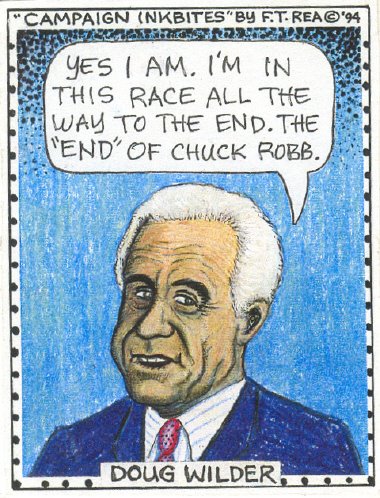
In the summer of 1994 O.J. Simpson-related material was on television round-the-clock. Meanwhile, a four-way political race developed in Virginia, as three candidates emerged to challenge the incumbent Chuck Robb for his seat in the U.S. Senate.

Republican Ollie North was nominated by a convention at the Richmond Coliseum. Former governor Doug Wilder, a Democrat, threw his hat in as an Independent. Finally, Marshall Coleman, a Republican former attorney general and failed gubernatorial candidate, ran as an Independent, too.

Naturally, both Wilder and Coleman were seen immediately as spoilers by many observers. The few members of the national press that weren't assigned to the story of Simpson's soon-to-begin trial were all over the circus-like story of the quartet of candidates in Virginia. Although Robb was the incumbent, North was easily the biggest celebrity in the group. Of course, Wilder might have argued that point.

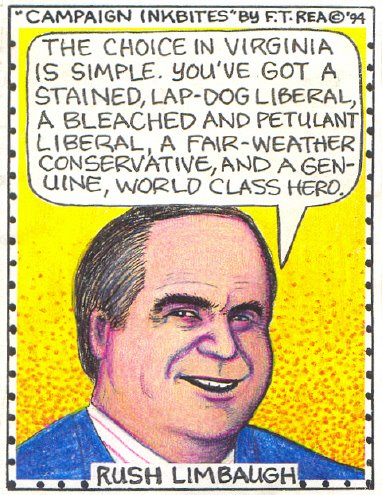
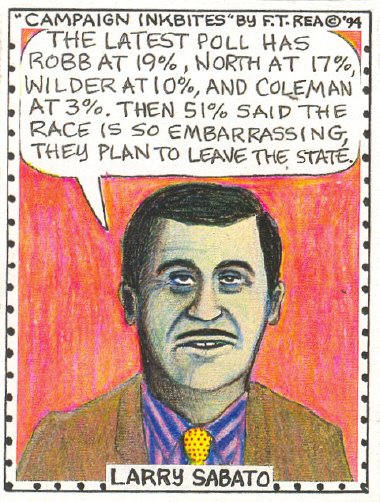
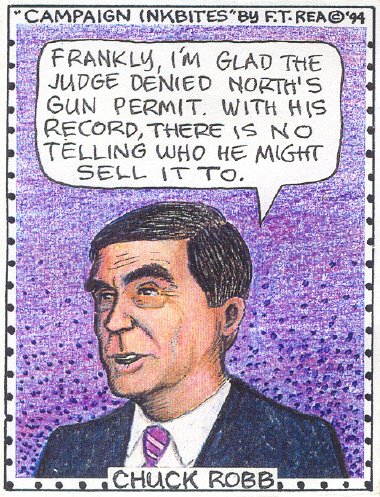
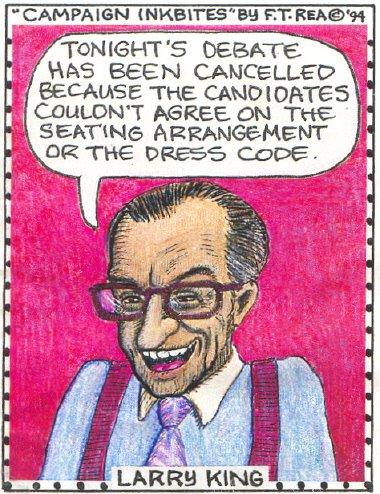
In late August, I issued what was then my fourth set of collectible cards -- “Campaign Inkbites: The ‘94 VA Senate Race.”

After swearing he was in the race 'til the finish, the mercurial Wilder withdrew in October. The wooden Coleman stayed the course, with stubborn Sen. John Warner as his chief backer. North, ever the checkered-shirted dandy, raised and spent over $25 million; what was then a new record for the most ever in a U.S. Senate race ... any state. In the end the awkward Robb outlasted them all and won reelection.

Beneath the 1994 newspaper article about that card collection are scans of 12 of the 15 original cards from the set. With 26 years of dust on the cards, some of my attempts at humor may not work so well now, maybe some of the caricatures are still fun to look at. As I produced these cards, it was an interesting challenge to try to write lines for the dialogue balloons that would hold up for a month or two, no matter what the developments.

Right out of the gate, this edition of political cartoons, adapted into a card format, was lucky with publicity. The Virginian-Pilot article reprinted below, by Poole and Yancy, kicked off what might have been seen for a few weeks as a "mini-fad."
Sept. 6, 1994: David Poole and Dwayne Yancey
Odds and ends from the past week of Virginia's U.S. Senate campaign: I'll swap you two Doug Wilders for a Tai Collins. The colorful U.S. Senate race has spawned a set of trading cards featuring the four candidates and a host of supporting characters - including the former Miss Virginia who gave a nude massage to Chuck Robb in a New York hotel.

There’s U.S. Sen. John Warner sounding defensive about his hand-picked candidate, Marshall Coleman: “Why should I strain to name an office he hasn't sought, or an abortion stance he hasn't taken? The point is: Marshall isn't Ollie.”

There’s conservative talk-show host Rush Limbaugh assessing the race: “The choice in Virginia is simple. You’ve got a stained, lap-dog liberal, a bleached and petulant liberal, a fair-weather conservative, and a genuine, world-class hero.”


There’s political pundit Larry Sabato reporting on the latest poll results: “Fifty-one percent said the race is so embarrassing they plan to leave the state.”
The “Campaign Inkbites” are the brainchild of F.T. Rea, a Richmond artist who a decade ago issued a similar deck of cards commemorating a massive death-row escape at Mecklenberg Correctional Center [by the notorious Briley brothers and four others]. The set of 15 Senate cards is available at Biff’s bookstore [also at Chickens, the snack bar in the State Capitol] in Richmond for $12 a pack.

The most unflattering likeness in the set is that of Sabato, whose green skin gives him the look of a vampire.

“Ironically, he’s my best customer,” Rea said of Sabato. “He bought 12
packs.”
Then an AP story written by Martha Slud ran. Lots of newspapers (1, 2) picked it up and printed various versions of it. Some ran the whole piece, as shown below, others edited it down.
Then came a five-minute report on the card set by reporter Bob Woodruff that appeared on CNN.

Previously, Woodruff had done a report on earlier card project of mine. As it happened, I just happened to run into him and he asked what I was up to. All that publicity prompted political memorabilia collectors from far and wide to buy the cards through the mail.

STYLE Weekly then asked me to do a cover and a five-page spread of cartoons on the same campaign. That feature ran in the Oct. 18, 1994, issue.

It was a wild ride.

*

Note: Click on any of the cards or the article to enlarge them.

Friday, February 14, 2020

1974: A Year of Change


The most obvious change in the air in 1974 was the day-by-day unraveling of Richard Nixon's presidency, culminating with his resignation. The Vietnam War was over and with the passing of those events the zenith of the hippie era was in the rear view mirror. The culture's styles in music, clothes, politics, movies, drugs, and you-name-it, began changing course. It was time to party. It was about this same time that my generation's focus on social causes also began to blur ... at least that's how I remember it. 

Still, going into 1974, no one would have guessed the most popular gesture of civil disobedience and group defiance on campus -- the protest march -- would morph into spontaneous gatherings to cheer for naked people, as they ran by. Yet, in the spring of 1974 streaking on college campuses suddenly became a national phenomenon.

After hearing about incidents of streaking on VCU's campus Richmond’s police chief, Frank Duling, announced that his department would not tolerate streakers running around in the city’s streets, alleys, etc. He didn’t care whether they were students, or not. But the VCU police department said if it took place on campus, streaking was a university matter and would be dealt with by its personnel.

It should be noted that the relationship between Richmond and VCU was somewhat awkward in this period. Leading up to this point, there had been a series of confrontational incidents on, or near, the VCU campus. Perhaps the most bitterly remembered of them occurred after Allen Ginsberg spoke at the VCU gym (Oct. 12, 1970). The city police used overkill force to break up a street party in the area of the 1100 blocks of Grove Ave. and Park Ave. Debris was thrown, a cop was hit by a brick and police dogs were set loose in the crowd. 

So, leading up to what happened on the 800 block of W. Franklin St. on the night of March 19, 1974, Richmond’s police department had some history with what might have been characterized as ta young anti-establishment crowd based in the lower Fan District.

Several groups of streakers had made runs on the sidewalks and between buildings before four naked kids rode down Franklin in a convertible at about 10 p.m. The crowd of 150-to-200 spectators cheered as the motorized streakers waved. The mood was quite festive. I know this firsthand, because I was in that crowd. This bizarre scene played out just a block from the Biograph Theatre. Usher Trent Nicholas and I had walked over to the commotion to see what would happen.

Then a group of some 50 uniformed policemen zoomed in on small motorbikes and in squad cars. They immediately arrested the four streakers in the car. They were city cops, not VCU cops.

After a lull in the action, the Richmond cops suddenly charged into the assembled bystanders. I saw now provocation for that change. A few of those bystanders were dragged into the middle of the street. One kid was knocked off of his bicycle and slammed repeatedly against the fender and hood of a police car. Others were beaten with clubs or flashlights. In person, I've never seen so many cops go crazy violent. It was a shocking scene.   

Crazy violent cops made bigger news at the Cherry Blossom Music Festival (which was headlined by the Steve Miller Band and Boz Scaggs) on April 27, 1974, at City Stadium. That was where the war between Richmond's partying hippies and its police force escalated beyond all previous clashes. When police officers attempted to arrest pot-smoking members of the audience, things got out of hand. Way out of hand!

Several police cars were destroyed in what turned into a four-hour battle. In all, 76 people were arrested. This unprecedented melee, which I missed, put the kibosh on any outdoor rock 'n' roll shows in Richmond, with alcohol available, for several years.

Other 1974 Noteworthy Events

Jan. 2: To conserve on gasoline President Richard Nixon signed a bill mandating a 55 mph speed limit, coast-to-coast.

Feb. 4: Patty Hearst was abducted; eight days later the Symbionese Liberation Army told the extremely well-to-do Hearst family it had to give $230 million in food aid to the poor.

Feb. 11: Richmond's Biograph celebrated its second anniversary with free movies and free beer and a wee prank. Once all the seats were filled for the 6:30 p.m. show thousands who had lined up around the block were turned away.

Mar. 2: Nixon was named by a federal grand jury as a co-conspirator in the Watergate cover-up. At this point it was still hard to see that he wouldn't last out the year.

Apr. 2: Acting on his own volition, Robert Opel streaked the 46th Academy Awards ceremony at Dorothy Chandler Pavilion in LA. As Opel ran by flashing a peace sign with his hand, host David Niven ad-libbed: "The only laugh that man will ever get in his life is by stripping off and showing his shortcomings."

Apr. 8: Playing for the Atlanta Braves, outfielder Hank Aaron broke Babe Ruth’s career home run record with his 715th round-tripper. Later the public was told about the many intimidating messages, including death threats, Aaron had received leading up to his feat.

Apr. 15: According to photographic evidence Patty “Tania” Hurst seemed to be helping her captors rob a bank at gunpoint. Nobody knew what to make of it.

May 15: Richmond-based A.H. Robins Co. yielded to pressure from the feds to take its contraceptive device, the Dalkon Shield, off the market.

June 28: One of the best films ever made, "Chinatown," premiered at the Biograph Theatre. It was owing to a lucky quirk of business that allowed the independent cinema to play several of Paramount's top first-run pictures that spring and summer.

July 27: The House Judiciary Committee voted 27-11 to impeach Nixon. Three days later the Supreme Court said Nixon had to surrender tape recordings of White House meetings that had been sought by the Watergate investigation’s special prosecutor. Nixon's presidency was in a death spiral.  

Aug. 8: Nixon resigned in disgrace; President Gerald Ford was sworn in. Millions of hippies celebrated Nixon's downfall; some of them stayed too long at the party.

Aug. 12: The Biograph Theatre closed to be converted by a 24-hour-a-day construction crew into a twin cinema in four weeks. The after-hours Liar's Poker games were the stuff of legends.

Sept. 8: Ford pardoned Nixon, which all but sealed Ford’s defeat when he ran for reelection in 1976.

Oct. 29: Muhammad Ali regained the world heavyweight boxing crown he had lost by refusing to be drafted into the army in 1967. In Zaire, Ali defeated the heavily favored champion George Foreman by a knockout in the eighth round. 

Nov. 13: Yasir Arafat, the head of the Palestine Liberation Organization, addressed the UN with a pistol strapped to his waist. Supporters of Israel cringed. Israel's enemies puffed up their chests. Lovers of peace weren't necessarily encouraged, but hoped for the best.

Dec. 12: Georgia governor Jimmy Carter announced he would run for president. Nobody noticed. Outside of his immediate circle of friends and advisers, who could have imagined it would matter?

Tuesday, February 11, 2020

Biograph Times: The First Year

by F.T. Rea 

Over 200 Titles in Year No. 1

Note: About six weeks before its opening gala this wide-angle view of The Biograph Theatre was captured by a Richmond News Leader photographer. It was snapped late in 1971, before the new building at 814 W. Grace St. received its distinctive buttercup yellow paint-job.

*

On what I remember as a bright morning, it was in early July of 1971, I went to a construction site on the north side of the 800 block of West Grace Street. Mostly, it was a big hole in the orange dirt between two old brick houses.

A friend had tipped me off that she’d been told the owners of the movie house set to rise from that hole were looking for a manager who knew something about movies and could write about them. She also said they were hoping to hire a local guy. Chasing the sparkle of that opportunity I met David Levy at the construction site.

Levy was the Harvard-trained attorney who managed the Biograph Theatre at 2819 M Street in Washington. D.C. He was one of a group of five men who, in 1967, had opened Georgetown’s Biograph in what had previously been a car dealership.

Although none of them had any experience in show biz, they were hip young movie lovers whose timing had been impeccable -- they caught a pop culture wave. The golden age of repertory cinema was waxing and those original partners happened to be living in what was the perfect town for their venture. They did well right away.

With their success in D.C. to encourage them, a few years later the same five, plus one, were looking to expand. In Richmond’s Fan District they thought they had discovered just the right neighborhood for a second repertory-style cinema, again using split weeks and double features. In this style of calendar house programming one usually adheres to a published schedule. So if a movie draws well, instead of holding it over you bring it back soon.

A pair of local players, energy magnate Morgan Massey and real estate deal-maker Graham “Squirrel” Pembroke, acquired the land. They agreed to build a cinder block building to house a single-auditorium cinema just a stone’s throw from Virginia Commonwealth University’s academic campus for the entrepreneurs from D.C. to rent. The "boys in D.C." had to pay for the projection booth equipment, the turnstile (we used tokens, rather than tickets) and the seats, some 515 of them.

At the time I was working for a radio station, WRNL, so I gave Levy tapes of some humorous radio commercials I had made for what had been successful promotions. About 10 weeks after that first meeting with Levy I was offered the manager’s position for the new Biograph.

Can't recall all that much about that day, except I was told I beat out a lot of competition. Oddly, what I do remember clearly is a brief flash of me sitting in my living room, trying to be nonchalant, so as to not to reveal just how thrilled I was at getting that offer. In truth, at 23-years-old, I could hardly imagine a better job for me existed, at least not in the Fan District. 

This all happened three years after Richmond Professional Institute and the Medical College of Virginia merged to become VCU in 1968. In the fall of 1971 there were few signs of the dramatic impact the new university would eventually have on Richmond. Although a couple of film societies were thriving on campus in that time, other than local film critic Carole Kass' History of Motion Pictures class, the school itself was offering little in the way of classes about movies or filmmaking.

There were a few VCU professors who occasionally showed artsy short films in their classes. Mostly, independent and foreign features didn’t come to Richmond. So, in 1971, the coming of the Biograph Theatre to Grace Street was great news to local film buffs. Generally, it was seen as another sign the neighborhood's nightlife scene was becoming more attractive to the young adult market. 

Levy and I got along well right away. We became friends who trusted one another. He and his partners were all about 10 years my senior.

My manager’s job lasted until the summer of 1983. Four years later, owing to unpaid rent, Grace Street’s Biograph Theatre was seized by Pembroke. A hundred miles to the north, the Biograph on M Street closed in 1996. David Levy died in 2004. Lenny Poryles, a second of those Georgetown-based bosses, died in 2018.

Today there’s a noodles eatery in same building that once housed the repertory cinema I managed for 139 months. Now it’s the oldest building on the block.

*

On the evening of Friday, February 11, 1972, the adventure got off the ground with a gem of a party. In the lobby the dry champagne flowed steadily, as the tuxedo-wearers and colorfully outfitted hippies mingled happily. A trendy art show was hanging on the walls. The local press was all over what was an important event for that bohemian commercial strip.

The feature we presented to over 300 invited guests was a delightful French war-mocking comedy — “King of Hearts” (1966); Genevieve Bujold was dazzling opposite the droll Alan Bates. Following splashy news stories about the party trumpeting the Biograph's arrival the next night we opened for business with a cool double feature: “King of Hearts“ was paired with “A Thousand Clowns“ (1965). Every show sold out.

The six owners were there for the first-ever Biograph party. That was the only occasion they were all there at the same time. Other than the projectionist, Howard Powers -- who was supplied by the local operators union -- I had hired the theater's opening night's staff: The cashiers were Cathy Chapman and Susan Eskey. The ushers were Bernie Hall and Chuck Wrenn. A few weeks later Chuck was promoted to assistant manager and Susan Kuney was hired as a third cashier.

The Biograph’s printed schedule, Program No. 1, was heavy on documentaries. It featured the work of Emile de Antonio and D.A. Pennebaker, among others. Also on that program, which had no particular theme, were several titles by popular European directors, including Michaelangelo Antonioni, Costa-Gavras, Federico Fellini, and Roman Polanski.

Like the first one, which offered mostly double features, each of the next several programs covered about six weeks. At this point Alan Rubin, one of the partners who worked in the Georgetown office, did the mechanical art for those programs, as he had been doing for the D.C. Biograph. In the initial months Levy and Rubin made most of the programming decisions, with me , of course, throwing in my two-cents worth.

In reading everything I could find about which movies were well-respected and popular in art houses, especially in New York and San Francisco, it was easy to gather that the in-crowd viewed most of Hollywood’s then-current product as either laughingly naive or hopelessly corrupted by the system. The fashion of the day elevated certain foreign movies, selected American classics, a few films from the underground scene, etc., to a level above most of their more accessible Hollywood counterparts. In 1972 perhaps the most admired of all foreign films were those considered to be part of the French New Wave, which began as the '50s ended with the early features made by Louis Malle, François Truffaut and Jean-Luc Godard. What my first year on the job eventually taught me was how few people in Richmond really cared all that much about seeing such films.

After the opening flurry of interest in the new movie theater, with long lines to nearly every show, it was surprising to me when the crowds shrank dramatically in the months that followed. Among other things that showed me how important the publicity running up to the Biograph's opening had been.

As VCU students had been a substantial portion of the theater’s initial crowd the slump was chalked off to warm weather, exams and then summer vacation. In that context the first summer of operation was opened to experimentation aimed at drawing more customers from beyond the immediate neighborhood. That gave me an opportunity to do more with a project my bosses had put me in charge of developing, Friday and Saturday midnight shows -- using radio in particular to promote them.

By trial and error I learned quickly that movies that lent themselves to attention-getting promotion performed better at the box office. Early midnight show successes were “Night of the Living Dead” (1968), “Yellow Submarine” (1968), “Mad Dogs and Englishmen” (1971), and an underground twin bill of “Chafed Elbows” (1967) and “Scorpio Rising” (1964). Most of the failures have been forgotten.

With significant input from Chuck, the theater’s well-known assistant manager, quirky non-traditional ad campaigns were designed in-house. Chuck's help with developing the style we used for choosing these late shows and promoting them effectively can't be overstated. 

We learned there were two essential elements to midnight show promotions: 1. Wacky radio spots had to be created and run on WGOE, a popular AM station aimed directly at the hippie listening audience. 2. I made distinctive handbills that were posted on utility poles, bulletin boards and in shop windows in high-traffic locations. Both elements had to show a sense of humor. 

Dave DeWitt produced the radio commercials. We happily shared the copy-writing chore. In his studio, Dave and I frequently collaborated on the making of those spots with an ample supply of cold Pabst Blue Ribbons and whatnot. Most of the time we went for levity, even cheap laughs. Dave had a classic announcer's baritone voice and he was quite masterful at physically crafting radio commercials. He was more of a nitpicker for perfection than I was, so we made a good team.

On September 13, 1972, a George McGovern-for-president benefit was staged at the Biograph. Former Gov. Doug Wilder, then a state senator, spoke. We showed "Millhouse" (1971), a documentary that put President Richard Nixon in a bad light.

Yes, I was warned that taking sides in politics was dead wrong for a show business entity in Richmond. Taking the liberal side only made it worse. But the two most active partners who were my bosses, Levy and Rubin, who was a geologist turned artist, were delighted with the notion of doing the benefit. They were used to doing much the same up there. So with the full backing of the boys in D.C. I never hesitated to reveal my left-leaning stances on anything political.  

Also in September “Performance” (1970), a somewhat overwrought but well-crafted musical melodrama -- starring Mick Jagger -- packed the house at midnight three weekends in a row. Then a campy, docu-drama called “Reefer Madness” (1936) sold out four consecutive weekends.

The midnight shows were going over like gangbusters. To follow “Reefer Madness” what was then a little-known X-rated comedy, “Deep Throat” (1972), was booked as a midnight show. By then the Georgetown Biograph was experimenting with playing naughty midnight shows. In Richmond, we had played a handful of films that had earned an X-rating, they had been more artsy than they were vulgar. This was our first step across the line to hardcore porn.

*

As “Deep Throat” ran only an hour, master prankster Luis Buñuel’s surrealistic classic short film (16 minutes), “Un Chien Andalou” (1929), was added to the bill, just for grins. It should be noted that like "Deep Throat," Buñuel’s first film, was also called totally obscene in its day. Still, this may have been the only time that particular pair of outlaw flicks ever shared a billing ... anywhere.

A few weeks after “Deep Throat” began playing in Richmond, a judge in Manhattan ruled it was obscene. Suddenly the national media became fascinated with it. The star of "Deep Throat," Linda Lovelace, appeared on network TV talk shows. Watching Johnny Carson pussyfoot around the premise of her celebrated “talent” made for some giggly moments.

Eventually, to be sure of getting in to see this midnight show, patrons began showing up as much as an hour before show time. Standing in line on the brick sidewalk for the spicy midnight show frequently turned into a party. There were nights the line resembled a tailgating scene at a pro football game. A determined band of Jesus Freaks took to standing across the street to issue bullhorn-amplified warnings of hellfire to the patrons waiting in the midnight show line that stretched west on Grace Street. It only added to the scene.

Playing for 17 consecutive weekends, at midnight only, “Deep Throat” grossed over $30,000. That was more dough than the entire production budget of what was America’s first skin-flick blockbuster.

The midnight show’s grosses conveniently made up for the disappointing performance of an eight-week program of venerable European classics at regular hours. It included ten titles by the celebrated Swedish director, Ingmar Bergman. The same package of art house workhorses played extremely well up in Georgetown, underlining what was becoming a painfully underestimated contrast in the two markets.

On the theater's first anniversary I made a list of all the titles we had presented. A few noteworthy shorts films were on the list, such as Chris Marker's "La Jetée" (1962), but I omitted most shorts. The list, which I had printed as a flyer to hand out, was over 200 titles long.

In 52 weeks, to establish what we were, the Biograph had presented over 200 different films, some in a couple of runs. Split weeks with doubles features, plus midnight shows, chewed up a lot of product. By the end of the first year Levy, Rubin and I knew we needed to make some changes in our programming.

The Fan District was not becoming Georgetown and in spite of what some folks were predicting, maybe it never would. To be successful in Richmond we realized we had to do more to cultivate the audience here to appreciate the sort of films we loved and most wanted to present. And, in the meantime, we had to figure out how to avoid losing money.

To start, maybe fewer old Bergman flicks.

*

Here's a small sample of the first year's avalanche of sweet double features. In this case I chose to have 12 double features on the list, because that's typically what was on one of the Biograph's calendar style programs.

Feb. 12-14, 1972: 
“King of Hearts” (1966): Color. Directed by Philippe de Broca. Cast: Alan Bates, Geneviève Bujold, Pierre Brasseur. Note: The first movie to play at the Biograph was a zany French comedy, set amid the harsh but crazy realities of too much World War I.
“A Thousand Clowns” (1965): B&W. Directed by Fred Coe. Cast: Jason Robards, Barbara Harris, Martin Balsam. Note: A social worker investigates the rules-bending circumstances in which a boy lives with his iconoclastic uncle, an unemployed writer.

Feb. 21-23, 1972:
“Z”  (1969): Color. Directed by Costa-Gavras. Cast: Yves Montand, Jean-Louis Trintignant, Irene Papas. Note: A political assassination’s cover-up in Greece spawns a compelling based-on-truth whodunit, with sudden plot twists, all told at a furious pace.
"The Battle of Algiers" (1966): B&W. Directed by Gillo Pontecorvo. Note: This account of the cruel tactics employed by both warring sides during the Algerian revolution is part documentary, part staged suspenseful recreation. Unforgettable.

Mar. 17-20, 1972: 
“Gimme Shelter” (1970): Color. Directed by Albert Maysles and David Maysles.  Performers: The Rolling Stones, the Jefferson Airplane, the Grateful Dead, Tina Turner and more. Note: A documentary with much concert footage and one murder.
“T.A.M.I. Show” (1964): B&W. Directed by Steve Binder. Performers: the Rolling Stones, the Beach Boys, the Supremes, James Brown, Marvin Gaye, Smokey Robinson and the Miracles, Lesley Gore and more appear in concert footage.

Apr. 12-13, 1972:
"Bell Du Jour" (1967): Color. Director: Luis Buñuel. Cast: Catherine Deneuve, Jean Sorel, Michel Piccoli. Note: Beautiful Severine loves her successful husband. With him she’s frigid. Her kinky fantasies lead her to the oldest profession … only by day.
"A Man and a Woman" (1966): Color. Director: Claude Lelouche. Cast: Anouk Aimée, Jean-Louis Trintignant. Note: A widower and a widow meet by chance at their childrens' boarding school. As they struggle to deal with their attraction to one another, neither has gotten over their loss.  

June 1-7, 1972: 
“McCabe & Mrs. Miller” (1969): Color. Directed by Robert Altman. Cast: Warren Beatty, Julie Christie. Note: With Altman, the routine gambling, prostitution and power struggles in the Old West take on a different sort of look. More grit. Less glory. All random.
"Klute" (1971): Color. Directed by Alan J. Pakula. Cast: Jane Fonda, Donald Sutherland, Roy Scheider. Note: Fonda grabbed a Best Actress Oscar for her convincing portrayal of a damaged prostitute who helps a dogged private detective solve a complicated missing person case.

June 14-18, 1972:
“Putney Swope” (1969): Both B&W and color. Directed by Robert Downey Sr. Cast: Stan Gottlieb, Allen Garfield, Archie Russell. Note: This strange but hilarious send-up of Madison Avenue was Downey’s effort to crossover from underground to legit. Probably his most accessible work.
"Trash" (1970): Color. Director: Paul Morrissey. Cast: Joe Dallesandro, Holly Woodlawn. Note: It was billed as "Andy Warhol's Trash," as he was credited with being the producer of Morrissey's series of undergroundish films. This one reveals the down-and-out urban lifestyle of an oddball couple.

June 29-July 2, 1972: 
"Dr. Strangelove or: How I Learned to Stop Worrying and Love the Bomb" (1964): B&W. Directed by Stanley Kubrick. Cast: Peter Sellers, George C. Scott, Sterling Hayden, Slim Pickens. Note: This nuke-mocking black comedy raised eyebrows at the height of the Cold War. Still a laugh riot.
 “M.A.S.H.” (1970): Color. Directed by Robert Altman. Cast: Donald Sutherland, Elliott Gould, Sally Kellerman. Note: This cynical comedy about doctoring too close to the pointless battles of the Korean War is much funnier than the long-running TV show that followed it.

Sept. 21-24, 1972:
"Citizen Kane" (1941): B&W. Directed by Orson Welles. Cast: Orson Welles, Joseph Cotten, Dorothy Comingore. Note: The meaning of a powerful, lonely man’s last word enlarges into a mystery. Flashbacks reveal a large life driven by lusts and obsessions. As American as it gets. 
"The Magnificent Ambersons" (1942): B&W. Directed by Orson Welles. Cast: Tim Holt, Joseph Cotten, Dolores Costello, Anne Baxter. Note. This truncated-by-the studio version of what the indulgent director intended follows the meandering story of a prominent family's fortunes.  

Oct. 9-11, 1972:
“The Third Man” (1949): B&W. Directed by Carol Reed. Cast: Joseph Cotten, Orson Welles, Alida Valli. Note: This elegant film noir mystery, set in crumbling post-war Vienna, is pleasing to the eye and stylishly cynical. Hey, no heroes here, but great music. 
"Breathless" (1960): B&W. Directed by Jean-Luc Godard. Cast: Jean-Paul Belmondo, Jean Seberg. Note: An opportunistic thief on the lam becomes irresistible to a pretty American journalism student in Paris. Uh-oh, the guy is dangerous. How long can living in the moment last?

Nov. 17-19, 1972:
“Duck Soup” (1933): B&W. Directed by Leo McCarey. Cast: The Four Marx Brothers (Groucho, Harpo, Chico and Zeppo), Margaret Dumont. Note: With Rufus T. Firefly as dictator of Freedonia and flush from a fat loan from Mrs. Teasdale, what could hilariously go wrong? How about war?
"Horse Feathers" (1932): B&W. Directed by Norman McLeod. Cast: The Four Marx Brothers, Thelma Todd. Note: The Biograph's secret password that opened doors was "swordfish." The scene that spawned that tradition is in this gag-filled send-up of on-campus life and football.

Dec. 7-10, 1972: 
“The Producers” (1968): Color. Directed by Mel Brooks. Cast: Zero Mostel, Gene Wilder, Kenneth Mars, Dick Shawn. Note: Brooks’ first feature film laughed at Nazis with what was a fresh audacity. Mostel and Wilder are so funny it ought to be illegal.
“The Graduate (1967): Color. Directed by Mike Nichols. Cast: Anne Bancroft, Dustin Hoffman, Katherine Ross. Note: The mores of upper middle class life in the '60s are laid bare, as a recent college graduate's idleness leads to an affair with the beautiful, but wrong older woman.

Jan. 25-28, 1973:
"The Conformist" (1971): Color. Directed by Bernardo Bertolucci. Cast: Jean-Louis Trintignant, Stefania Sandrelli, Gastone Moschin. Note: A visually stunning look at fascist Italy, with Mussolini in power and old class distinctions melting away. Betrayal is in the air.
 “The Garden of the Finzi-Continis” (1971): Color. Directed by Vittorio De Sica. Cast: Dominique Sanda, Lino Capolicchio, Fabio Testi. Note: With WWII approaching, why did wealthy, well educated Jews stay too long in Germany and Italy? This film provides some answers.
 
-- 30 --