Thursday, November 09, 2006

Carlos the crab-folder

Carlos Runcie Tanaka, a Peruvian sculptor of what one brief biography called, “of mixed Japanese and European ancestry,” is a star in the international art world. As it happened Mr. Tanaka was in Richmond’s Fan District for a few days in April of 2001.

Let me tell you, after watching the sculptor fold and crease a piece of paper in a local bar, I’ve got two words of advice for him -- Show Business. This concept would combine the origami with Tanaka’s considerable talent for yarn-spinning.
OK, maybe I’m getting a bit ahead of myself. Like so many tales, this one began with Happy Hour:

The Baja Bean is a Fan District watering hole located in the basement of what was originally a schoolhouse. The building itself is a stone and brick fortress. It was a typical crowd of mid-week regulars -- there were about 20 decidedly adult faces around the three-sided, horseshoe-shaped bar. The group was approximately equal parts white collar, blue color and no collar.

When then-chairman of Virginia Commonwealth University’s sculpture department Joe Seipel came in the room, with Carlos Tanaka at his side, Joe was smiling more broadly than usual. Seipel, who enjoys telling a good story, maybe even more loves to present a cool visiting artist to his pals at Happy Hour. It’s a tradition left over from the Texas-Wisconsin Border CafĂ© (1982-99), the nearby much-missed saloon which Seipel himself once co-owned. Seipel introduced Carlos to those who hadn’t already met him.

Tanaka has done much traveling, owing to his acclaim as an artist. At an art confab somewhere in South America he had met and gotten to know Seipel, plus a couple of other art faculty types at VCU’s world renown fine arts school. Then they arranged for him to come to the art school here as a visiting artist/scholar. That’s how a Peruvian artist ends up in the Bean at beer-thirty.

As an aside, Tanaka was among the hostages taken by the Tupac Amaru in that bizarre 1996 incident in Lima, Peru, at the Japanese ambassador’s home. Nonetheless, his experience as the hostage of hell-bent terrorists for 50 days apparently did nothing to diminish his overall sense of humor.

Eventually, someone asked him about the crab-folding thing.

Bingo!

Someone else supplied a blank sheet of paper. For the next 20 minutes Tanaka told stories, made observations, ad-libbed and entertained everyone on hand. Nothing else was happening in the room for that spell. The product was an intricate paper crab made from an ordinary piece of white bond paper.

Looking at the crab was fun; it almost seemed cute, for a crab. But watching the artist fold the paper, over and over -- each fold exactly where it had to be -- as he offered his lighthearted patter, like a pro, was a rare treat. To the delight of the person who had supplied the sheet of paper, the crab-folder gave it to them.

Of course, someone else had to have one, too. Then another. Tanaka must have folded four or five paper crabs that afternoon. He never ran out of offbeat stories about drinking, playing practical jokes, making art, fools in high places, and so forth. By the way, the upbeat Tanaka never mentioned the dark time he was a hostage. I found out about that later.

The next time I saw Carlos in the Bean, a couple of days later, he gave me a paper crab as a souvenir. Soon afterward he went back to Peru. As he’d been away from his studio for months, traveling and lecturing, the artist had said he was glad to be going home. I haven’t seen him since. Occasionally I do see Tanaka’s name associated with a big art happening in South America or Europe. Earlier this year he did his visiting sage routine at the University of Cincinnati.

So, what’s that “mixed ancestry” business mean?

It seems one of Tanaka’s grandfathers was British, the other was Japanese. Both men married Peruvian women.

Anyway, whenever Carlos is ready to take a break from the sculpture gig, I still say a career in Show Biz as a crab-folding monologist awaits. In the meantime, I hope the reader takes the time to click on the two links here -- one; two -- to look at more of Tanaka’s art and read a bit about it and him, too.

No doubt, I’ve spent too many of my personal allotment of hours in bars. Although it’s easy to say most of them were wasted, every now and then something genuinely unusual has happened, out of the blue, that makes me say, “I’m glad I was there.” If nothing else those times provide fodder for a story to tell at a subsequent Happy Hour.

Like our ancestors we listen and observe, so we can tell stories about what seemed unusual. Later today, after a round of Frisbee-golf, I’ll hoist a Happy Hour beer to the time the crab-folding monologist from Peru held court at the Baja Bean in a fashion unduplicated since.

-- 30 --

Photo: SLANT

In Search of Brer Rabbit

Below the reader will see a feature article I wrote three years ago, which was published by a Richmond magazine called FiftyPlus. It is about a writer named Daryl Cumber Dance. She’s a charming woman who is well known in some circles. But I suspect many of SLANTblog’s readers will be learning about her for the first time when they read the piece. Dance is a University of Richmond English professor who has written extensively about African American folklore. Enjoy.

In Search of Brer Rabbit
By F.T. REA

Unbeknownst to the slave traders transporting their kidnapped human cargo from Africa to the New World, there was a stowaway onboard. Folklore scholars tell us that Brer Rabbit made his way across the Atlantic Ocean, hidden in the minds of shackled men and women on their way to a life that might as well have been on another planet.

Impish Brer Rabbit is just one of the fascinating characters from African American folklore who appeal to University of Richmond English professor Daryl Cumber Dance.

In Dance’s newest book, From My People: 400 Years of African American Folklore, she has fashioned an eclectic collection of African American folklore, music lyrics, art, toasts, proverbs, riddles, and superstitions.

“What I’m doing is capturing a certain tradition, in print,” she said of her 736-page anthology, published last year by W. W. Norton.

That “certain tradition” was a subculture that in its time relied entirely on the spoken word of storytellers, or griots (pronounced gree-oh). After all, it was illegal during extended parts of America’s slavery era to even teach Negroes how to read and write.

In From My People, next to her collection of yarns featuring mythical characters, such as Brer Rabbit, the Signifying Monkey, and Stagolee, Dance includes thought-provoking samples of the words of well-known black figures, including Ralph Ellison, Jelly Roll Morton, Zora Neale Hurston, Langston Hughes, and Martin Luther King, Jr.

Then, too, there’s a chapter on Soul Food, with plenty of useful recipes.

While Brer Rabbit made it to America’s shores in the memories of slaves, Dance pointed out, it was Joel Chandler Harris (1848-1908), author of the Uncle Remus stories, who brought Brer Rabbit to the reading public.

Slaves told him those stories, featuring animals blessed or cursed with human-like traits, when he was a boy. Uncle Remus, the kindly yarn-spinner, was Harris’s invention. Significantly, the stories were written in a style he asserted was the dialect spoken by slaves in his youth. Harris also underlined the universal nature of stories concerning subjugated underdogs and their struggle for survival with dignity intact.

Dance happily subscribes to the basic idea expressed by mythology guru Joseph Campbell (1904-1987), when he held forth, in his authoritative writings on storytelling in ancient civilizations, that fables about heroes and their transforming quests are more similar than not.

Now, well after the days of Harris’ Uncle Remus, the study of folklore has become quite important to historians and anthropologists. Then, too, folklore can also be seen as the forerunner to today’s popular culture of magazines, movies, popular music and broadcasting.

The word “toast” is among the interesting terms Dance examines in From My People. As she explains, toasts were artful rants presented from the point of view of a powerful black man. They began to be a popular form of expression/entertainment in urban neighborhoods around the turn of the century. They were always bawdy.

“A clean version of a toast is not a toast,” said Dance, eyebrows raised.

She struggled with how to include such material in From My People. Nonetheless, Chapter Nine contains some traditional toasts, including Stagolee.

If that title has a familiar ring to it, that’s because there is a raft of songs out there about a gun-toting Stagolee, or Stagger Lee. New Orleans singer/songwriter Professor Longhair did his take on it, “Stag O Lee,” in 1974. There was also Lloyd Price’s big hit, “Stagger Lee,” in 1959. Still, Mississippi John Hurt’s version of the song, “Stack O'Lee Blues,” in 1928, is considered the definitive version.

Deciding the book needed some examples of traditional toasts in it, while also wanting to make it accessible to young readers, Dance compromised her long-held belief in absolute authenticity, to do with wording. She crafted a few substitute terms, here and there, hoping to retain the original toast’s meaning and verve.

As a toast, Stagolee probably originated in turn-of-the-century Memphis. It may well have been based on a real murder. Eventually the songs came, with all the variations on the same theme. Today, it’s easy to imagine the bloody saga of Stagolee and Billy presented with a hip hop treatment.

“Rap is an outgrowth of the toast,” said Dance. “Things find ways of going on.”

That apt observation sheds light on such acts as the legendary Last Poets. Their first performances in New York City in 1968, of what many popular culture aficionados see now as seminal rap music, could also be seen as bringing the long-established tradition of the toast forth for a new generation.

Click here to read the entire piece.

Wednesday, November 08, 2006

VCU tops VUU in hoops exhibition

B.A. Walker was feeling it from long range -- five for nine on three-pointers -- as he scored a game-high 22 points in leading the VCU Rams to a exhibition game victory over the Virginia Union Panthers at the Siegel Center: VCU 77, Union 56.

Although the Rams shot at a 52 percent clip, it was their trapping defense that was the deciding factor in the contest, as they forced the Panthers to turn the ball over 27 times. For what it’s worth, VCU looked more intense and better prepared tonight that it did in last week’s exhibition against Virginia State.

VCU’s new head coach Anthony Grant announced earlier today that four high school seniors have signed early National Letters of Intent to play their college ball at the Siegel Center next year. All four are playing their senior years at high schools in the state of Florida. They are:
  • Myk Brown, 6-4, 200, averaged 14 points per game and 8.5 rebounds per contest as a junior. He made the third team all-state team.
  • Lance Kearse, 6-6, 225, averaged 18 points and 12 rebounds as a junior. He was named first team all-state.
  • Joey Rodriguez, 5-11, 160, averaged 13 points as a junior with 3.5 rebounds and 10.2 assists, which led the state of Florida. He was named to the second team all-state.
  • Larry Sanders, 6-9, 210, averaged 13 points and 11 rebounds last season. He was second team all-state.
Last season Grant was an assistant coach on Billy Donovan’s staff at the University of Florida, when the Gators won the national championship.

Election analysis, briefly told

Why the Republicans lost so many races in so many states is the topic of the day for pundits, bloggers and Happy Hour wags. OK, I’ll play.

Reason No. 1: Iraq

Since Sec. of Defense Donald Rumsfeld has already been pushed aside, it’s obvious President George Bush could see the effect the war in Iraq -- the Mother of All Quagmires -- had on the midterm elections this year. So somebody had to take the fall, because Iraq stands as the most glaring and expensive failure of the Bush administration.

Reason No. 2: Hurricane Katrina

To me, the utter failure of Bush’s Homeland Security Dept. to prepare for, or deal with, the disaster in New Orleans and the rest of the stricken Gulf area was the tipping point for many independent-minded voters. And, it energized Democrats in a way the war issue had not at that point.

Reason No. 3: Scandals

The Republicans didn’t invent corruption. But too much is too much. Names such as Jack Abramoff, Randy “Duke” Cunningham, Tom DeLay, Mark Foley, Lewis “Scooter” Libby, Robert Ney, Ralph Reed, and so forth, probably did more to hurt the prospects of Republicans yesterday than anybody speaking for the GOP today will admit.

Of course there were other reasons and there were specific reasons that applied to particular races. Still, I think the impact of the three main reasons above came to bear on most if not all of the congressional contests.

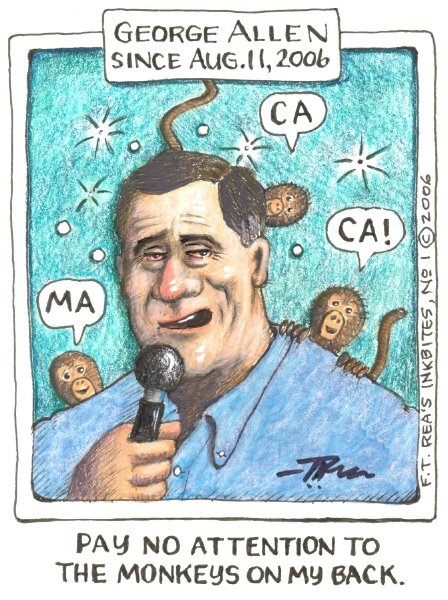
In Virginia, as much as I applaud Jim Webb’s apparent victory, I have to say that George Allen did more to hurt himself than anything anyone opposing him did. History will probably say Allen was the first thought-to-be-invincible politician to defeated by the Internet, by way of the famous “Macaca” YouTube video.

Then, once Allen’s gaffes let his rather politically inexperienced opponent into the race, Webb swelled up and managed to make himself into a better campaigner than a lot of people had thought he could.

*

Update: On Wednesday evening the Associated Press and other news agencies declared Webb to be the winner. Click here to read the Washington Post’s coverage.

“Democrat Jim Webb won Virginia's pivotal Senate race Wednesday, unseating Republican George Allen and giving the Democrats total control of Congress for the first time in 12 years.”

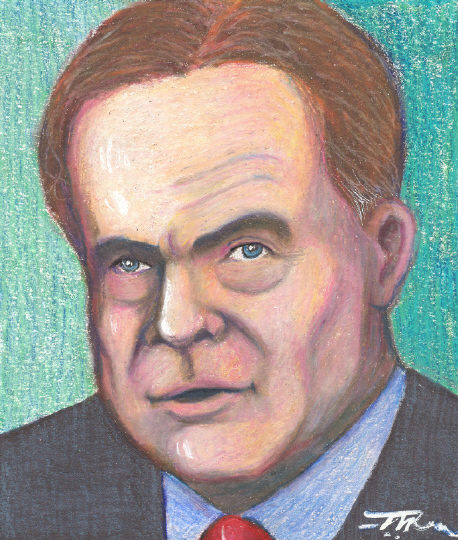
Art by F.T. Rea. Click here to see about getting a souvenir T-shirt with the above image on it.

Webb declares victory

With the margin still razor-thin and his brother playing the bagpipes, a smiling Jim Webb spoke to his gathered supporters, "The votes are in ... and we won!"
Photo: SLANT

Tuesday, November 07, 2006

The Sound

Running for political office is something most people don’t do. Still, there are some lessons that can only be learned from firsthand knowledge.

When the race is over, the fall from being a “hopeful” to being a “loser” has to hurt no matter how much the candidate may have tried to prepare himself/herself. I know. Yet, I still regard what was my own losing campaign for City Council in 1984 as one of the best things I ever did. Below is a piece I wrote about my days as a candidate for STYLE Weekly in 2000:

The Sound by F.T. Rea
The campaign was launched on the steps of Downtown Richmond's Public Library
In the spring of 1984, I ran for public office. In case the Rea for City Council campaign doesn’t ring a bell, it was a spontaneous and totally independent undertaking. No doubt, it showed. Predictably, I lost, but I’ve never regretted the snap decision to run, because the education was well worth the price.

In truth, I had been mired in a blue funk for some time prior to my letting a couple of casual friends talk me into running, as we played a foosball game in a nightclub. Although I knew winning such an election was out of my reach, I relished the opportunity to have some fun mocking the system. Besides, at the time, I needed an adventure.

So it began. Walking door to door through Richmond’s 5th District, collecting signatures to qualify to be on the ballot, I talked with hundreds of people. During that process my attitude about the endeavor began to expand. People were patting me on the back and saying they admired my pluck. Of course, what I was not considering was how many people will encourage a fool to do almost anything that breaks the monotony.

By the time I announced my candidacy at a press conference on the steps of the city library, I was thoroughly enjoying my new role. My confidence and enthusiasm were compounding daily.

On a warm April afternoon I was in Gilpin Court stapling handbills, featuring my smiling face, onto utility poles. Prior to the campaign, I had never been in Gilpin Court. I had known it only as “the projects.”

Several small children took to tagging along. Perhaps it was their first view of a semi-manic white guy -- working their turf alone -- wearing a loosened tie, rolled-up shirtsleeves, and khaki pants.

After their giggling was done, a few of them offered to help out. So, I gave them fliers and they ran off to dish out my propaganda with a spirit only children have.

Later I stopped to watch some older boys playing basketball at the playground. As I was then an unapologetic hoops junkie, it wasn’t long before I felt the urge to join them. I played for about 10 minutes, and amazingly, I held my own.

After hitting four or five jumpers, I banked in a left-handed runner. It was bliss, I was in the zone. But I knew enough to quit fast, before the odds evened out.

Picking up my staple gun and campaign literature, I felt like a Kennedyesque messiah, out in the mean streets with the poor kids. Running for office was a gas; hit a string of jump shots and the world’s bloody grudges and bad luck will simply melt into the hot asphalt.

A half-hour later the glamour of politics had worn thin for my troop of volunteers. Finally, it was down to one boy of about 12 who told me he carried the newspaper on that street. As he passed the fliers out, I continued attaching them to poles.

The two of us went on like that for a good while. As we worked from block to block he had very little to say. It wasn’t that he was sullen; he was purposeful and stoic. As we finished the last section to cover, I asked him a question that had gone over well with children in other parts of town.

“What’s the best thing and the worst thing about your neighborhood?” I said with faux curiosity.

He stopped. He stared right through me. Although I felt uncomfortable about it, I repeated the question.

When he replied, his tone revealed absolutely no emotion. “Ain’t no best thing ... the worst thing is the sound.”

“What do you mean?” I asked, already feeling a chill starting between my shoulder blades.

“The sound at night, outside my window. The fights, the gunshots, the screams. I hate it. I try not to listen,” he said, putting his hands over his ears to show me what he meant.

Stunned, I looked away to gather my ricocheting thoughts. Hoping for a clue that would steady me, I asked, “Why are you helping me today?”

He pointed up at one of my handbills on a pole and replied in his monotone. “I never met anybody important before. Maybe if you win, you could change it.”

Words failed me. Yet I was desperate to say anything that might validate his hope. Instead, we both stared silently into the afternoon’s long shadows. Finally, I thanked him for his help. He took extra handbills and rode off on his bike.

As I drove across the bridge over the highway that sequesters his stark neighborhood from through traffic, my eyes burned and my chin quivered like my grandfather’s used to when he watched a sad movie.

Remembering being 12 years old and trying to hide my fear behind a hard-rock expression, I wanted to go back and tell the kid, “Hey, don’t believe in guys passing out handbills. Don’t fall for anybody’s slogans. Watch your back and get out of the ghetto as fast as you can.”

But then I wanted to say, “You’re right! Work hard, be tough, you can change your neighborhood. You can change the world. Never give up!” During the ride home to the Fan District, I swore to myself to do my absolute best to win the election.

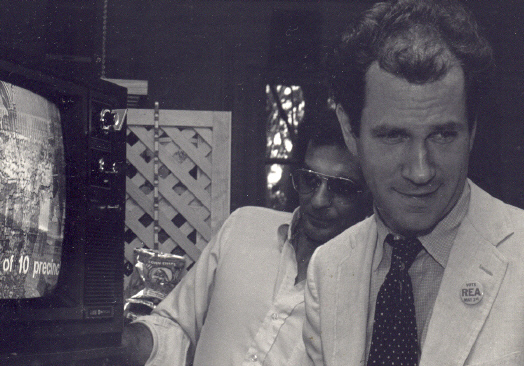
A few weeks later, at what was billed as my victory party, I, too, tried to be stoic as the telling election results tumbled in. The incumbent carried six of the district’s seven precincts. I carried one. The total vote wasn’t even close. Although I felt like I’d been in a car wreck, I did my best to act nonchalant.
This shot, taken at Grace Place (a VCU-area restaurant), shows my reaction to the news that with half the votes counted I no longer had a chance to win.
In the course of my travels these days, I sometimes hear Happy Hour wags laughing off Richmond’s routine murder statistics. They scoff when I suggest that maybe there are just too many guns about; I’m told that as long as “we” stay out of “their” neighborhood, there is little to fear.

But remembering that brave Gilpin Court newspaper boy, I know that to him the sound of a drug dealer dying in the street was just as terrifying as the sound of any other human being giving up the ghost.

That same boy would be in his mid-30s now, as I was when I met him, if he’s still alive. The ordeal he endured in his childhood was not unlike what children growing up in any number of the world’s bloody war zones are going through today. Plenty of them must cover their ears at night, too.

For the reader who can’t figure out how this story could eventually come to bear on their own life, then just wait ... keep listening.
-- 30 --

Haskins on blogosphere's day after

Conaway Haskins III has been studying Virginia’s burgeoning blogosphere, trying both to understand its nature and influence its direction. Due to his thoughtful writings posted on his South of the James blog, Haskins has already had a positive impact on the state of blogging in Virginia. Now he wants to do more.

While most bloggers are totally focused on today’s elections, the culmination of what has been a frenzy of blogging activity in support of candidates and ballot measures, Haskins is looking at tomorrow. Posted on Bacon’s Rebellion, his thoughts on the untamed blogosphere’s future, "The Day After Tomorrow," are well worth reading.

Webb should replace Allen, no on Marshall-Newman

Jim Webb has had my visible support throughout the Democratic primary race against Harris Miller, and then in the general election against Republican Sen. George Allen. So, for me to announce now that SLANTblog is endorsing Mr. Webb would seem redundant, or worse.
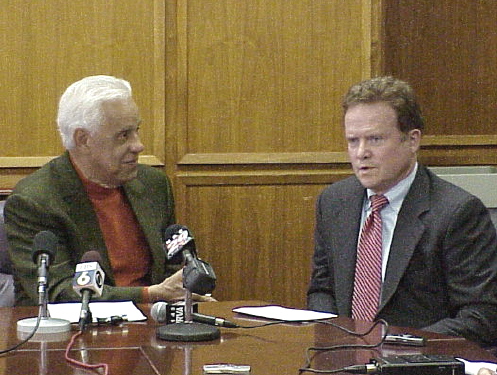
At City Hall Doug Wilder endorsed Jim Webb
Furthermore, I’m not sure a blog “endorses.”

A newspaper, which has an editorial department in addition to its news department, etc., endorses. Key politicians, such as Mayor Doug Wilder, endorse. Most of the time I’d say blogs either support candidates, or they don’t. However, please note that I’m not saying other bloggers who use their space to “endorse” are wrong.

SLANTblog also must urge its readers to vote against the Marshall-Newman amendment. Legally, when J. Harvie Wilkinson III, who served as a law clerk to Supreme Court Justice Lewis F. Powell (1972-73) and was appointed to the Fourth Circuit bench by Ronald Reagan (1984), says it’s half-baked, that’s good enough for me:

“...Ordinary legislation -- not constitutional amendments -- should express the community's view that marriage ‘shall consist only of the union of a man and a woman.’ To use the Constitution for prescriptions of policy is to shackle future generations that should have the same right as ours to enact policies of their own. To use the Constitution as a forum for even our most favored views strikes a blow of uncommon harshness upon disfavored groups, in this case gay citizens who would never see this country's founding charter as their own.”

As a lawyer, Allen may know this ploy/amendment is quite likely to be shot down in the first court in which it is challenged -- for being vague/poorly written -- but that doesn’t matter so much to him. Not now, because Allen is looking for all the help it might give him on election day.

Anyway, rather than go on about all that, I’d rather offer some links to editorials and articles on this amendment, such as Wilkinson’s, which present the case against it better than I can. Likewise, SLANTblog is offering a list of links to the best endorsements of Webb by daily newspapers.

Marshall-Newman vote-no editorials/OpEds
Judge J. Harvie Wilkinson’s Post OpEd, “Hands Off Constitutions,”
Virginian-Pilot
Richmond Times-Dispatch

Jim Webb newspaper endorsements:
Daily Press: Virginians should vote for change
Roanoke Times: Send an independent thinker like Webb to Washington, D.C.
Virginian-Pilot: James Webb for U.S. Senate
Washington Post: Mr. Webb offers hope
Photo: SLANT

Monday, November 06, 2006

What about Webb, the writer?

Want to know more about James H. “Jim” Webb, Jr., the writer?

Webb has actually done quite well in the word biz, but is the Vietnam War combat veteran and former Sec. of the Navy really a smut-peddler, as his rather desperate opponent, Sen. George Allen, has been crying since Webb pulled ahead in the opinion polls?

If after Allen’s most recent avalanche of television ads -- which charge that Webb writes in a “deviant” fashion -- you’ve gotten a little curious about his reputation as an author, then perhaps you should take a few minutes to look at that side of his life. Click here to go to jameswebb.com.

LA Times: "'Lost Soldiers' is a strong and unusual novel. On its face, it is a standard tale of intrigue, adventure and mystery. James Webb has written a well-plotted story about Americans and Vietnamese in Vietnam more than a quarter-century after the war’s end. You want to know what will happen next. You will not be disappointed. Yet, in retrospect, the plot fades away, and what the reader remembers most is the deep pull of affection the Americans feel for Vietnam and the Vietnamese. It's not just that love that comes through; there is also powerful nostalgia for lost youth, friends dead, forever-missed possibilities of life.”

Washington Post (on “Something to Die For”): “Webb is not just a writer of war thrillers; he is a genuine novelist of ideas...A century hence, James Webb will be studied for the light he sheds on military life and civil-military relations at the climax of the American Century.”
Photo: SLANT

Roy Scherer: 'Vote for the children'

Roy B. Scherer is a man I’ve known for about 35 years. His brand of Libertarian political philosophy and his keen sense of social justice have always been at the center of his dogged activism.

Longtime Virginia politicians, as well as political writers, are quite familiar with Scherer (pictured right, my photo) and his opinions. Whether I agree with him on a particular issue, or not, I know Roy to be a thoughtful man, whose beliefs seem to come from his experience in life, rather than some canned party line sort of thinking.

This time I couldn’t agree with him more. Below this paragraph is Scherer’s thinking on the Marshall-Newman amendment, which is deceptively being called the “Marriage Amendment” by some of its proponents:

*

I'd like to encourage people to vote for the children on Tuesday.

Two of my close friends have been together for fourteen years, and they have two children, twelve and seven years old. They’re delightful, and both of their mothers love them very much.


Their birth mother stays at home, minds the house, and home-schools the children. Their other mother works at her profession, pays the mortgage and other bills, and helps with the house and the kids.


Since the parents realize that sometimes bad things can happen, they’ve taken the precaution of making a contract (something that would not have been necessary if they had been allowed to marry). The breadwinner has acknowledged that the children are hers, and that she assumes full responsibility for their care and education. Should they break up, or if their birth mother should die, the children are provided for. Also, the birth mother and the children have been covered for years under the other mother's insurance policy at work.

That is, they are provided for right now. If the so-called marriage amendment is passed, both the insurance and the contract will be explicitly nullified, since they are intended to provide the “rights, benefits, [and] obligations” of marriage.

That means that if the birth mother or either of the children should have a serious illness, the insurance that they've been paying for will not be allowed to cover it, and the family will go bankrupt. It also means that if the birth mother should die, their other mother will no longer have an obligation, nor even any right, to care for them. The Commonwealth would have to take the children and place them in an orphanage or in foster homes.


Please, vote for the children, and defeat the so-called “marriage amendment.”

-- Roy B. Scherer

Saturday, November 04, 2006

In reality, Webb is a breath of fresh air

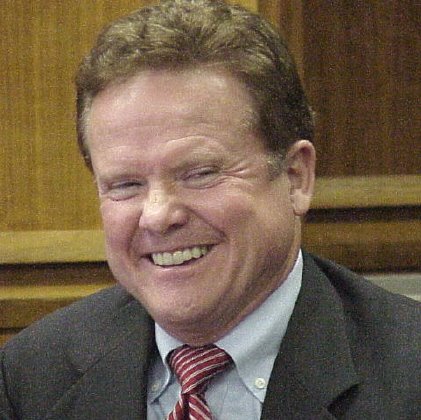
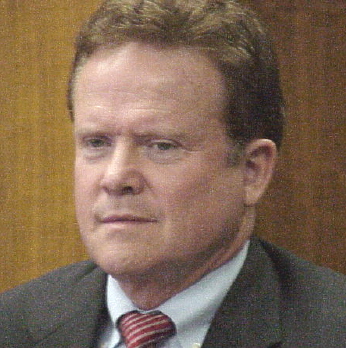
Democratic senatorial candidate Jim Webb
In a way unseen before in Virginia politics, fiction has become a part of the 2006 senatorial race. For months Sen. George F. Allen has been using a snide tone to call his opponent, James H. “Jim” Webb, a “fiction-writer.” More recently, Webb’s novels have been derided by Allen as smut.

Allen’s ubiquitous television commercials are now claiming Webb’s writings are “deviant” and that they “demean” women. Well, it’s no wonder Allen’s handlers want him to focus on fiction. In the last 12 weeks reality has been awfully tough on Allen’s supposedly easy run to win a second term in the U.S. Senate.

In reality, Allen’s record as a senator stands in obedient compliance with the Bush administration’s woefully unpopular positions on many issues, including the war in Iraq and stem cell research. Reality now has Allen trailing in the most recent polls, having dropped over 10 points in the last month.

Reality now has Allen’s heretofore useful image as an aw-shucks Southern gentleman in tatters. Reality also has comedians poking fun at Allen as a buffoon, a total phony.

It was in the real world that a youthful Jim Webb survived combat missions as a marine in Vietnam. That experience served as the foundation for his career, both as a writer and in public service as an expert on military matters in the Reagan administration.

In the real world Jim Webb has a built a resume that testifies to his many accomplishments. Webb has won widespread praise for his fiction, as well as his reportage on international politics.

Attacking an award-winning writer for his body of work is an extreme measure. In truth, only desperation or stupidity would make a political campaign do it, because the professional spin doctors know full well that the press -- with writers at the heart of it -- is not going to like such a tactic much, no matter whether they lean to the left or the right.

So, Allen’s attack on Webb’s profession -- a lurch backward into the bad old days of book-burning -- is the surest sign we’ve seen that Allen knows he’s behind Webb and time is running out.

In reality, Webb is a welcome breath of fresh air in politics; he thinks for himself, says what he believes and carries himself with dignity.

Reality in 2006 has called for a change. Fortunately for Virginians, Webb heard the call and, once again, he stands ready to do his duty.

Friday, November 03, 2006

Allen's book burning ploy

Since the Allen camp is running ads in the last weekend before the election, using its book-burning hype to smear Webb as a writer of pornography, it’s time to think again about where this sort of tactic ends up. To go after writers for expressing in their own voice what truths they’ve found in their travels is to march backward toward a darker time.

For the Allen supporters who would burn the widely-acclaimed novels written by Jim Webb, calling him a pornographer in order to achieve their political end, there may be a lot more work to do. Below is a section of Genesis they may feel compelled to set ablaze, as well. After all, if just mentioning an act is to advocate it, well ...

"19:30 And Lot went up out of Zoar, and dwelt in the mountain, and his two daughters with him; for he feared to dwell in Zoar: and he dwelt in a cave, he and his two daughters.

"19:31 And the firstborn said unto the younger, Our father is old, and there is not a man in the earth to come in unto us after the manner of all the earth.

"19:32 Come, let us make our father drink wine, and we will lie with him, that we may preserve seed of our father.

"19:33 And they made their father drink wine that night: and the firstborn went in, and lay with her father; and he perceived not when she lay down, nor when she arose.

"19:34 And it came to pass on the morrow, that the firstborn said unto the younger, Behold, I lay yesternight with my father: let us make him drink wine this night also; and go thou in, and lie with him, that we may preserve seed of our father.

"19:35 And they made their father drink wine that night also: and the younger arose, and lay with him; and he perceived not when she lay down, nor when she arose.

"19:36 Thus were both the daughters of Lot with child by their father."

Does this rather sordid story in the first book of the Bible make the Good Book itself pornography? Do Christians who believe in a strict interpretation of Genesis, the anti-evolutionists, also favor incest when the end justifies the means?

Once you start pointing fingers at literature and burning selected books, where does it stop?

Updated on Nov. 3.

Today in Urbanna

This morning a old friend took me to the Urbanna Oyster Festival. Although this year marked the 49th time this charming event has be staged, it was my first time there. Originally called Urbanna Days, and built around the display of antique cars, in 1961 it was changed to the “Urbanna Oyster Festival.”

After an hour’s drive from Richmond we spent about five hours in the bright crisp fall weather, walking about, seeing the sights and eating Virginia seafood. Yes, in spite of what one reads in the press, some Virginia oysters were being served.My guide for the day, Larry Rohr (above, on the right), has been to the Oyster Festival every year for decades, so he had regular stops to make.At the Lions Club tent (above) Larry went for the oyster fritter, as he said he always does, while I opted for a soft shell crab sandwich. At other stops, in spite of my policy of restraint, I had a bowl of oyster stew, a crabcake sandwich and some roasted oysters. All the food was good, I enjoyed the oyster stew the most.

On the waterfront I ran into some friends from Richmond who live down that way now, actually in Deltaville. By the time I left, in the mid-afternoon, the little town of Urbanna was absolutely overflowing with humanity. Saturday’s crowd will easily triple today’s, I’m told. So, I’m glad I went today.Although the aging digital camera I was using didn’t do as much as I’d like to capture the true colors, the light during this season in Virginia has a distinctive look. Today was a very November day.

Thursday, November 02, 2006

Rams 84, Trojans 78

VCU's Anthony Grant
In preseason men’s basketball action the home-standing VCU Rams struggled to put away the visitors, the Virginia State Trojans. Still, the Rams got what they needed in the way of big plays at the end of the game to prevail: VCU 84, Va. State 78. Tonight’s exhibition marked the first appearance on the Siegel Center floor for the Rams new head coach Anthony Grant.

Senior guard Jesse Pellot-Rosa paced the scoring for the Division I Rams with 22 points. State was led by its senior big man Avis Wyatt, who scored 23 points and showed impressive ball-handling skills. Since the Trojans play at the Division II level, they have to feel good about extending the more highly regarded Rams as they did. I have to think Wyatt will be very difficult to check by his D-II opponents this season.
Photo: SLANT

The Kerry factor

Having admired Sen. John Kerry for decades, I was disappointed that he turned out to be such a poor national candidate in 2004.

To me, long before his career in public office, Kerry was just as much a patriot for what he did after his duty in Vietnam, as he was in volunteering to serve there. Some say his heartfelt congressional testimony, focused on what was going terribly wrong in Vietnam, was a betrayal. They are surely entitled to their opinion. I understand that view.

Still, I say it took guts to tell a part of the truth many people in power didn’t want to hear. And, I say he told what he knew to be the truth out of concern for his brothers, men who were still in harm’s way, and his nation’s best interests.

However, the shameless political opportunists who threw trash at Kerry’s service in Vietnam, in order to cut the legs off his run for the presidency, are people who are probably happy to do without my respect for them. They certainly don’t have it.

Returning to the matter of Kerry’s loss in 2004, many observers have said it was a failure of the whole Democratic Party. Or, they’ve made Republican strategist Karl Rove out to be a genius, for his successful role in steering the Bush administration’s propaganda juggernaut.

Well, I’m not going to say those two factors weren’t important, but I do want to emphasize there was a bigger factor: Kerry is a politician who is so bad at public speaking that he can’t even put a joke over in front of a friendly crowd.

In other words, John Kerry probably lost the 2004 election more than George Bush ever won it.

Which leads me to this: Kerry does a fine job of representing Massachusetts in the U.S. Senate, but he does a poor job of representing the Democratic Party as a spokesman. And, until Nov. 7th, I hope he stays in Boston or DeeCee and keeps his good intensions to himself.

So, the Dems should take heart from Kerry having reminded them of how bad he can be behind a microphone with his bumbling this week. Here is why: It was indeed the candidate, himself, who lost in 2004. The man at the top of the ticket was the weak link in the chain.

Moreover, Kerry now has to face the truth -- he should not be a national candidate again.

All partisan politics aside, people who can’t tell a joke well should not run for president. And, Democrats should think hard about how they choose their next national ticket.

Wednesday, November 01, 2006

Ruby Harvey Memorial Children's Run

What follows is from the Ruby’s Run web site:

“Ruby’s Run is a fundraising event ‘by kids and for kids’ in the Greater Richmond area. All proceeds go to the Ruby Harvey Memorial Scholarship Fund at Ruby’s preschool, Second Presbyterian Child Care Center in the heart of downtown Richmond. Our goal this first year is a modest one: to raise enough money to pay for one child for one year at the Center."

Note: This event is scheduled for Sat., Nov. 4, 2006. Races will begin at the Carillon/Dogwood Dell area in Byrd Park at 9 a.m. The races are open to children ages 4-14; those 15 and over are welcome as volunteers. Click here for more information.

For background information about the Harvey family's deaths click here.

Landscape littered with apology demands

Today is no different than any other day. Once again the political landscape is littered with lame demands for apologies, which, however contrived, inevitably become news stories. The surest way to create a news event out of thin air is to call upon a campaigning politician to apologize.

Then the story goes through its predictable cycle. It usually goes something like this:

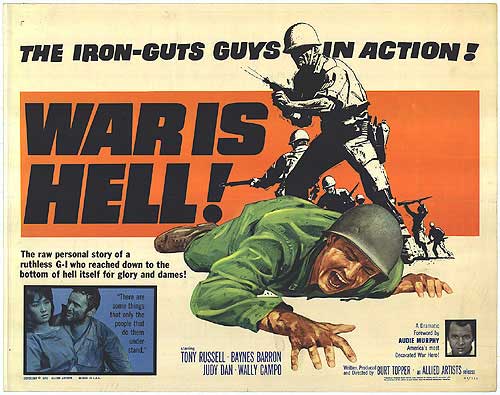
The Demander: Sir, I demand an apology. When you said, “war is hell,” you demeaned every single young American in uniform today, particularly those serving on the Iraqi battlefield of this nation’s War on Terror. You were saying they’ve gone to hell, which is to say they do not deserve to go to heaven. Who are you to judge?

The Offender: What in heaven’s name are you talking about? “War is hell,” is a quote from General William Tecumseh Sherman.

The Demander: That’s your opinion.

The Offender: OK. I regret accidentally offending anyone who agrees with you, if it is true that they were offended.

The Demander: If? I demand you apologize for issuing an insulting apology, and I also call upon you to apologize to Maria Shriver Schwarzenegger.

The Offender: What’s she got to do with this?

The Demander: When you say “war is hell” it has to remind her of the assassin Lee Harvey Oswald, because that was the title of the war movie he slipped into a Dallas theater to see, after he alone shot President Kennedy. Why do you hate poor Maria and the rest of the Kennedy family?

The Offender: How about I just hate Arnold Schwarzenegger’s movies?

The Demander: Your un-apology apologies reek of sarcasm, which is outrageously disrespectful of our troops in Iraq, and brave veterans like President Bush.

The Offender: Sorry. Does saying, “war is the h-word,” make it any better?

Allen's Unsportsmanlike Conduct

Going into the race to hold his seat in the U.S. Senate this year, George Allen seemingly had all the advantages. It was his race to lose, and it looks like he’s about to do that.

The Allen campaign hit the wall on August 11 with his bullying of a Webb staffer -- the notorious “macaca” gaffe -- that became a YouTube phenomenon. Since that fateful date Allen has been in a free fall. Allen may not know much about literature, or war, but he does have a background in football. Like all football fans, he has seen many a game in which the momentum shifted dramatically over one lucky play.

Politics is a game, too, whether we like to think of it that way or not. Having lost the momentum to his opponent, having fallen behind in most of the latest polls, last week Allen threw a Hail Mary pass. Allen attacked Jim Webb’s novels as pornography, smut demeaning of women.

Like last-minute desperation passes do, it caused a sensation during the flickering moments the ball hung in the air.

When the political football landed harmlessly on the turf, Allen saw yellow penalty flags flying; for one last moment there seemed to be hope. When it was announced the penalty was on George Allen -- UNSPORTSMANLIKE CONDUCT -- that likely signaled the end of his chance to stave off an upset.

Strategically, it seems that no matter what the Allen camp has done, it has blown back in Allen’s face. The attack on Webb’s novels being the most recent example.

Has Webb been lucky?

Perhaps, but I’d say it’s more like Webb has seized the moment. As the old football clichĂ© goes -- good luck is when preparation meets opportunity.

And, I am hardly the only writer seeing Allen’s anti-writer maneuver as “unsportsmanlike.” There have been many from the left and the right saying as much. Here are the views of two such pundits about Allen’s laughably sleazy Hail Mary strategy:

William F. Buckley: “Who Is Being Smuttier?

“...At a practical level, Sen. John McCain, than whom no one is better qualified to judge war and writers who describe war, commented about one of Webb’s novels: ‘It captures well the lingering scars of the war. A novel of revenge and redemption that tells us much about both where Vietnam is headed and where it has been.’

“Some say that the mere publication of smutty, erotic, realistic passages from Webb's fiction will undermine his claim to credentials to serve in the Senate. There are many reasons to vote for the Republican incumbent, but anyone who votes for him in protest against Webb's fiction needs to -- grow up.”

E.J. Dionne: “Republicans’ Double Negatives

“...[I]n Virginia we have Sen. George Allen, a Republican, assailing the widely admired novels written by his opponent, Democrat Jim Webb, for what an Allen adviser called "chauvinistic attitudes and sexually exploitative references." Lost here is that Webb's fiction has drawn praise for the moving and realistic way he has depicted war and those who fight for their country. Conservatives should be embarrassed by Allen's last-minute sliming of Webb's books, since conservative critics have been among their biggest fans.”

The last time this writer can recall a statewide candidate dropping in the polls (Rasmussen, CNN) as fast as Allen has, it was Mary Sue Terry in 1993’s gubernatorial race. Allen was the beneficiary then.

Which points to another cliché -- what goes around, comes around.