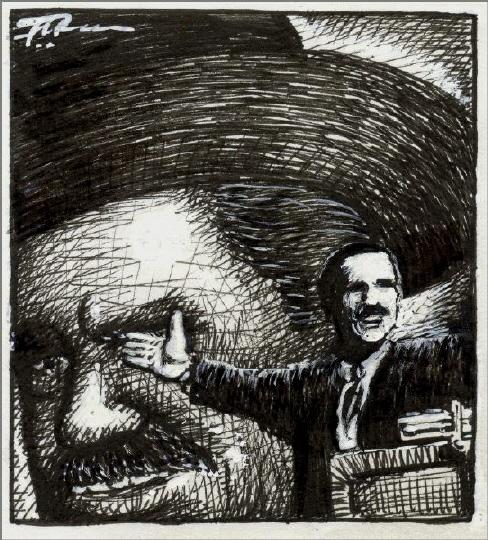
Monday, March 21, 2005

Walking With Baugh

by F. T. Rea

Like successful lawyers can sometimes be, David P. Baugh is not afraid to be garrulous, even galling, when he thinks something important is at stake. In a courtroom he’s a tough customer, yet, Baugh is also a bit of a dreamer, who calls the Constitution is his “religion.”

Consequently, where others saw only indefensible evil, Baugh recognized chances to shore up a basic principle he says he cherishes -- in the USA everyone is entitled to a fair trial. To make that talk into more -- a walk -- at times Baugh has represented notorious clients, charged with heinous high-profile crimes. “Most lawyers don’t get the opportunity to take on such cases,” said Baugh in his roomy office on Cherry Street in Oregon Hill. “Criminal lawyers don’t represent people; we represent a set of principles.”

By “such cases,” no doubt, Baugh was referring to two of his clients, in particular. In 1999 there was the unrepentant cross-burning Ku Klux Klan official, Barry E. Black, of Johnstown, Pennsylvania. Then there was Mohamed Rashed Daoud al-‘Owhali, card-carrying follower of Osama bin Laden. For his role in the 1998 bombing of the American embassy in Kenya al-‘Owhali received a life sentence in 2001, supposedly, with no chance of release.

In pursuit of taking stands Baugh has served a little time (five days for his 1991 courthouse scuffle with then-Commonwealth’s Attorney Joe Morrissey) and he has served on the Richmond School Board. I met Baugh shortly after he began his law practice in Richmond in 1983. Over the years talking with him about politics has always been interesting, because he is not the least bit shy about saying what he thinks, off the top of his head.

During the interview that preceded the Q and A section below a new aspect of Baugh was revealed to me. It was a side of him I hadn’t seen before -- the proud son, with big shoes to fill. His father, Howard L. Baugh (who grew up in Petersburg), was one of the legendary Tuskegee Airmen, who flew P-40s and P-51s in World War II.

The unpracticed warmth in the son’s voice, as he spoke of his father’s military adventures and the medal, France’s Legion of Honor, that was bestowed upon him in a ceremony in Paris last summer, underlined his adoration for his father. “He was always my hero,” said Baugh.


SLANT: As men you had to work with how difficult were Black and al-‘Owhali? Were they in any way similar?

BAUGH: Mr. Black and Mr. al-‘Owhali were zealots, persons driven by a cause. Both were very polite and gentlemanly. There was an initial phase of distrust, but that is to be expected. Due to the nature of the defense, I did not have to work with Mr. Black. The facts were set and uncontested. The sole reason for the trial was to make a record from which to appeal and challenge the statute. With al-Owhali -- a death case -- there was much more work and the need to get the jury to understand the defendant’s perspective to assess the morality, or immorality, of his actions.

S: To prepare for the al-‘Owhali case what did you do beyond gathering facts, to better understand your client’s mindset, and al-Qaida’s motives and its way of operating?

B: For the al-‘Owhali case I tried to read the Koran. Impossible! I did read history books, a lot of Internet information from that area and a wonderful book, “Teach Yourself Islam,” from a woman in England. This 250-page book exposed me to my ignorance and the general ignorance of the West, concerning this religion. When I understood these things I could understand the framework upon which my client’s logic was laid.

S: What does the general public in this country need to better understand about al-Qaida’s nature?

B: In [al-‘Owhali’s] trial, Al-Fadl [a former member of al-Qaida] testified: ‘You cannot understand al-Qaida unless you understand Islam. We have more people willing to martyr themselves than we have targets.

One of the realities of democracy is the need for a well-educated and informed population. [In America] news programs are a collection of sound bites, and the news is slanted. Everyone concerned with the preservation of the world should spend some time learning about Islam and the truth about it.

S: What’s your stand on the military tribunals, rather than trials, for the Guantanamo detainees?

B: The entire policy reminds me of a lousy Nazi movie and [it] reflects a lack of faith in the brilliant philosophy of our constitution -- which is not merely a list of rules, but more accurately, our morality, our moral rudder which guides us and who we are.

S: What’s your reaction to the call for Constitutional amendments to ban same-sex marriages and flag-burning?

B: The proposed same-sex marriage ban and flag-burning amendments would undermine the constitution from within. The sole purpose of the bill of rights is to protect us from our government and the majority of ourselves. When the majority and the government suggest amending to limit rights, rather than expand rights, it should be viewed with great suspicion.

S: Regarding Virginia’s laws and practices, what needs to be changed right away?

B: Virginia needs to be more inclusive. The laws preventing full restoration of convicted felons need changing. These laws are not odd when one considers Virginia’s history of trying to limit the voting base to property owners and whites.

S: Finally, regarding politics, are there any more runs for political office in you?

B: I was on the school board and lost reelection. I still feel that the school system is the key to the resolution of the nation’s woes. Democracy requires a well educated and informed populace. The quality of students being graduated from America’s schools is pitiful, by and large. Basic information is not known to most and information which is not directly related to some paycheck is deemed unnecessary.

If I could spend more time in Richmond, instead of following my practice around the country, I would run for that office again. We cannot make all parents good parents. Therefore [at school] we must expose younger children to that to which they should be exposed. We need to shape a new perspective.

-- 30 --

Thursday, March 17, 2005

SitCons and Stupors

by F. T. Rea

First they stand for this, oops, then they don’t. Then they're opposing that, uh oh, then they won’t. Perhaps the ultra-modern conservatives, or “neocons,” as some call them, would be more aptly referred to as “situational conservatives.” Forget about wishy-washy liberals, today’s brand of conservative is as moody as a chameleon sliding across a checkerboard.

And, now those same nu-style conservatives have climbed down from their moral high-horse, stepped over their obstreperous calls for less government intrusion in life, to insinuate themselves into yet another private situation. Thus, the nation is knee-deep in the story of poor Terri Schiavo, 41, the comatose woman down in Florida with the frozen gasping expression since 1990, whose family has been shanghaied by political goons.

Willing, or not, Shiavo’s husband and parents have become players in a game being dominated by an Orwellian White House propaganda machine, which has become indistinguishable from the so-called fourth estate.

Rather than argue to support either side of the Schiavo case, all I want to do is ask how anyone can say they oppose same-sex marriages -- because to allow for such unions undermines the traditional concept of marriage -- and then flip-flop to support Shiavo’s parents effort to trump the voice of her husband.


Isn’t one spouse’s right/duty to speak for the other -- in times when it’s called for -- at the center of our collective understanding of what marriage has meant? So, unless there’s an indication of malfeasance on the husband’s part, how can anyone see what opportunists are up to in this business, as being “pro-family values,” or the least bit “conservative?”

But, I suppose folks who like to claim they are conservative on fiscal matters, then switch into stupor mode -- so they can believe that President Bush’s radical tax policies and his bumbling adventures in Iraq and environs are actually “fiscally conservative” moves -- might just believe anything. Anything!

The Schiavo battle is hardly about morality. No. Neither was the similar Hugh Finn case, here in Virginia, on former-governor Jim Gilmore’s watch. And, what of dignity? Does "dignity" appear on the necocons’ up-to-date list of that which is worthwhile?
-- 30 --

Wednesday, March 09, 2005

NeoConMen

For readers interested in the history of the neoconservative movement in America this piece by Brian Giles may fill in some blanks:

"...The term 'neoconservative' makes less and less sense the more it is explored. Conservatism is based on preserving the status quo and opposing progressive changes, but the neocons were radicals at heart, defying the very meaning of 'conservative.'"

Surprisingly, in the 1960s, Richmond’s own Supreme Court Justice, the late Lewis F. Powell, Jr., played a role in the story, according to Giles. Read the story in the Weekly Dig: The Best Little Paper in Boston.

Monday, February 28, 2005

For the Sake of Our Children

In Earthlight, a magazine devoted to "spiritual ecology," Robert Kennedy, Jr. looks at snowballing environmental dangers through a prism of morality. He writes with clarity and punch:

"Five years ago, if you asked the leaders of the major environmental groups in America, What's the gravest threat to the global environment?, they would have given you a range of answers: overpopulation, habitat destruction, global warming. Today, they will all tell you one thing: it's George W. Bush. This is the worst environmental president that we have ever had. ...[His administration is responsible for] a concerted, deliberate attempt to eviscerate thirty years of environmental law."

To read Kennedy's examination of the scary Bush policy on matters to do with the environment click here.

Thursday, February 24, 2005

On the Money? Or, On the Make?

Baseball in Richmond's Shockoe Bottom? The Bounce takes a look at the issue and makes a helpful suggestion:

"The initial buzz from the proposal's backers, the Richmond Braves and Global Development Partners, was that the new ballpark with its surrounding development would more or less pay for itself -- in essence it would be free! However, one can go cross-eyed trying to focus on just how free 'free!' would be."

Click here to read F. T. Rea's last sports column for Richmond.com.

Saturday, February 12, 2005

Cross-eyed Mona

Fiction by F.T. Rea

September 21, 1977
: The Luis Bunuel double feature playing at the Fan City Cinema drew a sparse but appreciative crowd. In the lobby, just before the nine-thirty show got underway, manager Roscoe Swift said to a pair of regular customers who were Bunuel aficionados, “Yeah, I suppose if we’ve got to go broke at least we’re doing it with style.” At 10:45 p.m. Swift locked the bank deposit from the evening’s take in the ancient safe in his office. As he left the theater the 29-year-old manager set out to wash away the still-clinging vestiges of a hangover that had dogged him all day. Swift’s destination was the stained glass and wood-paneled confines of J.W. Rayle, his favorite watering hole. Once outside, he decided to walk, hoping the fresh air would do him some good.
Monroe Park was quiet. As he walked Roscoe recollected a series of images from events that had unfolded in that park, which bordered the Virginia Commonwealth University academic campus. The montage stopped abruptly at his memory of a Sunday afternoon live-music happening where a young man fell to his death from atop the park’s cast iron fountain.

Upon arriving at the restaurant Roscoe was glad to see Rusty Donovan was the bartender on duty. He and Rusty had been friends since boot camp in 1966. Eleven years later they were teammates on the J.W. Rayle softball team.

Lean and agile Rusty was the best all-around athlete in his high school class. Yet he passed on opportunities to play college basketball because he didn’t crave competition as do many jocks. Nor did he have any desire to launch a serious career. He liked being a bartender, attracting pretty girls and playing shortstop on the bar’s softball team. All three tasks were easy for Rusty. That’s how he liked it.

Rusty’s droopy mustache widened as he glanced up from washing a glass to see Roscoe. “Yo!”

“Heineken please,” Roscoe said, taking a seat at the bar. “Slow night?”

“So far,” Rusty replied, setting the bottle in front of Roscoe, “Maybe it’ll pick up. Peach said she’d stop by. Sal just called, he’s on his way.”

“It was slow at the Fancy, too,” said Roscoe. “I watched most of ‘Los Olvidados,’ it still knocks me out. Bunuel is the champ.”

“Aw, give me the ol‘ ‘Dog,’ every time,” Rusty laughed. “That eyeball-slicing scene, oh man, the effect it ... it’s cosmic.”

“The audience always groans,” Roscoe affirmed. “What year was it that kid died climbing on the fountain in Monroe Park?”

“Beats me,” Rusty shrugged. “You’re the stickler for dates. I’d guess five or six years ago, maybe more. Why?”

“No real reason,” said Roscoe, “I walked here from the Fancy and something reminded me of being there the afternoon it happened. I didn’t see him fall, but I remember Bake said he was rocking back and forth. I think you and Finn were there, too. I sure remember how the fountain looked, all skewed.”

Rusty asked, “Didn’t that happen the day after we went to that post-Kent State war-protest in DeeCee?

“Sounds right,” said Roscoe. “Kent State was 1970, so...”

“Look!” bellowed an unfamiliar male voice behind Roscoe, “I saw you. Don’t lie!”

Rusty cringed. Roscoe turned to look behind him at the squabbling couple, seated about twelve feet away.

The balding, rather soft-looking man, was probably in his mid-30s. Roscoe pegged him as the ne’er-do-well son of a fat cat. Decked out in a big-collared shiny polyester get-up, the guy had an air about him that reeked of bad karma. His opposite at the small round lounge table was a striking beauty. She couldn’t have been much over 21, if that. With her dark hair and gamine, long-limbed look, Roscoe was reminded of Audrey Hepburn, as she appeared in “Sabrina.”

After taking a generous swig of his beer, Roscoe was pleased to see the veteran bartender cranking the volume up on the bar’s stereo, which was playing a reel-to-reel tape: The rather apt song of the moment was the Amazing Rhythm Aces’ “Third Rate Romance.”

Roscoe cracked his knuckles as he once again noticed the irritating joke reproduction of the Mona Lisa on the back wall; this version of Mona was cross-eyed. Once again, he wondered why the silly thing struck others as funny.

A couple of minutes later the song ended and Roscoe glanced at the bickering girl. She was sitting alone, retouching her lipstick. He studied her gypsy-like eyes, her long nose and wide mouth. Her small head rested perfectly on a swan-like neck. She had a dark tan. Wearing a form-fitting powder blue tube top and tiny floral-print shorts she looked like a fancy dessert.

Leaning on her elbow, lovely Sabrina glanced up from her hand mirror at Roscoe. Her vexed expression melted into a sweet smile that took his breath away. When had he seen her before? After a long second, the girl averted her eyes, unsmiled, and nervously lit up a cigarette. Roscoe turned away, so as not to stare.

His thoughts drifted. Over the previous Labor Day weekend Roscoe and his wife of nearly seven years, Julie, decided to separate, temporarily. He wondered if the hard-edged single man’s life he had been leading would bring tobacco back into the picture. It had been almost a year since he had fired up a Kool Filter.

“Do you believe that?” whispered Rusty, nodding toward the two-top, as Sabrina’s sparring partner returned. “Why would she be with him?”

“What a waste,” agreed Roscoe, polishing off the dregs of his first beer of the night. He closed his eyes to see the teal color of Julie’s eyes light up and dissolve into a familiar picture of her in mid-stride, running on the beach the day her met her.

Rusty placed a second frosty green Heineken in front of his friend and said, “On the house, amigo.”

“Just what the doctor ordered,” said Roscoe, “thanks.”

Sal Modiano, the art professor, walked into the room. Sal was a skinny, cocky son of Italian immigrants from New Jersey, he looked like a character straight out of “The Godfather.” Sal was an ordinary athlete, if that. He played second base on the restaurant’s softball team.

Since the split-up with Julie, Roscoe had been staying in Sal’s Grove Avenue carriage house art studio. The amenities were minimal but the roof didn’t leak. Although he had no plan for what to do next, after only two weeks, Roscoe already sensed that he and Julie would not live together again. While they still cared for one another, far too many injuries to their relationship -- which began the summer before they were juniors in high school -- had been ignored over time, left to heal wrong.

As John Lennon’s voice warbled from the speakers, Roscoe softly sang along, “Ah, bowakawa pousse, pousse.”

“Yeah, yeah ... Turn me on dead-man,” Sal chuckled, as he plopped down next to Roscoe at the bar. “Rustman, I’ll have the same as our leftfielder here. And, ‘Scoe, what the hell does that bozo-cow-eye, pussy, pussy line actually mean?”

“Beats me,” Rusty laughed.

Roscoe shrugged, then suggested to Sal they move from the bar to get further away from the obnoxious battle underway behind them. Sal nodded and picked up his beer to follow Roscoe to a table nearer the back of the room.

Having scored an ounce of expensive hothouse marijuana that afternoon, Sal was wearing a telltale illegal smile. “Bet your life, man, I’m having just an excellent night -- happy hour at the Rainbow Inn, followed by some excellent oysters at Gatsby’s...”

“Who was at the Rainbow?” asked Roscoe.

“The usual suspects,” said Sal. “Zach came in. The mouthpiece bought a round for the house to celebrate winning a big case. Later on JD was in the back booth dealing nasty, nasty half-grams for thirty-five bucks. The sample line felt like he had cut it with Ajax. I think JD, the crazy deejay, is stepping all over the product and going to get himself in trouble. Oh, and Julie came in.”

Roscoe resisted, then asked, “Was she with anybody?”

“One of her girlfriends,” Sal replied. “I forget, ah, heavy jugs, thick ankles, bleached blonde hair. What say we take us a little a ride ‘round the block to burn one? I’ve got a fresh batch of sweet primo for you to test. Forget Julie for a while, man. Give it a rest.”

*

Twenty minutes later, the teammates were finished with their smoke break. Re-entering Rayle’s lounge, Roscoe and Sal were pleasantly surprised to see that Rusty’s sharp-looking new strawberry blonde girlfriend, Peach, was sitting at the bar with another young woman, an equally attractive brunette.

Peach introduced Kit to Roscoe. Sal already knew her, as both girls were art majors who had transferred from Old Dominion University. Both wore the obligatory paint-speckled faded blue jeans and T-shirts that signaled they were art girls.

Peach mentioned that Kit had played volleyball at ODU. Roscoe liked her immediately. He hoped to get to know her better, but when the battling couple resumed their argument, he and Sal fled to their table.

For Roscoe and Sal a discussion followed that digressed effortlessly from the rudderless aspect of current politics into the days of the Grove Avenue Republic, which was a group of anarchy-loving neighbors living on the 1100 block of Grove. That area of the Fan District was the epicenter of a few notable street parties that brought out the worst in the local police force. Roscoe brought up the time the cops actually turned dogs loose to chew up a crowd of hippies.

Sal complained about how the Fan, with its distinctive architecture, was suddenly losing its front porches to a “weird trend” in renovation.

“What’s so wrong about a porch?” demanded Sal, in a voice the whole room could hear. “The Fan is changing, man! No surprise, Bake was right again when he predicted a new breed would move into the Fan to run off the hippies and old folks. Look around, it’s happening!”

“Yep, the times are a-changing,” said Roscoe. “How about having to choose between Disco and Punk Rock?”

“Not in Rayle, not on my shift,” Rusty tossed out from behind the bar. On cue, the next cut on the tape started -- “Poor Little Fool,” by Ricky Nelson.

Sal’s rant morphed into his favorite source of material for yarn-spinning, the colorful life of the late Roland “Bake” Baker.

A bullet to the head finished off Bake in 1975. His body was found in a boarded-up house on Floyd Avenue, a couple of blocks from where Julie and Roscoe lived. It had never been determined what happened, or who else was involved. The weapon that killed him wasn’t found. In the newspaper, according to a police department spokesperson, it was considered to have been, “a drug-related murder.” In the same article, Bake was made out to have been a “known associate of anti-American radicals and underworld figures.”

While Bake had played guitar in a couple of Rock ‘n’ Roll bands and dealt pot on a substantial basis for several years, to cast him as a spy or mobster was preposterous to anyone who knew him at all.

For the benefit of those in the room who were tired of hearing the unhappy couple slug it out, Sal, in full Jersey throat, began telling the “Bake Calling His Shot” story. Roscoe and Rusty had heard it many times.

According to Sal, it all happened at Finn Daley’s pad on Harvie Street. There were six guys there. The happy raconteur named them all to add credibility to the tale.

“They were discussing the clues to the Paul-is-dead controversy, or scam,” said Sal. “Bake was stretched out on his back on the couch. His feet were on the coffee table, next to several beer cans, an ashtray, a bong, and a Coca-Cola bottle. Abruptly, the late Mr. Baker announced, ‘Watch this shot, boys. Swish!’”

Sal took up a matchbook and began acting out the part. “He pulled the last match out and whistled. Then he aimed it, man, squinting one eye. The he tossed it at the bottle, and ladies and gents, the match went straight into the Coke bottle like a guided missile. Voila!”

“Voila?” Roscoe interrupted, “Did it swish?”

“‘Voila,’ is what he said,” Sal fired back. “You remember, Rusty, we measured the flight of the match at over seven feet. That’s a one-in-a-hundred, a one-a-thousand shot, man. He called it. Calling the shot man, that’s…”

“How do you know Bake was aiming for the Coke bottle?” Roscoe inquired. “What makes you think you even know what he meant? He could...”

Sal puffed up. “I believe you were still in the brig then, man. I was there and heard him call the shot. I saw the match go in the bottle.”

Roscoe laughed, “Yeah, I know. Oh, for the record, by then I out of the Navy and in school. I was at class that day.”

It both amused and annoyed Roscoe that so many of Bake’s old running mates were continuing to glorify everything he had ever done. Bake climbed the WTVR broadcast tower. Bake hit a flamboyant politician, Howard Carwile, with a water balloon. Got away with it. When the riot broke out in the midst of the Cherry Blossom Festival, he torched one, maybe two of the police cars. Got away with it then, too. Stranger than the exaggerations of Bake’s actual doings were the ghost rumors and soap opera speculations concerning his demise. Roscoe was uncomfortable with the idea of Bake, who had been his closest friend, becoming a minor league James Dean-like cult figure.

“Knowing Bake,” said Roscoe, as Dan Hicks’ “I Scare Myself” began to fill up the room with close harmony. “I just wonder if he had a vision of the match going into the bottle. Or, if he thought he could will it to do so. No doubt, he was capable of either...”

A glass broke on the floor. Sabrina stood up and stomped her foot. Tearful and angry, she raised her voice, “...and don’t ever follow me again!” Her outraged companion grabbed her arm, forcefully. He hissed something unintelligible.

Roscoe closed his eyes and reminded himself that it was none of his business. Sal glanced sideways at the imbroglio and said, “Damn it, man, I wish he wouldn’t rough her up like that.”

“This is awful!” said Roscoe, turning to look through the antique leaded glass windows at the misty night on Pine Street.

“Ease up, buddy,” commanded Rusty from behind the bar, in a tone unusually stern for him.

The angry girl tried to wrench herself loose from the masher’s grip. In a rage he lifted her off the floor and growled, “You lousy coke-whore!”

Sabrina wrinkled her nose and spat in his face.

With his captive suspended overhead by a grip under her armpits, the man charged across the floor. Although Roscoe would rather have watched someone else deal with the crisis -- after all, he wasn’t in charge and he had a hangover -- no one among the others present moved. Significantly, he was the one most directly between the couple and where they seemed to him to be heading. Roscoe saw the scene’s heavy as about to throw the heroine through the windows, so he sprang from his seat.

Knowing a half-hearted gesture was likely to make matters worse, Roscoe slammed his right shoulder into the villain’s thighs with utter sincerity. Sabrina was freed as a result of the collision. Riding the momentum of his surge, Roscoe ripped the man’s legs up to drive him onto the tile floor on his back.

As he scrambled to his feet, Roscoe heard Rusty asking the damsel if she was all right. Disheveled and flustered, she grabbed her pocketbook and ran toward the door. She didn’t look back or say, “thanks.” Roscoe let the urge to speak to her pass, as his Sabrina disappeared forever.

Having caught his breath the lout got up from the floor, apologized profusely and slapped a $20 tip on his $12 check. Nonetheless, Rusty made him stay for a few more minutes in an awkward silence, to give the woman a better head start. Then he sent the guy packing with, “Listen here, don’t let me see you in here again. Get it? Don’t come back.”

Sal observed, “That slimy dude better be happy he’s not on his way to jail, or the hospital.”

Rusty picked up a fifth of Bushmills from the back bar. He placed three shot glasses on the bar. He poured, “Scoe, I’m glad you put that sicko in his place.”

Roscoe said, “I couldn’t just sit and watch him throw her through the glass. I had no choice.”

“Wa-a-ait a minute, man,” Sal said. “What makes you so certain that’s what he was going to do?”

As the Eagles’ “Hotel California” began to play, Rusty put in, “Look, either way, he had it coming. That poseur was way, way out of line. I’ve served him in here before, he’s always had a bad attitude.”

“No! It wasn’t like that, Rusty,” resisted Roscoe. “I wasn’t punishing him. They were two or three steps from ... I could see where it was going. Otherwise, it’s none of my business.”

Kit supported Roscoe, “I’m sure that poor woman is very thankful, even…”

“How can you know? pounced Sal. “Nobody else in the saloon felt obliged to nuke the dandy. Then again, the girl was pretty, hmmm, just your type.”

“Hey, my type, too,” jabbed Rusty.

“I heard that!” Peach laughed.

“Wait a minute,” said Roscoe. “The only reason I interfered was because I could see what he was doing ... the look he had ... I couldn’t allow it.”

“Interfered?” Sal mocked. “If that was interfering, I’d hate to see how hard you’d have hit the sucker if you held a grudge. Like, do you know him from somewhere?”

“No,” Roscoe laughed.

Rusty and Sal began rehashing the details of a two-month-old disputed game with their chief softball rival, the Back Door, a nearby bar. Roscoe searched the room for someone to testify on his behalf. Kit was talking to Peach. Once again he caught sight of the Mona Lisa painting on the back wall. For the first time, it seemed funny -- Mona’s mugging expression said it all.

Roscoe looked through the windows again. Pine Street seemed the same, but his hangover had subsided. With that realization he remembered where he had seen the expression in Sabrina’s eyes before. It was the key scene in “La Jette,” a short French New Wave film, which was made up of still images that dissolved, one over another.

Solving the mystery pleased Roscoe. Setting his empty glass down, he declared, “You guys can say what you want. I made a total commitment to my particular view of reality. Maybe I’m crazy, I couldn’t just watch.”

“Amen,” said Rusty. “I don’t care about any hidden motives. Thanks for putting the brakes on whatever was going to happen next.”

“I tell you what, man,” said Sal. “Bake would have said “amen” over that go-for-broke tackle, too. It was solid as a brick!”

“There you go, saving a worthy damsel-in-distress, that’s good karma,” said Rusty. “Who knows…”

“Nobody knows,” said Roscoe with a sardonic smile. “Nobody. Pour us three more, please, on me. Let’s drink to wherever hangovers go and to the utmost of worthy damsels, Rayle’s own cross-eyed Mona.”

* * *

(Illustration: F.T. Rea)

Friday, February 11, 2005

Musings About Valentine's Day

From a Valentine's Day piece by Georgie Ann Geyer: "At least since the 14th century, this lovers' festival has been about the romantic and passionate glories of men and women in love. But this year particularly, I wonder what feminism -- not its essence, but the way in which it has developed -- has done to the spirit of old St. Valentine." Click here to read more.

Then do yourself a favor and read some of her other recent OpEd essays. One, about the war in Iraq, is here. Geyer remains one of the most important journalists on international affairs of our time. What a life she has led. Click here to read a short bio of Geyer.

Saturday, January 01, 2005

Wilder Comes Home

In STYLE Weekly F. T. Rea looks at Richmond's new mayor, former Virginia governor L. Douglas Wilder, and what may be in store for the city in 2005 as a result of Wilder's landslide win in November.

"To understand better how a Mayor Wilder may operate, other than to gleefully fire a few high-visibility officials, it’s useful to remember how this 73-year-old man has built his career in politics. Since his election 35 years ago as a senator representing Richmond to the General Assembly, he’s been a pragmatic populist who grasped that if one doesn’t gain the trust of the establishment, governing successfully becomes unlikely. Sure, a politician can win an election on personality, or riding a hot issue, but to get anything done the cooperation of the most important business leaders in the community is usually essential.

"In short, Wilder’s charm and practicality have served him well."

Read the entire Back Page piece.

Sunday, December 26, 2004

Maybe Rosebud

Fiction by F. T. Rea

October 11, 1985: Waiting for the veterinarian to call back about his cat, Pal, Roscoe Swift sat at his old wooden desk. His breath was shallow. He stared at a blank sheet of paper as he struggled to listen to a radio report about one of his heroes, cinema luminary and champion prankster Orson Welles, who had just died.
As the tension gripped Swift's neck and radiated into his arms, he sought refuge from his mounting sense of dread in the realm of memories and imagination. Closing his eyes he saw the foreboding scene that sets the mystery in motion in Welles' masterpiece, "Citizen Kane." There was the mansion, Xanadu, and inside it publishing mogul Charles Foster Kane was dying alone in the shadows.

With his pen Roscoe sketched Kane's slumped body, but with the head of a cat. The artist drew a dialog balloon next to the cat's face. In it he put Kane's ambiguous last word: "Rosebud." He had fashioned the cat's look after Zig-Zag, the little stray Roscoe and his ex-wife, Julie, had taken in a few weeks after their marriage in the summer of 1970. A neighbor on his way to class tossed the kitten in Roscoe's Studebaker to save her from a pack of dogs. Later, Roscoe found her hiding under his seat.

Four years after Zig Zag's unexpected arrival, she disappeared. Eventually, Roscoe found her under a bush in a back yard down the street. Her latest paramour, a black tomcat, scampered off as Roscoe approached. Lying on her side, Zig-Zag was stiff and her eyes were glazed over. Maggots were having at her guts. Patting her head and whispering her name, he carried the body home on a unfinished plank he found.

Through the kitchen window Julie saw him coming. She rushed out onto the back porch and began to sob. Without a word Roscoe placed the board on the porch. Then, as Julie crouched and touched poor Zig-Zag, quite unexpectedly, the cat moved. She was alive!

Roscoe ran inside to call a veterinarian. But seconds later, with Julie holding her, Zig-Zag cried out, arched her back, and gave up the ghost for good. Julie seemed comforted by the notion that Zig-Zag hadn't died alone in another yard. Roscoe mentioned her tomcat friend had been nearby when he found her.

The next day Nixon resigned. Three summers later Roscoe and Julie split up. The sound of the radio broke through his time-trance, abruptly, so he switched it off. Then he noticed loud footsteps, overhead, in the apartment above him. His new neighbor, a woman in her mid-30’s, had a heavy-footed walk.

*

Pal had made her first appearance at Roscoe's English basement apartment shortly after his longtime job as manager of the Fan City Cinema evaporated on the last day of 1982. Virginia Commonwealth University bought the old converted church building and dismantled it to build on the lot. He and his sometimes-live-in girlfriend, Tess Dailey, were having breakfast on an unseasonably warm winter morning, when a peculiar noise got their attention. They discovered a determined gray cat squeezing its way through the chicken wire stretched across the outside of the window.

Roscoe didn't want to encourage the animal to stay around, but playful and charming Tess insisted on feeding it something, which turned out to be his leftover pizza. The next day, ignoring Roscoe's wishes not to name the cat Tess started calling it "Rosebud."

Well, it turned out Rosebud was smart and would eat anything Roscoe would eat. Then, only a month later, Tess, the kid-sister of his old friend, Finn, announced she had given her notice on her art gallery job. Beyond that, she had decided to move to New York to pursue her career as a dancer/choreographer.

"I gotta go before I'm too old and scared to do it," Tess explained.

They hadn't had any sort of squabble, but Roscoe, 35, knew the drill well. She'd seen all his moves and heard all his jokes. Smart, pretty girls her age, 23, know when to say, "when."

Later, in the airport parking lot she leaned her back against his Volkswagen bus, as they kissed goodbye. Roscoe held her chin and couldn't resist using his Bogart imitation: "We'll always have Paris, Schweetheart."

Tess laughed, cried and made him promise to reconsider keeping Rosebud. And, that he did, except he renamed the cat "Pal."

Ultimately, Pal proved to be a good companion. Their morning ritual at the kitchen table, as Roscoe slowly drank his coffee, was rarely changed for any reason until she got sick. Pal always insisted on curling up on the parts of the Richmond Times-Dispatch he had finished reading. She would get up each time he needed to put another section on the used pile. Then she would park herself on the newspaper stack again, to doze. Pal was waiting for him to push his cereal bowl toward her, so she could drink the milk at the bottom.

Taking a break from the numbing fog of nostalgia Swift opened the door, to step outside and check his mailbox. It was noticeably colder than it had been earlier in the day. He found only junk mail and his telephone bill. "It'll keep," he muttered, shutting the box.

He decided to take a walk around the block. Swift breathed deeply, the crisp autumn air smelled good. A pair of pleasant, fragile-looking old ladies offered him a religious tract. He politely said, "No, thank you." Red, orange and yellow leaves were blowing about the street as he considered, once again, the role of irony in the grand scheme of things. Fresh thoughts began to fall into place, his stride quickened.

Back inside, the artist and occasional no-budget filmmaker -- who for his income depended mostly on a part-time position as special events coordinator for a charity -- pulled out a few blank sheets of paper. After a flurry of writing he put the pen down and went to the refrigerator. Breaking his new weekday rule -- no beer before 5 p.m. -- he cracked open a green can of Heineken.

Staring into a poster of a Degas ballerina painting, which was over his desk, another bubble of realization popped: Yes, it had been far too long since he had gotten laid. Roscoe sighed/chuckled, as he reached for the paper to read over what he had just written:

It would be easy to continue to see all of life itself as God. For me that's been a comfortable notion for many years. I have thought of it as a soft-edge brand of existentialism that avoids dwelling on doubt and debate. However, at this particular sad moment I find it more interesting, perhaps more useful, to see God in a different light. What about The Creator as the totally unpredictable random factor that causes change?

Thus, I submit – the ironic God. This God is itself another dimension – fifth, sixth, take your pick. Since it has no form or action we are capable of corralling to measure, it remains beyond the grasp of our reason. Perhaps we sense it most when we take risks, when we are in uncharted waters.

In many ways the biggest risk we take is falling in love. The playful, musical laughter of young lovers -- off, in their own dimension -- may be as close to being at one with this mysterious force as human beings are likely to get.

Putting the page down, the author rubbed his eyes. The text before him seemed to have been written by another hand. It excited him. After another swig of beer he grabbed the pen. Again, the words poured out, effortlessly:

The spark that set life in motion on this planet stemmed from the magic of the aforementioned force -- a force that creates anomalies as it wafts its way, hither and yon, and into the cosmic gears of order.

Why?

Who knows? Who knows if it cares about what it does? Who knows what else it can do, if anything? Preachers say they know, then they ask for money. I say nobody even knows what entity created order, in the first place, so it could then be tweaked by this ironic force of change? We just know that nothing stays the same, and payback is a bitch.

What the hell does that mean?

Maybe everything, or nothing. Maybe Rosebud. If there is inevitably a yes, no, and maybe aspect to all earthly propositions, then perhaps God is a kaleidescope of ever-changing maybes.

Change -- a big bang? -- caused mass to emerge from what had been only energy. Then came more change. We move from single cells, to dinosaurs, to mammals, to whatever is next in line; no doubt, something that will thrive on the poisons my species has unleashed on nature.

No matter how comforted people are by their worshiping of order and predictability, the existence of the species is owed to mutations through the ages. Without the random changes which fall like leaves one time, and a ton of bricks the next, the short life we struggle to live wouldn't even exist.

The phone rang. Walking like a zombie, Roscoe picked up the receiver: "Hello."

He listened to the vet's report: Pal's infection was so massive it was a medical wonder she was still alive. She had not responded to the antibiotic, nor had she regained any interest in eating. Fluids had been pumped into her. She was only getting weaker.

"I'm sorry to have to tell you this," said the careful male voice, "but the quality of, ah, your Pal's life, in whatever time she has left, is only going to continue to deteriorate. Do you want to take her home for the night and see what happens? Or, you might consider putting her down today. It's your decision. Mr. Swift."

"There's no good in prolonging her suffering, " said Roscoe, "if the situation is hopeless. She must be so confused, and..."

"I understand," the vet said. "If you want, we can take care of it in about an hour, including disposal of the remains. But you can still come to see her to say good-bye, or whatever..."

"How do you," Swift cringed, "I mean, will it be lethal injection?"

"Yes," Roscoe heard from the receiver, as his heart sank.

"OK, I’ll be there in a half-hour," said Roscoe. "And, yes I'd like to spend a few minutes with Pal before you put her to sleep. And, well, I’m not so sure about the rest, because I can't... After she's kaput, I'll take her body with me."

"That's fine, I understand," said the man. "And, I'm sorry we couldn't make her well."

"Thanks," said Swift. He hung up. Tears spilled onto his cheeks as he sat at his desk again. He began connecting to other sad times, disappointments, losses, deaths, melancholia. The phone rang, again.

On cruise-control, Roscoe listened to an artificially perky woman he didn't know.

"This may be YOUR lucky day! If you qualify and register now, you will be eligible to win an all-expenses-paid vacation in HAWAII. That's SEVEN sunny days and romantic nights for two in paradise. How does THAT sound to you Mr. Roscoe?"

"What on earth are you talking about?" protested Roscoe. "Ah, listen, my last name is Swift, not Roscoe."

The anonymous voice began again, "That's SEVEN sunny days and romantic nights for..."

"You shouldn’t have called," Roscoe advised. "This is a ... Look, I'm trying to work. Whatever list I'm on, please just take my name off of it."

"This may be YOUR lucky day! If you qualify and register now, you will be eligible..."

Roscoe shouted, "Believe me, I don't qualify! You've got the wrong guy. Look! I never buy anything, and I don't even give a happy Shinola about Hawaii, much less whatever you're selling!"

Swift hung up and walked back to his desk to cut the radio back on. Mercifully, "Rhapsody in Blue," was playing. Pen in hand, he went to work, again:

Shrill voices and strident blather. Relentless telemarketing and talk-show crackpots. Constant accusations. Constant denials. Aggressive promos and seeping disinformation. When you add them all up, the combination becomes a cacophony that stands like a wall of noise, separating us from whatever quiet truths we might discover, but for it.

The wall of noise is more than a mean-spirited abuse of our sense of hearing. It's a greed-driven abuse of the most cherished of rights – Free Speech. In such a maddening condition one of mankind's basic universal pursuits – peace of mind – is all but out of reach.

*

During the fifteen minutes Roscoe spent alone with Pal, in the quiet pale green room in which she would soon die, he found the courage to push through his lifelong needle-phobia. He simply couldn't abide the idea of Pal having to go out without her only true friend at her side. So, he opted to stay on for the execution.

Roscoe gently stroked Pal's head as the vet, Dan Yost, prepared to shoot poison into the animal's veins. His assistant, Sally, held Pal in position by her striped legs. Swift avoided looking at the syringe, hoping to suppress the queasy, lightheaded sweats the sight of an injection -- anyone's injection -- always brought on. To block out his powerful desire to turn away from the nauseating specter, he focused totally on Pal's face, on her eyes that looked so weary.

"Easy there girl," Roscoe said, scratching behind her ears as she flinched from the prick of the needle. "Easy Pal," he said in a low tone that would ordinarily make her purr up a storm. Pal had never liked anybody fooling around with her feet. She struggled weakly to free herself from Sally's grip.

Panic made Roscoe's heart race as he saw Pal's dignity being compromised. Then she slowly turned her head to the side and sank her teeth into his right thumb. Roscoe didn't react. Seconds later, she was motionless.

When Roscoe's thumb began bleeding Dan was shocked: "I've never seen that happen. Hey, I'm so sorry, man. I didn't think there was any way."

"It's OK," said Roscoe. "She never liked being held down. She protested, even if she was ready to go, and she left me something to remember her by. I'm glad."

Dan was greatly relieved and said so. He cleaned and dressed Roscoe's wound and continued to apologize. Roscoe watched Sally's gentle hands as she carefully wrapped the lifeless cat in a white towel. Dan cautioned him to watch for infection and to go to the doctor if there was swelling.

Remembering he needed to call a friend about borrowing a shovel, Roscoe asked, "May I please use your telephone for a short call?"

"Sure, not a problem," said Dan. "And, watch that thumb."

At sunset, Roscoe and two of his oldest friends, Rusty Donovan and Zach Collins, buried Pal under a large oak tree in Byrd Park. Each of the three took turns digging the grave. The oak was located at a dogleg in the middle of the ninth fairway of their unmarked Frisbee-golf course, where their small group had been playing for ten years.

Roscoe showed off his bandage as he told them about what happened when Pal died. He opened the towel and put the lifeless cat into the fresh hole in the ground. After they covered the grave the men toasted Pal with a ceremonial beer. Rusty, who was still always holding, broke out a joint. Stories about favorite pets were exchanged.

The three agreed to meet there the following afternoon for a round of golf. Starting with that next round's play, they began treating Pal's grave site as hallowed ground. It became routine for the players to meow and hiss, out loud, whenever a drive inadvertently smacked into the "Dead Cat Tree."

On a bright morning almost three weeks after Pal's burial, Roscoe saw Sally sitting alone in a new coffee shop that he'd been meaning to try. She invited him to sit at her table. As they lingered over coffee, they shared his Washington Post. She pointed out a funny article about a wild celebration of the 47th anniversary of Orson Welles' "War of the Worlds" radio prank. He told her a funny version of the story of Pal's name-change.

* * *

(Illustration by F. T. Rea)

Thursday, December 02, 2004

Exit The Masterpiece

After 40 years of lazy lunches and stretched happy hours Frank Chiocca closed his place down .

"...Chiocca's Park Avenue Inn was known for its time-capsule atmosphere and its made-to-order sandwiches; the signature sandwich was called "the Masterpiece." It featured an anchovy sauce based on Frank's mother's recipe. Watching his hands carefully constructing a sandwich and arranging the presentation on the plate was always worth studying; he was a polished craftsman."


Read F. T. Rea's account on Richmond.com.

Wednesday, November 24, 2004

Harvey backup

This section consolidated links from earlier posts, it was started at 3:09 a.m. on Jan. 3, 2007
Last Update: Fri., Feb. 10, 12:30 p.m.
The Latest Posts

R-TD: Gag Rule Might Expand

Links to other web sites offering background or reactions to the story of the slain Harvey family have been added and removed, as needed, since this post went up in the wee hours of January 3rd. Readers should feel free to comment, report broken links, or make suggestions. And, thanks to those readers who are helping with the updates.

Richmond Times-Dispatch
Harvey Family Remembered (its entire collection of articles)
Forum: Harvey forum (many pages of comments from readers)
Deadly week in Richmond

Other News & Commentary
John Sarvay's Buttermilk & Molasses (a number of posts)
Don Harrison at Save Richmond
Hollywood Reporter
Rolling Stone
LA Times: Death of a Skyrocket
CNN: Men Charged in Slaughter
N.Y. Daily News: Pals of slain rocker find solace on Net
WRIC: Harveys Remembered
AP: Police consider suspects concerning other crimes
TimesOnline: Obit
Richmond Democrat: Suspects Arrive in Richmond; Charges Explained
Richmond.com: Where do we go from Here?
NO-IDEA: Farewell, Harvey Family
Three Wheels: All Things Must Pass
The Blue Raccoon: World of Tears
Washington Post: Brutal Slayings Shock Richmond
Sarvay at Buttermilk & Molasses: Holding Onto the Memories
SLANTblog: Harvey Segment on Dateline

Photos
Oz Geier's photo gallery
House of Freaks @ GAPD (four pages of late-80s publicity photos)

Background & Tribute
9X: House of Freaks: Remembering The Great, Original Guitar/Drum Duo
Work Magazine profile of Kathryn Harvey
Richmond.com profile of Kathryn Harvey
World of Mirth
Also Also: Bryan Harvey and the New South Gothic
Richmond.com: In Remembrance
bluecricket.com: Ask Bryan (fanzine interview)
Jalpuna: Please remember him well
Trouser Press: House of Freaks
Save Richmond: Bryan Harvey interviewied by Andrew Beaujon (2004)
Elizabeth Cougar for STYLE Weekly: Kathryn Harvey's Imaginative Eye
Greg Weatherford for STYLE Weekly: A Real-Life Love Song
National Review: Remembering Him Well
Henrico County Leader: Devoted father
Rhino Magazine: Bryan Harvey Remembered Well
Rhino (2004 reissue): "Monkey on a Chain Gang" (w/audio samples)
Rhino (2004 reissue): "Tantilla, Plus" (w/audio samples)
Pop Matters: Review of House of Freaks' 2004 reissues
Rhino: Remembering Byran Harvey by Steve Wynn

Memorial Endowment
SLANTblog: Harvey Memorial Fund Established
Radio PSA's to Spotlight Memorial Fund

email condolences to: condolences@bryanandkathrynharvey.net

Monday, October 25, 2004

Unvarnished Schizophrenia

by F. T. Rea

Now 350 tons of explosives, give-or-take a ka-plooey, have turned up missing in Iraq. The best guess is that the stuff was snatched in the early days of the American operation there, which is at 19 months and counting. Perhaps it's a good thing we didn't find any WMDs, because the local hoodlums would probably have stolen them, too.

Which leads to a cold question that should be considered in the hours leading up to the election: Since he took office, what the hell has George Bush done right?

For a man who campaigned as "a uniter, NOT a divider," as "a compassionate conservative," and to be a president who would not use American troops in arrogant missions of "nation-building," how does today's unvarnished reality jibe with Dubya's 2000 campaign promises?

Uh, oh, there I go again -- I was thinking in a pre-9/11 fashion. According to the Bush post-9/11 gospel, asking awkward questions of the Commander in Chief is forbidden. Continuing with the flashback theme, in 1998, when Clinton bombed Osama bin Laden's camp in Afghanistan, the same Republicans blaming poor Slick Willie for 9/11 were branding his effort to strike at al Qaeda as a mere distraction from the then-all-overshadowing Lewinsky scandal investigation.

However, without blaming Bush for 9/11 it is possible to criticize his reactions to it. His administration has used fear like a monkey wrench to grab power so shamelessly that it has shocked the rest of the world. Furthermore, Bush's 2000 campaign promise to govern in such a way as to heal the divisions was pure baloney. So, too, was Bush's alleged compassion; his signature education program has fizzled -- the taxcut agenda won out.

Bush's so-called "conservatism" is counterfeit, too; let's face it, he's breaking the bank with his spending. And, other than "nation-building" what would you call the on-going operation in Iraq? OK, maybe "failed-nation-building" is more on the money.

George Bush is the most dangerous president of modern times. He's off the chart! Bush's neoconservative advisers see a window-dressing of democracy and unfettered corporate capitalism as a sort of new-style religion to be spread by their armed missionaries to enlighten the backward masses of the Middle East.

It says here Bush's twisted policies and outright incompetence are making the world, including the USA, more dangerous every day. That while tough-talking Dubya claims God speaks to him directly -- rather than to TV evangelist Pat Robertson -- about what to do in Iraq.

Uh, oh! What would you call that sort of claim -- deeply felt religion or schizophrenia?

-- 30 --

Wednesday, October 20, 2004

Addicted to Choice

by F. T. Rea

"Whatever gets you thru the night
‘salright, ‘salright.
It’s your money or your life ‘salright,
‘salright.”

-- John Lennon

Obsessions, compulsions and addictions have always been in play. Now we see a somewhat new twist in driven behavior: In a time of plenty, many Americans seem to have become addicted to the act of choosing between this and that. This group has unwittingly developed what amounts to a jones for choosing from a smorgasbord of options.

Yet, as with any buzz, when it subsides the anxious feelings it allayed return with a vengeance. Thus, choice addicts find themselves living in a continuous loop of making choices in order to cope with their habit. This is beyond consuming, it's just about choosing.

Of course Madison Avenue, great facilitator in this shop-’til-you-drop scenario, has long depicted “choice” as utter bliss — Yowser! Yowser! Yowser! These wonderful widgets come in five, I say five, designer colors.

Choice has also been a hot political buzzword for some time. To a person wanting to express a belief that a woman is absolutely entitled to opt for an abortion, choice is a useful word for a slogan. It implies that ending the pregnancy is a matter of a person having dominion over her own body, rather than submitting to an authority claiming to represent society’s collective will. Of course, those calling for “choice” in this case see the individual’s right to choose an abortion as trumping whatever damage, if any, might be done to society by the abortion.

The notion that it should be fine for any citizen to pull his tax money out of the funding of public education, in order to finance sending his own child to private school, is called “choice” by its advocates. While this argument appears to be resting on a brick-hard logic, it ignores the long-held American tenet that everyone in the community has a stake in public education, regardless of how many children they have.

In both cases, the sloganeers show a telling awareness of the lure the word “choice” has today. Perhaps this is due to some new collective sense of powerlessness in the air. Or maybe the scam aspect of selling folks their own freedom is as old as dirt.

In “One-Dimensional Man,” German-born philosopher Herbert Marcuse (1898-1979) warned us in the 1960s about illusions of freedom: “Free choice among a wide variety of goods and services does not signify freedom if these goods and services sustain social controls over a life of toil and fear.” Marcuse’s keen eye saw the counterfeit aspect of the processed brand of freedom wielders of easy credit felt, even then, as they exercised their prerogative to select one set of time-payment obligations over another.

Marcuse’s hard-nosed take on what he saw as controls over modern society is out of style today. But his view of how language is predictably used by a few of us to manipulate the rest of us is still as valuable as ever.

French diplomat Charles Maurice de Talleyrand-Périgord’s (1754-1838) words on the topic of language remain crisp today. Talleyrand offered, “Speech was given to man to disguise his thoughts.” British philosopher/mathematician Bertrand Russell (1872-1970) went further: “Speech was given to man to prevent thought.”

OK, so tricky lingo has long been used to shape perception. However, as a true believer in the unfettered streaming marketplace of ideas, I expect tortured language and agenda-driven slogans to come and go. My point is that the act of choosing should not be so highly valued that it comes at the expense of appreciating what happens after the choice is made.

For example, can constantly switching TV channels for hours be a more satisfying experience than watching one interesting program? Well, the answer probably depends on whether you value what comes after the choice. After all, in order to be able to surf 200 channels, as opposed to only 50 or 100, customers gladly pay extra, although many of them never watch any program in its entirety.

Much of television’s most popular programming feeds its audience a steady flow of information about people who happily act as if they have genuine clout — rich celebrities who cavort about with enough bread to buy anything. Then, quite conveniently, every few minutes, commercials interrupt the celebrity news to offer the viewer a chance to unjitter his jones.

Choices! Schmoices! Anytime your options are limited to what’s on a menu put together by someone else, by choosing from that prepared list you are surrendering some control to the list-maker.

And, the mountain of disposable schmidgets grows, evermore, as choice addicts cast off yesterday’s quick-and-dirty urge, to grab after today's fresh urge, just to get through the night.

-- 30 --

Saturday, October 16, 2004

Buy Nothing Day

The zany folks at adbusters have designated November 26 as Buy Nothing Day, a 24-hour period to avoid making a purchase. In order to stage a boycott that mocks/protests the ugly side of today's consumer culture adbusters has picked the day after Thanksgiving -- the tradional launching of the frenzy that is the holiday shopping season -- for the stunt. In print or online the plucky braintrust at adbusters has always good for cooking up a laugh, and sometimes much more.

"For 24 hours, millions of people around the world do not participate -- in the doomsday economy, the marketing mind-games, and the frantic consumer-binge that's become our culture. We pause. We make a small choice not to shop."

The handbills promoting this collective pause to imagine a life less devoted to defining one's self by what one buys are already up on utilty poles in the Fan District. Click here to learn about the Buy Nothing Day Action Pyramid.

Friday, October 15, 2004

God and Man at Tempe

The always erudite Richard Reeves writes a nice piece that reacts to the discussion of religion that took place during the most recent debate in Tempe. Here's an excerpt:

"...If memory serves, I had heard the phrase [born again] only once before. I was sitting on an airplane, and the guy next to me said, "Are you a Christian?"

"Yes," I said. But I don't talk about it with strangers.

"Are you born again? Have you found Jesus in a personal way?"

I had no idea what he was talking about. I thought about saying I didn't know Jesus was lost. Forgive me. But I decided just to change seats."

Click here to drink in the rest of Reeves' thoughtful words on religion and politics.

Click here to read on Reeves' impressive background.

Imperial Dreams

Georgie Anne Geyer is a legendary journalist/columnist whose analysis of international politics has been required reading for decades. Furthermore, Geyer is anything but a liberal. Her take on what Bush or Kerry would face if elected, and how they would most likely proceed, should be required reading today.

"...If the president wins again, he will oversee an even more radical administration than his first. With his all-or-nothing temperament, he will take re-election as carte blanche to go ahead with his program of pre-emption and imperium. Rather than pulling back from future Iraqs, he will rush ahead, feeling ordained by history. In a second Bush administration, virtually all the moderates will disappear."

Click here for the rest of Geyer's penetrating analysis.

If you are interested in Geyer and her credentials click here for a brief biography.


Thursday, October 14, 2004

Over There

by F. T. Rea

President George W. Bush has warned the voters that his opponent, Sen. John Kerry, is not tough enough to face down America's most dangerous enemies. In stump speeches Bush repeatedly has said that he will not "wilt" or "waver" in prosecuting the War on Terror, the suggestion being that Kerry lacks the manly rigidity it takes to act decisively in matters of national defense.

For example, it was President Bush who swelled up to protect America from Yusuf Islam (formerly Cat Stevens) by having him snatched off of an airplane in Bangor, Maine and promptly deported. On the other hand, Kerry probably listened to Cat Stevens' wimpy pop music when he and the comely but commie-coddling Jane Fonda were smoking banana peels.

It seems the sitting president's boldness to protect America is boundless. So, too, is his subtle shrewdness. Both traits are well illustrated by Bush's trumpeted assertion that he would rather fight the terrorists over there than here. "Over there" meaning Iraq, and "here" meaning the USA. By invading Iraq -- for whatever reason, like, who cares? -- now, if we squint just right, we can see that Bush has created what amounts to a siphon to draw out terrorists from wherever they have been hiding and sucker them into whatever it is that's going on in Iraq.

Who knew it would be so easy to trick al Qaida sleeper cell operatives into throwing off their secret identities and long-planned missions in cities the likes of Buffalo, Fresno, and Tupelo to book passage to Iraq, so they could fight America over there?

President George W. Bush, that's who.

Would a wind-surfing John Kerry have been willing to launch a war on false claims, over the objections of most of our allies, in order to cleanse America of all the potential crop-duster-stealing, anthrax-mailing, power plant-sabotaging, water supply-poisoning, dirty bomb-exploding, suicide mission cats that were hiding in our midst?

Because the quagmire in Iraq is getting bloodier by the minute, the potential to draw every terrorist in the world -- regardless of his creed or cause -- into the fray is growing. Would a President Kerry be willing to spend enough of whatever it takes to keep the battle in Iraq going long enough to snooker all the terrorists into leaving Afghanistan, Japan, Russia, Israel, Ireland, Indonesia and Idaho to fight an American army waiting for them over there?

Where to fight is the key.

Young John Kerry apparently misunderstood where to fight the Vietnam War, as well. Looking to win medals, he traipsed off to Vietnam. While the visionary George Bush opted fly beneath the radar to smoke-out the Viet Cong operatives possibly hiding in Texas and Alabama. Bush was even willing to disappear for a while for an off-the-record mission that was apparently so secret he still won't talk about it.

With less than a month until election day it's important to remember that both Texas and Alabama made it through America's longest war unscathed by communist terrorism. As an undergraduate at Yale Bush learned what would prove to be a valuable lesson about war, while serving proudly as a varsity cheerleader: Some games must be played on the road, others are best played at home.

Ever the stalwart cheerleader, it was Bush who bravely donned a flight suit, stuffed a King James version of the Bible into his jock strap, faced the pitiless cameras, and declared, "Bring it on!"

Which now we know must have sounded something like this to the terrorists -- Hey, all you evil-doers! Drop whatever you're doing in this country. Go to Iraq and blow up anything you like. Yes, cut off some heads, scare American voters out of their wits, and my reelection will be assured.

-- 30 --

Wednesday, October 13, 2004

From Baghdad

Written by Wall Street Journal reporter Farnaz Fassihi, here's the story of how hollow a pharse like "Freedom Is On the March" must sound to anyone close to the sad truth:

"Being a foreign correspondent in Baghdad these days is like being under virtual house arrest. Forget about the reasons that lured me to this job: a chance to see the world, explore the exotic, meet new people in far away lands, discover their ways and tell stories that could make a difference..."

This is a compelling story that everyone should take the time to read, and then tell others to read. Click here to see the rest of it.