Monday, April 15, 2019

Some Biograph-Centric FDSL History

The Biograph Naturals in 1980. (Original photo by Phil Trumbo.)

Referred to as the “hippie league” by softball players who played in the polyester-clad softball world governed by recreation and parks departments, the Fan District Softball League had its own style, which leaned toward cotton, silk-screened T-shirts. Its games were played on “open fields,” rather than in softball complexes with fences. Among other things that meant the Fan League featured a style that put more emphasis on defensive play, rather than simply a home-run derby, with big-bellied Bubbas trotting around the bases.

It also meant the league’s activities received less scrutiny by authorities outside of itself, which was viewed then as a good thing.

The somewhat unorthodox Fan League bubbled up out of the pop culture ooze of the summer of 1973, which was the heyday of WGOE, the daytime AM radio station that then dominated the Fan District in a way that's never been equaled. Its sound could be heard in the shops and on the sidewalks of the bohemian commercial strip of West Grace Street, adjacent to Virginia Commonwealth University. Anyway, it was WGOE that set what eventually became the Fan League in motion, when its promotional softball team of deejays and a few ringers -- the ‘Nads -- played a few games against impromptu squads representing a few regular advertisers on the station, mostly bars.

By the next summer teams began to jell into rosters, but there was no formal schedule. Fields were still being commandeered, rather than secured by arrangement with any proper authority.

By 1975 the name Fan District Softball League had come into use and the six-team organization had its first commissioner — Van “Hook” Shepherd. Cassell’s Upholstery beat the Bamboo Cafe in a one-game playoff for the first season’s championship finale. The four other teams in the league that inaugural season were the Back Door, Sea Dream Leather, Uptop Sub Shop and WGOE.

In 1976, in addition to the regular season the league staged two tournaments. Teams representing the Biograph Theatre, Hababas, J.W. Rayle, deTreville, the Pinheads (the VCU sculpture department and friends) and the Rainbow Inn were formed in 1976.

As the years wore on more bars, and whatnot, came and went. During the first decade of summers of the league’s existence, next to the music and bar scene, softball-related activities were at the heart of the Baby Boomer-driven culture in the Fan District.

Unlike most softball leagues in those days, the FDSL usually had lots of fans at its games. Of course, the kegs of beer that were around — which meant free beer — probably had something to do with that. The freewheeling FDSL was also the only organized-yet-independent softball league in the Richmond area.

Thus, the Fan League governed itself, made its own schedule, cut its own deal with the umpires, etc. It remained so through its last season in 1994.

*

On the first Saturday of May, every year since 1980, a softball reunion is held. Anyone who ever played on one of the Biograph softball teams from any year has been welcome, along with their families, friends, etc.

Serendipitously, that first reunion/old timers game was staged on the afternoon in which the Kentucky Derby would be run. The game was played at Thomas Jefferson HS. Afterward, most of us went to the Track Restaurant to join a Derby-watching party already underway.

The reunion subsequently became an institution and it’s been Derby Day ever since. Over the years, the game has moved around to various locations. Several of the guys at the most recent gathering were teammates of mine in 1976, the first summer of organized softball at the Biograph.

We called our team the Swordfish, after a joke in a Marx Brothers movie. That first year the Swordfish played a schedule that was not set in advance. Instead, our practice was to challenge established teams to play us for a keg of beer.

The lucky Swordfish won 15 games of the 17 we played that initial season. In spite of having few experienced softball players on a roster made up of employees, old friends and a few film buffs -- including two French guys who'd never seen a baseball game -- we probably won half of those keg games by coming from behind in late innings.

Typically, our opponents saw themselves as more experienced/athletically superior, which only made it more fun when they bumbled their way into handing us the victory. That first year, it was uncanny how often those supposedly better teams seemed willing to overplay their hands.

Now, having played and observed a lot of organized softball, I know that virgin Swordfish squad was absolutely charmed. In any sport, it was the loosest team with which I’ve ever been associated.

Both of the Swordfish’s losses came in extreme situations. The first was the championship game of one of the two tournaments we entered. Yes, we won the other one.

The second was played inside the walls of the old state penitentiary. Located at Belvidere and Spring Streets, the fortress prison loomed over the rocky falls of the James River for nearly 200 years (it was demolished in the early-1990s).

As it happened the guy in charge of recreation at the pen frequented J.W. Rayle, a popular bar of the era, located at Pine and Cary. During a conversation there he asked me if the Biograph team — I played outfield and served as the coach — would consider taking on the prison’s softball team on a Saturday afternoon. Chuck Wrenn, the bar manager at Rayle, had already told the guy the restaurant's team would do it. So I went along with it, too.

As it turned out the first date the prison guy set up was canceled, due to something about a small riot.

OK.

A couple of weeks later the Swordfish entered the Big House. To get into the prison yard we had to go through a process, which included a cursory search. We had been told to bring nothing in our pockets.

As we worked our way through the ancient passageways, sets of bars were unlocked and then locked behind us. Each of us got a stamp on our hands that could only be seen under a special light. Someone asked what would happen if the ink got wiped off, inadvertently, during the game. He was told that was not a good idea.

OK.

The umpire for the games — Rayle played the prison team first, then the Biograph -- was Dennis “Dr. Death” Johnson, a rather high-profile Fan District character, at the time, who played on yet another team. Among other things, Johnson did some professional wrestling, so he was good as hamming up the umpire's role.

The fence in left field was the same high brick wall that ran along Belvidere Street. It was only about 230 to 240 feet from home plate. Yet, because of its height, maybe 30 feet, a lot of hard-hit balls caromed off of it. What would have been a routine fly ball on most fields was a home run there. It was a red brick version of Boston’s Green Monster.

The prison team, known as the Raiders, was quite good at launching softballs over that towering brick wall. They seemed to have an unlimited budget for softballs, too. Under the supervision of watchful guards, about a hundred other prisoners seated in stands cheered for the home team. Actually, they cheered the loudest for good plays in the field and sliding collisions on the base paths.

During a conversation with a couple of my teammates behind the backstop, I referred to the home team as “the prisoners.” Our opponents’ coach, who was within earshot, immediately stepped toward me. Like his teammates, he was wearing a typical softball uniform of that era with “Raiders” printed across the chest in a script and a number on the back.

“Call us the Raiders,” he advised, somewhat sternly, as he pointed to an awkward-looking mural on the prison wall that said, “Home of the Raiders.” It looked like a jailhouse tattoo, blown up large.

OK ... it was obvious, I had made a faux pas.

“While we are on this ball-field, we’re not The Prisoners,” he said with, ahem, conviction. “We’re the Raiders.”

“Raiders,” I said. “Right.”

“And, all our games ... are home games,” he deadpanned.

We all laughed, grateful the tension had been broken. The Raiders coach patted me on the back and thanked us for being there, for agreeing to play them.

In a tight, high-scoring affair the Raiders prevailed. Johnson knew how to play to the crowd with his calls, too. Afterward, I was glad the Swordfish had met the Raiders. And, I was glad to leave them, too. Located smack dab in the middle of Richmond that prison was a perpetual nightmare in our midst. 

In terms of winning and losing, the Biograph teams that played on in the FDSL through 1994 never found anything close to the success that first year's team knew. Still, popups and bad hops aside, I'll wager most of the guys from the 1976 team remember more details about their meeting with the Raiders than many of the games we won playing at Chandler Ballfield, the home of the "hippie league" for 18 years.

*
In 1978 the league expanded to 12 teams. That's the year the FDSL began throwing a party draped around its All-Star Game, in the middle of each season. Each summer in mid- to late-June, the stars of the Mars Division played the stars of the Jupiter Division. As I remember it, Buddy Noble came up with the notion of using planets for the names of the two six-team divisions.

The method for selecting the all-stars varied with the year. Occasionally there were votes held, more times there were caucuses of the bossiest guys; the best teams always put more men on those squads. Other times, each manger just named three players from his team. No matter how it was done, popularity, or the lack of it, always influenced the results. 

In 1980, blonde bombshell Donna Parker and the aforementioned Dennis Johnson made a memorable appearance at one of the All-Star Games at Chandler Ballfield. The ever-outrageous Johnson was dressed in his Dr. Death mask and wrestling costume. His date was outfitted in a black leather bikini. Space limitations don't allow for elaboration at this time, but Johnson left town soon afterward.

In 1982, the Bamboo Cafe went through the regular season undefeated, 33-0, but lost to its bitter rival, Hababas, in the finals of the playoffs. Throughout the decade of the '80s one of those two outfits won the playoffs every time.  

For several years during the ‘80s the all-star exhibition/party was staged at the Colombian Center in Henrico County. That era had the largest turnouts for the annual event, as between 200 and 300 people paid five bucks each to attend. Once admitted the beer was free and the food was plentiful.

 In the foreground: Artie Probst, Fitz Marston and Paul Sobel at the 
1985 All-Star Game at the Colombian Center.  

One particularly hot day for the party, according to the Budweiser truck guy, the attendees went through 22 kegs of beer. Figuring 200 beer drinkers, do the math.

For music, a couple of years Chuck Wrenn deejayed the parties. In 1986 the Motovators played live. The softball games were played on what was a field always in poor shape -- rocks in the infield and overgrown clumps of weeds in the outfield. We played with a rule against sliding on the base paths, to prevent injuries. The late Pudy Stallard was once called out, when, out of habit, he slid into second to beat a throw from the outfield.   

In 1987 and ’88 the food contest was at the center of festivities. Each team put out a spread to share and the consumers voted for the best of them. Some teams went to great lengths to coordinate their overall entry, others simply had people bring out covered dishes and whatnot.

The most talked about of all the efforts was the 3rd Street Diner’s 100 pound hamburger in ‘88. The beef was packed into a giant patty at the Diner. It was hauled around with great care, so as not to break it apart. The huge bun was put together at the Tobacco Company and baked in one of its large ovens.

Cooking the burger on an open grill at the picnic site turned out to be the best part of the ordeal. There must have been 25 experts and assistant experts standing around that grill, opining on how to go about doing the the job. The burger itself was a good eight inches thick. The flipping of the thing, to cook it all the way through -- without having it fall apart -- turned out to be an engineering task.

After all the kibitzing, it was done without mishap, much to the delight of one and all. A spontaneous celebration ensued ... smoke-um-if-ya-got-um. 

The FDSL also established its Hall of Fame in 1986. The first class was elected by the 12-team outfit’s designated franchise representatives. To be eligible then one had to have retired from play and considered to be among the founders. Ten names were selected as the first class of Hall-of-Famers.

The same rule held true in 1987, when six new names were put on the plaque. However, by 1988, a few of those who had been inducted into the Hall had un-retired.

So, in 1988, eligibility to the Hall was opened up to anyone who seemed deserving. Those already in got to vote, as well. Nine new members were selected. The meetings to select new inductees were always quite lively, as were most FDSL meetings, the voting process was probably no more twisted than any hall of fame’s way of choosing new names.

For 1989 six additional names were added. The class of ‘90 included seven names, and in ‘92 the last five names were tacked on. In all, 41 players and two umpires were tapped. The list leans heavily toward those who made significant contributions to the league's lore in its early years.

Those men who were inducted into the FDSL’s Hall between 1986 and 1992 are as follows: Ricardo Adams, Herbie Atkinson, Howard Awad, Boogie Bailey, Yogi Bair, Jay Barrows, Otto Brauer, Ernie Brooks, Hank Brown, Bobby Cassell, Jack Colan, Willie Collins, Dickie deTreville, Jack deTreville, Henry Ford, Danny Gammon, Donald Greshham, James Jackson, Dennis Johnson, Mike Kittle, Leo Koury, Jim Letizia, Junie Loving, Tony Martin, Kenny Meyer, Cliff Mowells, Buddy Noble, Randy Noble, Henry Pollard, Artie Probst, Terry Rea, John Richardson, Jerry Robinson, Larry Rohr, Billy Snead, Jim Story, Hook Shepherd, Pudy Stallard, Durwood Usry, Jumpy White, Barry Winn, Chuck Wrenn.

At this writing, by my count, 10 guys on the list above have died (I may not have this completely up to date), with Howard Awad being the most recent to pass away. 

As an organization, the Fan District Softball League lasted 20 years, which was a wonder in itself. There are plenty of true stories from those years that are almost unbelievable. 

-- 30 --

Tuesday, March 19, 2019

Rhoades' Army

Here's my take on VCU's men's basketball team's weekend that was and its much-anticipated weekend ahead in the limelight of the NCAA Division I Men's Basketball Tournament. It was written for Style Weekly.

In recent years VCU has grown accustomed to participating in that postseason tournament. The Rams are making their 17th NCAA appearance, overall, and this year's bid is the eighth of the past nine seasons.

Accordingly, in the East Region on Fri., Mar. 22, at approximately 9:40 p.m., VCU's Rams (25-7) will meet the Knights of the University of Central Florida (23-8).

The game will mark Rams' second-year head coach Mike Rhoades' first trip to the Big Dance as VCU's skipper. It will take place at the Colonial Life Arena in Columbia, S.C. CBS will carry the broadcast.

Friday, March 15, 2019

Restoring Confidence

Final score in Brooklyn: Rhode Island 75, VCU 70.

The loss sent Coach Mike Rhoades' (pictured left) team home from the A-10 tournament early, to shake it off and prepare for their first game in the NCAA tournament.

Given the loss of Marcus Evans (left leg injury), VCU's all-conference point guard and top scorer, somebody had to step up. Marcus Santos-Silva did exactly that: 26 pts./22 reb. Unfortunately, some of his teammates couldn't seem to get over seeing Evans helped off the court in pain.

However, VCU still should not have allowed a clunky team that averaged 67.6 points per game during the regular season, playing against opponents with defenses inferior to VCU's, to score 75 points in a postseason tournament tilt. Period.

*

The VCU Rams were brimming over with confidence during their 12-game winning streak to finish off the regualr season. It was obvious in their performances during those games and in post-game interviews. The kids were having a good time and it showed -- but not in a bad way.

Following VCU's frustrating loss in Brooklyn the Rams head coach is now being called upon to restore his team's confidence in itself. Its confidence that the coach's "army" scheme not only worked in the regular season it actually has them prepared -- as a team that uses 12 players in most games -- to fill into the gaps, to get better and move on.

Playing without Evans in VCU's first game in the NCAA tournament will change the chemistry of the Rams offense, but the math is simple. It will mean other capable players have to hunt for shots.

Going into this season, coming off of last season, Rhoades resolved that VCU's half-court defense would be much better this year: “We're going to guard people and going to stop people.”

If VCU can get it's swagger back in gear, its feared overplaying defense can hold a good team that's never seen the Rams defense before to a score in the 50s.

That's how to win the next game with the Rams top scorer unavailable. Now Coach Rhoades has a job to do. It's the job he was born to do.

-- 30 --

Tuesday, February 19, 2019

Woody Drake's Yearbook Picture

On Nov. 8, 1992, the revenge-driven crime spree ended as the man I remembered as Drake the Flake blew out his brains with a .32 caliber revolver. In the 11 hours before taking his own life Lynwood C. "Woody" Drake III had shot and killed six people, wounded a seventh and beaten a former landlady with a blackjack.

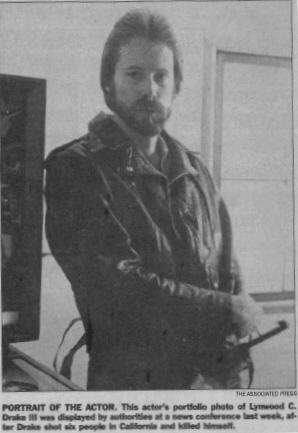
It had been over 20 years since I saw him last; it was in the lobby of the movie theater I then managed, the Biograph Theatre. Still, when I saw the AP photo of him in the Richmond Times-Dispatch 27 years ago, Drake was instantly recognizable.

More about Woody Drake later, but it should come as no surprise to most film buffs that sometimes there is a dark side to the business of doing business after the sun goes down. Some saw the Biograph (1972-87) as a movie-themed clubhouse. For others it was a place to hide from reality. So, like any business, sometimes unexpected things happened; sometimes things just went wrong.

*

There were crazy, street people who would sometimes cause trouble. Although nearly everyone who worked at the Biograph during my almost-12-year-stint as its manager was on the up-and-up, there were a couple of rotten apples. As I hired both of them, I have to take the blame there. But those are stories for another time.

Then there were the customers. One man died in the Biograph. His last seconds spent among the living were spent watching "FIST" (1978), starring Sylvester Stallone, in an aisle seat in the small auditorium -- Theatre No. 2.

Yes, the movie was bad, but who knew it was THAT bad?

At the time I was 30 years old. The dean man was about my age. His man 's face was expressionless. His eyes were open. As the rescue squad guys shot jolts of electricity into his heart, his body flopped around on the floor like a fish out of water. Meanwhile, down in Theater No. 1 "The Rocky Horror Picture Show" was on the screen delighting its usual crowd of costumed screwballs.

There was the night someone fired five shots of high-powered ammo through one of the back door exits into Theatre No. 1. Five bullets came through the door's two quarter-inch steel plates to splinter seats. This all happened just as the crowd was exiting the auditorium, at about 11:30 p.m. It seemed no one caught on to what was happening. Amazingly, no one was hit. Later the police were baffled, leaving us to speculate as to why it happened.

Another night, a rat died in the Coca-Cola drain and clogged it up. Not knowing about the rat, and thinking I knew what to do to clear the clogged drain, I poured a powerful drain-clearing liquid -- we called it "Tampax Dynamite" -- directly into the problem.

Soon a foul-smelling liquid started bubbling and backing up all over the lobby's carpet. A flooding mess ensued. It ran everybody out of there on a busy Saturday night. We had to replace the carpet.

*

Back to Drake: The news stories reported that Drake, who fancied himself as an actor, had compiled a long list of people he intended to pay back, someday. Drake wore theatrical grease paint on his face when he committed his murders. As the cops were closing in on him Drake punched his own ticket to hell.

From what I found out Drake's childhood was straight out of a horror movie. Apparently he was always a problem to those around him. The photo above -- it was a publicity shot he used to apply for work as an actor -- ran in the Richmond Times-Dispatch on November 16, 1992. What follows are excerpts of a piece I wrote for SLANT a couple of weeks later.
...The November 16th edition of the Richmond Times-Dispatch carried Mark Holmberg's sad and sensational story of Woody Drake. As usual, Holmberg did a good job with a bizarre subject. In case you missed the news: Lynwood Drake, who grew up in Richmond, murdered six people in California on November 8. Then he turned the gun on himself. His tortured suicide note cited revenge as the motive.
An especially troubling aspect of Holmberg's account was that those Richmonders who remembered the 43 year old Drake weren't at all surprised at the startling news. Nor was I. My memory of the man goes back to the early days of the Biograph Theatre (1972). At the time I managed the West Grace Street cinema. So the unpleasant task of dealing with Drake fell to me.
Owing to his talent for nuisance, the staff dubbed him 'Drake the Flake.' Although he resembled many of the hippie-style hustlers of the times, it was his ineptness at putting over the scam that set him apart. Every time he darkened our door there was trouble. If he didn't try to beat us out of the price of admission or popcorn, there would be a problem in the auditorium. And without fail, his ruse would be transparent. Then, when confronted, he'd go into a fit of denial that implied a threat.

Eventually that led to the incident in Shafer Court (on VCU's campus) when he choked a female student [Susan Kuney] who worked at the Biograph.
That evening he showed up at the theater to see the movie, just like nothing had happened. Shoving his way past those in line, he demanded to be admitted next.
An argument ensued that became the last straw. Drake the Flake was physically removed from the building, tossed onto Grace Street, and banned from the Biograph.
The next day, Drake made his final appearance at the Biograph. He ran in through the lobby's exit doors and issued a finger-pointing death threat to your narrator. Although I tried to act unruffled by the incident, it made me more than a little uncomfortable. In spite of the anger of his words, there was an emptiness in his eyes. In that moment he had pulled me into his world. It was scary and memorable.
Using a fine turn of phrase, Holmberg suggested that, "Whatever poisoned the heart of Woody Drake happened in Richmond..."
If you want more evidence of the origins of the poisoning, take the time to look him up in his high school yearbooks (Thomas Jefferson 1967/68). Pay particular attention to the odd expression in his eyes. Looking at Drake’s old yearbook photos reminded me of a line in the movie 'Silence of the Lambs.' In reference to the serial-killer who was being sought by the FBI throughout the film, Dr. Lechter (a psychiatrist turned murderer himself) tells an investigator that such a man is not born; he is created.
There is no doubt in my mind. Someone close to Woody Drake, when he was a child, systematically destroyed his soul. So while we can avert our eyes from the painful truth, we basically know where the poison is administered to the Drake the Flakes of the world.
Yes, we do. The assembly line for such monsters runs through their homes. The story went that Drake liked to beat up women. After I literally threw him out of the Biograph and he disappeared, several people told us stories about various females he had hurt.

Shortly before Drake ended his wretched life, he woke up a 60-year-old woman by smacking her in the head with a blackjack. She scrambled to hide under her bed and lived to tell the story.

-- 30 --

Saturday, February 09, 2019

Looking Before Leaping Still Pays in 2019


On Friday, February 1, Virginia's blackface scandal dropped on the Governor's Mansion (pictured above) like a bomb from the sky. On social media the calls for Gov. Ralph Northam to resign erupted so quickly it almost suggested that some of those expressing their outrage had been poised to pounce.

To those demanding Northam's departure from the Governor's Mansion, immediately, it seemed the existence of the now infamous photograph of two costumed people posing – one in blackface, the other in a white-robed, masked KKK get-up – was sufficient to close the book on Northam's term in office. No need to hear the governor's explanation.

To make matters worse, on Saturday afternoon Gov. Northam stood before the gathered press to awkwardly withdraw a significant aspect of what had been his Friday night apology. Without fully explaining why he had originally admitted to being one of the two pictured in the 1984 photo, he claimed he had determined (through a tortured process) that he had been wrong to say he was in that snapshot ... because he wasn't.

When Northam went on to volunteer that in 1984 he had indeed painted his face black for a dance contest costume in Texas, well, it did little to rescue the moment for him. Watching that bizarre presser was simultaneously stunning and laughable. To say the governor's panic-driven alibi strained credulity is an understatement.

Looking at all-star photographer Jay Paul's telling photos of the reactions in the room, it seemed even the jaded working press was aghast. Afterward, there were way more questions than there had been before Northam stepped before the microphones. Therefore, at that point, man oh man, I was sure Northam's goose was cooked.

Now I have to say maybe I was wrong. Furthermore, maybe a lot of us in Virginia should stop rushing to pronounce our judgments cooked up by Facebook feeding frenzies.

Democrats who had seemed rather delighted with the prospect of Lt. Gov. Justin Fairfax ascending to the governor's position were then sucker-punched by the sexual assault charge that surfaced against him. Those who wondered, what the hell could be next? got their answer in the form of Atty. Gen. Mark Herring's bewildering and somewhat tardy admission that he'd worn a blackface costume in his college days.

For me, that was when it all began to feel surreal. Then came another charge against Fairfax from a second woman. This time it was rape. With that thickening of the plot, it seemed Fairfax might turn out to be the first big shot Democratic politician to walk the plank.

Meanwhile, a week later, it's looking like Northam is still determined to try to ride it out. At least he hasn't been charged with a crime. One thing for sure, there's no template, no playbook, to guide him or any of us.

So who knows? Crazy as it might sound, once the dust settles maybe we'll be in a better place. How could that be?

Maybe by then we'll have learned more about the racism in Virginia (and elsewhere) that's still festering below the surface. The racism that, by habit, too many white people conveniently ignore. I know I've thought more about the cruelty of blackface than ever before. Seeing its shameful place in the Jim Crow era, rather than dwelling on its strange place – fetishistic? – in show business history, was edifying for me. Maybe for others, too.

On top of that, we Virginians may also have caught an instructive glimpse of what might be wrought by living angry and outraged all the time, with zero tolerance and no sense of proportionality.

Obviously, we need to hear the plain truth from these office holders, ASAP. Let's see what additional background information emerges and let's see how each of them handles his own fitness crisis. At this point, I'll withhold my demands. Instead, I'll try to use what I've learned to see each development more clearly for what it is in its context.

Bottom line: Yes, dear reader, it still pays to look before leaping.

-- 30 --

Monday, January 21, 2019

VCU Men's Basketball Team is Now Drawing Notice

Today's projections from CBS Sports for NCAA March Madness brackets have Saint Louis getting the A-10's automatic bid and VCU getting an at-large invitation (First Four). Remember, this is just some guy's (Jerry Palm) predictions.

Five teams the Rams have already faced are also on the list of 68. They are Temple, St. John's, Hofstra, Texas and Virginia. Yes, it helps that the Rams beat three of them. Smart VCU fans should hope that entire group does well from here on.

Meanwhile, Saint Louis is the only team VCU still stands to play (Feb. 26 at the Siegel Center) that is on today's list of likely invitees. With so many games left to play, obviously these projections will probably change, maybe a lot, over the next six weeks. 

So, for the most part, all this means to Rams fans is that VCU's body of work is getting noticed. My take on this is that at 13-5 the Rams have now shrugged off the mediocre seventh-in-the-A-10, prediction (from the A-10 media) they started the 2018/19 season out saddled with. Perhaps they were underestimated? Or are they maybe overachieving?

VCU's current RPI is No. 31. The Rams' NET rating today is 51.

Sunday, January 13, 2019

Purity or Expansion

My opinion? Of course I'll weigh in. 
A fair-minded observer would have to say the Democratic Party picked up some momentum from the 2018 elections. What should Democrats do within their own ranks to best use that momentum?

Should they expand the party by welcoming a variety of opinions and encouraging people to express themselves? Or should Democrats circle the wagons, refine their message to a couple of good catch-phrases and then insist upon messaging loyalty from the top on down the line?

Democrats who want more than anything else to win the next presidential election need to think it over and discuss it. Soon the leaders of the party should be deciding between policies designed to start reshaping the party in just one of two directions:
1. Expand the party by taking in more people, all around its current periphery. Campaign in every district and encourage all anti-Trumpists to hop on the bandwagon. 

2. Force the party to be more uniformly "progressive" by moving to the left on as many issues as feasible. Campaign for big turnouts in targeted states. 
It says here you can't really do both, simultaneously. At least not convincingly.

Here's what planners have to ask themselves: Does moving significantly to the left energize more voters than it turns off? Does going hard left recruit enough new voters to outnumber the old voters it leaves behind?

On Nov. 6, 2018, I was delighted to see Rep. Alexandria Ocasio-Cortez win. Since then, watching her confound her detractors has been fun. Now I hope she and other socialist-leaning liberals will be successful in convincing lots of other Democrats to move the party to the left on a number of issues.

Likewise, I hope state legislatures become more liberal. Remember, in Virginia both houses of the General Assembly are up for election on Nov. 5, 2019.

OK, I see the notion of purging so-called “moderates” or “Clintonistas,” from the Democratic Party, as a mistake. Punishing well-meaning people because they won't change fast enough is frequently a mistake.

Meanwhile, some "progressives" have been adamantly defending the sort of rough language they used to complain about Trump using. To them, saying "fuck," on the record -- as have Rep. Rashida Tlaib and Beto O'Rourke recently – should nowadays be heard as evidence of one's "passion."

Passion? Really?

Hey, I'm not the word police, but on this matter I have to call out hypocrisy. Which doesn't help when you're trying to appear to be more credible than your opponents.

For what it's worth, I think the 2020 presidential election will be much more about truth and trustworthiness than it will be about ideology. Therefore, on election day 2020, I think a lot more voters will go for a presidential candidate they believe is most trustworthy. That instead of the one who promises to satisfy their wish list.

Maybe I'm wrong. I hope not.

Summing up, I think Democrats should let their members and representatives follow their ideological hearts and speak honestly about their thinking. If that means there is no one "national message" for the whole party, then fine. They can disagree about some issues, as long as they all agree that honesty in all things and adherence to the rule of law are valued above all else.

Bottom line: In 2020 a righteous agenda will be served by sending a trustworthy Democrat, who listens to advice from wise heads, to the White House to clean up Trump's mess.

-- 30 --

Tuesday, January 08, 2019

Five Film Favorites: Newspapers

by F.T. Rea
Legendary editor Ben Bradlee at the Washington Post.

This installment of Five Film Favorites offers a special challenge. It touches on two industries I've poured years of my time and toil into – the movie business and periodical publishing. It's also challenging, because, from what I can tell, after the field is properly narrowed with some rules, the remaining list of outstanding flicks about newspapering isn't as long as one might expect.

Then again, this list is isn't about declaring what I think are probably the five greatest films in the category. Instead, it's about favorite films. My favorites, today. Next week the list could change.

About those rules for this column: “Citizen Kane” (1941) isn't on my list this time. Here's why: Rather than focusing on Charles Foster Kane, the publisher or editor, etc., it's really more about Kane, the vain empire-builder who must dominate all he surveys. That and the lonely Kane, who has a fetish for collecting objects. Although it has been one of my all-time favorite films since forever this time around it doesn't make the cut. Rules.

“The Parallax View” (1974) is well worth watching again. Nonetheless, it's more a political thriller with a dauntless reporter for a protagonist. It's not a look at the people who put out a newspaper and how they do it. Accordingly, this means a ton of movies, good and bad, are being ruled out for this particular list since they rely too much on cliché-ridden variations of the independent-minded reporter being a fist-fighting, tough-guy detective.

So, in addition to being about films with interesting stories to tell about good characters, this list is about appreciating what it takes to assemble the staff, gather the news properly, write and edit the copy on deadline, design the pages, sell the ads, run the presses and circulate the newspaper. In alphabetical order, here are my five favorite films about newspapers:
  • “All the President's Men” (1976): Color. 138 minutes. Directed by Alan J. Pakula. Cast: Robert Redford, Dustin Hoffman, Hal Holbrook, Jason Robards, Jack Warden. Note: In covering a story about unusual burglars getting caught breaking into the Democratic Party's headquarters, which was in the Watergate building, Washington Post reporters Bob Woodward (Redford) and Carl Bernstein (Hoffman) find some loose ends. Following up, they begin an investigative journey that eventually hastens the collapse of the Nixon presidency.
  • “Between the Lines” (1977): Color. 101 Minutes. Directed by Joan Micklin Silver. Cast: John Heard, Lindsay Crouse, Jeff Goldblum, Jill Eikenberry, Gwen Welles, Michael J. Pollard. Note: As the 1970s wound down the alternative periodicals that had thrived in the late-'60s and early-'70s began to go out of style. And, the baby boomer staffers for such publications were getting older. This film reveals the conflicts they faced and the angst they felt as the culture was changing and their time for being carefree and cool was running out.
  • “Deadline U.S.A.” (1952): Black and white. 87 minutes. Directed by Richard Brooks. Cast: Humphrey Bogart, Ethel Barrymore, Kim Hunter, Ed Begley, Paul Stevens. Note: Bogart is the embattled editor of a large daily newspaper that's about to be sold off to tabloid-publishing interests that will pull the plug on it. It's interesting to see that some of the problems large newspapers have struggled with in the last 20 years of decline seem to go back much further than the age of the Internet. This film's noirish style and somewhat corny plot actually holds up pretty well.
  • “Newspaperman:The Life and Times of Ben Bradlee” (2017): In this documentary black and white and color still images, as well as movie footage are presented. 90 minutes. Directed by John Maggio. Note: Among those seen and heard (as themselves) are: Ben Bradlee, Carl Bernstein, Bob Woodward, Tom Brokaw, Sally Quinn, Jim Lehrer. Most folks are at least somewhat aware of Bradlee's pivotal role as the editor of the Washington Post during the Watergate scandal (See "All the President's Men"). However, Bradlee's life story, before and after that episode, is well worth knowing more about.
  • “Spotlight” (2015): Color. 129 minutes. Directed by Tom McCarthy. Cast: Mark Ruffalo, Michael Keaton, Rachel McAdams, Liev Schreiber, John Slattery, Stanley Tucci. Note: In 2001 investigating the Catholic Church for charges of facilitating the sexual abuse of children, many children – in Boston! – posed quite a problem for the Boston Globe. This view of the methodology of the editors and reporters doing their jobs properly is as good as it gets. The revelation of the powerful forces against them is brutally unsparing.
By the way, another rule I usually apply to movies selected to be on Five Film Favorites lists is that I must have seen the picture more than once. It's a good rule. Accordingly, I just watched “Spotlight” again recently, so I could include it. It's a well-crafted film.

These five movies do a good job of presenting pictures of inky newspaper people, on the job, publishing – always on deadline! – what Washington Post publisher Phil Graham liked to call, “the first rough draft of history.”

-- 30 --

Saturday, January 05, 2019

FLASHback to 1980

Working in show business can be tough duty. Ask anybody who knows. It’s not all fun and games.

For instance, one evening in July of 1980 a couple of traveling porn queens came by the Biograph Theatre. Naturally, they asked for the manager.

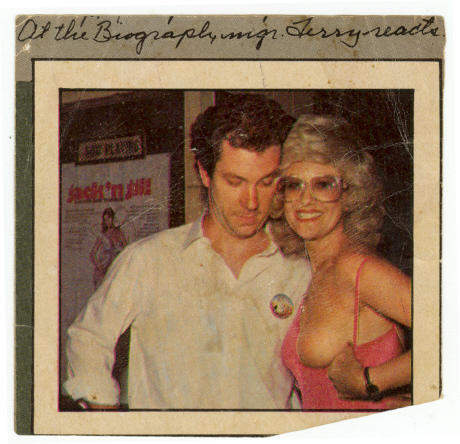
So I was fetched from my sanctuary office to talk with Annie Sprinkle and another woman (the one in the photo) who claimed she was from Richmond (Hermitage High). Sometimes, the X-rated touring performers from the live shows at the Lee Art Theater in the next block of Grace Street stopped by, so I figured that was the deal.

Like, maybe they were film buffs who wanted free passes? They had a limo parked in front of the theater. Their driver was a dwarf. No joke.

After what sounded to me like a lot of cocaine-driven nonsense about a glossy magazine spread, and how they'd been to other local landmarks, Annie asked me to pose in front of the theater with the other lady. Those were simpler times. Why not?

As Annie told me to stand a little closer, what’s-her-name? -- I think it might have been Honey -- gave me a hug and flashed what I immediately believed to be her left breast. Annie took the picture. My reaction (as seen in the photo) was genuine. Spontaneous. The duo had what they wanted, so they giggled and piled back into the limo.

My co-workers couldn't stop laughing, as they had seen the whole thing through the cinemascopic front windows. Later the silly picture showed up in Partner, a forgettable soft-core rag. (Roy Scherer was kind enough to bring me a copy. He couldn't stop chuckling.) The magazine feature displayed other shots of "Honey" in flash modes in front of various familiar local landmarks.

By the way, the button I'm wearing in the photo that Annie snapped displayed a Spanish Mr. Natural. It was a gift. And, that was that.

To change the subject, the next year (1981) Grace Street was changed from a west-only one-way street to two-way. The change was probably toughest on the area's winos, but it wasn't easy on anybody.

That neighborhood hasn't been the same since. And, good night Mrs. Calabash, wherever you are..."

-- 30 --

Friday, December 28, 2018

Five Film Favorites: Insider Looks at American Politics

by F.T. Rea

Today is Day Seven of the USA's third federal government shutdown of 2018. By the way, the longevity record for shutdowns also took in the holiday season, the 21 days of Dec. 16, 1995 to Jan. 6, 1996.

While the particulars of such confrontations change over the years, the sort of politicians who absolutely must get their way -- come hell or high water -- until they can't, doesn’t change all that much from one generation to the next. So, even with Trump in the game, there's plenty of here-we-go-again in the way this current shutdown feels.

At least, so far.

Larger than life politicians, who ruthlessly exploit whoever and whatever they find along the way, make good characters for screenwriters to flesh out. This list of political films is about characters. It isn't about social causes or tides of history. No revolutions. No big wars. The films on this list are about charismatic politicians and the sort of people one generally finds surrounding them -- ambitious deal-makers and back-stabbers.

No documentaries this time, no biographies. All five films on the list are fiction ... perhaps thinly veiled, sometimes. What else these flicks have in common is their emphasis on their behind-the-scenes looks at the tactics of hardball politics. 
  • “All the King’s Men” (1949): B&W. 110 minutes. Directed by Robert Rossen. Cast: Broderick Crawford, John Ireland, Joanne Dru, John Derek. Mercedes McCambridge. Note: Adapted from the novel with the same title, the story follows the phenomenal rise of Willie Stark, a populist campaigner fashioned after a real Depression Era politician -- Louisiana’s Huey P. Long (1893-1935). It is seen through the eyes of a political reporter who goes to work for Stark and eventually cringes as unchecked power overcomes and corrupts his boss.
  • “Bob Roberts” (1992): Color. 102 minutes. Directed by Tim Robbins. Cast: Tim Robbins, Giancarlo Esposito, Alan Rickman, Gore Vidal. Note: Affecting the style of a documentary, the story is set in 1990. The character of Bob Roberts, played by Robbins, first appeared on Saturday Night Live in 1986. The movie’s story is focused on the take-no-prisoners, kick-in-the-door quest of Roberts, a wealthy folk-singer/conservative politician, to win a seat in the U.S. Senate.
  • “The Candidate” (1972): Color. 110 minutes. Directed by Michael Ritchie. Cast: Robert Redford, Peter Boyle, Melvin Douglas, Allen Garfield. Note: A spin doctor talks the son of a popular governor into running for the U.S. Senate, to unseat a Republican incumbent. The original idea is he can say whatever he likes, because he has no chance to win ... or was it? When events change the odds, the temptation to compromise and tone down his message starts to build on the idealistic candidate.
  • "Mr. Smith Goes to Washington" (1939): B&W. 129 minutes. Directed by Frank Capra. Cast: Jimmy Stewart, Jean Arthur, Claude Rains, Edward Arnold. Note: By what amounts to a fluke idealistic Jefferson Smith finds himself appointed to the U.S. Senate. Trouble is, he's not as malleable as those who arranged his appointment had thought he would be. When the political machine running the show in his state pulls the rug out from under him, Smith (Stewart) and Saunders (Arthur, at her best) get creative.  
  • “The Last Hurrah” (1958): B&W. 121 minutes. Directed by John Ford. Cast: Spencer Tracy, Jeffrey Hunter, Dianne Foster, Pat O‘Brien, Basil Rathbone. Note: With times a-changing, Democrat Frank Skeffington, a 72-year-old big city machine politician, runs for reelection as mayor. His opponent is an empty suit with a pleasant face who is an WWII vet. The effect of the new propaganda medium, television, is explored. In its time, this was seen as a story about a real Boston mayor -- James Michael Curley.

Thursday, December 20, 2018

Five Film Favorites: Film Noir

by F.T. Rea

The characters were often damaged goods; usually someone had deliberately done them wrong. The lighting was dramatic -- lots of shadows and chiaroscuro. Cigarettes and handguns were ubiquitous. Liquor was consumed without ice or mixers. Payback was a bitch and happy endings were hard to come by.

That was film noir in its day, or maybe I should say night, since “film noir“ means black films.

We’re told the term "film noir" was first applied to cynical American crime dramas in 1946. A French critic, Nino Frank, used it in an article about films made during World War II that he saw as having something in common. These motion pictures hadn’t been seen in occupied France, because of the war. But the term itself didn’t become popular until years later.

If any of the major studios in Hollywood could be said to have specialized in making film noir movies it was probably RKO. In some part that was because RKO produced many of its well-crafted features of all types on B movie budgets. Clever art directors and cinematographers could hide a lot of money-saving compromises in frames filled with shadows. RKO was usually hurting for cash. 

The protagonists of film noir pictures were usually men with specific reasons to be bitter. Life had taught them to put faith in taking direct action to solve problems, rather than calling for help. They tended to be spontaneous anti-heroes. Film noir females were more self sufficient than the women in most American movies in the ’40s and ‘50s. Such worldly women used lots of makeup. They were just as focused on getting their way as were the fedora-wearing men.    

However, most Americans didn’t recognize these movies as being in a category with a special label until the film noir era was in the rearview mirror, style-wise. Thus, the titles on my list of favorites below weren’t promoted in their original release time as film noir, at least not in this country.

To me, it now seems the film noir era was a post-WWII phenomenon. It was influenced not only by the spooky German Expressionism of the 1920s, but also the gritty Italian Neorealism of the 1940s. Film noir was both a look and a focus on subject matter.

Timeline-wise that puts great movies like “M” (1931) and “The Maltese Falcon” (1941) in a category of movies that was a precursor to film noir. They are among the best dark-themed crime dramas that paved the way to film noir. But in a general sense, in my view both of them are too concerned with morality -- right and wrong -- to be seen in the same category with the best of the world-weary noirs.

Once society began absorbing the troops coming home from the war with their own damage, movies changed. Which means to make the cut this time the movie must have been released between 1946 and 1959. Naturally, it has to have been shot in black and white. Then again, although I’d like to restrict the list to American films only, what’s probably the best movie on my list, “The Third Man” (1949) -- made in England -- won’t permit it.
 
Without further ado, my five favorite film noir movies for today are:
  • “The Big Heat” (1953): B&W. 90 minutes. Directed by Fritz Lang. Cast: Glenn Ford, Gloria Grahame, Lee Marvin, Jocelyn Brando. Note: Sgt. Dave Bannion (Ford) is an honest cop who is drawn into investigating the apparent suicide of a coworker. He eventually ends up battling the local crime syndicate. Marvin is at his evil best as the brutal enforcer for the syndicate's boss. Yes, this is the picture with the notorious scene that has Marvin's character slinging boiling coffee into his girlfriend’s (Grahame) pretty face ... just for grins.
  • In a Lonely Place (1950):  B&W. 94 minutes. Directed by Nicholas Ray. Cast: Humphrey Bogart, Gloria Grahame, Frank Lovejoy, Art Smith. Note: WWII vet Dixon Steele is dealing with lingering issues from the war. Depression and rage dog him. Steele, played convincingly by Bogart, is a quick-witted screenwriter with a dark sense of humor. Trouble is -- his writing has suffered. Maybe he needs a muse? Then the same day he's connected to a murder he happens onto a new girlfriend -- enter Gloria Grahame, at her best. A writing mania ensues. 
  • "The Killing" (1956): B&W. 85 minutes. Directed by Stanley Kubrick. Cast: Sterling Hayden, Coleen Gray, Vince Edwards, Jay C. Flippen, Marie Windsor, Elisha Cook. Note: This lean story about a race track heist put Kubrick on the map (he was just 28 when it was released). Rather than the feel of a caper melodrama, the presentation feels sort of detached ... like a documentary with a narrator giving the viewer an inside look at the crime.  
  • "The Third Man" (1949): B&W. 104 minutes. Directed by Carol Reed. Cast: Joseph Cotten, Alida Valli, Orson Welles, Trevor Howard. Note: Screenplay by Graham Greene. This elegant murder mystery is set in crumbling post-WWII Vienna. Or, is it a murder mystery? All the characters are working an angle, so the truth isn’t easy to grasp. The movie’s distinctive theme music was also a hit in its time. Maybe a perfect movie.
  • "Touch of Evil" (1958): B&W. 95 minutes. Directed by Orson Welles. Cast: Charlton Heston, Janet Leigh, Orson Welles, Akim Tamiroff, Dennis Weaver. Note: This crime melodrama, set on both sides of the American/Mexican border, is so chock full of weird characters it feels like a cartoon. And, don’t be put off by Heston’s presence, the director uses his wooden, bad acting to a good purpose. For some critics and wags this movie marked the end of the film noir era.


Tuesday, December 11, 2018

Does Celebrity Still Rule?

The 20th century gave us mass media: magazines that featured stories aimed at a national readership; feature films and newsreels distributed coast-to-coast; radio and television networks; the Internet – all of which gave us entertainment and useful information. As a byproduct, the mass media also gave us celebrities. Not just the accomplished people who tend to earn fame, but also the narcissistic self-promoters we're accustomed to seeing, as they parade about trying to create gossip. 

The minting of those early batches of talented and not-so-talented celebrities in the first quarter of the 1900s quickly spawned celebrity-worshipers. I'm told print cartoonists were treated like little kings in Manhattan saloons in the 1920s. (Ah, those were the days.) Anyway, with celebrity-worshipers came baseball cards, movie magazines, fan clubs, celebrity endorsements, etc.  

Since we know lots of people want like hell to be worshiped by legions of groupies the 21st century has given us social media, so wannabe celebrities can beam their make-me-a-celebrity auditions to a potentially unlimited following. Meanwhile, they go on dreaming of being catapulted out of their mundane existence, onto the lofty perch of those who are worshiped. 

That's a whole lot of wannabe-ism. It's a lot of damn worshiping, too. Our sitting president saw both factors and thought he knew a bunch of chumps when he saw it. He was right. Also feeling emboldened by the nasty level of racism he sensed was growing, Trump threw his red MAGA cap into the ring. Then it seemed enough voters didn't want to vote for his opponent to make it possible to elect the celebrity whose star burned brighter.

So far, Trump the Compulsive Tweeter has cashed in on America's addiction to consuming folderol about celebrities better than any other politician. In polls he has seemed to consistently have about a third of voters on his side, no matter what he says or does. In fact, the more loutish he is, the more they seem to like him.

Question: Does his loyal base – the aforementioned chumps – actually agree with him, with all the lying, the cruelty and such?

Answer: Doesn't matter. As the ultimate celebrity, they worship Trump ... so far.

Looking ahead, with 2018 all but done, could celebrity worship have passed its zenith? Have we the people finally seen enough weaselly scamming in the White House to start wising up? Or, in 2020, do the Democrats need to nominate their best celebrity?  

Monday, November 26, 2018

Vann Named A-10 Player of the Week

 From VCU's Chris Kowalczyk:
VCU redshirt junior Issac Vann (Bridgeport, Conn./Maine) has been named Atlantic 10 Conference Player of the Week, the league announced Monday.

A 6-foot-6 guard/forward, Vann averaged 19.0 points, 5.7 rebounds, 3.0 assists and 1.7 steals, while shooting .514 (19-of-37) from the field in three games for the Rams. VCU finished the week 2-1 after it earned victories over Temple and Hofstra.

Vann scored 11 points in a hard-fought win over Temple on Nov. 19 in the semifinal round of the Legends Classic at Barclays Center in Brooklyn, N.Y. The following night, he erupted for a career-high 30 points, 11 rebounds and five assists in an overtime loss to St. John’s in the Legends Classic Championship. On Nov. 24, Vann produced 16 points, four rebounds, three assists and four steals to lead VCU past Hofstra in overtime.

Through six games, Vann is averaging a team-best 14.8 points per game, as well as 5.7 rebounds, 2.8 assists and 2.2 steals.

Vann and VCU return to the court on Wednesday, Nov. 28 when they travel to face rival Old Dominion at the Ted Constant Convocation Center in Norfolk, Va. Tip-off is scheduled for 7 p.m. on MASN. 

Thursday, November 22, 2018

What It Is Ain’t Exactly Clear

Fiction By F.T. Rea

Jan. 24, 1991: Bright sunlight lit up the thin coating of freezing rain that had painted the city the evening before. In the crisp air, Roscoe Swift, a slender middle-aged man, a freelance artist/writer, walked at a careful but purposeful pace on the tricky sidewalk.

The ice-clad trees along the street were dazzling, as seen through Swift's trusty Ray-Bans. The woolly winter jacket his girlfriend, Sally, had given him for Christmas felt good.

Since the freelancer couldn’t concentrate on his reading of the morning’s Richmond Times-Dispatch, he left half a mug of black coffee and a dozing cat on his desk to walk to the post office. He hoped the overdue check from a magazine publisher was waiting in his post office box.

Anxiously, Swift opened the box with his key. It was empty. He shrugged. An empty box had its upside, too -- there were no cut-off notices in it. With his last 20 bucks in his pocket, the freelancer hummed a favorite Fats Domino tune, “Ain’t That a Shame,” as he headed home.

By the end of the workday Roscoe's task was to finish an 800-word OpEd piece, with an accompanying illustration, and drop it all off on an editor’s desk in Scott's Addition. With the drum beat for war in the air he wanted to focus on the inevitable unintended consequences of any war. Yet, with the clock ticking on his deadline he was still at a loss for an angle.

The country was still mired in an economic recession. The national debt was skyrocketing. War with Iraq was looming, it seemed all but inevitable. Pondering what demons might be spawned by an all-out war in Iraq -- only to be discovered down the road -- he detoured a couple of blocks, to pick up a Washington Post and a fresh cup of coffee.

Approaching the 7-Eleven store Roscoe noticed a lone panhandler standing off to the left of the front doors. The tall man was thin and frail. He wore a lightweight denim jacket with a hooded sweatshirt underneath. Snot was frozen in his mustache. The whites of his heavy-lidded eyes were an unhealthy shade of pink.

When Roscoe had run the Fan City Cinema, in the '70s, he had determined his policy should be to never in any way encourage panhandlers to hang around on the sidewalk in the neighborhood surrounding the theater. The rigid policy had lingered well after the comfortable job had faded into the mists.

On this cold day it wasn’t easy for Roscoe to avert his eye from the poor soul’s trembling outstretched hand. Not hearing the desperate man’s hoarse plea for food money was impossible. When there are always so many lives to be saved in our midst, Roscoe wondered, why do we have to go to the Middle East to save lives?

Inside the busy store Roscoe poured a large coffee. Fretting profusely, he snapped the cup’s lid in place. It was one of those times when the little Roscoe with horns was standing on one of his shoulders, while his opposite, the one with the halo, was on the other; both were offering counsel.

Roscoe's policy caved in seconds later. Still, he decided to give the freeloader food, rather than hand over cash to perhaps finance a bottle of sweet wine. It might change my luck, he thought as he smiled.

Trying to max out the bang-for-the-buck aspect of his gesture, Roscoe settled on a king-sized hot dog, with plenty of free stuff on it -- mustard, chopped onions, relish, jalapeno peppers, chili and some gooey cheese-like product. Not wanting to push it too far, he passed on the ketchup and mayonnaise.

Outside the store, Roscoe found the starving panhandler had vanished.

So, the crestfallen philanthropist took the meal-on-a-bun with him as he walked, softly singing a Buffalo Springfield song, “For What It’s Worth.” With his strides matching the beat he kept to the sunny street, to avoid the sidewalk in the shade.
There’s somethin’ happening here,
What it is ain’t exactly clear.
There’s a man with a gun over there,
Tellin’ me I gotta beware.
I think it’s time we stop, children, what's that sound,
Everybody look, what's going down.
A line from that song’s last verse -- “paranoia strikes deep” -- suddenly snapped an idea for the OpEd into place, which launched an instant mini-mania. A block closer to home an image for the illustration occurred to him. The freelancer picked up his pace and began whistling a jazzy version of “For What It’s Worth.”

Back in his office/studio space, rather than waste money, he tore into the feast he had prepared for a beggar. The food scared, or perhaps offended the cat, who fled. Between sloppy bites the artist wiped his hands off and sketched furiously to rough out a cartoon of Saddam Hussein as the provocative Tar Baby of the Uncle Remus story, inviting America into a war.

About an hour later the heartburn started. Eventually, it got brutal. Roscoe pressed on. He wrote about the way propaganda always works to sell war -- every war -- as glorious and essential to the everyday people, who risk their lives. That while the wealthy, who rarely take a genuine risk on anything, urge the patriots on and count their profits.

Thinking of the war in Vietnam that thinned his generation out, he wrote:
After the war the veterans were largely ignored, even scorned.
Roscoe lamented the popular culture having gone wrong, so there was no longer a place for anti-war protest songs. He wrote:
Where are today’s non-conformists? Today's questioners of authority?
The freelancer turned in his work at 4:50 p.m.

An hour later his sour and noisy stomach began to calm down during his second happy hour beer at the Bamboo Cafe.

When he recounted the tale of the stuffed frankfurter and the inspiration of the Buffalo Springfield song, Roscoe made it seem funny enough to friends gathered around the elbow of the marble bar. They laughed. Since the bar's owner had agreed to hold his tab for a day or two, Swift bought a round of beers and joked about his empty mailbox.

Sally showed up with a smile. She joined Roscoe's small audience that chuckled and groaned when he finished off with, “Sometimes it's a thin line that separates heartburn and inspiration ... for what it’s worth.”

* * *

All rights reserved by the author. "What It Is Ain’t Exactly Clear" along with its accompanying 
illustration are part of a series of stories called Detached.

Too Many Secrets

Camelot at 1600 Pennsylvania Ave lasted 1,036 days. In particular, for the children in school on Nov. 22, 1963, the murder of President John F. Kennedy was stunning in a way nothing has been since.

On Nov. 24, 1963 a live national television audience witnessed the murder of the assassination’s prime suspect, Lee Harvey Oswald. There was no doubt that Jack Ruby, a Dallas nightclub operator, was the trigger-man. What made him do it is still being questioned.

Shortly after JFK’s death, columnist Mary McGrory expressed her dark feelings to Daniel Patrick Moynihan: “We’ll never laugh again.”

Moynihan, who was an Assistant Secretary of Labor then, famously replied, “Heavens, Mary, we’ll laugh again. It’s just that we’ll never be young again.”

The cynicism spawned by the cloaked-in-secrecy aftermath of the JFK assassination has tinted everything the aforementioned school children have seen since those dark days. Everything.

However, I’m not at all convinced there had to have been a complicated conspiracy to kill the president and cover up the tracks.  Furthermore, after he was dead, just because some people deliberately obscured related information, we don't necessarily know why they did it. In some cases it was probably people trying to cover asses, hither and yon, for a myriad of reasons.

On the other hand, I’m not saying there was no conspiracy that led up to the murder of President Kennedy. So, for now, let's skip past the argument over whether Oswald acted alone. Let's not speculate about whether Oswald was a dupe, or one of the greatest marksmen who ever lived. The point of this remembrance is to recognize that the secrecy that rushed in to obscure what happened in November of 1963 poisoned the American culture in a way that is still being felt. 

The President's Commission on the Assassination of President Kennedy, known as the Warren Commission, published its report on Sept. 24, 1964: Oswald was found to have been a lone wolf assassin. Which immediately unleashed the questioning of the Commission’s findings. Was its famous “single bullet theory,” which had one projectile traveling circuitously through two victims, or was it great sleuthing?

Or was it an unbelievable reach?

*

In 1965 gunmen murdered Malcolm X in an auditorium in Manhattan. Three years later Martin Luther King was killed on a motel balcony in Memphis by a sniper. Two months after that assassination, Sen. Robert F. Kennedy was gunned down in a Los Angeles hotel.

Unfortunately, the official stories on those three shootings were widely disbelieved, too. In the ‘60s more public scrutiny of how those assassination probes were conducted might have led to different conclusions. More importantly, even if more sunlight into those probes failed to produce different outcomes, at least Americans might have felt better about the good faith of the processes.

Instead, it seemed then the authorities generally believed the citizenry didn't really have a right to see the whole truth and nothing-but. Too often it seems to have been decided on high that the public was better off not knowing some things, as if we were all children.

Of course, such secrecy can hide everyday malfeasance, as well. Shielding the citizenry from such information is the sort of thinking that went with world wars, with spies lucking about. In the 1960s the public expected its government to routinely withhold all sorts of secrets.

At long last, it took the rudest of revelations to snap many Americans out of blithely tolerating an over-abundance of secrecy:
  • The My Lai Massacre horrors.
  • The publishing of the Pentagon Papers.
  • The Watergate Scandal hearings.
  • The Iran-Contra Scandal hearings.
  • The bogus justification for invading Iraq. 
As those events paraded by, America steadily morphed into a nation of cynics. Now, those of us who recognize the damage that's been done by official lies know better. We know we were wrong to ever have accepted such skullduggery in the name of keeping America safe.

*

In 1997 Sen. Moynihan’s book, “Secrecy: The American Experience,” was published. In the opening chapter he wrote:
In the United States, secrecy is an institution of the administrative state that developed during the great conflicts of the twentieth century. It is distinctive primarily in that it is all but unexamined. There is a formidable literature on regulation of the public mode, virtually none on secrecy. Rather, there is a considerable literature, but it is mostly secret. Indeed, the modes of secrecy remain for the most part -- well, secret.
On inquiry there are regularities: patterns that fit well enough with what we have learned about other forms of regulation. But there has been so little inquiry that the actors involved seem hardly to know the set roles they play. Most important, they seem never to know the damage they can do. This is something more than inconveniencing to the citizen. At times, in the name of national security, secrecy has put that very security in harm's way.
Fifty-five years after the murder of JFK, it’s high time to stop tolerating unnecessary secrecy in government at all levels. After all, a secret that invites speculation can serve a nefarious agenda just as well as a lie. 

Justice Louis D. Brandeis wrote: 
"Publicity is justly commended as a remedy for social and industrial diseases. Sunlight is said to be the best of disinfectants; electric light the most efficient policeman."
Today, to trust official conclusions, we not only need investigations, we need to see into the investigations. That means more public hearings. The scary notion that somehow the Mueller Probe's findings could be shielded from public scrutiny is crazy and too dangerous to allow. Lastly, in the age of Trumpism, for democracy to have a chance of working properly, we citizens surely need to know whose money is behind every politician. Brandeis was totally right about sunlight. 

Taking it home: Single bullet theory, you say?

Great name for a punk era band.

-- 30 --

Thursday, November 15, 2018

Remembering RKO


In its heyday RKO (for Radio-Keith-Orpheum) was known as one of the Big Five movie studios of Hollywood's Golden Age. It was also known for its ability to produce well-crafted, sometimes artsy or offbeat features using a smaller budget than the other so-called major studios. Nonetheless, it was almost always in trouble, financially. 

Thus, RKO stopped producing feature films in 1953. In 1955 RKO became the first major studio to cave and sell off the exhibition rights of its library of titles to television. So, like plenty of baby boomers, I grew up watching many of those well-crafted black and white films on TV. It was then I first became a fan of legendary producer Val Lewton's scary films, although I doubt I knew his name then.

Eventually, I also became a devotee of RKO's stylish film noirs with their lean stories and moody chiaroscuro lighting. To this day, I still get a kick out of discovering a good one online that I've never seen. For me, watching one of those precious old films serves as something akin to time travel back to my salad days. Comfort movies. 

In the summer of 1982 I put together a six-week festival offering 12 RKO double features. The Biograph Theatre's Program No. 60 played out in Theatre No. 1, the larger of the two auditoriums. It was an unusual program in that all 24 of the feature films were from one company, RKO, which still operated as a distributor.

The 12 double features in this festival were: Top Hat (1935) and Damsel in Distress (1936); The Hunchback of Notre Dame (1939) and The Informer (1935); King Kong (1933) and Mighty Joe Young (1949); Suspicion (1941) and The Live By Night (1948); Sylvia Scarlett (1936) and Mister Blandings Builds His Dream House (1948); Murder My Sweet (1945) and Macao (1952); The Mexican Spitfire (1939) and Room Service (1938); Journey Into Fear (1942) and This Land Is Mine (1943); The Thing (1951) and Cat People (1942); The Boy With Green Hair (1948) and Woman on the Beach (1947); Citizen Kane (1941) and Fort Apache (1948); The Curse of the Cat People (1944) and The Body Snatcher (1945).
 

Tuesday, November 13, 2018

Peanut Shells, Fish Bones and Politicos

In 2001 I covered the Shad Planking for Richmond.com. That was my only visit to the annual event, which gradually lost its power to attract a big crowd. It seems to be mostly a thing of the past now. Here's what I wrote about the scene 17 years ago, when it was a bipartisan event that was still going strong. 


*

According to a 53-year-old tradition the Shad Planking, sponsored by the Wakefield Ruritan Club, is held on the third Wednesday of April. The event's roots go back to the early '30s, when only a certain breed of cat was invited. Today it's an open-to-the-public outdoor throwdown featuring ample libation and regional taste treats aplenty. But it is politics, undiluted statewide politics, that draws the crowd each year to the Loblolly pines of Wakefield, Va., the self-proclaimed peanut capital of the world.

Although the scheduled speechmakers are always politicians, 2001 marked a Shad Planking first, in that active gubernatorial candidates were at the top of the speaker's card at the Wakefield Sportsman Club.

Thus, when they weren't perched on the flatbed dais provided for honored guests and speakers between 4 p.m. and 5 p.m., Democrat nominee-in-waiting Mark Warner and his two Republican rivals, Lt. Gov. John Hager and Attorney Gen. Mark Earley, worked the rustic soiree with their campaign-sign-holding entourages at their backs every step of the way. Wherever the trio of hopefuls wandered among the many booths and displays, the same strategy was evident: Every potential photographic vignette had to be filled to the edge of the frame with the team colors.
An invisible yet pervasive aspect of the occasion was the unprecedented backdrop of the much-reported budget stalemate that has Gov. Jim Gilmore at odds with legislators of his own party, most notably Sen. John Chichester of Stafford. News of the twists and turnings of the day at the General Assembly session rippled through the crowd of 3,000-plus during the seasonally cool, partially cloudy afternoon.

Sustenance and Sauce

With the price of admission, $14 in advance or $16 at the gate, one could eat and drink to his heart's content. Peanuts in bushel baskets, flavored this way and that, were easy to find. Crab cakes were available at one booth; cups of Jack Daniels were poured from a tailgate setup. Dressed with a squirt of Dr. Nettles' Secret Shad Plank Sauce, the same peppery slather that's brushed onto to the Shad as it's smoked on oak planks, deep-fried shad roe whetted the tongue perfectly for a taste of cold beer.
Open taps on beer trucks were provided by the campaigns of several candidates. For what it's worth, Forbes offered the Coors line, Kilgore made his statement with Miller brands, and Hager, Warner and Diamondstein chose Bud. In a contrast of styles, the Earley booth offered hot coffee.

Candidate Warner, the Northern Virginia venture capitalist, also provided the party with a portion of its musical fare: the Blue Grass Brothers, featuring on vocals former congressman Ben Jones, who may be best known for his television work as Cooter on "The Dukes of Hazzard."

Between tunes, one of which was a semi-rousing campaign song for Warner, Jones japed that he was an "independent Democrat." Then, with the timing of a seasoned pro, the country crooner claimed former U.S. Sen. Sam Nunn, of Georgia, liked to say "I was as independent as a hog on ice."

About 2:45 p.m., the event's staff, more than 200 volunteers participated in some way, began to dole out plates of smoked shad, fried trout, coleslaw and corn muffins to the long lines of party-goers.

Politics in the Air
 

As he autographed a souvenir Shad Planking baseball cap for an admirer, John Hager mentioned he'd missed only two Shad Plankings in the last 22 years. From my vantage point, of the three men seeking to occupy the Governor's Mansion, Hager seemed the most at ease with the opportunity to chat off-the-cuff in a social setting.

Asked for his opinion on the imbroglio over tax-cut percentage points, Mark Warner was eager to offer some advice, "You don't negotiate with press releases. Everybody's got these intractable positions, and nobody can budge."

On the now-familiar 55 percent vs. 70 percent topic, Mark Earley said, "I think a lot of them [Democrats] don't want a budget because they want an issue for this fall."

However, it was U.S. Sen. George Allen who had the most interesting comment on the subject. As he dealt with my question, "How can the eventual GOP gubernatorial candidate turn the negatives of the car tax phase-out problem into a plus for him in the fall campaign?" Allen seemed to open the door to the notion that the time is nigh for Gilmore to find a way to cut a deal.

"I'm not the one negotiating and drawing lines in the sand, and all of that," Allen said, boot-scooting through the minefield carefully.

"In your mind, could there be a number other than 70 percent?" I pressed.

"There are ways it can be finessed, if people will negotiate in good faith with one another," he replied good-naturedly.

As the Shadows Lengthened

 
By 6 p.m., more than half of the attendees had had their fill and made their way to the parking area. Since I bailed out about that time, I can't say when the last of the diehards left the party.

However, it's not every day that one can have one-on-one conversations with so many active candidates, office-holders and operatives of both major parties. Also at the gathering were U.S. Sen. John Warner, former-Gov. Gerald Baliles, former-U.S. Sen. Paul Trible, Richmond Mayor Tim Kaine, and many other current and former elected officials.

I can't help but think it would be a better world if there were more happenings like the Shad Planking, where politicians of all stripes are so accessible. 


Bottom Line: In spite of the considerable difficulty of negotiating one's way around the countless tiny bones in a shad, I have to give the affair itself an enthusiastic two thumbs up. George Allen will be the speaker for the 54th Shad Planking.

Sunday, November 11, 2018

A Veterans Day Remembrance


In 1916 the fit young volunteers who were members of the Richmond Light Infantry Blues were dispatched to Brownsville, Texas, to watch over the border and chase Mexican bandit/revolutionary Pancho Villa, who had crossed the border to stage a few raids on American soil ... or, so people said.

To do the job the Richmonders were quickly converted into a cavalry unit. My grandfather, Frank W. Owen (1893-1968), seen at the age of 23 in the 1916 photo above, was one of those local boys in that Richmond Blues outfit.

Following that campaign, in 1917 the Blues were sent to Fort McClellan, located in the Alabama foothills, near the town of Anniston, for additional training. Then it was across the pond to France to finish off the Great War -- the war to end all wars.

Frank Owen grew up in South Richmond in what was then called Manchester. Before his active duty he had mostly made his living as a vocalist. The stories I remember him telling from his years as a soldier were all about his singing gigs, playing football and poker, and various other adventures.


Owen is on the right in the photo above. Like other men of his generation, who saw war firsthand, he apparently saw no benefit in talking about the actual horrors he'd seen. At least I never heard such stories. However, he was always quick to point with pride at having been in the Richmond Blues, then seen by many in Richmond as an elite corps.


F. W. Owen depended completely on his own view of life. He passed what he could of that self-reliance on to me. My grandson's middle name is Owen. It's a name he should always wear proudly. A long way from home, almost a century ago, his great-great-grandfather certainly did.

The story below is about my grandfather. A previous version of it was published in SLANT in 1990. This version was published in Style Weekly in 2000.

*
The Cheaters
by F.T. Rea
Having devoted countless hours to competitive sports and games of all sorts, nothing in that realm is quite as galling to this grizzled scribbler as the cheater’s averted eye of denial, or the practiced tones of his shameless spiel.
In the middle of a pick-up basketball game, or a friendly Frisbee-golf round, too often, my barbed outspokenness over what I have perceived as deliberate cheating has ruffled feathers. Alas, it's my nature. I can't help it any more than a watchful blue jay can resist dive-bombing an alley cat.
The reader might wonder about whether I'm overcompensating for dishonest aspects of myself, or if I could be dwelling on memories of feeling cheated out of something dear.
OK, fair enough, I don't deny any of that. Still, truth be told, it mostly goes back to a particular afternoon's mischief gone wrong.


*

A blue-collar architect with the Chesapeake & Ohio Railway for decades, my maternal grandfather, Frank Wingo Owen was a natural entertainer. Blessed with a resonant baritone/bass voice, he began singing professionally in his teens and continued performing, as a soloist and with barbershop quartets, into his mid-60s.
Shortly after his retirement, at 65, the lifelong grip on good health he had enjoyed failed; an infection he picked up during a routine hernia surgery at a VA hospital nearly killed him. It left him with no sense of touch in his extremities.
Once he got some of his strength back, he found comfort in returning to his role as umpire of the baseball games played in his yard by the neighborhood's boys. He couldn't stand up behind home plate, anymore, but he did alright sitting in the shade of the plum tree, some 25 feet away.
This was the summer he taught me, along with a few of my friends, the fundamentals of poker. To learn the game we didn’t play for real money. Each player got so many poker chips. If his chips ran out, he became a spectator.
The poker professor said he’d never let us beat him, claiming he owed it to the game itself to win if he could, which he always did. Woven throughout his lessons on betting strategy were stories about poker hands and football games from his cavalry days, serving with the Richmond Blues during World War I.
As likely as not, the stories he told would end up underlining points he saw as standards: He challenged us to expose the true coward at the heart of every bully. "Punch him in the nose," he'd chuckle, "and even if you get whipped he'll never bother you again." In team sports, the success of the team trumped all else. Moreover, withholding one’s best effort in any game, no matter the score, was beyond the pale.
Such lazy afternoons came and went so easily that summer there was no way then, at 11, I could have appreciated how precious they would seem looking back on them.
On the other hand, there were occasions he would make it tough on me. Especially when he spotted a boy breaking the yard's rules or playing dirty. It was more than a little embarrassing when he would wave his cane and bellow his rulings. For flagrant violations, or protesting his call too much, he barred the guilty boy from the yard for a day or two.
F. W. Owen’s hard-edged opinions about fair play, and looking directly in the eye at whatever comes along, were not particularly modern. Nor were they always easy for know-it-all adolescent boys to swallow.
Predictably, the day came when a plot was hatched. We decided to see if artful subterfuge could beat him at poker just once. The conspirators practiced in secret for hours, passing cards under the table with bare feet and developing signals. It was accepted that we would not get away with it for long, but to pull it off for a few hands would be pure fun.
Following baseball, with the post-game watermelon consumed, I fetched the cards and chips. Then the four card sharks moved in to put the caper in play.
To our amazement, the plan went off smoothly. After hands of what we saw as sly tricks we went blatant, expecting/needing to get caught, so we could gloat over having tricked the great master. Later, as he told the boys' favorite story -- the one about a Spanish women who bit him on the arm at a train station in France -- one-eyed jacks tucked between dirty toes were being passed under the table.
Then the joy began to drain out of the adventure. With semi-secret gestures I called the ruse off. A couple of hands were played with no shenanigans but he ran out of chips, anyway.
Head bowed, he sighed, “Today I can’t win for loosing; you boys are just too good for me.” Utterly dependent on his cane for balance he slowly walked into the shadows toward the back porch. It was agonizing.
The game was over; we were no longer pranksters. We were cheaters.
As he carefully negotiated the steps, my last chance to save the day came and went without a syllable out of me to set the record straight. It was hard to believe that he hadn’t seen what we were doing, but my guilt burned so deeply I didn't wonder enough about that, then.

*

My grandfather didn’t play poker with us again. He went on umpiring, and telling his salty stories afterwards over watermelon. We tried playing poker the same way without him, but it didn’t work; the value the chips had magically represented was gone. The boys had outgrown poker without real money on the line.
Although I thought about that afternoon's shame many times before he died nine years later, neither of us ever mentioned it. For my part, when I tried to bring it up, to clear the air, the words always stuck in my throat.
Eventually, I grew to become as intolerant of petty cheating as F.W. Owen was in his day, maybe even more so. And, as it was for him, the blue jay has always been my favorite bird.

-- 30 --