Monday, July 10, 2017

The Tenth Commandment

Note: A version of this piece was published by STYLE Weekly in 1999.

According to the Old Testament, Moses heard directly from God about establishing standards of civilized conduct. A portion of the instructions Moses is purported to gotten from God, Himself – known as the Ten Commandments – is still a news-maker.

The Bible says there were several other rules offered by God atop Mount Sinai; rules we hear less about. If you try reading the book of Exodus, it won’t take long for you to see why. Some of those other rules are rather Old World – such as the proper regulation of slavery and burnt offerings.
For the most part the Ten Commandments are to-the-point, covering basic stuff: Honor God and your parents. Be willing to make sacrifices for what matters most to you. Along the way don’t kill, lie, or steal. Don’t cheat on your spouse, or perhaps spouses – uh-oh, there's that Old World thing again.

In the final of the Ten Commandments, Moses said that we ought not to “covet” our neighbors’ goods. Isn't is curious that after a rather easily understood list of rules, put in the form of “shalt-nots,” the last rule is against even thinking too much about a shalt-not? Like, don't allow yourself to dwell on wanting what's not properly yours.

Covet? Come on Moses, what’s the problem with a little mild coveting? Why not stick to nine rules about actual behavior?

Hopefully, the reader will permit me the post-modern license to move directly from the Bible to a Hollywood thriller, in order to help Moses with his answer: In “Silence of the Lambs” (1991) the brilliant but evil psychiatrist, Hannibal Lecter, instructs the movie’s detective heroine, Clarice Starling – who is in search of a serial killer – that people covet only what they see all the time.

Bulls-eye!

Of course the ravenous doctor was right about what fuels obsessive cravings. If one hasn’t seen it, how can one lust for it? To dwell on wanting something, to the point of no return, one must see it regularly. Coveting is a festering of the mind; it's a craving for that which one should not have. 

Today, because of the reach of the mainstream and social media, just about everyone alive sees how wealthy/powerful people live all the time. One sure thing movies, sitcoms, soaps, and the celebrity news all do – in addition to telling a story – is to show us how well off some people are. Then the advertisements tell us just how to buy the same pleasures and accouterments the stars in those stories possess.

If you’ve got the dough to buy the stuff, that’s one thing. If you don’t that’s another. That might spawn some coveting.

The lifestyle of a celebrity is constantly sold to consumers as the good life. Wanting that good life is a carrot on the stick that helps drive our consumer culture. Therefore, in some ways, it has been good to all of us. My thesis for today’s rant is that there is a dark side to this strategy.

When powerless/poor people see that same good life promotions they want it, too. Why not?

However, if they are trapped in their circumstances and have no hope, they don’t believe the good life is available through legitimate channels. So, instead of feeling motivated to work overtime, to earn more money, the powerless are left to covet.

Eventually all that desire for the unobtainable can lead to trouble. I’m convinced that some part of the violence we have seen from teen-agers, in recent times, stems from their exaggerated sense of powerlessness. In the worst cases, their impatience boils over while waiting for what they imagine to be an adult’s awesome power over life and death.

The good news is that kids grow up. Most of our children won’t shoot up their schools because of frustration with having so little say-so over their schedule. The bad news is that for most of the world’s underdogs their sense of powerlessness is something that isn’t going to dissipate so easily.

In the so-called Third World, the longing for First World goods and options is festering as you read this. Meanwhile, these powerless coveters aren’t thinking about where to shop for knockoffs of what they see flaunted on screens. A hundred years ago, 50 years ago, the world's underclass wasn't wired into the rest of civilization. Now it is and it sees what we had for lunch. It sees our vacation snapshots. It sees what we brag about the most. Today the underclass knows exactly how soft life is for the well-off.

History isn’t much help here because it tells us the unwashed masses have usually had to take what they wanted by force. How much longer we can rely on the gentle patience of the world’s hungriest millions is anybody’s guess. In the meantime, perhaps the other side of “thou shalt not covet” is “thou shalt not flaunt.”

Just think about how many American movies and TV shows are about rich people doing as the please. If the wisdom of the ages — the Ten Commandments — suggests it's smart to discourage destructive cravings in the shadows, perhaps it would also be smart to stop promoting such trouble with our brightest spotlights.

Bragging was never cool. Now American's braggarts, who flaunt their wealth, are asking for the sort of trouble that will splash onto all of us.

– 30 –

-- Words and art by F.T. Rea

Friday, July 07, 2017

Chasing Dignity

Note: A version of this piece was first published by STYLE Weekly in 2006


“…Now once more the belt is tight and we summon the proper expression of horror as we look back at our wasted youth. Sometimes, though, there is a ghostly rumble among the drums, an asthmatic whisper in the trombones that swings me back into the early twenties when we drank wood alcohol and every day in every way grew better and better, and there was a first abortive shortening of the skirts, and girls all looked alike in sweater dresses, and people you didn’t want to know said ‘Yes, we have no bananas,’ and it seemed only a question of a few years before the older people would step aside and let the world be run by those who saw things as they were — and it all seems rosy and romantic to us who were young then, because we will never feel quite so intensely about our surroundings any more.”
– from “Echoes of the Jazz Age” (1931)
by F. Scott Fitzgerald
In the summer of 1978, with “The Rocky Horror Picture Show” playing to the delight of a midnight show packed house, a fight broke out in the middle of Grace Street. Insults, rocks and bottles flew back and forth between the two factions of four each: VCU frat boys vs. an Oregon Hill crew. Their battle was unfolding a perilous 25 to 30 yards from the Cinemascopic all-glass front of the Biograph Theatre.

The box office had just closed and the cashier had started her count-up. At the same time a group of my Biograph Swordfish softball teammates was in the lobby playing a pinball machine. As manager, I felt obliged to drive the danger away, so I opened an exit door and yelled that the cops were already on the way, which they were.

That was good enough for the frat boys, who scampered off. Their opposites simply switched over to bombing me. As they advanced rocks bounced closer. A tumbling bottle shattered on the sidewalk. I closed the door, then a piece of brick smashed through its bottom panel of glass to strike my right shin.

When we lit out after them, there were six or seven men running in the impromptu posse of employees and pinball players. The hooligans scattered, but my focus was on the one who’d plunked me. Hemmed in by three of us in a parking lot, he faked one way, then cut to the other. His traction gave way slightly in the gravel paving. As he stumbled to regain his balance I tackled him by the legs.

The others got away. With some help from my friends, we marched the captured 19-year-old back toward the theater. I could feel the adrenaline coursing through my limbs. During the trek east on Grace, the culprit said something that provoked one in my group to suddenly punch him in the face. That, while the punchee’s arms were being held.

A policeman, who had just arrived, saw it. He sarcastically complimented the puncher for his aggressive “technique” before the street-fighting man was hauled off in the paddy wagon. In contrast, I told the vigilante puncher he had overreached in hitting the kid unnecessarily, especially while he was helpless.

Surprised by my reaction, my softball teammate laughed.

Which prompted me to say something like, “Hey, we’re no better than the fascist bullies we’ve claimed to deplore if we resort to their damn tactics.” He disagreed, saying essentially this — that his summary punishment would likely be the only price the little thug would ever pay for his crime. Another in the group agreed with him. Others saw it my way, or they said nothing.

It wasn’t long after that night I found myself poring over a favorite essay by F. Scott Fitzgerald, “Echoes of the Jazz Age.” The excerpt above is the evocative piece’s last paragraph. During that rereading, it occurred to me the brick shattering the glass door had been the sound of the hippie era ending for me.

Yes, as the '70s fizzled away we baby boomers were about to discover that our sweetest day in the sun -- with its righteous causes and rock ’n’ roll anthems -- had been another dollop of time, a period with its look and sound. In some ways, the Roaring ’20s redux.

A month later I agreed to the court’s proposal to drop the assault charge, provided the brick-thrower was convicted of a misdemeanor for breaking the glass and paid for the damage. A payment schedule was set up. As we spoke several times after that, I came to see the “hooligan” wasn’t really such a bad guy. Payment was made on time.

Eventually, he asked for the name of the man who’d punched him. While withholding the name, I agreed with him that the blow had been a cheap shot.

About a year later, on a late summer afternoon, a thief snatched a handful of dollar bills from a Biograph cashier, then bolted out the front door. The cashier’s frightened look triggered an alarm in your narrator’s sense of duty/propriety; her face was quite expressive.

As this happened half of my lifetime ago, I was still young enough to think chasing down criminals in the street was traditional. Quaint as it may sound now, in those days it did seem that some collective sense of dignity was sometimes at stake.

In short, the thief was fast but he wasn't so good at getting away. It took less than 10 minutes to discover his hiding place, then turn him over to the cops who’d shown up at just the right time. During the search I received some unexpected help in cornering the thief. As I had run west on Grace Street behind the 20-year-old grab-and-run artist, another young man — a total stranger — had jumped out of his pickup truck to join in the chase.

Later, when the dust settled, I thanked the volunteer and asked him why he’d stopped. He answered that he knew I was the Biograph’s manager, because a buddy of his had once pointed me out. His friend? It was the same Oregon Hill street-fighter I’d tackled a year before.

My assistant thief-chaser also told me his friend assured him I’d dealt fairly with him. Consequently, a favor was owed to me. Before he left, my collaborator said that in his neighborhood the guys stick together. Thus, he’d supported me in my time of need, to help pay off his friend’s debt. We shook hands.

Over the years what connects those two chase scenes has become increasingly more satisfying. No doubt that’s because so many times over the years, in dealing with bad luck and other ordinary tests of character, I’ve done nothing to write home about — even the wrong thing.

At least in this story, maybe, I got it right.

The point?

Dear reader, in spite of the wall-to-wall cynicism of our current age, there really was a time when cheap shots were seen in a bad light. Moreover, returning favors was part of what held things together. Through the mist of “ghostly rumbles” and “asthmatic whispers,” to some graying hippies, that hasn’t changed.

-- 30 --

Thursday, July 06, 2017

Unplugged: Waking Up the Day After

Note: With the electricity having been off for days, I was a spooked. I saw it as another sign of how getting old was humbling me. Hey! I had always loved storms. Hurricane Isabel changed that. I wanted hot coffee in the morning and I wanted to write. 

Back then my work was getting published regularly, so I was writing on something specific every day. After several powerless days I needed my routine. Plus, I wanted the Internet at my fingertips for research ... and comfort.

Which meant schlepping my laptop down to a coffee shop with electric power and WiFi to plug in, which wasn't something I was accustomed to doing. Anyway, because I had already assembled a file of information on Manny Mendez's background for a project that hadn't materialized, I was able to write this piece mostly in one sitting. It was published later that fall by STYLE Weekly, as part of a special section about Hurricane Isabel.

*

Unplugged: Waking Up the day After
by F.T. Rea

On the Friday morning after Hurricane Isabel blew through town (Sept. 19, 2003), the sky was blue and the air smelled clean. The residents of the Fan District, at the heart of Richmond, Va., woke from an uneasy sleep. Day One of the unplugged life was underway.

Before the worst of the storm passed, about midnight, Isabel tossed huge trees around like a handful of pickup sticks. Power lines snapped. Cars were crushed. Roofs caved in and basements flooded. As the shocking devastation dealt out by the previous night’s onslaught of wind and rain was revealed to the stunned urbanites in the Fan, so too did the reality of widespread electricity deprivation.

Still, faced with all sorts of uncertainty and disconnected from the doings in the rest of the world, many wandering the streets like zombies on that morning faced the immediate problem that there was no hot coffee to be had.

For hundreds of his neighbors, Manny Mendez, owner of Kuba Kuba, took care of the coffee shortage on that surreal morning. Boiling water on the restaurant’s gas stove and pouring it over sacks (improvised coffee filters) in a big colander, Mendez and his staff doled out tasty Cuban coffee to anyone who stopped by.

While opportunists in other parts of town were marking up prices on candles, batteries, ice, generators and anything else for which the supply was short and the demand was great, Kuba Kuba was pouring strong coffee for one and all at no charge — free!

“What are we going to do [under these circumstances], charge people for coffee?” Mendez asked rhetorically with a shrug.

When word got around that Kuba Kuba — at Park Avenue and Lombardy Street — had hot coffee, the crowd on the sidewalk outside the small restaurant swelled. Into the afternoon the size of the gathering fluctuated between 20 and 40 people at a time. Many neighbors met for the first time. By the time the coffee-making effort shut down in mid-afternoon, 100 gallons of free coffee had been served in paper cups.

By then several of Manny’s tables were on the sidewalk, with chairs arranged around them. Out came the boxes of dominoes.

The marathon dominoes scene continued for hours under the lights of a borrowed generator. Players sat in for a while, then sat out. Neighbors appeared with what they had in the way of libation. They swapped stories and the laughter from what had become an impromptu party drove off the demons that lurked in the eerie darkness, only 50 yards away.

Dominoes shark Manny Mendez was all of sx years old when he boarded an airplane with a one-way ticket to a totally uncertain future in the United States. In 1968, for people such as the Mendez family, getting out of Cuba was worth the risk of fleeing into the unknown.

The day little Manny left Cuba, his father was thought to be in Spain, as he had been deported. His mother was crestfallen when told that there were no flights going to Spain on the day her family was offered its chance to flee what Cuba had become. Recently released from 13 months of confinement at an agricultural labor colony, she opted to board the Red Cross-sponsored Freedom Flight for wherever it was going.

On Aug. 2, 1968, that airplane took Judith Mendez and her two children, Manny and his sister, Judy, away from Cuba. It landed in Florida. Upon touching down, Judith Mendez called her relatives, who lived in Richmond, to tell them the good news.

To her surprise she was told her husband, Manuel, was already in Richmond.

After a spell in an apartment building at Harrison Street and Park Avenue, the Mendez family moved to the 3400 block of Cutshaw Avenue, where several other Cuban families had settled. There was one car, a ’56 Chevy owned by his uncle, for the whole group to share.

Manny’s father had been an accountant in Cuba; in Richmond his first job title was “janitor.” As time passed, Manuel Mendez improved his situation and became a leader of the growing Cuban community in Richmond by making regular trips to Washington, D.C., to buy the essentials for Latin cooking and other imported goods unavailable in Richmond.

“Papi, how often did we used to lose power in Cuba?” Manny asked of his father during one of the dominoes games.

In his distinctive accent, with the timing of a polished raconteur, Manny’s father rolled the “r” as he said, “Oh, about two or three times … a night!”

Those gathered laughed, having instantly gained a wider perspective of coping with bad luck. Manny’s mother and the Cuban employees of Kuba Kuba laughed the loudest. Then, too, that may account for why Kuba Kuba routinely carries candles for sale along with other sundries.

The dominoes party broke up about 1:30 a.m. Most of the crowd returned to homes without power — with strange noises in the anxious quiet — no televisions, no Internet, and refrigerators full of risky food. No doubt, some of those dominoes players that unusual night carried away a new appreciation for people who can handle hardship with grace. Some may have even gained a new sense of how it must be in places where millions do without power, in one way or another, most of the time.

-- 30 --

Thursday, June 29, 2017

Summing up the Trump Presidency

Nut in a Trump-Shell

Five Film Favorites: Crazy Protagonists


For this edition of Five Film Favorites the common denominator is craziness. Not just somewhat eccentric, or sort of peculiar. I’m talking about bats-in-the-belfry loony.

To get on this list the protagonist’s madness is what drives the story. Maybe they’re trying to keep a grip on the reality around them. Maybe not. In each of the movies on the list below, the main character is adrift in sea of imagination, gone wrong.

However, context is the key to this premise. Therefore, if most everybody in the story is just as strange, which character is the one that’s off-kilter? The same goes for a plot that depicts a world of pretend. If the customary norms simply aren’t present, then the protagonist isn't disconnected from the reality of his or her peers.

Example: David Lynch‘s brilliant surreal joke of a film, “Eraserhead” (1977), doesn’t qualify. In the dark realm Lynch thrusts at the viewer, Henry Spencer (played by Jack Nance) doesn't appear to be any more detached from everyday life on Earth than the rest of the film's characters. Although the viewer is told that “in heaven everything is fine,” it's plain to see "Eraserhead" isn't set in heaven, either ... but I digress.

The same everybody-is-crazy reason keeps Werner Herzog’s “Heart of Glass” (1976) from being considered for the list. Accordingly, since it's tricky to find anything like a sane world in the midst of a shooting war, moving pictures set in that brand of bloody madness have been excluded this time.

In alphabetical order here are my five favorite films with crazy protagonists: 
  • "Network" (1976): Color. 121 minutes. Directed by Sidney Lumet. Cast: Peter Finch, Faye Dunaway, William Holden, Robert Duvall. Note: Written by Paddy Chayefsky, the future of cable television’s soon-to-be-seen excesses in bad taste and irresponsible broadcasting is anticipated with chilling accuracy. This is the flick that gave us the line, “I'm as mad as hell, and I’m not going to take this anymore!” Both Finch and Dunaway won Oscars.
  • "Repulsion" (1965): B&W. 105 minutes. Directed By Roman Polanski. Cast: Catherine Deneuve (pictured above), Ian Hendry, John Fraser. Note: When a shy manicurist is left alone in her flat she begins to wallow in paranoia. With her sister away on vacation the beautiful young woman descends into madness. Did I mention she’s got a dead rabbit in her purse? Could she be dangerous? You won’t forget this one.
  • “Sling Blade” (1996): Color. 135 minutes. Directed by Billy Bob Thornton. Cast: Billy Bob Thornton, Dwight Yoakam, J.T. Walsh, John Ritter. Note: Thornton wrote the play. The fey but lovable character he invented/plays is Karl Childers. In “The Idiot” Dostoyevsky’s character Myshkin can only tell the truth; so he’s seen as crazy. In this very unusual movie honest and gentle Karl wouldn’t kill anyone without a good reason. He told them so when was discharged from the hospital.
  • "Taxi Driver" (1976): Color. 113 minutes. Directed by Martin Scorsese. Cast: Robert DeNiro (pictured right), Jodie Foster, Peter Boyle, Cybill Shepherd, Albert Brooks. Note: Travis Bickle is an ignored, alienated veteran. We stare in the mirror with Travis the insomniac as he points his gun asking, “You talking to me?” We ride with him in his cab, as he steers toward becoming a protector of innocence and a vengeful assassin. This neo noir classic is still as eye-popping and haunting as it was 41 years ago. 
  • "Wise Blood" (1979): Color. Directed by John Huston. Cast: Brad Dourif, Harry Dean Stanton, John Huston, Amy Wright, Dan Shor. Note: This is a deft adaptation of the Flannery O’Connor story about a self-styled street preacher’s twisted efforts to fit into a low-road world of shadows and scams. But he’s an atheist of a sort. It’s one of those movies that makes you feel a little bit guilty for laughing, but you can’t help it.
While identifying with at least one character in the story being presented on the screen is important to many viewers, some of us creative types find a special comfort in watching movies about characters we like to think are crazier than we are.

To close, here's the last title I had to cut from the list to get it down to five: "Aguirre, the Wrath of God" (1972) by Herzog.


-- 30 --

Wednesday, June 28, 2017

Five Film Favorites: Courtroom Dramas

The courtroom in "To Kill a Mockingbird"
by F.T. Rea

After the crime has been committed, the cops have investigated it and the handcuffs have been slapped on the culprit some movies end. Most viewers probably assume the captive will face the music for having been caught breaking the law.

In a general sense, the characters in such films are usually developed by what they do -- action. If the story is more about the legal ordeal after arrest, the trial, then it’s usually dialogue that drives the story. Typically, the characters are developed by what they say … and of course, how and when they say it. 

This installment of five film favorites is focused on courtroom dramas. Legitimate courtrooms, please. Not kangaroo courts. So trials that take place outside of a real courthouse, such as in "M" (1931) or in "The Ox-Bow Incident" (1943), as good as they both are, belong on another day’s list of favorites.

To further narrow the field, military trials aren’t being considered this time, either. So that means great war films with pivotal trials in them, such as "Breaker Morant" (1980), "The Caine Mutiny" (1954) and "Paths of Glory" (1957) can’t be included on this particular list.

My five favorite courtroom dramas are as follows:
  • "12 Angry Men" (1957): B&W. 96 minutes. Directed by Sidney Lumet. Cast: Henry Fonda, Lee J. Cobb, Jack Klugman, Martin Balsam, E.G. Marshall, Ed Begley. Note: An 18-year-old boy/man is charged with murdering his father. Adapted from a teleplay, the story follows the jury’s deliberations to determine a verdict. On the first vote just one juror says he isn’t convinced of the defendant’s guilt. Then the perspectives and prejudices of each juror are examined as they argue their points.   
  • "Anatomy of a Murder" (1959): B&W. 160 minutes. Directed by Otto Preminger. Cast: James Stewart, Lee Remick, Ben Gazzara, George C. Scott, Eve Arden. Note: In the late-50s this story about a violent killing and some sex-related issues was a bodice ripper. Stewart is the easy-going defense attorney. Gazzara, the defendant, claims to have amnesia. Remick, a fun-loving temptress, is his wife. The judge is played by Joseph Welch, a lawyer made famous by the live telecasts of the Army-McCarthy Hearings.
  • "Inherit the Wind" (1960): B&W. 128 minutes. Directed by Stanley Kramer. Cast: Spencer Tracy, Fredric March, Gene Kelly, Harry Morgan. Note: Adapted from the play with the same title, which was a fictionalized version of the famous Scopes “Monkey” Trial (in 1925), the movie offers Matthew Harrison Brady (March) as a William Jennings Bryan-like figure. Henry Drummond (Tracy) as a Clarence Darrow-like figure and E. K. Hornbeck (Kelly) as a H. L. Mencken-like figure. To avoid a spoiler, I can't reveal here who plays the role of the monkey.
  • "To Kill a Mockingbird" (1962): B&W. 129 minutes. Directed by Robert Mulligan. Cast: Gregory Peck, Mary Badham, Brock Peters, Robert Duvall, Phillip Alford. Note: Harper Lee’s Pulitzer Prize-winning novel, via Horton Foote’s screenplay, was smoothly interpreted to the big screen in this compelling story set in a small town in Alabama during the Depression. A respected white lawyer, who is the father of two precocious kids, is appointed to defend a black man accused of raping a white woman.
  • "The Verdict" (1982): Color. 129 minutes. Directed by Sidney Lumet. Cast: Paul Newman, Charlotte Rampling, Jack Warden, James Mason, Lindsay Crouse. Note: Newman’s character was a hot shot attorney at a big law firm before alcoholism unraveled his life. As a favor, a helpful former colleague tosses him what seems at first glance to be an easy medical malpractice case. Of course, it turns out to be a much more complicated situation and tough choices must be made. 
The courtroom in "The Verdict"
Maybe one reason so many courtroom dramas have been produced is that if most of the scenes are in the courthouse, it saves money on sets. Another reason is that a trial provides a ready-made and organized context in which to present a story. The testimony of witnesses can tell the whole tale. The disclosure of the verdict is a natural way to wrap up a story.

Once the suspense is over, the viewers see The End appearing over footage of attorneys gathering up their papers. Whether it's justice that has been wrought, or not, the characters at one the two lawyers' tables is usually happier than the other.

*

Note: The column above was written a few years ago, however, recently I watched "Judgment at Nuremberg" (1961) and I had forgotten how good it is. So it gets an honorable mention.

-- 30 --

Thursday, June 22, 2017

Five Film Favorites: Overwhelming First Viewings

Vanessa Redgrave and David Hemmings in "Blow-Up"
This edition of Five Film Favorites makes a short list of movies that absolutely bowled me over when I saw them for the first time. Each of them prompted me to rethink what I expected from a movie. In the vernacular of my youth, these films "expanded my mind."
  • “8½” (1963): B&W. 138 minutes. Directed by Federico Fellini. Cast: Marcello Mastroianni, Claudia Cardinale, Anouk Aimée. Note: A film about making a film, but fret not about making sense of it. Just watch as Fellini dazzles you with unforgettable characters and images. Eventually, you'll get the picture.
  • “Blow-Up” (1966): Color. 111 minutes. Directed by Michelangelo Antonioni. Cast: David Hemmings, Vanessa Redgrave, Sarah Miles, Jane Birkin. Note: With England’s cool mod scene in the background, a detached, cocky fashion photographer stumbles onto a murder mystery … or does he?
  • “Chinatown” (1974): Color. 130 minutes. Directed by Roman Polanski. Cast: Jack Nicholson, Faye Dunaway, John Huston. Note: This is a dark story about a dogged detective who won’t let go of a dangerous mystery. The evolving truth keeps getting more diabolical. Ironically, this noirish tale unfolds in soft pastel colors. This one is about as close to a perfect movie as it gets.
  • “The Discreet Charm of the Bourgeoisie” (1972): Color. 102 minutes. Directed by Luis Buñuel. Cast: Fernando Rey, Paul Frankeur, Delphine Seyrig. Note: This is said to be the prankster director's most accessible film. With its dry wit this dream within a joke, within a dream, sparkles like a jewel.
  •  “Napoleon” (1927): B&W (a few scenes are tinted to achieve a color effect). 240 minutes. Directed by Abel Gance. Cast: Albert Dieudonné, Vladimir Roudenko, Edmond Van Daële. Note: The tale of resurrecting Abel Gance’s masterpiece from the ash heap is almost as fascinating as this ancient film is eye-popping.
It was in the summer of 1964 that I first saw “8½” in Virginia Beach. I was 16 years old when I watched it to kill some time. I’m pretty sure it was at the Beach Theater. As I hadn’t seen many foreign films, it was utterly fascinating, but I hardly knew what to think of it. It didn’t seem to have a plot.

The ending seemed to mock all of what had preceded it. So, I went back the next day and saw “8½” again.

“Blow-Up” played its first run engagement in Richmond at the Loews (now the Carpenter Theatre at Richmond CenterStage) in 1966. After seeing it, I remember arguing about the movie with a group of friends on the sidewalk under the theater‘s marquee. Some of them thought it was overly artsy and made no sense. In particular, its mysterious ending was criticized. 

While I loved “Blow-Up,” ambiguous ending included, I was not able to put together a convincing case of why. That experience made me want to see more foreign films and read more about them.

In the summer of 1974 “Chinatown” made its Richmond premiere at the Biograph Theatre. I first watched it with a small audience; it was a critics’ screening before it opened. A few friends and members of the theater’s staff were also there. As it ended I was sure we had just seen one of the greatest movie ever made.

Couldn’t wait to tell the whole town. Now I’ve seen “Chinatown” countless times.

My first viewing of “Discreet Charm” was at the old Cerberus in D.C. in late-1972. After it ended I stayed and watched it all the way through a second time. I can still laugh out loud upon remembering certain scenes.

When the famously restored version of Gance’s “Napoleon” played at Radio City Music Hall in 1981, it was an event unlike any other in the history of movies. Francis Ford Coppola’s father, Carmine Coppola, conducted an orchestra to accompany the silent film as it played out on three large screens. That I was paid by my bosses to go to Manhattan to see it just put the frosting on the cake ... but that’s another story.

All five of the movies on this list played at the Biograph Theatre while I managed it (1972-83). So I had a chance to not only see them again, but I could study them. Anyway, all five of these movies tattooed my brain.

Note: Two first-run highlights:

On April 11, 1973, “The Discreet Charm of the Bourgeoisie” opened at the Biograph for its Richmond premiere. It had just won the Oscar for Best Foreign Movie. That I wasn’t able to persuade enough Richmonders to see it to keep from losing money on its two-week run was a huge disappointment at the time.

  
On June 28, 1974, “Chinatown” opened at the Biograph. It did good business and ran for five weeks. As a movie theater manager, I was never happier with a first-run engagement than I was during those 35 days.

The Birth of the Blockbuster: Or How Margot Kidder Made My Day

The movie business changed during the summer of 1975. A new style of creating, promoting and exhibiting feature films was established when “Jaws” opened in 465 theaters and became a box office smash.

Typically, in those days, major releases opened initially in the most popular movie houses in a handful of large cities. Which meant the advertising buys were all local. The unprecedented marketing strategy for “Jaws” required enormous confidence. Its distributor, Universal, had to spend millions on national advertising and strike enough prints of the film to serve all of the theaters playing the film. 

Before that summer was over “Jaws” had already broken all-time Hollywood box office records.

Washington D.C. was a regional hub for film distribution. Part of the strategy for releasing “Jaws” was that Universal chose not to screen the film for bookers and exhibitors in the usual way.

Ordinarily, a feature about to be released would be shown a couple of times in a small screening room downtown. Run by the National Association of Theater Owners, it seated about 50 people. Bookers for theater chains would see the new films to help them weigh how much money should be bid for the rights to exhibit the picture in a given market. But security on admission wasn't all that tight, so any industry insider, entertainment writer, etc. might have been in the audience on a given day.

At this time I managed the Biograph Theatre on Grace Street in Richmond. My bosses were located in Georgetown and I saw several movies in the DC screening room over the nearly-12 years I worked for the guys who oversaw the Biograph on "M" Street.

The prior-to-premiere screenings of “Jaws” took place a few weeks before it was to open. It was shown to theater owners and their guests in selected cinemas in maybe a dozen cities. As I remember it, the screenings were all on the same night.

As a treat my bosses gave me four of their allotment of tickets to the special screening of “Jaws” at the old Ontario in DC. My ex, Valerie, and I were part of a full house; the show itself went over like gangbusters. The audience shrieked at appropriate times and applauded as the movie’s closing credits were lighting up the screen.

Not only was I knocked out by the presentation, I came back to Richmond convinced “Jaws” would be a gold mine. It was the slickest monster movie I’d even seen. The next day, still caught up in that mania, I tried to talk my bosses into borrowing a lot of money to support a bid on “Jaws” that would include a substantial cash advance.

That summer I wanted to bet everything we could borrow to out-bid Neighborhood Theatres for the Richmond market. I even convinced a neighborhood branch bank manager to try to help us borrow the dough.

Well, we didn’t get the money, but it was privately satisfying seeing “Jaws” open on June 20, 1975, and go on to set new records for its box office grosses. Its unprecedented success put its director, Steven Spielberg, on the map.

After “Jaws” Hollywood hustlers aplenty rushed out to try to duplicate the formula its producers and distributors had used. Thus, in 1975, the age of summer blockbusters with massive ad campaigns and widespread releases began.

Another thing “Jaws” did was make young men who were sometimes too self-absorbed, like me, feel intimidated by Spielberg’s outrageous success at such a tender age. I can still remember reading that he was younger than me.

Although I had a great job for a 27-year-old movie-lover who liked to work without a lot of supervision, it offered no direct connection to filmmaking. At this time I had one nine-minute film and one 30-second television commercial, both shot in 16mm, to my credit. 1975’s Boy Wonder, Steven Spielberg, made me feel like I was on the wrong track. That might have been the first time I gave much thought to how and when to leave the Biograph.

Fast-forward 34 years to when I watched a BBC-produced documentary, “Easy Riders, Raging Bulls: How the Sex, Drugs and Rock 'n' Roll Generation Saved Hollywood,” about filmmaking in the ‘60s and ‘70s.  Directors and other players from that time were interviewed. Made in 2003, it was thoroughly entertaining. I saw it on Turner Movie Classics in 2009.

Among those who made comments in the documentary were Tony Bill, Karen Black, Peter Bogdanovich, Roger Corman, Richard Dreyfuss, Peter Fonda, Dennis Hopper, László Kovács, Kris Kristofferson, Arthur Penn and Cybill Shepherd.

Dreyfuss, who was one of the stars of "Jaws," spoke of attending one of those pre-release screenings. He said he got caught up in the experience of seeing it for the first time in a crowded theater; he totally forgot himself as the actor on the screen.

Actress Margot Kidder (best known for her Lois Lane portrayals in the Superman series of movies) appeared on camera several times. She made a joke out of how Spielberg had begun to fib about his age, once he became famous. She had known him before his sudden notoriety, so she noticed it when he went from being older than her to being younger. Kidder claimed Spielberg was fudging his birth date by a couple of years.

Well, flashing back on my absurd jealousy to do with Spielberg’s rise to stardom, when he was supposedly younger than me, I had to laugh out loud. Then I looked up Spielberg’s age; he’s older than both Margot and me.

So, I searched for more on the age-change and found some old articles about “Jaws” and Spielberg. Yes, it looks like Kidder was right. Back in the ‘70s, perhaps to play up the Boy Wonder aspect of the story, Spielberg’s birth date was being massaged. Somewhere along the line, since then, it looks like it got straightened out.

Laughing at one’s own foolishness is usually a healthy exercise. Yes, and when the laugh had been waiting over three decades to be realized, it was all the sweeter.

After all, nothing has ever been more integral to Hollywood’s special way of doing business -- before or after “Jaws” -- than making up fibs, especially about one’s age.

*   *   *

Tuesday, June 20, 2017

Remembering 1968, Forgetting the Pueblo

The USS Pueblo
For as long as it has existed, dealing with North Korea (the Democratic People's Republic of Korea) has never been easy for the USA. So, since the end of the Korean War (1950-53), other than watching Robert Altman's "M*A*S*H" (1970) and then later the television show, we have mostly averted our eyes. With regard to the Pueblo Incident, in 1968 so many other shocking things happened it was easy to look away.

Maybe our government should have handled North Korea's piracy differently. Maybe there were no good options. No doubt, America's armed forces were stretched so thin in 1968 that all options weren't on the table. So 49 years ago, 15 years after the end of the Korean War, America was humiliated by North Korea. And we sucked it up, pretending there was nothing to see.

From Smithsonian.com:
The Johnson administration considered several risky courses of action to retaliate for the Pueblo seizure. They included a blockade of North Korean ports, air strikes on military targets, an attack across the Demilitarized Zone separating the two Koreas, a phony intelligence leak to the Soviets that the United States planned to attack North Korea, and a "show of force" by U.S. naval and air units outside the port of Wonsan, where the Pueblo was being held.
Click here to read the entire article in the Smithsonian.

Jan. 23: The USS Pueblo was seized on the high seas by North Korean forces; at least that’s the story I got. At the time I was in the Navy and I had little doubt we would rescue the Pueblo’s crew, even if it meant another war.

Subsequently, as captives, the Pueblo’s 83 men endured an ordeal that was shocking to an American public that had naively thought the USA's Super Power status meant such things could not happen.

Jan. 30: The Tet Offensive began, as the shadowy Viet Cong flexed its muscles and blurred battle lines with simultaneous assaults in many parts of South Vietnam. Even the American embassy in Saigon was attacked.

Mar. 16: In what came to be known as the My Lai Massacre, some 500 Vietnamese villagers -- women, children and old men (animals, too) -- were killed by American soldiers on patrol. However, it would be another 20 months before investigative journalist Seymour Hersh would break the horrifying story of the covered-up massacre, via the Associated Press wire service.

Mar. 31: Facing the burgeoning antiwar-driven campaigns of Sen. Eugene McCarthy and Sen. Robert Kennedy, President Lyndon Johnson suddenly withdrew from the presidential race, declining to run for reelection by saying, “I shall not seek and I will not accept the nomination...”

Apr. 4: America’s most respected civil rights leader, Martin Luther King, was shot and killed in Memphis, Tennessee. Riots followed in cities coast-to-coast. The bitterness that remained after the dust settled was scary.

In Richmond, it ended an era. Young adventurous whites who followed music could no longer go in the black clubs they had once patronized. No more Sahara Club for me.

May 13: The USA and North Vietnam began a series of negotiations to end the war in Vietnam that came to be known as the Paris Peace Talks. Ironically, as a backdrop, France, itself, was in chaos. Workers and students had shut down much of the country with a series of strikes. The trains weren’t running, the airports were closed, as were schools, etc.

May 24: On the same day I was discharged from the Navy, Father Philip Berrigan and Thomas Lewis (of Artists Concerned About Vietnam) were sentenced to six years behind bars for destroying federal property, stemming from an incident where duck blood was poured over draft files at Baltimore’s Selective Service headquarters.

June 3: Artist Andy Warhol nearly died from wounds received from a gunshot fired by Valerie Solanis. She was a sometime writer and one of the many off-beat characters who had occasionally hung out at Warhol’s famous studio, The Factory.

June 5: Having just won the California primary, Robert Kennedy was assassinated by Sirhan Sirhan in Los Angeles. The hopes of millions that the Vietnam War would end soon died that night. It’s hard to imagine that Richard Nixon would have been able to defeat Kennedy in the general election. Kennedy's death meant the gravy train being enjoyed by big corporations supplying the war effort would continue to chug along.

June 8: James Earl Ray was arrested in London. Eventually, he was convicted of murdering Martin Luther King. Yet, questions about that crime and Ray's role linger today.

July 1: By an act of the General Assembly which was signed by Gov. Mills Godwin, Virginia Commonwealth University was established by a merger that seemed awkward at the time. The School of the Arts the new university inherited from RPI was already the largest professional art school in the country. The Medical College of Virginia was showing the world how to do heart transplants.

July 23: After watching “2001: A Space Odyssey” at the Westhampton Theatre, I saw The Who play live on stage at the Mosque (now the Altria Theater). Looking at the long line to get into the concert, I was quite surprised at how many hippies there were in Richmond. This was in the period the band was into smashing up its equipment to finish off shows. The acid I took an hour or so before seeing the movie served me well.

Aug. 20: Soviet tanks rolled into Czechoslovakia to crush what had been a season of renaissance. As it had been with the construction of the Berlin Wall and the Cuban Missile Crisis, talk of World War III being one button-push away was commonplace.

Aug. 28: In Chicago the Democratic convention that selected Vice President Hubert Humphrey to top its ticket melted down. With tear gas in the air and blood in the streets 178 demonstrators/bystanders were arrested. Many were roughed up on live television. As cops clubbed citizens in the streets, CBS reporters Mike Wallace and Dan Rather were punched on the convention floor.

Watching the riots surrounding the Democratic convention on television, I began wondering if those who were saying our society was coming unglued might be right. Consequently, for the first time my political ideas were aired out in a newspaper, when my letter to the editor was published by the Richmond Times-Dispatch. That experience began a love affair with seeing my name in print.

Oct. 18: At the Summer Olympics at Mexico City, American track stars Tommie Smith and John Carlos raised their fists during the medal ceremony for the 200 meter race. Smith and Carlos wore black gloves (and other symbolic accouterments) for a protest gesture that was widely seen as a “black power” salute.

Nov. 5: Richard Nixon narrowly defeated Hubert Humphrey. Although Humphrey, himself, was for peace, out of loyalty he refused to denounce Johnson’s failing war policy. Disillusioned liberals stayed at home and it cost Humphrey dearly. Also elected that day was Shirley Chisholm from Brooklyn. She was the first black female to serve in the House of Representatives.

Dec. 21: The first manned space mission to escape Earth’s gravity and orbit the moon began with the launching of Apollo 8.

Dec. 24: After having its way with them for 11 months, torture and mock executions included, North Korea released all of the members of the Pueblo’s crew but kept the ship. The U.S. Navy seemed to blame the Pueblo’s captain, Commander Lloyd M. "Pete" Bucher, for the entire fiasco. Mercifully, the Secretary of the Navy called off any official punishment.

Today, for many of my vintage, 1968 is remembered mostly for its explosion of violence, in particular the assassinations. We mostly don't like to remember the Pueblo.

*

Thursday, June 15, 2017

The Sound

A scan of the campaign handbill
mentioned in this story.

Ed. Note: A longer version of this story was published in 1987 in SLANT. Then, in 2000, it was cut down to this version, which ran in STYLE Weekly as a Back Page.


*

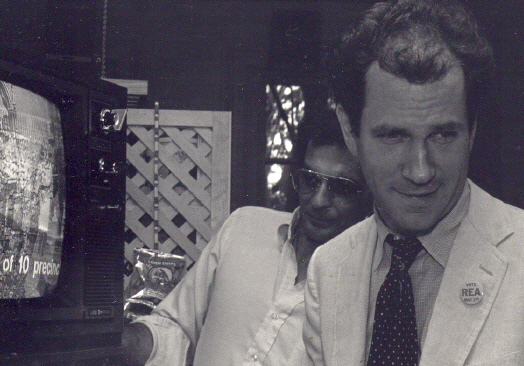
In the spring of 1984, I ran for public office. In case the Rea for City Council campaign doesn’t ring a bell, it was a spontaneous and totally independent undertaking. No doubt, it showed. Predictably, I lost, but I’ve never regretted the snap decision to run, because the education was well worth the price.

In truth, I had been mired in a blue funk for some time prior to my letting a couple of friends, Bill Kitchen and Rocko Yates, talk me into running, as we played a foozball game in Rockitz, Kitchen's nightclub. Although I knew winning such an election was out of my reach, I relished the opportunity to have some fun mocking the system. Besides, at the time, I needed an adventure.

So it began. Walking door to door through Richmond’s 5th District, collecting signatures to qualify to be on the ballot, I talked with hundreds of people. During that process my attitude about the endeavor began to expand. People were patting me on the back and saying they admired my pluck. Of course, what I was not considering was how many people will encourage a fool to do almost anything that breaks the monotony.

By the time I announced my candidacy at a press conference on the steps of the city library, I was thoroughly enjoying my new role. My confidence and enthusiasm were compounding daily.

On a warm April afternoon I was in Gilpin Court stapling handbills, featuring my smiling face, onto utility poles. Prior to the campaign, I had never been in Gilpin Court. I had known it only as “the projects.”

Several small children took to tagging along. Perhaps it was their first view of a semi-manic white guy — working their turf alone — wearing a loosened tie, rolled-up shirtsleeves, and khaki pants.

After their giggling was done, a few of them offered to help out. So, I gave them fliers and they ran off to dish out my propaganda with a spirit only children have.

Later I stopped to watch some older boys playing basketball at the playground. As I was then an unapologetic hoops junkie, it wasn’t long before I felt the urge to join them. I played for about 10 minutes, and amazingly, I held my own.

After hitting four or five jumpers, I banked in a left-handed runner. It was bliss, I was in the zone. But I knew enough to quit fast, before the odds evened out.

Picking up my staple gun and campaign literature, I felt like a Kennedyesque messiah, out in the mean streets with the poor kids. Running for office was a gas; hit a string of jump shots and the world’s bloody grudges and bad luck will simply melt into the hot asphalt.

A half-hour later the glamour of politics had worn thin for my troop of volunteers. Finally, it was down to one boy of about 12 who told me he carried the newspaper on that street. As he passed the fliers out, I continued attaching them to poles.

The two of us went on like that for a good while. As we worked from block to block he had very little to say. It wasn’t that he was sullen; he was purposeful and stoic. As we finished the last section to cover, I asked him a question that had gone over well with children in other parts of town.

“What’s the best thing and the worst thing about your neighborhood?” I said with faux curiosity.

He stopped. He stared right through me. Although I felt uncomfortable about it, I repeated the question.

When he replied, his tone revealed absolutely no emotion. “Ain’t no best thing … the worst thing is the sound.”

“What do you mean?” I asked, already feeling a chill starting between my shoulder blades.

“The sound at night, outside my window. The fights, the gunshots, the screams. I hate it. I try not to listen,” he said, putting his hands over his ears to show me what he meant.

Stunned, I looked away to gather my ricocheting thoughts. Hoping for a clue that would steady me, I asked, “Why are you helping me today?”

He pointed up at one of my handbills on a pole and replied in his monotone. “I never met anybody important before. Maybe if you win, you could change it.”

Words failed me. Yet I was desperate to say anything that might validate his hope. Instead, we both stared silently into the afternoon’s long shadows. Finally, I thanked him for his help. He took extra handbills and rode off on his bike.

As I drove across the bridge over the highway that sequesters his stark neighborhood from through traffic, my eyes burned and my chin quivered like my grandfather’s used to when he watched a sad movie.

Remembering being 12 years old and trying to hide my fear behind a hard-rock expression, I wanted to go back and tell the kid, “Hey, don’t believe in guys passing out handbills. Don’t fall for anybody’s slogans. Watch your back and get out of the ghetto as fast as you can.”

But then I wanted to say, “You’re right! Work hard, be tough, you can change your neighborhood. You can change the world. Never give up!” During the ride home to the Fan District, I swore to myself to do my absolute best to win the election.

A few weeks later, at what was billed as my victory party, I, too, tried to be stoic as the telling election results tumbled in. The incumbent carried six of the district’s seven precincts. I carried one. The total vote wasn’t even close. Although I felt like I’d been in a car wreck, I did my best to act nonchalant.

http://photos1.blogger.com/blogger/6291/212/1600/Rea84z.0.jpg
This shot, taken at Grace Place, shows my reaction to
the news that with half the votes counted I no longer
had any chance to win.
In the course of my travels these days, I sometimes hear Happy Hour wags laughing off Richmond’s routine murder statistics. They scoff when I suggest that maybe there are just too many guns about; I’m told that as long as “we” stay out of “their” neighborhood, there is little to fear.

But remembering that brave Gilpin Court newspaper boy, I know that to him the sound of a drug dealer dying in the street was just as terrifying as the sound of any other human being giving up the ghost.

If he's still alive, that same boy would be older than I was when I met him. The ordeal he endured in his childhood was not unlike what children growing up in any number of the world’s bloody war zones are going through today. Plenty of them must cover their ears at night, too.

For the reader who can’t figure out how this story could eventually come to bear on their own life, then just wait … keep listening.

 -- 30 --

Five Film Favorites: Rock 'n' Roll

The Mamas and Papas onstage (1967).

Movies and music go together. Like peanut butter and jelly? Perhaps more like Bonnie and Clyde.

Anyway, because moving images and music, in one form or another, compliment one another so nicely and they both rely on timing, we get the two together so often we don't even notice it. Then there are other times we're supposed to notice -- times when the music is at least as important as the picture.

When considering music films for a favorites list there are so many different kinds of musicals and movies about musicians that the category has to be narrowed. Therefore, for this list of five favorites, I’m looking only at rock ‘n’ roll movies, the genre baby boomers like me grew up hearing.

However, over the last five decades, plus, there have been so many movies that used rock ‘n’ roll music to add to the story, or perhaps to fill some gaps, that the category must be narrowed further. Just think of how many movies copied the manner in which George Lucas used oldies in "American Graffiti" (1973). Still, calling that movie a rock 'n' roll flick would be a stretch. 

So, for this list of five, only those films which present the music as concert footage are being considered. All five on my list present the musicians, performing as themselves, on-stage, before a live audience. All are documentaries of concerts of a certain stripe, even if they were staged for the purpose of making the film.

Which means that as much as I like "A Hard Day's Night" (1964) I can't put it on this particular list. Tomorrow I might change my mind, after all it's my list, but today my five favorite 'rock 'n' roll concert films are:

“Gimme Shelter” (1970): Directed by Albert Maysles and David Maysles. Performers: The Rolling Stones, also with Jefferson Airplane, The Grateful Dead, Tina Turner and more.

“The Last Waltz” (1978): Directed by Martin Scorsese. Performers: The Band and various guest musicians.

“Monterey Pop” (1968): Directed by D.A. Pennebaker. Performers: Jimi Hendrix, The Who, Big Brother and the Holding Company, Simon and Garfunkel, The Mamas and Papas, Otis Redding, and more.

“Stop Making Sense” (1984): Directed by Jonathan Demme. Performers: Talking Heads.

“The T.A.M.I. Show” (1964): Directed by Steve Binder. Performers: The Rolling Stones, The Beach Boys, The Supremes, James Brown, Marvin Gaye, Smokey Robinson & The Miracles, Lesley Gore and more.

Sorry, "Woodstock" (1970) didn't make the cut.

Wednesday, June 14, 2017

Picky Progressives and Red Meat

You're in your favorite vegetarian restaurant for lunch. As you order a bowl of black bean soup with extra jalapeño cornbread two guys in dark suits, both about 25, are making a commotion. Seated at a table across the room, they are demanding to be served cheeseburgers with lettuce, tomato and mayonnaise. 

All the while, their waitress is trying to explain that the place just doesn't serve any red meat, poultry or seafood. Ignoring her, one of the guys says he wants his cheeseburger medium-rare. The other goes for well-done. Both of them laugh with satisfaction. 

You ask your waitress, who is a friend, how often that sort of thing happens. She sighs, rolls her eyes and says, "At least once a week."

You return to the magazine article you were reading. It's about the gubernatorial race in Virginia, in particular it focused on some disgruntled Democrats saying they can't vote for Ralph Northam. You read about how some self-styled progressives basically see their vote as sacred. So they can't support a man who is too conservative, or even one who maybe used to be. Those quoted in the article said they wanted Tom Perriello to win, because he was properly seen as the "progressive" in the race. A few said they will not vote at all. Others said they will vote, just to write in Jill Stein or Mickey Mouse.

The guys who ordered the burgers are shouting at their bewildered waitress. The manager of the restaurant rushes in to tell the unruly customers to stop making a scene. Undaunted, they demand to be served what they want to eat. One of them suggests, "Go out and buy the damn meat at the grocery store and..."

"There's no check for your drinks, please just leave," the manager says abruptly. As the troublesome duo laughs and gets up from their table, the room remains dead silent. Without delay, they finish their cocktails standing up.  

A minute later your waitress puts a longneck Pabst Blue Ribbon on your table. She knows you don't need a glass. You tell her you were just reading about some Virginians who refuse to vote for a candidate who is on the ballot. You explain that for governor they don't like the Democrat or the Republican. 
 
She says, “But one of them is going to win. From what I see Gillespie and Northam are different enough. One of them has to be either better, or worse, than the other.”

As the burger bros leave in a huff, you whisper to her, “That's pretty much how I see it. I'm for Northam.”

She grins, “Me, too, but it sounds like those lefties in the magazine are the same kind of brats who might demand to be served, I say SERVED, a medium-rare cheeseburger in the best vegetarian restaurant in town. Sorry boys, it's not on the menu.”

After a quick gulp of cold beer, you say, “Bull's-eye.”