Saturday, April 20, 2013

Rep. Nate Bell: 'Boston liberals spent the night cowering'

Yesterday, as the intense manhunt for a Boston Marathon bombing suspect was ongoing, a smugly porcine member of the Arkansas state legislature, Rep. Nate Bell, posed a question (via Twitter) about “liberals” that was surely on the minds of some of his fellow Republicans: “I wonder how many Boston liberals spent the night cowering in their homes wishing they had an AR-15 with a high-capacity magazine?”

Click here to read more about Bell's quip at Boston Magazine.

Bell's barbed rhetorical question represents exactly how too many pushy people believe the modern political game should be played. They are constantly on the make; always poised to capture what’s in the air and promptly twist it out of shape. They know that if it bleeds it ledes, and then later they can always say, "Oops, I hope no one took offense."

Yes, Democrats do it, as well as Republicans. But with Republicans, particularly on guns issues, their apparent tone deafness has sometimes been rather startling. Wisecracking about fresh tragedies is guaranteed to upset people who are still in shock, still grieving. It will always get a reaction from those who care about the victims.

Yes, some people enjoy provoking such reactions ... then pretending it wasn't their aim. Some people like to pull the wings off of bugs, too.

So, I think Bell was busting what he saw as cool move -- issuing a bon mot! -- hoping to delight lots of Republican tweetsters and gun nuts who see the NRA’s Wayne LaPierre as a great thinker and a hero. And, who generally love to see Bostonians ridiculed.

Bell did what plenty of right-wing pundits and politicians do on a regular basis: He said the snarkiest thing he could think of to say about his enemies. Then he hoisted a glass to share the naughty giggle with his colleagues and admirers. Then, of course, he issued a non-apology apology, full of winks and nods, and snorts.

Tennessee’s Sen. Rand Paul’s acrid comment about the Newtown families, “In some cases, I think the president has used them as props,” is another recent example of what seems to me to be a calculated tone deafness by a Republican talking about guns.

Paul knows that when the reporters come back to ask him about an apology/restatement, it routinely means a followup story will be written. The second article will allow him to water down the original snark, while the most important message has already been received by the extremists.  

However, in Bell’s case, when he used the word, “cowering,” he went further than Paul and he crossed a line, or maybe jumped over a ditch. That was in the hate-in-your-face style of the Westboro Baptist Church funeral demonstrators.

The giggling Mr. Bell deserves to be hounded out of public office. 

Wednesday, April 17, 2013

Infamy in the Senate

Formerly a member of the U.S. House of Representatives, Gabby Giffords is also a recovering victim of a massacre. Today the U.S. Senate pissed her off.
This defeat is only the latest chapter of what I’ve always known would be a long, hard haul. Our democracy’s history is littered with names we neither remember nor celebrate — people who stood in the way of progress while protecting the powerful. On Wednesday, a number of senators voted to join that list.
Click here to read all of Gabby's blistering New York Times OpEd piece that reacts to the Republican-led filibuster to block a vote on gun legislation that most Americans seem to favor. 

Monday, April 15, 2013

Millsaps on Jackie Robinson

Sept. 22, 1947 issue of Time

Since I was only nine when Hall-of-Famer Jackie Robinson retired, it took years before I could begin to understand what he meant to so many people in Richmond, people who mostly lived in the parts of town I knew little about, then.

As a kid I was a New York Yankees fan. My excuse is they had a Triple A farm club here between 1954 and 1964. Without question, I pulled for the Richmond Virginians, or V's, for short. As the Yankees played in the American League, to me, Robinson was mostly another player for the National League enemy Brooklyn Dodgers.

At that age, although I was a devout baseball fan, there was just no way I could fully grasp what Robinson had accomplished in breaking the color line in 1947. In truth, I’m still learning about what a genuine hero Robinson was during the baseball season that was played over eight years before Rosa Parks and the Montgomery bus boycott put Martin Luther King, Jr. on the map.

“To Neet, Dodger Ranked a Source of Pride,” is an elegant sports remembrance. It was crafted by one of the best sportswriters I’ve known, Bill Millsaps. To commemorate the 60th anniversary of Robinson's debut with the Dodgers, it was published by the Richmond Times-Dispatch in 2007. 
“...As young children, we didn’t know a lot about Neet, except we knew she was a wonderfully gentle soul. We knew she and her husband Glenzon lived over in The Ridges on the other side of the Southern Railroad tracks, that they raised a family of four children, that they were people of deep religious faith, and that Neet answered most questions one of two ways: ‘Yessum’ and ‘Nome.’ To say that Neet kept her feelings and opinions under wraps is to say that the Grand Canyon is a very big ditch. Then Jackie Robinson came to the major leagues 60 years ago today as a member of the 1947 Brooklyn Dodgers, and Neet couldn’t hide her pride.”

Click here to read the entire piece.

Before serving as the executive editor of the Richmond Times-Dispatch (he retired in 2005), Millsaps was the sports editor of that same newspaper 1973-91. And, he wrote on sports, regularly.

By the way, now I'm strictly a National League fan, and I routinely root for anybody to beat the Yankees.

Anybody!

Thursday, April 11, 2013

The Billy Roast ... Perhaps


Billy Snead's pals roasted him at the Biograph Theatre softball team's 30th annual Derby Day reunion party on May 2, 2009. At the time some of us also wanted to celebrate our friend Billy's applause-worthy stiff-arming of leukemia. The video below documents the roasting.

Always a stalwart about attending the Derby Day reunion, Billy Snead (pictured above in 1992) couldn't make it to the 33rd edition of the party on May 5th of 2012. The cancer had returned; he died on the day after, May 6th.

The video footage from 2009's Derby Day get-together was shot using a borrowed digital camera with no tripod (camera sitting almost level on a table), no lights, with whatever sound was in the air (including a brief rainstorm). Nonetheless, rough as it might be, in spots, this short film manages to capture a natural celebration of camaraderie that is uplifting.


The music, "Bill's Journey," is by Bill Blue. It was used with his permission.

To read some very funny stories Billy wrote about his salad days growing up in the Fan District click here.

Saturday, April 06, 2013

The Zism and Dancing Doodles

Note from Rebus: The image of the zism (depicted right) came to Rea in a time when he was at loose ends. After nearly 12 years of devotion to keeping the Biograph open, upon leaving his job as its manager he was on the lookout for something new. Or maybe it was something he had lost along the way. 

Yet, after years of being immersed in a pretend world of movie scenes, rather than seeking enlightenment, or focusing on learning a useful trade, Rea went deeper into living in an imaginary realm. Which led to him making up his own ism. 

*

In the spring of 1983 the Biograph Theatre's owners, based in Georgetown, could see the bad trends from a hundred miles away. The deterioration of the commercial neighborhood surrounding the theater was obvious. Baby boomers in their 30s were moving out of the Fan District. The growing impact cable television was having on repertory cinemas, in general, was depressing. There were other problems,too, including what the owners saw as a bloated payroll.

In May they almost sold their struggling independent twin cinema to a chain. When the potential buyer refused to accept responsibility for all of the Richmond Biograph's debts, the deal fell apart.

Those few days of anxiety-ridden uncertainty, when it appeared everything I'd worked for was about to disappear like a puff of smoke, scared the hell out of me.   

Which made me see that my persona was resting entirely on the platform my peach of a job had provided for me. It was who and what I was perceived as being. I lived it 24-hours-a-day. There was no other job like it in Richmond. Which also meant, one way or another, most of the favors that had tumbled my way since 1972 had traveled across that same platform.   

It was a high-profile position in a rather small world. And, in my tortured frame of mind it was also a trap that had me in its grip. The painful truth that I hadn't been a particularly good manager for most of the previous year also weighed on me. After stewing in my juices for a few weeks, dwelling on such darkly-tinted thinking, I lurched to  a decision -- continuing to be terrified of losing my job was simply intolerable.

Consequently, for the first time, just closing the door and walking away from the Biograph began to seem to be my best option. My divorce had just become final and my then-girlfriend, Tana, thought I had gotten stale keeping the same job too long. In spite of how crazy it seems now, having no plan for how to make a living scared me less than staying on.

Thus, for reasons good and bad and fantasizing I would solve whatever money problems popped up with my willpower, I took the plunge and resigned.

Caught up in a mania, I promptly sat down in my downtown apartment on Franklin Street and created a three-page, hand-lettered resume ... with 'toons for illustrations. Then I mailed off a batch of them to apply for jobs that looked attractive to me. In some cases they just went to organizations I admired, without applying for a particular opening.

Awaiting all the new opportunities, I seriously set about making some new art -- stuff that would have nothing to do with selling classic double features or midnight shows. I worked on depicting what a couple of my childhood recurring dreams looked like. I also tried to do some writing but became frustrated with the process.  

Naturally, it was disappointing when the interviews and offers I was sure would flow my way from sending out those goofy resumes never happened.

At this time I was acting as the art director for Throttle (magazine) and I hosted a weekly show on Color Radio. Neither of those time-eating responsibilities paid a nickel. However, I also sold and produced advertisements for both entities, which did bring in a little money. Very little. So, I began the process of shrinking my lifestyle -- selling off old collectible stuff, cool objects I had acquired in fatter times.

As the summer passed I drew some comic strips, made a series of small paintings featuring Rebus (like the one to the left), and I put together a couple of collages (that I later destroyed). A large abstract painting was also produced (which I still have). In the doing of all that I designed a logo-looking graphic to represent movement through time and dimensions.

With an eye always on sarcasm and mockery I called my new gimmick a “zism,” to label it as the symbol of the last ism, the inevitable final system of beliefs and conclusions that would assimilate all the previous isms in history -- a perfect postmodern ism, as chock-full of mysterious hokum as any of them.

The zism's look was inspired by the 1920s constructivist movement in the USSR and 1930s cartoons, especially those created  by Max Fleischer -- Popeye, Betty Boop, etc. In my view it suggested both structure and spontaneity.

In truth, the zism was a mindless doodle drawing that I played with and refined over time. As I then considered doodles to be my most natural way of drawing that meant the zism was also about truth. The first published zism, along with some gesture drawings of little dancing pairs, appeared on the cover of Throttle's December 1984 issue.  

Eventually, I had to draw zisms on handbills and put them up on utility poles to see what would happen. In the spring of 1985 I posted a series of “Zism” handbills. They featured cartoons, photos, off-the-wall questions and sayings … and zisms. I liked drawing them. The handbill pictured below was No. 2.
In a droll way I thought the twirling symbol, representing anything you wanted it to, was funny.

Funny?

Maybe that was just more proof of how unhinged I was in this period. And, speaking of unhinged, a dislocated ankle put me on crutches and ended the handbill series. It also made me concentrate on writing, again, in the weeks that followed the injury. I designed the first issue of SLANT, a 16-pager. I also made four large collages on plywood panels. The largest of them was installed in the 3rd Street Diner. 

Then, in the spring of 1986, I started stapling issues of SLANT -- this time front-and-back, two-page handbills -- to selected utility poles twice a week.

In part, that was done to protest the City of Richmond’s renewed crackdown on fliers. I also wanted to establish that a periodical’s legitimacy could be in the eyes of the beholder. In the course of that oblique mission I fell in love with publishing. Then SLANT came down off the poles to go through several changes in format over the next eight years, or so.

The doodle-like drawings of couples dancing made a comeback in 1986. By then I had named them Dancing Doodles. They were used to fill the variable small space that remained open at the end of the pasting up of an issue of SLANT. The space to be filled was usually about an inch or an inch-and-a-half tall.

In printer's parlance the Dancing Doodles were used as dingbats. Drawing them was the fun part of the paste-up chore I always saved for last. They were drawn quickly without a plan; each mark was simply a reaction to the last. Those little Dancing Doodle drawings were further attempts at depicting structure and spontaneity moving in harmony -- sort of like what a good jam session is made of.

After a year or so, I stopped putting the Dancing Doodles in SLANT, as the 'zine matured and got tighter in its layout. I was surprised but pleased when I got some complaints.

In the mid-1990s I made a few paintings of dancing couples, maybe a half-dozen. Again, I was thinking about the righteousness of doodles. These pieces were larger and more involved than what had come before. A few prints of them sold, cheaply, then I put them on the back burner again. Dancing Doodle No. 3 (approximately 8" by 10"), seen below, was part of that series.

Friday, April 05, 2013

The Underdog Room


Carl W. Hutchins (1924-2006) was a professional boxer in his youth. He claimed to have been a contender in his day. Most people called him “Piggy.”

Piggy Hutchins was known by three generations of Richmonders. They were locals of a certain stride, folks who ate, drank and shared their lives in his restaurants. Piggy’s most loyal customers tended to use his dives/eateries as a clubhouse … except when a feud kept one of them away for a while.

A corner restaurant called “Piggy’s,” located at Mulberry and Cary (where the Cary St. Cafe is now), began the series of places he would own. The Attaché, at 5816 W. Broad St., was the last of them; it closed down in 2002.

Eighteen years ago I was associated for a short stint with the legendary Attaché (although for some reason Piggy was calling it William Henry’s that year). A money crisis pushed me across the Henrico County line, inquiring after a bartender position that was listed in the newspaper's want ads. That afternoon I met the one and only Piggy Hutchins. I had known him only by reputation before.

After a pleasant chat with Piggy, I suspected there was no bartender job open. Nonetheless, Piggy’s older brother, Pete, and Bill, a nephew, gave me a tour of the decidedly suburban split-level facility -- the restaurant itself, the after-hours club on the upper story and the basement tavern. They explained that Piggy was really looking for an idea more than someone else to put on the payroll. He had advertised the job to attract someone who'd give him a new scheme.

Well, I needed money, and fast. So that’s exactly when a concept of how to use the basement space came to me in a flash.

Like characters in a Damon Runyon story, we all sat at the main table to cut a deal over draft beer and coffee. I explained how it could work. Right away, Piggy liked it that I volunteered to take on the promotional costs and booking duties, that I wanted only a cut of the bar receipts -- no guarantees. Plus, I got tips as the bartender on duty. And, Piggy liked telling his war stories to a writer.

As it happened, I left the place that day nurturing an absurd notion that became the Underdog Room. For three nights a week, I presented stand-up comics and live music in the basement, which had a boxer's heavy bag hanging in it, leftover from when Piggy still worked out and trained young boxers in that space.

To kick off the Underdog Room era, I booked the Vibra-Turks. Some of them were usually known as the Bop Cats. The Vibra-Turks were: Mike Moore (bass); Gary Fralin (keyboard); Lindy Fralin (guitar); Stuart Grimes (drums); Jim Wark (guitar). In one way of looking at it, we had a band with a fake name playing in a room with a fake name.

Nonetheless, a good break, publicity-wise, helped the handbills flush out enough barflies and aging scenesters to make for a good-sized audience. When Piggy came downstairs he liked the look of the crowd, he seemed to even liked the Vibra-turks. But some members of his staff members remained unsure about the direction of things.

On Thursdays it was comedy night. Usually seven or eight comics would show up. My old friend, John Porter, served as the emcee/recruiter. The performers split the cash from a cheap cover charge and drank beer for free. Hoping to establish to new venue, several of the the area's comedians stopped by to do a few minutes on most Thursdays.

On Friday and Saturday nights a band played, usually the same band on both nights. The bands would take what came in at the door, but as the weeks wore on, getting my Fan District nightlife friends to venture into Henrico County grew more difficult. As the take at the door shriveled, from one week to the next, I gradually ran through the established acts I could easily persuade to give the Underdog Room a try.     

The Scariens, a local performance-art/rock 'n' roll act, stretched the culture clash aspect of my shaky gig to pieces. Piggy and his Attaché crowd of regulars were utterly baffled by the Scariens, who sometimes seemed to baffle themselves, too. They were led by another old friend, Ronnie Soffee.

To make matters more fractious, some of the comedians seemed to rub Piggy's confidants the wrong way; to say they didn't get the jokes is an understatement. After almost four months of it, I came to my senses and bailed out.

Leaving Palookaville on good terms, I limped back to the Fan. It had been fun working with the comedians and musicians in such an off-the-wall situation. And, getting to know Piggy, to the extent that I did, was like living in a low-budget film noir picture from the late-1940s. 

Thursday, April 04, 2013

The Tipping Point for Shockoe Bottom Baseball

Note: This piece was published by Richmond.com on June 18, 2009. For whatever reasons, the once-dead-and-buried notion of stuffing a baseball park into Shockoe Bottom has been reanimated. So here's a look at my take on how it all ended, abruptly, four years ago.

*

The Tipping Point for Shockoe Bottom Baseball
by F.T. Rea

The air of inevitability that once hovered over the Highwoods Properties/Richmond Baseball Club plan to build a new baseball stadium in Shockoe Bottom is gone.

The story of where professional baseball ought to be played in Richmond has taken many a turn over the last decade. Longtime Richmonders can’t remember another squabble quite like the one between supporters of building a baseball stadium in Shockoe Bottom and those opposed it.

While of many of those among the opposition prefer their baseball on the Boulevard, still others see baseball itself as relatively unimportant to Richmond’s future, when compared to The City's infrastucture needs, schools, etc.
 
The Richmond Times-Dispatch ran an article on Monday about purple martins roosting in trees in Shockoe Bottom and online readers criticized/mocked the newspaper, “environmental whackos,” “anti-development crusaders,” former Mayor Doug Wilder, Mayor Dwight Jones and you-name-it.

Over the last eight months the comments space under most online newspaper and magazine articles about baseball in Richmond has included the same sort of over-the-top comments from partisan readers, who either boost or bash Shockoe Bottom or the Boulevard with practiced passion.

In the blogosphere it has been the same; if anything, the tone has been worse. That many of such comments were crafted under the cloak of anonymity hasn’t done much for the civility of the discussions.

After all the news stories saying the purchase was close, closer, closest -- RBC, headed up by Bryan Bostic, came up short of money to purchase the Connecticut Defenders by the June 1 deadline the team’s owner had set. With the news of the collapse of Bostic’s effort to buy the Defenders the momentum for keeping baseball on the Boulevard has picked up.

We read that other teams are interested in moving to Richmond. A new plan to refurbish the 24-year-old Diamond has surfaced: Opening Day Partners says it can do the job for $28 million.

Somewhat ironically, this newest plan bears a noticeable resemblance to the $18.5 million agreement that would have given the old ballpark a makeover after the 2004 season was completed by the Richmond Braves. That plan had The City, the owners of  the R-Braves and the surrounding counties all participating in paying for the facility.

Now the Shockoe Center project, as designed by Highwoods Properties, is up in the air. Highwoods’ spokesman, Paul Kreckman, has said repeatedly that without the baseball stadium component his company will just walk away from the entire $783 million scheme it has presented for developing both Shockoe Bottom and the area just south of the Diamond. 

Kreckman reaffirmed that position on May 12 at the Richmond Times-Dispatch Public Square Forum, conducted by the newspaper’s publisher Tom Silvestri.

To the extent the Shockoe Bottom baseball stadium concept is truly fizzling, the tipping point may well have been the night of that RT-D forum. After the four invited speakers made their presentations, a two-to-one majority of the audience members who spoke weighed in against baseball in Shockoe Bottom. Applause indicated a split along the same line.

Although the politicians in attendance had little or nothing to say, they surely saw a roomful of voters. And, they certainly heard a laundry list of sensible reasons why NOT to shoehorn a baseball stadium into Shockoe Bottom.

In addition to being way outnumbered, as far as the attendance went, another part of what underlined the weakness of Highwoods/RBC position was how fairly the forum was conducted. Silvestri’s calm evenhandedness offered a sharp contrast to those individuals who said things that were off-the-wall, or perhaps less than forthright.

After all the hyperventilating in comments under baseball stories, the thinking that Richmond was evenly divided on whether to build a baseball stadium in Shockoe Bottom was revealed to be an illusion -- poof!

No doubt, that illusion had been fostered in some part by the aforementioned online comments, which allowed a handful of determined downtown baseball boosters to appear to be many more, in numbers, than they really were.

Everyone who bothered to attend the May 12th forum saw the plain truth in the bright lights -- one side of the debate had turned out a lot more warm bodies than the other. Over and over, they heard fellow citizens questioning the veracity of what Kreckman and Bostic were saying. The doubts became contagious. If any of Bostic's would-be investors were in the room that couldn't have helped his cause. 

If it had been a baseball game the score would have been something like Boulevard 9, Shockoe Bottom 2.

-- 30 --

Wednesday, April 03, 2013

From Yeats to Greene to Stone

Balcomb Greene
Revved up over an English class assignment to write a paper on "The Second Coming," by W. B. Yeats, I stayed up all night crafting it, and thought I had hit a home run. The professor, an awkward, gangly sort of fellow in his late-20s, gave me a “C” on it.

Well, I just had to ask him to explain to me what was wrong with the paper. In a private conference he told me my analysis of the poem didn't jibe with the accepted school of thought on what Yeats was saying. While admitting my writing and analytical technique were fine, he nervously explained that I was simply wrong in my conclusions, no matter how well-stated my case might have been.

That sort of pissed me off, so I told him I thought that ambiguity could imply multiple meanings, and it deliberately invited alternative interpretations. Rather than defend as his stance the man suddenly grabbed his face and broke into tears.

The sobbing professor went into a monologue on the shambles his life had fallen into. His personal life! Worst of all, he said, his deferral had just been denied by Selective Service, so he would soon be drafted.

He was wearing a pitiful brown suit. His thinning beige hair was oiled flat against his scalp. My anger over the bad grade turned into disgust. As I remember it, I walked out of his office to keep from telling him what I thought.

Now, four decades later, I regret my impatience and feel sorry for the poor schlemiel. Still, when the offer came at the end of the semester to expand my part-time job to full-time, I took the leap. My chief duty was to schlep visiting scholars around Virginia from one university campus to the next in a big black Lincoln.

Each week, under the auspices of the University Center in Virginia -- a consortium of Virginia colleges and universities -- there was a new scholar in a different field. Somebody had to drive them to lectures, dinners, convocations and to hotels throughout the week. For one whole semester that was me.

Naturally, in the crisscrossing of Virginia, the wiseguy driver and the actually wise scholars had a lot of time to talk. Some of them kept to themselves, mostly. Others were quite chatty, in several cases we got along well and had great talks.

Three of them stand out as having been the best company on the road: Daniel Callahan (then-writer/editor at Commonweal Magazine), Henry D. Aiken (writer/philosophy professor) and Balcomb Greene (artist/philosopher and art history professor).

Callahan challenged me to think more thoroughly about situational ethics and morality. He was happy I was reading the books of Herman Hesse and others. He turned me on to “One Dimensional Man,” by Herbert Marcuse.

Callahan was quite curious about my experiences taking LSD, we talked about drugs and religion. Click here to read about him.

Aiken (1912-‘82) was then the chairman of the philosophy department at Brandeis University, he loved a debate. He was used to holding his own against the likes of William F. Buckley. Talking with him about everything under the sun in the wee hours, I first acquired a taste for good Scotch whiskey (which I haven't tasted in many a year).
From a ‘pragmatic’ point of view, political philosophy is a monster, and whenever it has been taken seriously, the consequence, almost invariably, has been revolution, war, and eventually, the police state.

-- Henry D. Aiken
Aiken, like Callahan, agreed to help me with a project I told them about. Inspired by popular new magazines Ramparts, Avant-Garde, Rolling Stone, etc. -- at 21-years-old -- I wanted to jump straight into magazine publishing, with no experience, ASAP.

That dream stayed on the back burner for 16 years, until the first issue of SLANT came out in 1985. How I went about designing SLANT to be a small magazine, mostly featuring the work of its publisher, flowed in great part from my brief association with Balcomb Greene (1904-90). Of the rent-a-scholars I met, he was easily the funniest.

The son of a Methodist minister, Greene grew up in small towns in the Midwest. He studied philosophy at Syracuse University, psychology at the University of Vienna and English at Columbia University. Then he switched to art, having been influenced by his first wife, Gertrude Glass, an artist he had married in 1926. He became a founder of the avant-garde group known as American Abstract Artists in 1936.

After World War II, just as abstract art was gaining acceptance, Greene radically changed his style. He began painting in a more figurative, yet dreamy, style that fractured time. Click here,
and here, to read about Greene and see examples of his work.

One day I’ll write a piece about the visit to Sweetbriar with Greene. It was a hoot collaborating with him, to have some fun putting on the blue-haired art ladies of that venerable institution. This time my mention of him is to get this piece to I.F. Stone. It was Greene who gave me a subscription to I.F. Stone’s Weekly.

I.F. “Izzy” Stone (1907-89) was an independent journalist in a way few have ever been. In the 1960s his weekly newsletter was a powerful voice challenging the government’s propaganda about the war in Vietnam. Click here to read about Stone, and here.
"All governments lie, but disaster lies in wait for countries whose officials smoke the same hashish they give out."
-- I.F. Stone
Stone remains one of my heroes. At my best, over the years, I have emulated him in my own small ways. Thank you for the schooling, Professor Greene.

-- 30 --

Sunday, March 31, 2013

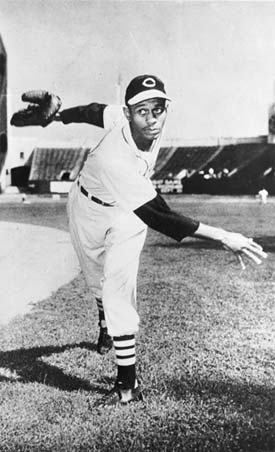
Satchel Paige: 'Don't look back'

Satchel Paige as a Cleveland Indian
With another Major League Baseball season about to get underway and the local team, the Richmond Flying Squirrels, about to open their season on Apr. 4 at the Diamond, I can’t help but think of what was a temple of baseball in my youth, Parker Field, which was located where the Diamond is now.

Parker Field opened in 1954 to serve as home for a new International League club — the Richmond Virginians. The Baltimore Orioles (formerly the St. Louis Browns) joined the American League that year, leaving an opening in the IL for the Richmond entry.

As the V’s became one of the New York Yankees’ Triple A farm clubs, in those days the Bronx Bombers paid Richmond an annual visit in April. Just before Major League Baseball’s opening day, Mickey Mantle, Yogi Berra, Whitey Ford and the other great Yankees of that era played an exhibition game in Richmond against V’s.

It was always a standing-room-only affair.

Other than the pinstripe-clad hometown V’s my favorite club of the IL then was the pre-revolution Havana Sugar Kings. They played with an intensity, bordering on reckless abandon that made them a lot of fun to watch, especially for the kids.

One of my all-time favorite players I saw pitch at Parker Field was Leroy “Satchel” Paige (1906-82). Yes, the legendary Paige, with his windmill windup, high kick and remarkably smooth release still working for him, plied his craft on the mound here in Richmond to the delight and other reactions of local baseball fans.

In 1971, Paige (pictured above, circa 1949) was the first of the Negro Leagues’ great stars to be admitted to Major League Baseball’s Hall of Fame, based mostly on his contributions before he helped break the Major League color line in 1948, as a 42-year-old rookie. The statistics from his pre-Big League days are mind-boggling. It's been said he won some 2,000 games and threw maybe as many as 45 no-hitters.

Furthermore, long before the impish poet/boxer Muhammad Ali, there was the equally playful Satchel Paige, with his widely published Six Guidelines to Success:
  • Avoid fried meats that angry up the blood.
  • If your stomach disputes you, lie down and pacify it with cool thoughts.
  • Keep the juices flowing by jangling gently as you walk.
  • Go very lightly on the vices, such as carrying-on in society - the society ramble ain’t restful.
  • Avoid running at all times.
  • Don’t look back, something may be gaining on you.
Long after his days as the best pitcher in the Negro Leagues, following his precedent-setting stint in the American League, Paige was on the roster of the Miami Marlins (1956-58). Like the V’s the Marlins played in the International League. When I saw him Paige was in his 50s. Not a starter, anymore, he worked out of the bullpen.

In the late-1950s live professional baseball in Richmond was mostly a white guys’ scene. Which meant the boos would start as soon as the crowd noticed Paige’s 6-3, 180-pound frame warming up in the middle of a game. When he’d be called in to pitch, in relief, the noise level would soar. Not all the grown men booed, but many did. That, while their children and grandchildren were split between booing, cheering, or embarrassed and not knowing what to do.

Naturally, some of the kids liked seeing the grownups getting unraveled, so Paige was all the more cool to them. Sadly, for some white men in Richmond, then caught up by the thinking that buoyed Massive Resistance, any prominent black person was seen as someone to be against. So, they probably would have booed Duke Ellington or A. Philip Randolph, too.

The showman Paige would take forever to walk to the mound from the bullpen. His warm-up pitches would each be big productions, with various slow-motion full windups. Then the thrown ball would whistle toward home plate with a startling velocity, making some of the kids cheer and laugh ... to mix with the boos.

Paige as a Miami Marlin

Paige, from Mobile, Alabama, must have understood what was going on better than most who watched him pitch then. He was a veteran performer, who knew perfectly well there wasn’t much he could do to change the boos; they were coming from folks trapped in the past.

So, Paige played to the cheers, as experience over time had taught him to do.

Of course, as a 10-year-old I lacked the overview that what I was seeing was an aspect of the changes the South was going through, to do with race.

My guess is few knew the reaction to Paige, largely being split on generational lines then, was a sign of how America’s baseball fans were going to change -- one day Jim Crow attitudes would have no place at baseball temples.

Now, with the benefit of decades of reflection, I understand that Satchel Paige was a visionary. He was seeing the future by following his own advice -- Don’t look back.

– Images from satchelpage.com

Saturday, March 30, 2013

Memes! Schmemes!

Next to a photo of Allen West, a former congressman from Florida, is the following text: “It used to be that movies reflected American culture. Now it seems they’re trying to define American culture. But then again, it used to be that mainstream media journalists reported the facts.”

It was one those meme things that clutter the news-feed of my Facebook home page regularly.

West, a darling of the Tea Party wing of the Republican Party, is referred to as Colonel Allen West in the meme graphic. After a long career in the Army, he retired as a lieutenant colonel following an ugly prisoner abuse incident in Iraq, for which West was disciplined. Nonetheless, he was allowed to retire promptly with full benefits. 

Actually, most of the memes I see on Facebook express liberal points of view, if they are at all political. That’s because most of my Facebook friends who care about posting political statements are lefties. I also see a lot of memes oozing with cuteness about animals, especially cats. Religious and pop culture memes make regular showings in my news-feed, too.

Which means that I haven’t yet hidden all the “friends” who tend to click and share such annoying sayings/captions with pictures. Still, even when I agree with the point made, I routinely hide the popular memes that annoy me the most. 

Back to West’s statement, I don't doubt the man knows something about the military world. But given what he said about the history of movies and journalism in America, I have to say they are both subjects he apparently knows little about.

Like many Republicans, who like to strike poses of righteous indignation as they rant against modernity, West is a grouchy guy who's plainly unhappy with today's popular culture and political trends. So, as some conservative pundits and politicians are in the habit of doing, West happily takes the liberty to rewrite history -- to suit himself -- then he suggests we all follow him back to his imaginary better times.

A week-or-so ago the same Facebook friend -- a nice guy who knows plenty about race cars and rock ‘n’ roll -- also posted a copycat meme citing the wisdom of Hank Williams, Jr., on deploring Americans who refuse to do any sort of useful work, live on the government dole ... and who always vote the wrong way to suit him. Like so many memes seen on Facebook, posted by folks of varying political persuasions, it was put there mostly to piss off people who disagree with its thrust.

Come on you lazy Facebook addicts! Enough of the insights of louts like Hank Willaims, Jr. and Allen West. If you want to ruffle some feathers, can't you at least do it using your own damn words?

A pox on your memes! 


Friday, March 29, 2013

Ghostly Spider's Skitter

Fifteen years ago, a spider bit me on the temple area next to my right eye. The first symptom was an itchiness that got steadily worse. Initially, I thought it was poison ivy.

It was my then-girlfriend who first suggested, “Spider bite.”

At first, I doubted her call. Since I hadn't seen or felt the little culprit poisoning my face I didn't know if she was right or wrong. By the end of the first day there was some swelling and redness. Over the next couple of days the swelling increased dramatically until my eye was completely closed by it. By then I felt weak and nauseous, with chills and body aches.

Usually, I don't go see doctors much ... almost not at all.

This time was different; the doctor I saw confirmed the spider bite diagnosis. He guessed it was a brown recluse; he told me he didn’t know all that much about spider bites and he said most doctors don’t. He told me it was just a matter of how my body would react to the venom. An antibiotic was prescribed to deal with the infection problem that sometimes comes along with any sort of bite.

Unfortunately, said the doctor, there was nothing he could give me to prevent the venom's tricks from running their course in my body.

Once I started taking the medicine, some of how I felt for the next week probably had something to do with a reaction to the pills, too. In general, I wasn’t as sick as the worst day of a full blown flu. It was somewhat similar to the flu, but it was much more disorienting.

As the swelling went down, the seven spots that had formed in the middle of it gradually turned from reddish-purple to bluish-black. Naturally, I looked at them every few minutes, to see what would happen next.

To understand my problem better I read about brown recluse bites online. That only scared me more. I came to understand the spots I was seeing on my face, grouped within an area the size of a penny, were necrotic flesh.

It was a sobering thought -- my flesh was dying. Not somebody on the Internet.

Me.

After looking at gross photographs of people who had huge tissue losses from brown recluse bites, I swore off my research. The sick feeling gradually went away. The swelling disappeared. The dark spots, most of them the size of a piece of rice, rotted away and dropped off ... leaving seven little holes.

Today the scars are mixed in with the crows feet lines extending from the corner of my eye, so mostly they are only noticed by someone who remembers the ordeal and wants to look for them.

Like other healing wounds there was an itching problem that was a distraction at times. That went on for months. What was the strangest aspect of it all came later, after I had stopped worrying about the spider bite all the time. You see, every so often, there was a feathery, fluttering sensation that felt just like a spider was skittering across my eyelid, or the eyeball itself.

Each time it happened I flinched, believing -- at least for a fraction of a second -- that it could be a spider on my eye. It was torture. Maybe a year after the spider bite that last spooky effect of it faded away, too. I've since believed that meant the healing was over.

Never worried about spiders much before this experience. Live and let live was my approach. After that fluttering eye thing, if I see a spider indoors these days, its biting days are over.

Eventually, I began to wonder -- why seven spots/holes?

Were there seven separate bites? Or, was it one big bite and seven reactions? The doc said he didn’t have the answer.

Bottom line: I was lucky it wasn't worse. 

-- 30 --

Thursday, March 28, 2013

Mondo Softball

With the 34th Biograph softball reunion party on the horizon (Sat., May 4), here's a flashback to a 1990 newspaper article that includes some related Fan District Softball League tomfoolery:
REA GIVES BIZARRE EDGE TO BLAB'S 'MONDO SOFTBALL'
Richmond News Leader
Date: 07-05-1990
Byline: Paul Woody

Years ago when Terry Rea was manager of the now defunct Biograph Theatre, he organized a softball team for the Fan League. But this wasn't just any team. This team had two illegal French aliens.
"One spoke no English at all," Rea said. "Neither had ever seen a baseball game. But they went out to a yard sale, found some funky `50s uniforms and they were a laugh riot."
The Biograph team also had a life-size, cardboard figure of Mr. Natural, a comic-book character created by R. Crumb of Zap Comics. Rea and his teammates took Mr. Natural to every game. They would carry him onto the field and chant to him.

"Some thought it was funny," Rea said. "Some thought we were mocking them. Some thought we were mocking the game."


All Rea was trying to do was enjoy a little softball and make the team and the league, "a rolling comedy show," he said. "I'm not sure everybody on the team was 100 percent behind me on that."


Rea began playing softball in 1976, but now, at the age of 42, he's in semi-retirement.


"I try in the offseason to lower my expectations, but I'm losing my game faster than I can lower my expectations," Rea said. "That drives everyone out of the game except the most fanatic."


Rea, however, is hardly done with softball. In fact, he may be contributing more to the game than he ever did as a player. Rea, a freelance graphic artist by trade, is the originator, host and creative force behind "Mondo Softball," a weekly, one-hour talk and call-in show seen Tuesday nights at 9 o'clock on BLAB-TV (Continental Ch. 7, Storer Ch. 8).


Mondo is Italian for "world." Rea took it from the drive-in movies of his youth that were all the rage.


"There were a bunch of `Mondo' films," Rea said. "Then, you started to see it thrown in front of almost anything to give it a bizarre connotation. People just know it has some sort of bizarre edge to it.


"And, of course, I'm using that."


Rea isn't the host of "Mondo Softball."


The host is Mutt deVille, a man of mysterious origin who always wears a baseball cap, sunglasses and softball jersey. Mutt deVille is Rea's alter ego. Mutt deVille was created by Rea as a pen name for the sports writer in Slant, the twice-monthly newsletter of commentary that Rea publishes, writes and edits.


DeVille initially existed to give some diversity to the pages of Slant, "and to create the illusion there was a staff of writers," Rea said. But the more Rea wrote as deVille, the more he liked it.


"My name, and my approach to things, like anyone who stays in his hometown long enough, carries a certain amount of baggage with it," Rea said. "I could move more freely as Mutt deVille.


"When I decided to do a show and it was a sports show, it seemed like a good idea to use Mutt. That led to the idea that Mutt should become a character and the time I was on camera should be a performance. Mutt is a device to make me feel at ease on stage."


"Mondo Softball" is not like any other show you'll see on BLAB. It's a one-hour play, softball as kitsch. It's part news -- standings, results and tournament highlights provided by Paul Joyce, the `field' reporter and a veteran local player -- part conversation with a guest, questions from callers and wisecracks, subtle humor and outright gags whenever possible. It's clever, and it's as entertaining as a show on recreational softball can be.


Rea said he has borrowed from shows he's seen. From the "Tonight Show," Rea took the idea that Johnny Carson is at his best and funniest when things go wrong.


"Part of live TV is that there are a lot of glitches," Rea said. "I've tried to incorporate the production values of an old `50s sci-fi movie and try to go with whatever goes wrong."


Each week, there is a great uproar over the magic word. If a caller says the word, he or she receives a $20 gift certificate from a local restaurant. The magic word is straight out of "You Bet Your Life" with the late Groucho Marx. In that show, it was called the secret word.


"If you're going to steal, steal from the best," Rea said.


Part of the attraction of "Mondo Softball" is that you can never be sure what will happen next.


"I think some people watch shows on BLAB just to see if the set will fall over," Rea said.


Rea brings a unique element of surprise to the screen. He isn't afraid to take a chance or play a little joke. When he was manager of the Biograph, a repertory theatre located near Virginia Commonwealth University, Rea once offered free admission to "The Devil and Miss Jones."


The line for the show, which most believed to be a well-known X-rated movie, stretched around the 800 block of West Grace Street. But the X-rated movie was "The Devil in Miss Jones." "The Devil and Miss Jones" was a 1941 comedy.


"Most people thought it was funny," Rea said. "But you always have some who get mad about something like that."


"Mondo Softball" has something of the same problem. Hard-core softball players don't always appreciate Rea's attempts at humor.


"I've heard some don't like Mutt's approach," Rea said. "But that's the reason Paul is there. Overall, though, the reaction I get is that they (the hardcore players) like Mutt."


BLAB-TV likes Mutt so much that another show already is in the works. "Mondo Pops," covering everything from sports to who knows what will premier this fall. It should be an interesting experience. Who knows, maybe even Mr. Natural will make an appearance.

*
Note: To see a 1990 video promo for Mondo Softball click here. 

Monday, March 25, 2013

Dr. Franken-Smart's Monster

https://blogger.googleusercontent.com/img/b/R29vZ2xl/AVvXsEhjhgwm6l9QW_TtFEYNAjB9qheo4HiZ_ZZFH5KLxIY-ntJKG7NHMxFwx_C0yXguJEhDIRbwWqqL6KOF95-RVdSukX7NCrCRo-jpTaNQz9TDxyop-bSz9OtImNmt6LTG000WuoOMHg/s320/Smart_3by3.jpg

Along with the buzzer-beaters and blowouts of March Madness come the firings in the coaching ranks. Along with the head coaches of losing teams getting fired, some coaches whose teams made the 68-team field of the NCAA tournament get axed, too.

Accordingly, UCLA has fired Ben Howland and Tubby Smith is out at Minnesota.

Howland, 55, was 233-107 in 10 years at UCLA. This year his team won the Pacific 12 regular season title and went 25-10. Ironically, his Bruins lost to Smith’s Golden Gophers in the NCAA tournament. Smith, 61, was an overall 124-81 in six seasons at Minnesota. He went 21-13 this year. Minnesota just lost to Florida in the round of 32.

UCLA and Minnesota qualifying for the NCAA's championship tournament wasn't enough. Headlines (here, here) are linking those two openings to Virginia Commonwealth University’s Shaka Smart (pictured above).

Which means, with the Sweet 16 games still to be played, the annual Shaka Watch has already started. In four years at VCU Smart, 35, has an overall record of 111-37. During the 2012-13 season Smart became the second youngest coach to win 100 games.

Last year Smart turned down an offer to make $2.5 million a year coaching at the University of Illinois. Why did he turn down roughly a million dollars more than he makes at VCU?

Perhaps Coach Smart had a list of good reasons to stay. Maybe he likes his job. Maybe he likes Richmond; he and his family have bought a home in the Fan District. Maybe he’s not chasing money, so much as it is chasing him. And, it could be that VCU’s phenom of a basketball coach is still in the process of building a project -- a basketball monster.

VCU's monster-in-progress looks like it's being built to consistently compete for the national championship. And, before Dr. Franken-Smart leaves his West Broad Street laboratory, this intense mad scientist wants to see his brainchild strut its monster stuff in the last tilt of the NCAA’s Big Dance.

When Smart first came to VCU, right away, he talked about his new system. He called it “Havoc.” Later, after one of his first games, in the media room in the Siegel Center Smart explained how it would work. He said no one would likely be playing 38 minutes a game, because to go at the pace he wanted, no player -- no matter how well conditioned -- would have the stamina. He said he would use his bench more liberally than many coaches do, because starters would play fewer minutes. 

The problem in the beginning was that he was using the previous coach’s recruits. Not to say they were bad players. Not at all. But to make Havoc work as he envisioned, Smart needed better defensive players than Joey Rodriguez, like maybe a Briante Weber. He also needed big men who could run the floor better than Jamie Skeen, like maybe a Juvonte Reddic. And, yes, he needed slashers to the basket with more finishing ability than Brad Burgess ... like Treveon Graham, for instance.

All three of the former Rams stars mentioned above were good basketball players -- guys who gave their all to the program and brought glory to it. While Smart coached them quite effectively, they weren’t handpicked by him to execute his trapping, overplaying defensive scheme.

Smart’s game plan also calls for open-court, unselfish play on offense -- a total commitment to group thinking. Truth be told, it’s harder to find the sort of player who is capable of thinking that way on most of the rosters of successful schools in the top six conferences. Weber, Reddic and Graham will all be back next year and Smart’s recruiting class for 2013-14 is fast afoot and impressive.

The pampered stars at Kentucky and Kansas don’t want to have to practice or play the smothering defense Smart insists upon. Nor do they hope/expect to play four years of college basketball.

Whereas, at VCU, the players are onboard for four years and they graduate. If Smart were to take his demanding system to a major conference school, it might be harder to sell it to talented one-and-done kids on their way to pro basketball. What Smart now has at VCU is a group of bright kids, who want to prove they can consistently beat such teams with a well-executed plan and an all-out effort.

With Dr. Franken-Smart as their coach the Rams seem to believe they can do it. After all, most of their opponents have no way of practicing realistically to face the monster known as Havoc.

Last year Smart’s players had to have loved it when he walked away from the temptation of more money. Coach is all in, too, is what they must have taken away from Smart’s continued dedication to building a program at VCU. If he does it again this time that feeling will only expand.

Yes, it’s reasonable to assume Smart will one day leave VCU to coach elsewhere. Someday an irresistible offer will come. Still, Rams fans hope the good doctor will wait for a call from an athletic director at a major program who wants to replace a longtime successful coach, a guy who's retiring as a happy man.

In the meantime, maybe next season, the biggest fans of Havoc are hoping for the Rams to be dancing to the Monster Mash, as their coach, a smiling Dr. Franken-Smart, cuts down the net for the last game of the 2013-14 season.

-- 30 --

Saturday, March 23, 2013

The RUMS free ride

Why isn’t there already a free shuttle bus service running a loop from VCU Medical Center to VCU Monroe Campus, to Virginia Union, to the Museum District, to the University of Richmond and back again?

It seems to me like there ought to be.

The shuttle bus could stop at a dozen-or-so appointed places in linking up Richmond’s three universities, its Arts District and several of its key museums.

Let’s see, the bus stops might go like this: VCU Medical Center, Carpenter Center, City Library, November Theater, VCU/ICA (a work-in-progress), VCU/Library, Virginia Union, Science Museum, VMFA, Cary Court, Grove and Libbie Avenues, UR/Modlin Center, UR/Commons … then back the way you came. Free WiFi. Of course, free tourist pamphlets and brochures with savings coupons would be available.

Buy a few small green-friendly buses and have them running every half-hour from 7 a.m. until 7 p.m. on weekdays. Maybe a truncated schedule after 7 p.m. until 11 p.m. and on weekends. Perhaps special stops to accommodate some college sports events could be made. Coffee, bottled water, granola bar snacks, etc., for sale.

What if it all got set up by wealthy corporations (that need to do good deeds) and governmental grants? After all, why wouldn't our community's leaders with vision want to see students and workers and families of tourists able to move about Richmond's cultural loop freely? 

Maybe the GRTC could adjust its operation to shift some of its resources out of that corridor.

If it was safe and dependable, wouldn’t a lot of people and businesses in the metro area benefit from such a system being in place? What about a free ride on a Richmond University/Museum Shuttle?

RUMS. 

Tuesday, March 19, 2013

Mar. 19, 2003: Protests and Warnings Ignored

"I don't listen to focus groups."
In March of 2003, in dismissing the protests of millions in other countries who demonstrated against the invasion of Iraq, President George W. Bush said, "I don't listen to focus groups."

So don't believe the history revisionists who say everyone believed Iraq had weapons of mass destruction that it was itching to share with al Qaeda. I believed the UN weapons inspection team headed up by Hans Blix, who said there were no such stashes of weapons. 

So did a lot of other people, including Sen. Robert Byrd (1917-2010). 

Byrd will be remembered for many things. Among them, he was the longest serving senator (1959-2010). Ten years ago, on the eve of a war, Byrd's words of warning were blown off by the deceitful hawks in the Bush administration. 

Byrd was cast by war mongers as an old goat out of touch with the times. His brief, passionate speech delivered on the floor of the U.S. Senate on March 19, 2003 makes for a particularly interesting read now, in light of all we've learned since that time.

Here are Sen. Byrd's words of advice that Congress and President Bush ignored:

I believe in this beautiful country. I have studied its roots and gloried in the wisdom of its magnificent Constitution. I have marveled at the wisdom of its founders and framers. Generation after generation of Americans has understood the lofty ideals that underlie our great Republic. I have been inspired by the story of their sacrifice and their strength.

But, today I weep for my country. I have watched the events of recent months with a heavy, heavy heart. No more is the image of America one of a strong, yet benevolent peacekeeper. The image of America has changed. Around the globe, our friends mistrust us, our word is disputed, our intentions are questioned.

Instead of reasoning with those with whom we disagree, we demand obedience or threaten recrimination. Instead of isolating Saddam Hussein, we seem to have isolated ourselves. We proclaim a new doctrine of preemption which is understood by few and feared by many. We say that the United States has the right to turn its firepower on any corner of the globe which might be suspect in the war on terrorism. We assert that right without the sanction of any international body. As a result, the world has become a much more dangerous place.

We flaunt our superpower status with arrogance. We treat UN Security Council members like ingrates who offend our princely dignity by lifting their heads from the carpet. Valuable alliances are split.

After war has ended, the United States will have to rebuild much more than the country of Iraq. We will have to rebuild America's image around the globe.

The case this Administration tries to make to justify its fixation with war is tainted by charges of falsified documents and circumstantial evidence. We cannot convince the world of the necessity of this war for one simple reason. This is a war of choice.

There is no credible information to connect Saddam Hussein to 9/11. The twin towers fell because a world-wide terrorist group, Al Qaeda, with cells in over 60 nations, struck at our wealth and our influence by turning our own planes into missiles, one of which would likely have slammed into the dome of this beautiful Capitol except for the brave sacrifice of the passengers on board.

The brutality seen on September 11th and in other terrorist attacks we have witnessed around the globe are the violent and desperate efforts by extremists to stop the daily encroachment of western values upon their cultures. That is what we fight. It is a force not confined to borders. It is a shadowy entity with many faces, many names, and many addresses.

But, this Administration has directed all of the anger, fear, and grief which emerged from the ashes of the twin towers and the twisted metal of the Pentagon towards a tangible villain, one we can see and hate and attack. And villain he is. But, he is the wrong villain. And this is the wrong war. If we attack Saddam Hussein, we will probably drive him from power. But, the zeal of our friends to assist our global war on terrorism may have already taken flight.

The general unease surrounding this war is not just due to "orange alert." There is a pervasive sense of rush and risk and too many questions unanswered. How long will we be in Iraq? What will be the cost? What is the ultimate mission? How great is the danger at home?

A pall has fallen over the Senate Chamber. We avoid our solemn duty to debate the one topic on the minds of all Americans, even while scores of thousands of our sons and daughters faithfully do their duty in Iraq.

What is happening to this country? When did we become a nation which ignores and berates our friends? When did we decide to risk undermining international order by adopting a radical and doctrinaire approach to using our awesome military might? How can we abandon diplomatic efforts when the turmoil in the world cries out for diplomacy?

Why can this President not seem to see that America's true power lies not in its will to intimidate, but in its ability to inspire?

War appears inevitable. But, I continue to hope that the cloud will lift. Perhaps Saddam will yet turn tail and run. Perhaps reason will somehow still prevail. I along with millions of Americans will pray for the safety of our troops, for the innocent civilians in Iraq, and for the security of our homeland. May God continue to bless the United States of America in the troubled days ahead, and may we somehow recapture the vision which for the present eludes us.
-- Illustration (2000 for Richmond.com) by F.T. Rea

Monday, March 18, 2013

The Mission: Win and Advance


Opinions are like, er, noses. Most people have one. So as we look ahead to the NCAA Division I men’s basketball tournament, we can see the regular season, the conference tournaments and lots of opinions in the rear-view mirror.

The polls came out today. The Associated Press dropped VCU from its list of the elite 25. After the weekend’s action, the Rams were were seen by its voters as what amounts to No. 26. The Coaches Poll has VCU as No. 23. The Rams' RPI is currently at No. 24, according to CBS Sports. ESPN’s BPI system has VCU at No. 21. And, so forth…

More importantly, the NCAA selection committee put VCU in its South bracket as a No. 5 seed. Which basically says it viewed the Rams as one of the best 20 teams in the field.

All those opinions say VCU (26-8) had a pretty good season. From here on opinions won’t matter. In the Big Dance, it’s a win-and-advance or a lose-and-go-home deal. On Thursday at 9:45 p.m. the Rams will face their first opponent in the tournament -- the Akron Zips (26-6). 

VCU has beaten Akron in the recent past, but they didn't face one another this season. Doesn’t matter. Akron’s head coach, Keith Dambrot, and Shaka Smart are good friends. Doesn’t matter. VCU plays in what is considered to be a better conference. That's an opinion, so it doesn’t matter now.

Moreover, this tournament usually makes a mockery of the concept of the power conference teams having a big advantage. We’re looking at March Madness. All that matters is for the Rams to prepare and execute … and keep on dancing.

Sunday, March 17, 2013

VCU is a No. 5 seed

 Shaka Smart at his first press conference at VCU in 2009.

VCU was shown some respect by the NCAA tournament selection committee, in that the Rams were placed in the South Regional as a No. 5 seed. That, in spite of VCU’s loss to Saint Louis in the final game of the Atlantic 10 tournament on Sunday afternoon: SL 62, VCU 56.

Saint Louis is a tough, well-coached team. But on Sunday afternoon VCU's head coach Shaka Smart, 35, was at a disadvantage. He had to outsmart both the Billikens’ current head coach and the ghost of their former head coach.

Jim Crews, 59, runs the show at Saint Louis. Crews is now considered a prime candidate for being named national coach of the year, because of the way he got the job and what he has done with that opportunity. His boss, the legendary Rick Majerus, died at 64 on Dec. 1, 2012. So, Crews was essentially coaching his old friend’s last team.

On defense Crews had his guards forcing Smart’s guards out further from the basket than they were comfortable being. The tactic worked like a charm to cut off angles for passing and driving with the ball. So the Rams senior point guard, Darius Theus, had a bad game. So did senior shooting guard Troy Daniels. But make no mistake, Saint Louis’ aggressive defense was what made them struggle on the court.

VCU had only five assists, so the Rams were taking tough shots and hit only 33.9 percent from the field. SL had 13 assists and shot at a 45 percent clip.

Click here to see the box sore. 

Since Saint Louis got a No. 4 seed that probably means the committee had already decided, before the game, to put the winner of the A-10 championship game at a No. 4 seed in the brackets and the loser at a No. 5. In its first match-up VCU (26-8) will face Akron (26-6), a No. 12 seed, on Thursday at 9:45 p.m. (EDT) in Auburn Hills, Michigan.

What a difference changing leagues can make. Last season, after winning its conference’s tournament -- to represent the Colonial Athletic Association in the NCAA tournament -- VCU left the CAA abruptly to join the Atlantic 10. The news from the NCAA selection committee Sunday evening underlined what a good move that was for VCU.

The A-10 not only has its conference champ in the Big Dance, four additional teams were given at-large bids. Whereas, the CAA has only one team in the hunt for the national championship, its tournament winner -- James Madison. And, the Dukes (20-14) were assigned one of the tournament’s first-round/play-in games.

Which means the CAA is apparently regarded as less than a mid-major conference in 2013. To make matters worse, next year, the CAA will lose two more members. And, the A-10 is also in a flux, with expectations that it will soon lose multiple members to the “new” Big East. So the musical chairs game of conference departures and additions is hardly letting up.

Meanwhile, there’s a tournament to be played that will end in Atlanta on April 8. Click here to see the brackets.

While directing his team in its effort to beat the Akron Zips, VCU's Smart will be facing one of his former colleagues/mentors, Keith Dambrot, the Zips head coach. For two seasons (2003-05) they were assistant coaches on the same staff at Akron. When Dambrot was promoted to head coach, Smart stayed on and assisted him for one season (2005-06).    

From here on it won’t matter what a committee or any sports pundits might think of the teams in the NCAA tournament. Only results matter. One loss ends your season, no matter who you are. If VCU defeats Akron it will face the winner of the South Dakota St. (seeded 13th) vs. Michigan (seeded 4th) game on Saturday.

Click here for a look at a report on the upcoming game at VCU's web site.

Friday, March 15, 2013

VCU’s 10 Basketball Coaches

Sonny Smith VCU's head coach 1989-98
Since 1968 none of VCU’s head coaches have left the job having accumulated a losing record. The highest winning percentage of any of the 10 coaches is currently held by Shaka Smart, who is still in his fourth year. It’s an eye-popping .755. Sonny Smith had the lowest winning percentage with a .517. However, Smith still holds the record for the most overall victories with 136.

Coach (number of seasons) wins-losses
Benny Dees (two) 25-21
Chuck Noe (six) 95-42
Dana Kirk (three) 57-23
J.D. Barnett (six) 132-48
Mike Polio (four) 65-57
Sonny Smith (nine) 136-127
Mack McCarthy (four) 66-55
Jeff Capel (four) 79-41
Anthony Grant (three) 76-25
Shaka Smart (work in progress) 108-35

Until Shaka Smart came along, it was easy to say J.D. Barnett has been the Rams most successful VCU coach. With the Rams playing in the Sun Belt Conference Barnett took VCU to five NCAA tournaments in the 1980s; his overall record at the Big Dance was 4-5. With this season’s story still being written Smart has taken VCU to two NCAAs in three seasons; his all-time record stands at 6-2 … and counting.