... and political parties should pay for primaries.
Why not? How the hell did it get this way?
Although it’s taken the current Republican primary mess to shine a light on the intrinsic problem with holding statewide primaries and signing loyalty pledges in Virginia, solving the problem for the long run shouldn’t be a partisan political football. It's actually rather simple to fix this:
Political parties, major or minor, should have to rent the commonwealth's election facilities, at a fair price, or set up their own primary voting apparatus. It could be done online. Or, the party could just opt for the old smoke-filled-room style -- hold a convention.
The public has every reason to pay for and oversee general elections. But there's no good reason for the taxpayers to foot the bill for a political party's primary, or for that matter -- its convention.
Political parties are private organizations the taxpayers have no say-so over. Such groups should pay their own bills for their own activities. That way, when members of a private group want to cheat their own candidates, except for its gossip value, it's none of my business.
In the short run, if disgruntled Republicans and other mischief-makers
keep provoking judges to act in this affair, it won’t surprise me if
some judge says, “Sorry Virginia Republicans, you can’t have a primary
on March 6th.”

Since 1985, in various formats, SLANT -- an independent voice based in the heart of Richmond, Virginia -- has offered its readers original commentary on politics and popular culture. Warning: Occasionally, that means wiseass cartoons and satirical content. Naturally, all rights are reserved.
Friday, December 30, 2011


Thursday, December 29, 2011
Why is Iran so belligerent?

The quote below is a bullet point from the introduction to a sad story about mistakes made during Cold War times.
The Central Intelligence Agency's secret history of its covert operation to overthrow Iran's government in 1953 offers an inside look at how the agency stumbled into success, despite a series of mishaps that derailed its original plans.Go here to see a special New York Times supplement created in 2000. It's chock-full of background information that will shed some light on why relations between Iran and the USA have been so strained for such a long time.
Go here to see a map of the American military installations that surround Iran today.
Wednesday, December 28, 2011
Biograph Theatre 40th Anniversary

My first good look at what was to become the Biograph Theatre was in July of 1971. Having gotten a tip from a friend that the DeeCee-based owners were considering the hiring of a local manager, I went to the construction site chasing the opportunity.
That day I met David Levy, one of six men who owned the repertory cinema operation that would be housed in the cinderblock building going up at 814 West Grace Street. Of the six, Levy would prove to have the deepest knowledge of film history, as well as the most hands-on knowledge of how to run a movie theater. At 33, Levy, a Harvard trained lawyer, was 10 years my senior.
A couple of months later I was offered what I saw as the best job in my neighborhood, the Fan District. The adventure that followed surely went beyond any expectations I might have had about becoming the manager of the Biograph Theatre.

In the lobby, with its cinemascopic view of Grace Street through a glass front, the dry champagne flowed steadily. A trendy art show was hanging on the lobby walls. Hundreds of equally trendy invited guests were there. The local press was all over what was an important event for that bohemian commercial strip, just a stone's throw from the Virginia Commonwealth University campus.
During the 1960s, college film societies thrived. Knowing film was cool; it could get you laid. By the 1970s, many of the kids who had grown up watching old movies on television had learned to worship important movie directors.
The fashion of the day elevated certain foreign movies, selected American classics, a few films from the underground scene, etc., to a level above most of their more accessible Hollywood counterparts. Mixed and matched in double features and packaged into little festivals, such was at the heart of a repertory cinema’s style. In that pre-cable TV age, much of the current-release domestic product was viewed by the film aficionado in-crowd as laughingly naive or hopelessly corrupt.
Once I began to understand more fully what an opportunity my job offered, I wanted the Biograph Theatre to be a place both detached from its surroundings and a good neighbor; like nothing else in Richmond, but a part of the Fan District’s bohemian milieu.
The Biograph’s programs, printed schedules with film notes, covered about six weeks each. Program No. 1 was heavy on documentaries, featuring the work of Emile de Antonio and D.A. Pennebaker, among others. Also on that program were several titles by popular European directors, including Michaelangelo Antonioni, Costa-Gavras, Federico Fellini, and Roman Polanski.

Of course, late screenings were nothing new when the Biograph opened in February of 1972, and the term “midnight show” had been around forever. Still, the midnight show formula for how to do it consistently had not been established. Something as simple as playing the same program on both Friday and Saturday nights, only at midnight, was still not set in stone.
About two months after we opened, an underground twin bill of “Chafed Elbows” (1966) and “Scorpio Rising” (1964) was the first special late show we presented; I think it started at 11:30 p.m. Moving such presentations to midnight soon proved better, and over our initial year of operation we came to understand the sort of pictures that would work best in that limited role and how to promote them.
When the Biograph started running midnight shows in 1972 the bars in Richmond closed at midnight, so there was a lot less to do at 12:01 a.m. than when the official cutoff time was extended to 2 a.m. in 1976.
Another reason midnight shows caught on was that drive-in theaters, which had done well in the ’50s and 60s, were going out of style fast. Some of the low-budget product they had been exhibiting found a new home as late-night entertainment in hardtop theaters like the Biograph. “Mondo Cane” (1962), “Blood Feast” (1963) and “2,000 Maniacs” (1964) all played as Biograph midnight shows.
By the time we booked “The Rocky Horror Picture Show” to play, in June of 1978, going to a midnight show was no longer seen as an exotic thing to do in Richmond. Multiplexes in the suburbs ran them all the time. Which made the timing perfect for a kitschy spoof of/tribute to trashy rock ‘n’ roll and monster movies to become the all-time greatest midnight show draw.
The midnight show craze of the ‘70s could only have flourished then, when baby boomers were in their teens and 20s. It came before cable television was widely available and video rental stores popped up in every neighborhood.
Sometimes, a successful midnight show run came along in the nick of time to pay the rent for the Biograph Theatre.

Six months after the theater’s second anniversary splash, with its infamous “Devil” prank, the same month that Richard Nixon resigned the presidency, the Biograph closed down for a month to be converted into a twin cinema. With construction workers toiling 24 hours a day that accomplishment remains a story of extremes, to itself.
Automating the change-overs from one 35mm projector to the other was essential to controlling costs. Among other things that meant Xenon lamps, high intensity bulbs that could be ignited by switches, had to replace our out-of-date, manually-operated Peerless carbon arc lamps.
On the day the exchange was made I got to see the same scene projected onto the screen with the two light sources. The light from the old system, which used two burning carbon rods, was whiter and gave the picture more depth and sparkle. The Xenon light was slightly yellow and had a flattening effect on the image.
As the edgy punk style began replacing the hippie culture that had ruled the Grace Street strip for the better part of a decade, none of us who were working at the Biograph Theatre had an inkling that the zenith of the repertory cinema era, nationally, was in the rear-view mirror.

Interestingly, after that melodramatic stunt, we never had much trouble with violence to do with “Rocky Horror” again.
However, there was no stranger night than when about six weeks into the run, a man in his 30s breathed his last, as he sat in the small auditorium watching “F.I.S.T.” Yes, that Sylvester Stallone vehicle was particularly lame, but who knew it was potentially lethal?
The dead man’s face was expressionless … he just expired.
When the rescue squad guys got there they jerked him out of his chair and onto the floor. As jolts of electricity were shot through the dead man’s body, down in Theater No. 1 “Rocky Horror“ was on the Biograph’s larger screen delighting a packed house.
The audience had no idea of what was going on elsewhere in the building. A couple of times, I walked back and forth between the two scenes, feeling the bizarre juxtaposition.
Learning just how much to allow the performers to do, what limits were practical or necessary, came with experience. John Porter’s leadership of the regulars was a key to keeping it fun, but not out of control. For his part John, a VCU theater major, was given a lifetime pass to the Biograph.
On Friday, March 1, 1980, with its 88th consecutive week, “Rocky Horror” established a new record for longevity in Richmond. It broke the record of 87 weeks, established by “The Sound of Music” at the Willow Lawn in the 1960s.
That night, with Porter’s help in front of the full house, I smashed a “Sound of Music” soundtrack album with a hammer, which went over quite well with the folks on hand. A couple of the regulars came dressed as Julie Andrews, in a nice touch to underline the special night‘s theme.
The Richmond Times-Dispatch’s sweetheart of a movie critic, Carole Kass, wrote a nice piece on the shenanigans. She was always a big help.

On Friday, February 12, 1982, the Biograph celebrated its 10th anniversary with a party that surrounded the Richmond premiere of “My Dinner With Andre.” It was especially fitting, because the artsy film had been shot for the most part in Richmond.
To prepare for the occasion we did some touch-up work on the big collage in the hallway to Theatre No. 1 and the entire lobby got a new paint job. To make the party more fun we brought in the caterer who had prepared the dinner for the characters featured in the film, Chris Gibbs, to serve our $25-per-head guests exactly the same dish. The whole shebang was a benefit for VCU’s Anderson Gallery.
Each day of the shooting of the Louis Malle movie in the old Jefferson Hotel -- it was closed at the time, soon to be renovated -- Gibbs had shown up with a platter full of Cornish game hens and bowls of wild rice, etc. That's what the actors, Wally Shawn and Andre Gregory, had for dinner in the movie’s imaginary restaurant, supposedly in New York City.
About a year-and-a-half before the Biograph’s movie premiere party had been imagined, I had gone with Gibbs to the set, to see how it all looked. For each scene, the production crew had to pick apart the fresh sets of meals to make them look eaten/aged to the point that they fit the timing in the story.
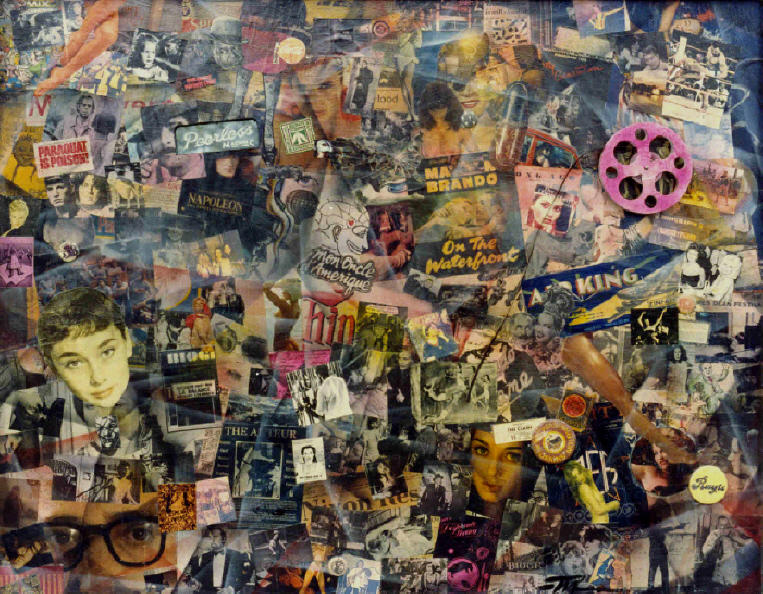
Now, 40 years later, my hope is for these excerpts of the Biograph’s history will pass along some sense of what we who worked there meant, when we referred to the “Spirit of the Biograph.” In short, that spirit could be found in the voice of the theater’s better angels.
Although this telling of the Biograph’s story has been through my eyes, the contributions of its staff were always a considerable part of why that cinema -- with the worst seats in town -- had such a loyal following. The guys who had my back, the dutiful and underpaid assistant managers -- Chuck Wrenn, Bernie Hall, Trent Nicholas and Mike Jones -- kept that theater on the road more than a few times, when I was asleep at the wheel. My stint as manager ended in June 0f 1983.
By the time the Biograph's pair of screens went dark, many art houses and revival cinemas not unlike it had already closed all over the country. Behind on the rent, Richmond’s Biograph was seized by its landlord and closed forever in December, 1987. That was two months shy of its 16th anniversary.
Over the first year of operation we screened over 200 different features for our patrons. In all, I don’t know how many films were thrown onto the Biograph’s screens in its 190 months of existence as a repertory cinema. What I do know is that the advice of those better angels, just mentioned, made a noticeable difference in Richmond, Virginia ... in Biograph Times.

To see information about the Biograph's 40th anniversary celebration on February 11, 2012 click here.
Tuesday, December 27, 2011
The CAA's woeful RPI rankings
Yes, it’s too soon for most Division 1 men’s basketball programs to get obsessed with their RPI position. Plenty of time for that in February. But it’s not too soon for members of a mid-major (whatever that is) conference to notice that its league is not on a track to place multiple teams in the NCAA postseason tournament field of 68.
Although in recent years the Colonial Athletic Association has made progress along those lines. This season? Not so much. There are 344 D-1 schools listed in CBS Sports’ RPI rankings. The CAA’s top ranked team, VCU, is sitting at No. 77, after winning six games in a row.
The highest ranked team VCU has beaten, so far, is Richmond (of the A-10), which is ranked No. 90. Of course, at this point in the season, the perceived strength-of-schedule of the teams is still overshadowing won/loss numbers more than it will later on.
Although in recent years the Colonial Athletic Association has made progress along those lines. This season? Not so much. There are 344 D-1 schools listed in CBS Sports’ RPI rankings. The CAA’s top ranked team, VCU, is sitting at No. 77, after winning six games in a row.
The highest ranked team VCU has beaten, so far, is Richmond (of the A-10), which is ranked No. 90. Of course, at this point in the season, the perceived strength-of-schedule of the teams is still overshadowing won/loss numbers more than it will later on.
RPI: School (record)
77: VCU (9-3)
120: UNCW (3-7)
130: Drexel (6-4)
141: JMU (6-3)
148: ODU (6-6)
194: Mason (8-4)
221: Delaware (5-5)
224: North‘n. (3-7)
271: Ga. State (9-3)
273: Hofstra (5-7)
323: W&M (1-10)
332: Towson (0-12)
77: VCU (9-3)
120: UNCW (3-7)
130: Drexel (6-4)
141: JMU (6-3)
148: ODU (6-6)
194: Mason (8-4)
221: Delaware (5-5)
224: North‘n. (3-7)
271: Ga. State (9-3)
273: Hofstra (5-7)
323: W&M (1-10)
332: Towson (0-12)
Sunday, December 25, 2011

Friday, December 23, 2011
Coming Soon: The Biograph's 40th

In other words, the James River Film Society will present “Breathless” — a 50th anniversary restoration 35mm print, no less — and “Lonely Are the Brave” at the VCU Grace Street Theater on Saturday, February 11, 2012.
“Breathless” (1960): B&W. Directed by Jean-Luc Godard. Cast: Jean-Paul Belmondo, Jean Seberg. Note: An opportunistic thief on the run becomes irresistible to a pretty American journalism student in Paris. Uh, oh, the guy is dangerous. How long can it last?
“Lonely Are the Brave” (1962): B&W. Directed by David Miller. Cast: Kirk Douglas, Gena Rowlands, Walter Matthau. Note: To help his friend, a free-spirited cowboy flings himself recklessly at the hobbling effects of modernity … then tries desperately to escape.

For the JRFS, this special event will kick off a three (or more) part series titled The Golden Age of Repertory Cinema. It will also serve as a fundraiser for the volunteer run nonprofit and an opportunity to officially launch its campaign to establish a small storefront cinema in downtown Richmond.
Soon more information on the event will be available, including the scoop on the post-screening party, plenty of background on the Biograph (1972-87) and the essential how-to-buy-advance-tickets details. Please note: Only 225 seats will be occupied once the light hits the screen. So, mark your calendars and when the advance tickets become available, be smart -- don’t wait.
The JRFS's Biograph 40th Anniversary Facebook event page is here.
Wednesday, December 21, 2011
About Richmond's Tacky Lights
The video above ran on the CBS Sunday Morning show (h/t Jackie) on Dec. 18, 2011.
For more about the tour's history click here to read a piece I wrote last year for Richmond.com about the special Tacky Lights 25th tour, which took place in 2010.
Click here to read more anecdotes from the history of the tour, which was originated by Barry “Mad Dog” Gottlieb in 1986.
Tuesday, December 13, 2011
Rename park after Ralph White
In recognition of Ralph R. White’s unique contribution to the quality of life in the greater Richmond area, stemming from his valuable work to do with the James River Park, it is hereby proposed that the publicly-owned land that constitutes the park be renamed after White.
Some people think all the land along a river should be exploited to the fullest commercial potential by private owners/developers. White, 67, obviously belongs to a different school of thought. It’s hard to think of anybody in the last quarter century who has done more for the commonweal of Richmond, with less recognition and less tangible reward, than White.
Click here to read a Richmond Times-Dispatch article about White’s 32 years of work to make nature more accessible to the general public.
After his retirement in 2013, the park he has been the good steward of should be called the Ralph White Park on the James River, or something like that. Shouldn't it?
Some people think all the land along a river should be exploited to the fullest commercial potential by private owners/developers. White, 67, obviously belongs to a different school of thought. It’s hard to think of anybody in the last quarter century who has done more for the commonweal of Richmond, with less recognition and less tangible reward, than White.
Click here to read a Richmond Times-Dispatch article about White’s 32 years of work to make nature more accessible to the general public.
After his retirement in 2013, the park he has been the good steward of should be called the Ralph White Park on the James River, or something like that. Shouldn't it?
Too many debates?

Six months ago they must have said -- hey, the more televised debates, the better. In the modern equivalent of smoke-filled rooms, the experts must have thought -- dueling conservatives behind podiums will steal the spotlight from the White House.
Nonetheless, now it appears the likely primary voters, schooled by the avalanche of debates, have gotten so fixed on finding a tough-talking arch conservative they imagine will kick Obama's ass in the 2012 presidential debates ... they‘ve wigged out.
The Republicans actually seem poised to embrace a puffy poseur, a friendless burner of bridges, whose lumbering bandwagon must drag behind it a thousand and one trunks full of lead balloons.
Monday, December 12, 2011
The Motion of Occupy Richmond's Saturday
A short video report with commentary, crafted by yours truly, on the activities of Occupy Richmond, Saturday, December 10, 2011. Spoiler: Only marching, chanting and picking up trash; no floggings or pepper spray content.
Thursday, December 08, 2011
Tough Talk vs. Reality

Republicans have liked bluster and tough talk for a long time. Then-President Ronald Reagan’s borrowed quip, “Make my day,” is still reverberating through GOP halls of power. When Reagan’s aides were caught selling arms to Iran -- and Ollie North was lying through his teeth to Congress -- it didn’t matter much, because they loved it so much when Reagan called out, “Mr. Gorbachev, tear down this wall!”
When the Berlin Wall later crumbled, rather than see the myriad of factors that had rotted the far-flung Soviet empire from within, Reagan's most moonstruck devotees preferred believing the Gipper's magic words -- his tough-talk to commies -- had actually done the job.
More recently, former-Vice President Dick Cheney made tough-talk-loving Republicans swoon with his verbal brickbats thrown toward enemies, foreign and domestic. His fans could have cared less whether what Cheney said made much sense, because they loved his growling tone.
Now it seems today's Republicans want to nominate the person who will break bad, verbally, on President Barack Obama in the debates next fall ... even if it's Newt Gingrich! Perhaps they've been reveling in Rush Limbaugh's blowhard style of bashing Obama so much, they now want a similar blowhard as a candidate.
So, even if Mitt Romney gives them a much better chance of actually winning the keys to the White House, they don't care. In other words, some good number of Republicans have lost touch with reality.
However, if you go back a few decades, Republican conservatives stood on the idea that they were about hard-edged reality. In those old days, they saw liberal Democrats as being dreamers about what ought to be, wishful thinkers yearning for utopia.
Republicans today point the finger of blame at government over-regulation of Wall Street and the energy industry for the recession. Spin is one thing, but how crazy is all that?
How deep into the denial of reality does one have to be to say Obama deserves no credit for finishing off Osama bin Laden? But we are hearing just such crazy-talk from conservatives.
Now, even though it’s total bunk to say that so-called “job-creators” need tax breaks, that huge corporations need tax breaks, Republicans go on promoting those bogus ideas as if they are founded in reality.
Now some Republicans don’t even believe in science, when there are votes in pretending that evolution didn’t happen/isn’t happening. When there are votes in ignoring scientists who warn of the dangers of continuing to exacerbate climate change/global warming, to hell with reality.
Virginia currently has a hard charging attorney general who seems to be fantasizing that talking tough to wimpy scientists -- accusing them of falsifying their findings -- will scare them into changing their minds, so as to make science serve his political agenda.
Eventually, we'll all see how realistic that plan to become governor of Virginia turns out to be.
-- Words and art (from 1986) by F.T. Rea.
Newt in the days of Splattergate
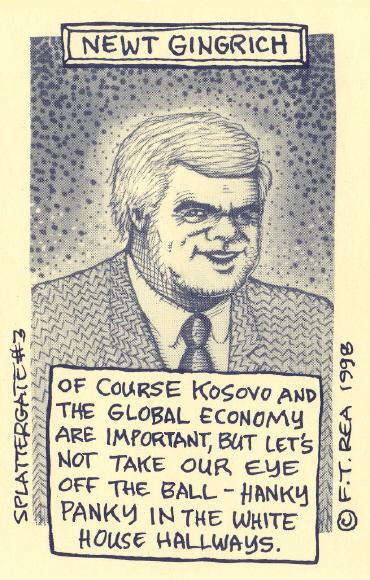 With Newt Gingrich surging to the frontrunner position in the field of GOP hopefuls, it takes us back to the 1990s. It takes us back to when Gingrich the would-be revolutionary lost a showdown with President Bill Clinton over shutting down the federal government. It takes us back to when Gingrich was censured for ethics violations by the House of Representatives -- the vote was a whopping 395 to 28; the fine was $300,000.
 Eventually, Gingrich's hypocrisy and hubris toppled him from his high horse. Now his candidacy is blowing the dust off of scandals aplenty, back in the day.
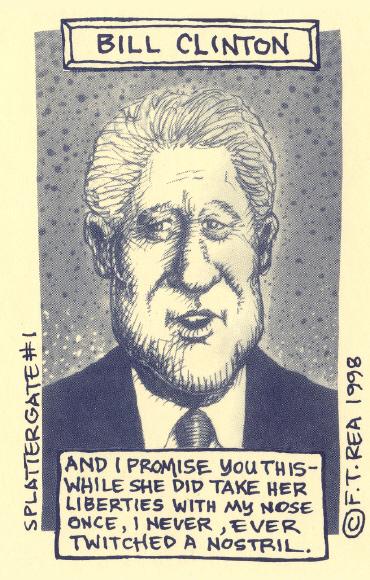
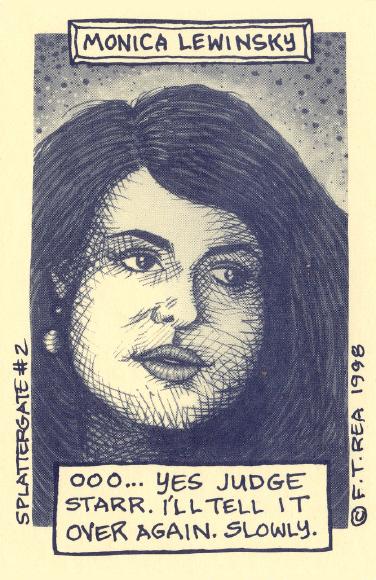
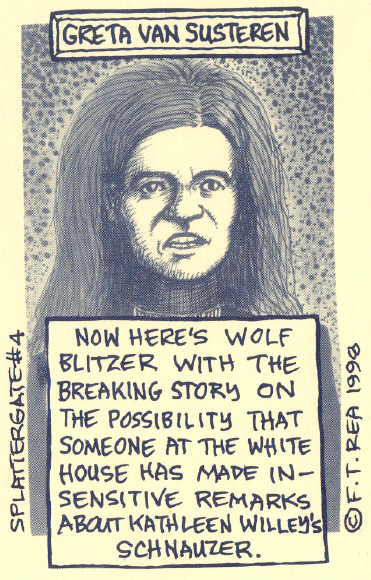
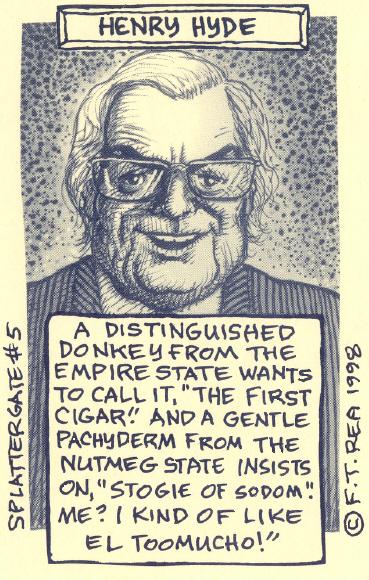
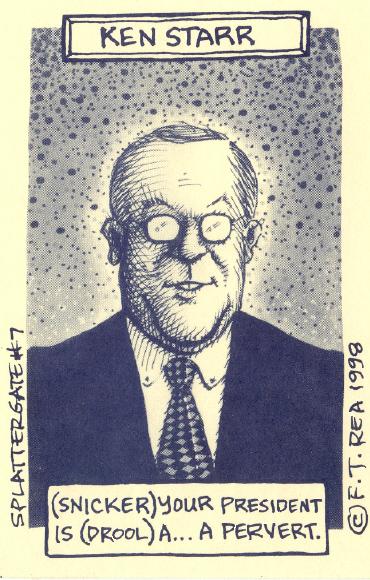
In 1998, with impeachment in the air and the Clinton administration being hobbled by the probe into the nature of the president’s relationships with various women -- most notoriously, Monica Lewinsky -- I felt called upon to lampoon the scandal. So I created a series of caricatures featuring some of the main characters and wrote goofy captions for them.
That was "Splattergate," my fifth series of collectible cards on a theme. Above and below are the images that appeared on eight of the ten frames for the Splattergate cards (click on an image to enlarge it).


Wednesday, December 07, 2011
Allen vs. Kaine
Just watched the Allen/Kaine debate.
Grades?
Well, I missed the first few minutes, but on what I saw I'm giving Kaine a B. And, Allen gets a C+.
Both candidates did a workman-like job of presenting their particular approach to how governments ought to work. The atmosphere was staid, they both stuck to boilerplate rhetoric.
While Allen may have hurt himself on birth control and abortion, I was a little surprised that he did as well as he did, in general. More such mild-mannered appearances might help to start replacing the bumbling images of him from 2006.
Perhaps, since I agree so much more with Kaine, it seemed to me he was the more effective communicator. Kaine demonstrated a firm grasp of the reasoning behind his positions.
The transmission worked fine, so the Richmond Times-Dispatch did a good job.
Grades?
Well, I missed the first few minutes, but on what I saw I'm giving Kaine a B. And, Allen gets a C+.
Both candidates did a workman-like job of presenting their particular approach to how governments ought to work. The atmosphere was staid, they both stuck to boilerplate rhetoric.
While Allen may have hurt himself on birth control and abortion, I was a little surprised that he did as well as he did, in general. More such mild-mannered appearances might help to start replacing the bumbling images of him from 2006.
Perhaps, since I agree so much more with Kaine, it seemed to me he was the more effective communicator. Kaine demonstrated a firm grasp of the reasoning behind his positions.
The transmission worked fine, so the Richmond Times-Dispatch did a good job.
The Lost Imaginings
On the occasion of the anniversary of his death, on Dec. 8, 1980, I can’t help but wonder what the founder of the Beatles — John Lennon, a master of word-play and sarcasm — would have to say about today's music, art and politics.
It would be anybody's guess. After all, in his nearly 20 years as a public figure Lennon’s knack for changing before our eyes was dazzling. There's no reason to think such a restless soul wouldn't have kept on changing.
In November, 2008, on the occasion of what was the 40th anniversary of the release of the Beatles’ White Album, the Vatican newspaper praised the groundbreaking British band for its body of work and forgave Lennon for his flippant 1966 quip about sudden success, “[We’re] more popular than Jesus.”
Even the bloody Vatican has changed but peace is still waiting, off-stage, for its chance.
In February of 1964 the Beatles made their initial appearances on the Ed Sullivan Show. At the time most people probably didn’t connect the events, but those two appearances were only three months after the assassination of President John F. Kennedy. Surely, the somber mood of the stunned nation, still trying to regain its balance, had something to do with why those early Beatles recordings cut through the heavy airwaves with such verve.
Clearly, there has been no explosion in the American pop music scene since them, with anything near the equivalent impact of Liverpool’s Fab Four.
Then, in 1980, the murder of moody John Lennon had an impact on the public few would have predicted. It was as if a world leader had been gunned down on the street in Manhattan.
Lennon’s obvious contributions as a songwriter and musician were huge. However, it was the working class hero’s sincerity, his sense of humor and delight in taking risks that helped set him apart from his teen idol counterparts, many of whom toyed with politics and social causes as if they were merely hairdos or dance crazes.
With the Vietnam War still underway in the early ‘70s, President Richard Nixon looked at Lennon and saw the raw power to galvanize a generation’s anti-establishment sentiments. Fearful of that potential, the Nixon administration did everything it could to hound Lennon out of the country. The details of that nasty little campaign are just as bewildering as some of the better known abuses that flowed from the Dirty Tricks Department in the White House during those scandal-ridden days.
With so many years of perspective on Lennon’s death, I have to say that even if that particular nut-case (a man I choose not to name because I refuse to add in any way to his celebrity) hadn’t pulled the trigger, it could easily have been another one; surely there were other bullets out there with John Lennon’s name on them.
Like the comets of each generation are bound to do, sometimes Lennon burned too bright for his own good. And, speaking of assassinations, at this time I’m also reminded of an item that ran in the Nashville Banner on Feb. 24, 1987. The article began with this:
In a nutshell, Gregg and Mike became incensed at seeing the magazine with a cover story about John Lennon’s murderer. They felt spotlighting the killer in that way might encourage another deranged wannabe to take gun in hand to go after whoever. So they fortified themselves with an adequate dose of what-it-takes — legend has it they were drinking out of an Elvis decanter — and set out on a mission to destroy the cover of every copy of the offensive publication they could find on the strip.
As the reader may know, this sort of endeavor is frequently best undertaken in the wee hours. In the course of their fifth stop, at a Nashville convenience store, the avenging angels were stopped by the cops and charged with “malicious mischief.”
Shortly afterwards, in a interview about the incident, McAdam said at the time, “If another guy like [name withheld again] sees that, he might think he can get on the cover of People magazine by killing a politician or artist.”
Bravo!
Primary among the reasons John Lennon was selected for the kill by his stalking murderer was he had a rare ability to move people. In that sense, Lennon was slain for the same reason as political figures such as Martin Luther King and Robert F. Kennedy. Two thousand years ago Jesus H. Christ was taken out of the game for much the same reason: He challenged people to change; to take a chance on a life based on something better than might making right.
Although Nixon miscalculated Lennon’s intentions, the soon-to-be-disgraced president was probably right about the former Beatle’s potential to focus the anti-establishment sentiments in the air. What Nixon didn’t grasp was that Lennon — in spite of his mischievous streak — was really more interested in promoting peace than fomenting revolution.
“The cops looked at me and McAdam,” said Wetzel recently, to flesh out the 24-year-old tale, “decided we weren’t exactly flight risks and entrusted our transport to the pokey with an attractive female officer, all by her lonesome. On the way to the hoosegow, Mickey hit on the cop. True story.”
After listening to a John Lennon compilation CD, even today, some of his best post-Beatles cuts seem fresh, they still have the feeling of being experimental.
Well into what are strange days, indeed, here on the 31st anniversary of his departure from the realm of the living, this grizzled scribbler can smile, wondering what more Lennon would have imagined.
Peace.
In November, 2008, on the occasion of what was the 40th anniversary of the release of the Beatles’ White Album, the Vatican newspaper praised the groundbreaking British band for its body of work and forgave Lennon for his flippant 1966 quip about sudden success, “[We’re] more popular than Jesus.”
Even the bloody Vatican has changed but peace is still waiting, off-stage, for its chance.
In February of 1964 the Beatles made their initial appearances on the Ed Sullivan Show. At the time most people probably didn’t connect the events, but those two appearances were only three months after the assassination of President John F. Kennedy. Surely, the somber mood of the stunned nation, still trying to regain its balance, had something to do with why those early Beatles recordings cut through the heavy airwaves with such verve.
Clearly, there has been no explosion in the American pop music scene since them, with anything near the equivalent impact of Liverpool’s Fab Four.
Then, in 1980, the murder of moody John Lennon had an impact on the public few would have predicted. It was as if a world leader had been gunned down on the street in Manhattan.
Lennon’s obvious contributions as a songwriter and musician were huge. However, it was the working class hero’s sincerity, his sense of humor and delight in taking risks that helped set him apart from his teen idol counterparts, many of whom toyed with politics and social causes as if they were merely hairdos or dance crazes.
With the Vietnam War still underway in the early ‘70s, President Richard Nixon looked at Lennon and saw the raw power to galvanize a generation’s anti-establishment sentiments. Fearful of that potential, the Nixon administration did everything it could to hound Lennon out of the country. The details of that nasty little campaign are just as bewildering as some of the better known abuses that flowed from the Dirty Tricks Department in the White House during those scandal-ridden days.
With so many years of perspective on Lennon’s death, I have to say that even if that particular nut-case (a man I choose not to name because I refuse to add in any way to his celebrity) hadn’t pulled the trigger, it could easily have been another one; surely there were other bullets out there with John Lennon’s name on them.
Like the comets of each generation are bound to do, sometimes Lennon burned too bright for his own good. And, speaking of assassinations, at this time I’m also reminded of an item that ran in the Nashville Banner on Feb. 24, 1987. The article began with this:
Two Nashville musicians remained free on $500 bond today after they went on a magazine-shredding tear …to protest People magazine’s current cover story.The two musicians were Gregg Wetzel, and Mike McAdam. As members of the Good Humor Band they were fixtures in Richmond’s Rock ‘n’ Roll scene in the early ‘80s. By the time the story mentioned above was published, the pair had established themselves as respected sidemen in Nashville — Wetzel on piano and McAdam on guitar.
In a nutshell, Gregg and Mike became incensed at seeing the magazine with a cover story about John Lennon’s murderer. They felt spotlighting the killer in that way might encourage another deranged wannabe to take gun in hand to go after whoever. So they fortified themselves with an adequate dose of what-it-takes — legend has it they were drinking out of an Elvis decanter — and set out on a mission to destroy the cover of every copy of the offensive publication they could find on the strip.
As the reader may know, this sort of endeavor is frequently best undertaken in the wee hours. In the course of their fifth stop, at a Nashville convenience store, the avenging angels were stopped by the cops and charged with “malicious mischief.”
Shortly afterwards, in a interview about the incident, McAdam said at the time, “If another guy like [name withheld again] sees that, he might think he can get on the cover of People magazine by killing a politician or artist.”
Bravo!
Primary among the reasons John Lennon was selected for the kill by his stalking murderer was he had a rare ability to move people. In that sense, Lennon was slain for the same reason as political figures such as Martin Luther King and Robert F. Kennedy. Two thousand years ago Jesus H. Christ was taken out of the game for much the same reason: He challenged people to change; to take a chance on a life based on something better than might making right.
Although Nixon miscalculated Lennon’s intentions, the soon-to-be-disgraced president was probably right about the former Beatle’s potential to focus the anti-establishment sentiments in the air. What Nixon didn’t grasp was that Lennon — in spite of his mischievous streak — was really more interested in promoting peace than fomenting revolution.
“The cops looked at me and McAdam,” said Wetzel recently, to flesh out the 24-year-old tale, “decided we weren’t exactly flight risks and entrusted our transport to the pokey with an attractive female officer, all by her lonesome. On the way to the hoosegow, Mickey hit on the cop. True story.”
After listening to a John Lennon compilation CD, even today, some of his best post-Beatles cuts seem fresh, they still have the feeling of being experimental.
Well into what are strange days, indeed, here on the 31st anniversary of his departure from the realm of the living, this grizzled scribbler can smile, wondering what more Lennon would have imagined.
Peace.
-- 30 --
Monday, December 05, 2011
D-1 bowls feature 70 college football teams
Starting on Dec. 17 and through Jan 9, 35 bowl games will be played.
There's the Famous Idaho Potato Bowl, the Bridgepoint Education Holiday Bowl, the New Era Pinstripe Bowl and the season winds up with the Allstate BCS National Championship Game on Jan. 9. In all, that's 70 college football teams, which means just 50 teams in the Football Bowl Subdivision (Division 1) aren't going to a postseason bowl game.
Click here to see the entire list of bowls games and the schools that will be participating at Sports Illustrated.
There's the Famous Idaho Potato Bowl, the Bridgepoint Education Holiday Bowl, the New Era Pinstripe Bowl and the season winds up with the Allstate BCS National Championship Game on Jan. 9. In all, that's 70 college football teams, which means just 50 teams in the Football Bowl Subdivision (Division 1) aren't going to a postseason bowl game.
Click here to see the entire list of bowls games and the schools that will be participating at Sports Illustrated.
The Riots of 1974

Some years turn out to be all about change. 1974 was surely one of those years. It was also a time in which extremes masqueraded as the norm. The most obvious change in the air in 1974 had to have been the unraveling of the presidency of Richard Nixon.
In parallel, the whole culture shifted during 1974, as tastes in music, clothes, politics, movies, drugs, and you-name-it, took off in new directions. It was also the year in which social causes suddenly went out of style.
Going into 1974, no one would have guessed the most popular gesture of group defiance on campus -- the protest march -- would morph into spontaneous gatherings to cheer on naked people, as they ran by. Yet, in the spring of 1974, streaking on college campuses became a national phenomenon.
Richmond’s police chief, Frank Duling, announced that his officers would not tolerate streakers running around in the city’s streets, alleys, etc. He didn’t care whether they were students, or not. But the VCU police department said if it took place on campus, streaking was a university matter and would be dealt with by its personnel.
The relationship between Richmond and VCU was still somewhat awkward in this period. And, leading up to this point, there had been an escalating series of incidents on, or near, the VCU campus. Police dogs had been set loose in crowds; cops had been pelted with debris.
So, Richmond’s police department had some history with what might have been seen as the anti-establishment crowd based in the lower Fan District, leading up what happened on the 800 block of W. Franklin St. on the night of March 19, 1974.
Several groups of streakers had made runs before four streakers rode down Franklin in a convertible at about 10 p.m. The crowd of 150-to-200 cheered as the motorized streakers waved. The mood was festive. I know this firsthand, because I was in that crowd. This scene played out a block from the Biograph Theatre, where I worked.
Seconds later a group of some 50 uniformed policemen stormed in on small motorbikes and in squad cars from every direction to arrest those four streakers in the car. No VCU cops were involved.
After a lull in the action, the Richmond cops inexplicably charged into the assembled bystanders. A few of those bystanders were dragged into the middle of the street.
One kid was knocked off of his bicycle and slammed repeatedly against the fender and hood of a police car. Others were beaten with clubs or flashlights. It was a shocking.
It was a riot -- a police riot.
When the dust settled 17 people had been arrested. Most of them were not streakers. While I’ve seen some clashes between policemen and citizens over the years at anti-war demonstrations and a few brawls, up close, what happened that night on Franklin St. was the most out of control I've ever seen from a large group of uniformed officers of the law.
Of course, I didn’t go to the Cherry Blossom Music Festival (which was headlined by the Steve Miller Band and Boz Scaggs) on April 27th at City Stadium. That was where the war between Richmond's partying hippies and its police force escalated beyond all previous clashes. When police officers attempted to arrest pot-smoking members of the audience, things got out of hand. Several police cars were destroyed in what turned into a four-hour battle. In all, 76 people were arrested.
This melee put the kibosh on any outdoor rock 'n' roll shows in Richmond, with alcohol available, for several years.
Back to the streakers on campus angle: Richmond's city manager, Bill Leidinger, promised me there would be an investigation into the conduct of the local police on Franklin St. on March 19 by an outside organization.
In exchange for that promise, I didn't go to the press with some volatile charges being made by a guy who said he had photos of the beatings. Unfortunately, he may have talked about them too much. He showed up at the theater, claiming the prints and negatives had been stolen from his car — while he was in a store, briefly — on his way to deliver them to me. It was strange; I had offered to put the stuff in the theater’s safe, because he told me he felt paranoid about it. The cat got so scared he left town.
Leidinger did not make good on his promise. Eventually, Richmond's police department held an in-house investigation of its own dirty doings on Franklin St. It found that it had done nothing wrong. I regretted trusting Leidinger.
*
1974 was a great year for movies, too. At the Biograph we premiered “Chinatown,” a superb film about corruption. We got it and several other mainstream Hollywood productions that year because Paramount and Neighborhood Theatres were having a feud. It’s still my all-time favorite feature.
Here are some other noteworthy events that happened during 1974:
January 2: President Nixon signed a bill mandating a 55 mph speed limit in order to conserve gasoline.
February 4: Patty Hurst was abducted; eight days later the Symbionese Liberation Army told the Hurst family it had to give $230 million in food aid to the poor.
March 2: Nixon was named by a federal grand jury as a co-conspirator in the Watergate cover-up.
April 8: Hank Aaron broke Babe Ruth’s career home run record with his 715th round-tripper. Later we found out about the death threats Aaron had received leading up to his feat.
April 15: Patty “Tania” Hurst helped her captors rob a bank at gunpoint. Nobody knew what to make of it.
May 15: A.H. Robins Co. yielded to pressure from the feds to take its contraceptive device, the Dalkon Shield, off the market.
July 1: Argentina’s President Juan Peron died. His wife, Isabel, took over in his stead.
July 27: The House Judiciary Committee voted 27-11 to impeach Nixon. Three days later the Supreme Court said Nixon had to surrender tape recordings of White House meetings that had been sought by the Watergate investigation’s special prosecutor.
August 8: Nixon resigned in disgrace; President Gerald Ford was sworn in. Millions of hippies stayed too long at the party to celebrate Nixon's downfall.
August 12: The Biograph Theatre closed to be converted by a 24-hour-a-day construction crew into a twin cinema in four weeks.
September 8: Ford pardoned Nixon, which all but sealed Ford’s defeat when he ran for reelection in 1976.
October 29: Muhammad Ali regained the world heavyweight boxing crown he had lost by refusing to be drafted into the army in 1967. In Zaire, Ali defeated then-champion George Forman by a knockout in the eighth round.
November 13: Yasir Arafat, the head of the Palestine Liberation Organization, addressed the UN with a pistol strapped to his waist. Supporters of Israel cringed.
December 12: Georgia governor Jimmy Carter announced he would run for president. Nobody noticed. Outside of his immediate circle of friends and advisers, who could have imagined it would matter?
* * *
Art and words by F.T. Rea
Saturday, December 03, 2011
Scandal at Penn State is about 'rape' ... not 'sex'

Should the headline be Sex Scandal at the University?
No, because a sex scandal is when a prominent person gets caught having a fleshy relationship with the wrong adult. Rape is a crime!
OK, then why are the media calling what crimes Jerry Sandusky is being accused of a Sex Scandal at Penn State? Yes, I'm wondering why more people aren't pissed off about blurring the distinction between what society calls “rape” and what it calls “sex.”
Sex might imply all sorts of things, some legal, some not. Sex a vague word, but most of the time its use implies that we’re talking about a consensual act. Rape is always a crime. In this case, we're talking about the raping of several children.
Therefore, it doesn’t matter if Sandusky, or anybody else, says it was a consensual act.
But as disgusting as it might sound, to fend off the charges, it seems Sandusky might be saying the acts were expressions of his affection, rather than his lust. If you read between the lines of his bizarre statements to the press, perhaps that’s one way this guy has been able to rationalize his crimes. Maybe Sandusky thinks what he was doing was OK, because he was helping those needy boys so much.
Still, that doesn’t explain away why so many in the media are mislabeling charges of “statutory rape,” as “sex.” Are the editors unwittingly buying into the idea that if the victims didn't resist -- maybe even liked -- what went on, then it somehow mitigates Sandusky's behavior?
Infuriating bottom line: Over the years, hasn’t that been the most common defense offered by serial rapists? Violent, soulless monsters who wink at us and then say the sexy victim actually liked it?
Thursday, December 01, 2011
All things Cuccinelli
Virginia Attorney General Ken Cuccinelli surprised few who have followed his career in politics, when he announced that he will not run for reelection as AG. Writing for the Richmond Times-Dispatch, Jim Nolan reports Cuccinelli has changed his mind and decided to run for governor in 2013.
Click here to read a good analysis of Cuccinelli's move by AP's savvy Virginia political writer Bob Lewis.
Cuccinelli, 43, has been campaigning for higher office since the day he was sworn in as the commonwealth's attorney general. Now I suspect he's trying to figure out when will be the best time to quit his current post, ostensibly, to concentrate on his campaign.
Of course, the best time will probably be before too many of the metaphorical chickens from the questionable legal actions Cuccinelli initiated in his first year in office start coming home to roost.
Here are links to stories I have written about his performance on the job:
[Cuccinelli] called being attorney general "the best job in my life" and said his decision was based on "my love for the commonwealth and to further the principles on which this country was founded."Click here to read the entire article.
Click here to read a good analysis of Cuccinelli's move by AP's savvy Virginia political writer Bob Lewis.
Cuccinelli, 43, has been campaigning for higher office since the day he was sworn in as the commonwealth's attorney general. Now I suspect he's trying to figure out when will be the best time to quit his current post, ostensibly, to concentrate on his campaign.
Of course, the best time will probably be before too many of the metaphorical chickens from the questionable legal actions Cuccinelli initiated in his first year in office start coming home to roost.
Here are links to stories I have written about his performance on the job:
- Click here to read "Our Showboating AG."
- Click here to read "Healthcare Brouhaha: It Ain't Over …"
- Click here to read "Cuccinelli the Corrector."
- Click here to read "Cuccinelli demands VMFA doodles."
- Click here to read "Cuccinelli’s Miracle."
- Click here to read "Activist Attorney General."
- Click here to read "How Free Are We to Express Hate?"
Subscribe to:
Posts (Atom)