Friday, February 24, 2006

Addicted to Choice

by F. T. Rea

"Whatever gets you thru the night
‘salright, ‘salright.
It’s your money or your life ‘salright,
‘salright.”

-- John Lennon

Obsessions, compulsions and addictions have always been in play. Now we see a somewhat new twist in driven behavior: In a time of plenty, many Americans seem to have become addicted to the act of choosing between this and that. This group has unwittingly developed what amounts to a jones for choosing from a smorgasbord of options.

Yet, as with any buzz, when it subsides the anxious feelings it allayed return with a vengeance. Thus, choice addicts find themselves living in a continuous loop of making choices in order to cope with their habit. This is beyond consuming, it's just about choosing.

Of course Madison Avenue, great facilitator in this shop-’til-you-drop scenario, has long depicted “choice” as utter bliss — Yowser! Yowser! Yowser! These wonderful widgets come in five, I say five, designer colors.

Choice has also been a hot political buzzword for some time. To a person wanting to express a belief that a woman is absolutely entitled to opt for an abortion, choice is a useful word for a slogan. It implies that ending the pregnancy is a matter of a person having dominion over her own body, rather than submitting to an authority claiming to represent society’s collective will. Of course, those calling for “choice” in this case see the individual’s right to choose an abortion as trumping whatever damage, if any, might be done to society by the abortion.

The notion that it should be fine for any citizen to pull his tax money out of the funding of public education, in order to finance sending his own child to private school, is called “choice” by its advocates. While this argument appears to be resting on a brick-hard logic, it ignores the long-held American tenet that everyone in the community has a stake in public education, regardless of how many children they have.

In both cases, the sloganeers show a telling awareness of the lure the word “choice” has today. Perhaps this is due to some new collective sense of powerlessness in the air. Or maybe the scam aspect of selling folks their own freedom is as old as dirt.

In “One-Dimensional Man,” German-born philosopher Herbert Marcuse (1898-1979) warned us in the 1960s about illusions of freedom: “Free choice among a wide variety of goods and services does not signify freedom if these goods and services sustain social controls over a life of toil and fear.” Marcuse’s keen eye saw the counterfeit aspect of the processed brand of freedom wielders of easy credit felt, even then, as they exercised their prerogative to select one set of time-payment obligations over another.

Marcuse’s hard-nosed take on what he saw as controls over modern society is out of style today. But his view of how language is predictably used by a few of us to manipulate the rest of us is still as valuable as ever.

French diplomat Charles Maurice de Talleyrand-PĂ©rigord’s (1754-1838) words on the topic of language remain crisp today. Talleyrand offered, “Speech was given to man to disguise his thoughts.” British philosopher/mathematician Bertrand Russell (1872-1970) went further: “Speech was given to man to prevent thought.”

OK, so tricky lingo has long been used to shape perception. However, as a true believer in the unfettered streaming marketplace of ideas, I expect tortured language and agenda-driven slogans to come and go. My point is that the act of choosing should not be so highly valued that it comes at the expense of appreciating what happens after the choice is made.

For example, can constantly switching TV channels for hours be a more satisfying experience than watching one interesting program? Well, the answer probably depends on whether you value what comes after the choice. After all, in order to be able to surf 200 channels, as opposed to only 50 or 100, customers gladly pay extra, although many of them never watch any program in its entirety.

Much of television’s most popular programming feeds its audience a steady flow of information about people who happily act as if they have genuine clout — rich celebrities who cavort about with enough bread to buy anything. Then, quite conveniently, every few minutes, commercials interrupt the celebrity news to offer the viewer a chance to unjitter his jones.

Choices! Schmoices! Anytime your options are limited to what’s on a menu put together by someone else, by choosing from that prepared list you are surrendering some control to the list-maker.

And, the mountain of disposable schmidgets grows, evermore, as choice addicts cast off yesterday’s quick-and-dirty urge, to grab after today's fresh urge, just to get through the night.

-- 30 --

Wednesday, February 22, 2006

Coveting and Rage

After reading “From 'Connectedness' to Conflict,” an excellent piece by David Ignatius (on a tip from Raising Kaine), I thought about a little essay I wrote for STYLE Weekly in 1999, “The Tenth Commandment.”

The Ignatius essay in the Washington Post is thoughtful and he’s on target with his analysis of a significant dilemma that seems to be built into our instant communications-driven, postmodern way of life. As an aside, I must say it was pleasant to read a provocative piece so much about politics, which had nothing to do with Red States, Blue States, and that whole contrived, lathered up realm of partisan politics.

Here's the opening paragraph of what Ignatius wrote for the Post:

"One of the baseline assumptions of U.S. foreign policy is that 'connectedness' is a good thing. Linkage to the global economy fosters the growth of democracy and free markets, the theory goes, and that in turn creates the conditions for stability and security. But if that's true, why is an increasingly 'connected' world such a mess?"

By the way, Lowell Feld's comments on that same piece, posted at Raising Kaine, are well worth reading, too.

Try reading the Ignatius piece first, then see if you can dig the connection I made to what I wrote for STYLE back in those sepia-toned pre-9/11 days, a sample of which is below:

“The Ten Commandments are to the point and very basic stuff: Honor your God and your parents. Be willing to make sacrifices for what matters most to you. Don’t kill, lie, or steal and don’t cheat on your spouse. And in the final of the 10, we are warned not to covet a neighbor’s goods. I find it interesting that after the laundry list of shalt-nots, the last rule is against even thinking too much about a shalt-not. What were those ancient cats thinking about with that afterthought of a commandment?

“...The lifestyle of a celebrity is constantly sold to consumers as the good life. Wanting that good life is a carrot on the stick that helps drive our consumer culture. Therefore, in some ways, it has been good to all of us. But my thesis here is that there is a dark side to this strategy. When powerless people, who have no financial resources see that same material, they naturally want the good life too. However, if they have no hope, they don’t believe the good life is available to them through legitimate channels. So, instead of feeling motivated to earn more money, the powerless are left to covet.”

Note: At the top of the piece in STYLE that subtitle about "God's law" was added on by the magazine

Allen's Shriveling Advantages

A few months ago, Sen. George Allen was viewed by many to be a lock to hold his seat as Virginia’s junior senator. Then came the Bush administration’s handling of the Hurricane Katrina disaster. After that Allen’s protege Jerry Kilgore lost badly in November. Suddenly, or so it seems, a new light has been cast on Allen’s reelection prospects. A Survey USA tracking poll shows his approval rating has dipped five points in the last month.
What happened to the lock?

It never existed, except in the minds of Republican propagandists trying to discourage competition.

Meanwhile, Allen is the same affable, go-along-to-get-along rightwing senator he’s been all along. Yet, with the Bush administration spinning out of control, Allen’s role as a Bush/Cheney cheerleader probably won’t be much of a plus with most Virginia voters. Yes, with bad vibes all around him, Allen is likely to be campaigning this time around on his own personality and record, for what that’s worth.

Looking back on it, in a way he's never been tested. In statewide elections Allen defeated Mary Sue Terry and Chuck Robb; in both instances he benefited from having opponents whose political careers had peaked and begun to ebb. Allen was the fresher face. This election year that won't be the case. With two candidates new to most voters vying for the chance to unseat the incumbent having emerged -- James Webb and Harris Miller -- Virginia Democrats, on the heels of Gov. Tim Kaine's convincing victory, are beginning to lick their chops at the prospect of facing Allen in the fall.

The advantages Allen seemed to have not so long ago are shriveling. But, as we've all seen, in politics a lot can happen in a matter of a few months.
Illustration by F. T. Rea (from SLANT Legends 1994)

Flicker Rescheduled

This notice came in from Flicker's local founder James Parrish:

We at the Richmond Moving Image Co-op have decided to reschedule the February 23 Flicker, mainly due to the "squeeze" created by our wonderful Italian Film and Food Festival held in late January and our earlier-than-usual James River Film Festival, March 20-26. We were ambitious in thinking we could fit a Flicker in between there and do it justice. So, the next Flicker will be held on Thursday, April 27 -- our 8th anniversary show!

Let me know if you'd like to show a film at this special show. Submissions must be under or around 15 minutes and shot on film. Otherwise, it's first come, first served. Meanwhile, we'll use the extra time to focus our energies on the upcoming James River Film Festival, March 20-26.

Tuesday, February 21, 2006

Stalking the Man of Mystery

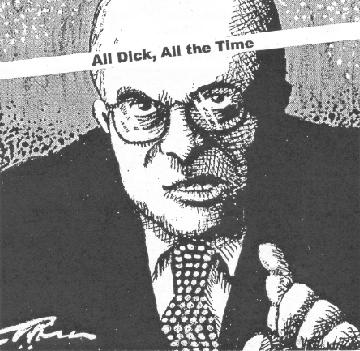
Yes, laughing at the list of lame alibis for the infamous “delay” in reporting the “peppering” of Dick Cheney’s unlucky hunting companion, Harry Whittington, has been fun. Imagining the swaggering Cheney in a scheming frenzy with his yes-men, as the precious minutes ticked by, still makes me smile.

With each minute that passed Cheney’s problem with explaining the delay grew. I see him fretting and growling at bad suggestions. "They'll believe whatever I tell 'em to, kid. Hey, where's that bottle?"

"Sir, whimpered a squirming yes-man, "it's empty ah, and you agreed..."

OK. That's enough of my cartoon-vision.

Still, all the schemers on the Cheney team, being pros at what they do, surely knew the press would go bonkers once it got wind of what had happened. So what actually went on while the press was kept in the dark was more important than immediately doing what they all knew was the right thing.

Given Cheney’s secretive nature, I’d say there’s a good chance we’ll never know what went down during that all-too-obvious stalling maneuver. Moreover, it’s not really the most important mystery to do with Cheney that needs solving.

Laughing at avalanche of Cheney jokes, the political cartoons, the talk show rants, has neatly shifted the focus away from Cheney’s serious political problems which were dogging him before he mistook the 78-year-old Whittington for a small bird. Investigative reporter and essayist Russ Baker, examines that very angle at TomPaine.com:

“...Hence, we observe a media response which disproportionately favors the ‘sexier’ if less substantive material. We saw it in the alacrity with which all manner of news organization—local, national, print, electronic—reported what could be surmised about every aspect of the hunting accident. In particular, news organizations expressed outrage at the lack of timely disclosure. Everyone in the country, it seems, was talking about Dick Cheney’s stonewalling.

“Cheney stonewalling? Not sharing vital information? Operating secretively? Causing unnecessary pain, then walking away from the scene of the crime? That’s not the story of the last week; that’s the story of the past five years.”
Photo Credit: unknown

Dick Cheney's Problem

Paul Greenberg, a Pulitzer prize-winning columnist who is hardly known as a leftwinger, examines Dick Cheney's suspicious strategy to delay the reporting of his hunting mishap. The savvy Greenberg isn't buying the Veep’s flimsy story:

“Even though presidential counselor Dan Bartlett and the president’s press secretary, Scott McClellan, both advised [Cheney] to get the story out -- widely -- as soon as he could. But the best advice is of no use if one doesn’t take it, and the vice president didn’t. Instead, he left it to his hostess, Katharine Armstrong of the Armstrong Ranch in South Texas, to tell the local Corpus Christi Caller-Times about a story of far more than local interest. As if this were an item for its Society Notes. The vice president, brainy man that he is, still claims that was the right call -- since the news would then have come from his hostess, who was there, and, besides, if the story had gone out Saturday night instead of the next day, it might have been incomplete. As if this story is going to be complete any time soon.

“...Leaders who are trusted tend to be those who trust the rest of us to be fair. Which is why the best way to manage the news may be not to try so hard to manage it -- just tell it the way it happened. And don’t wait till you’ve got all your quail in a row for Fox News.”

Shaking It Up

At Save Richmond Don Harrison offers his view of Paul Goldman’s departure. In what should come as no real surprise to those familiar with Save Richmond, Harrison disagrees somewhat with the Richmond Times-Dispatch’s corporate take on this story. Harrison writes:

“Someone needs to set the record straight -- Paul Goldman’s main crime was not that he was hard to get along with. He just didn’t suffer fools gladly. More pointedly, he challenged the behind-the-scene wheeler-dealers who have heretofore dictated how Richmond should be run. So he had to go.

“...For all of his rumpled sportcoats and distinct mannerisms, for all his battles with Carol Wolf and Manoli Loupassi, for all of his egregious campaigning for democrats (the real crime), Goldman was one of the very few within the city’s power structure to truly REACH OUT to anyone other than the usual CEO power brokers, City Hall insiders and select neighborhood associations.”

CAA News

With March Madness thinking starting to move to the front burner, these notes are from the Colonial Athletic Association's weekly update: George Mason is the first CAA team since Navy was No. 18 in 1987 to be nationally ranked, when it was named No. 25 in the ESPN/USA Today poll this week.

Meanwhile, five CAA teams are ranked among the nation's top 70 D-I schools, according to the current RPI ratings released by Collegiate Basketball News: George Mason is No. 19; UNC Wilmington is No. 37; Hofstra is No. 46; Old Dominion is No. 52; VCU is No. 69.

The annual CAA men's basketball tournament, featuring all 12 teams, will take place at the Richmond Coliseum, Mar. 3-6. At this point maybe half of them seem capable of winning it. The tournament's champion receives an automatic bid to the NCAA's Big Dance.
Photo credit: F.T. Rea

Saturday, February 18, 2006

BuTTercuP

A notice about an upcoming fundraiser for a worthy cause came in this morning from a locally-based band called BuTTercuP: In the photo above they are (left to right) Cassandra Cossitt, Octavia Carpin and David Stover.

The band's harbinger of spring reads:

We have the coolest gig ever! You are cordially invited to the first annual Tricycle Gardens Fundraiser on Saturday, March 11, 2006, to be held at "The Expansion Joint", 211 West Seventh St. (near Legend Brewery).

Tricycle Gardens is a non profit community garden located in Church Hill. Their goal is to help create a better Richmond through community gardening. They are also striving to create educational programs, such as seed starting workshops and working with youth in the community.

Tickets for the dinner portion of the evening (7 p.m. - 9 p.m.) with Buttercup for desert, are $40 each or $75 a couple. This includes a fabulous buffet dinner, wine and champagne, and a silent auction with great donations from local artists, restaurants, and local businesses. Buttercup will be raising the roof from 9 p.m. on. Once again we are honored to be joined by several extra-special guest artists!

"Music-only guests" may come at 9 p.m. Tickets are $15 and will be available at the door. For more info and to reserve your dinner please contact Lisa @ (804) 683-7968. Hope to see you there!
A glance at the two easy-on-the-eyes guitar players reveals that the drummer is obviously smarter than he looks. What does the band sound like? From its web site: "Stir in some vintage country, add two chicks, a rock-steady drummer with a penchant for punk, and three shots of tequila. Whaddya got? Buttercup."

Pucker up!

Harvey Links Page

During the month of January there were a number of posts here about the shocking deaths of the Harvey family -- Bryan, 49; Kathy, 39; Stella, 9; Ruby, 4 -- on New Year's Day, and the stormy aftermath. On Jan. 2, SLANTblog began maintaining a regularly updated section with breaking news and a collection of links to many other web sites which carried stories about the slain family.

Although that post has moved off the front page the link to the central Harvey page is will stay in the column to the right. Note: the Harvey updates link is the second one in the top section. It will continue to be updated, so check it from time to time if you have been following the story.

Thursday, February 16, 2006

Those Wascally Wepublicans!

Have you heard the predictable complaints from the predictable apologists for Vice President Dick "Elmer Fudd" Cheney?

Who hasn't? Like, the "liberal media" is hammering the poor Veep, blowing the accidental shooting incident up. Cheney's unlucky hunting companion, Harry Whittington, was only “peppered,” why won’t the story go away? Cheney only had a beer, maybe two. You know Aaron Burr did much worse in his day, etc.

No. Sorry apologists, this is a story with lo-ong legs. And, if watching what has gone around for years come back around onto the Bush administration is fun for some people, maybe there are good reasons. To understand better what I'm getting at, I’ll defer to columnist Georgie Anne Geyer. Once again, she is on target with her commentary:

"It has been said often enough that this administration is abnormally secretive, suspicious and surreptitious in its dealings with the world; but really, it's much worse than that. They have so closed themselves off from any position or idea not their own that they have become almost a American-style budding Kremlin. Virtually nobody has any access to the vice president's huge, but silent, staff and his unprecented counter-national security staff. Almost no reporters now speak to the vice president, in contrast to earlier days when many of us had at least some access. (I remember one lunch with him and a prominent congresswoman when Cheney spoke not a single word!)

"From this White House, everything comes down from on high. Mount Olympus is the altitude of the west and east wings, and Moses coming down from the mountain with his pesky and fearsome commandments is the iconic image all strive to emulate."

Of course, the official Texas-style investigation has cleared the less-than-on-target vice president of whatever he needs clearing of, or from.

Goldman Is History

Today the Richmond Times-Dispatch reports:

"Paul Goldman, Richmond Mayor L. Douglas Wilder's longtime political confidant, resigned yesterday as Wilder's senior policy adviser."

Goldman seems to be a man whose talents -- his list of victories is impressive -- are best applied to a campaign, with its focus and intensity. The everyday chore of being a cog in the big machine and getting along with people to help make government run smoothly is not everyone's cup of tea. Hopefully, he will go back to helping worthy Democrats win elections.
Photo credit: F.T. Rea

Tuesday, February 14, 2006

To Smell the Truth

Maybe I kidded you a bit, at times. Maybe I fibbed about "that woman" and a little ol' bee-jay. But I never lied about starting a war. Hey. Or, how I came to shoot a Texas lawyer, much as I might have wanted to cap one in my day.

Lies, damn lies, and even statistics come in shades of red or blue these days. Not to mention, in appropriate scents, as well. These are partisan times. In an era happy with pickled news, credibility is a quaint concept.

Harry Whittington, who was shot by Vice President Dick Cheney in what is so far being called a “hunting accident,” has now had "a minor heart attack," according to hospital officials. Apparently some of the birdshot from Cheney’s shotgun blast is moving around in the the 78-year-old Texas attorney’s heart.

Oops! The old expression "as serious as a heart attack" is suddenly politically incorrect on one side of the aisle. So, make that a heart attack lite.

Today I couldn't help but hear the usual barroom I'm-never-wrong experts bellowing about the agenda of the "liberal media" over laughter about what Cheney himself has wrought. Sorry boys, Dave Letterman knows this one is good for laughs. And so does anyone else who knows the difference between shinola and Texas truth.

“Harry was in the line of fire and got peppered pretty good,” has said Katharine Armstrong, the owner of the site of the shooting, Armstrong Ranch, who was a witness. “It broke the skin,” she said the day after the incident.

"Peppered" sounds sort of mild. So, just how far from the victim was Cheney standing when his 28-gauge shotgun went off? Armstrong has said it was 30 yards. With a wee projectile in Whittington's heart it sounds like the peppering process did a bit more than merely break the skin.

If, as I have read, nearly all of the pellets from the shotgun shell actually struck Whittington in the face, neck, chest, etc., what does that suggest? While I’m no firearms expert, I'm wondering if that tight of a shot pattern and that level of penetration through winter hunting garb and flesh suggests we may not be hearing the unvarnished truth about this story. A couple of my bird-hunting friends tell me I might have something.

Then there's the poorly explained delay in the details of the shooting getting out. In 2006 Cheney and his handlers all knew that such a delay in reporting the incident would make red flags pop up. Yet, they let it happen, anyway.

Was what went on in that time worth it? Perhaps so.

Bottom line: I bet Bill Clinton would like to watch Dick Cheney answer questions about it under oath. Hmmm. Smells like more of that Texas truth.
Illustration by F.T. Rea

To Tell the Truth

From the Editorial Page of the Richmond Times-Dispatch comes "Pants on Fire," a short piece that notes a consistent problem with what comes out of the Bush White House labeled as "truth."

"President Bush condemned the Valerie Plame leak, vowed to get to the bottom of the story, and indicated he would fire any staff members involved in the affair. Columnist Robert Novak says he believes Bush knows the source of the leak; Scooter Libby, who has been indicted in the case, reportedly has testified that higher ups told him to spread the Plame stories. Libby was a ranking aide to Vice President Dick Cheney; officials higher than he inhabit the political stratosphere.

"After the catastrophe in New Orleans, the administration said it did not have timely notice that the levees had been breached. The latest information suggests the administration knew the dimensions of the crisis almost immediately after water began pouring out of Lake Pontchartrain.

"The White House says President Bush did not personally know Jack Abramoff. Abramoff says he and Bush met on several occasions. The President asked about the lobbyist's children and invited him to the Crawford ranch.

"Remember when Republicans and conservatives deplored the culture of deceit during the Clinton years?"

Yes, I do remember the year of huffing and puffing from the outraged GOP about Clinton White House deceit, dishonesty which constituted high crimes and whatnot. It was 1998. The Republicans' inquisitors tied up Bill Clinton, while the rest of the world went on with its business, anyway, with one problem -- defending himself from charges that he lied about a sexual relationship outside of marriage.

Well, the heat didn’t bring out the best in Clinton. He was shown to be a flawed man whose integrity about his personal life was beneath the standards our society calls for, at least on the record, both in marriage and the workplace.

Now, once again it seems we have a sitting president who can’t tell the truth when the pressure is on -- George Bush. Fortunately, for all concerned, Dubya has only been disingenuous about trivial matters, such as those outlined above by the T-D's apt editorial comments.

Then there's the matter of the now-discredited pretext for the invasion of Iraq. But, not to worry, compared to hanky panky in the hallways of the White House, that's just another small matter.

It seems the modern Republican code of ethics allows for some deceit from public officials, just as long as it’s not about something truly important to the nation as a whole.

OK, I think I get it.

Pitchers and Catchers Report Thursday

Charles Odom, writing for AP notes that pitchers and catchers are reporting to the Atlanta Braves spring training camp on Thurs., Feb. 16. And, just as it was last year, and the year before, and so on, the know-it-all baseball pundits are saying the Braves can’t possibly reload again. No. This year manager Bobby Cox’s run of 14 straight titles is done.

Well, although I’m a Braves fan I bought it last year -- too many good players had left Atlanta. The string couldn’t continue...

OK. This time, I’m going to wait and see. The job Cox did in 2005 was so masterful I’m not sure what the former-R-Braves third baseman (1967) can’t do as a manager. Cox, a natural patient leader with the nerves of a cat burglar, is the best in the biz.

AP: After winning 14 straight division championships, Bobby Cox is confident that spring training will provide solutions to the latest challenges facing his Atlanta Braves. When pitchers and catchers report to spring training Thursday in Kissimmee, Fla., followed by the rest of the team next week, most of the roster will be set. But the few holes are significant. The Braves need a new leadoff hitter and a closer, and they must adapt to new pitching coach Roger McDowell after having Leo Mazzone on the job for 15 years.

With a shrug, Cox said he'll somehow find one or more answers. "We like what we've got," Cox said. "We've done it before with pieces and we'll do it again."
Illustration by F. T. Rea

Kaine: How I Won

Gov. Tim Kaine must have gotten tired of reading what the pundits had to say about how and why he defeated Jerry Kilgore in November, when they kept getting it wrong. So, to put the record straight Kaine has penned his own analysis of the Kaine camp's smart moves, How I Won. Here's an excerpt:

"...For starters, I ran in a state that President Bush had won by 8 percentage points in 2004. In addition, I began with a 21-point name identification deficit and lagged behind in every poll -- sometimes by double digits -- until September 2005, only two months before the election. Finally, I was targeted by an unprecedented series of negative attack ads and was financially out-raised and outspent through most of the contest. Yet I won the popular vote by a margin of 6 points and more than 113,000 voters. I attribute my victory to three factors: the exceptional popularity of Gov. Mark Warner, my predecessor and partner over the past four years; my campaign's understanding of Virginia's changing demographics; and my ability to speak directly to voters and offer them a positive vision for our future."

Sunday, February 12, 2006

Cheney Misses Bird...

Responding to a pelting of media questions about the weekend's bizarre hunting accident, Cheney growled, “Any blasphemous cartoons on this private topic will be seen as siding with the terrorists. What happens in Texas stays in Texas!”

Warning: This page may contain satire. Please don't let it scare you.

Saturday, February 11, 2006

Those #$%? Cartoons!

by F.T. Rea

The meanderings of international affairs have at last strayed into my bailiwick, my natural field of expertise -- unreality.

Cartoons by sarcastic European artists, designed to ruffle feathers, have flushed out a shockingly angry response that seems to be feeding on itself. Peace-loving folks everywhere are bewildered, wondering how far this absurd momentum will take us. It's 2006, already, and adults are killing each other over cartoons. What’s next?
The Cartoon War:
"Ye gods and little fishes!" Rebus exclaimed. "Called up from the cartoon reserves at my age!"

Most Americans are probably surprised by riots over edgy art. Not me. There’s plenty of precedent for it. In the interest of full disclosure, I’ve known since the third grade that a cartoon mocking a thin-skinned bully can start a fistfight.

As a kid, I was a self-appointed cartoon critic who adored Heckle and Jeckle. Loathed Chip ‘n’ Dale. Loved Pogo. Hated Peanuts. Dug salty Popeye. Cringed at wimpy Mickey Mouse. Cartoons were close to my heart. Growing up in Richmond I had the good fortune to see Fred O. Seibel’s elegant work on a regular basis, as he was the world class political cartoonist in residence at the Richmond Times-Dispatch. Subsequently, at 17, my first published work was a caricature of Hubert Humphrey.

So my fascination with political art was stoked at an early age. Eventually, I came to admire renown political cartoonists such as Herbert Block (Herblock), Bill Mauldin, Thomas Nast, Honore Daumier and other masters of the genre. My favorites list is too long for this space, however, the father to all of them was Francisco de Goya. He stunned viewers in the early-1800s who had never seen war portrayed as horror, set in an un-glorious context.

Political art, by its very nature, has always stirred passions. It has galvanized movements and spawned flare-ups of violence aplenty. How Goya got away with his unprecedented depictions of blood-lust and lost souls during the French occupation of Spain baffles me. Take a look at some of it, you’ll see what I mean. Daumier was thrown in jail six months for mocking the king with his deft pen.

OK, so what’s my cartoonist’s take on the controversy raging over depictions of a certain Middle Eastern prophet, you-know-who? Like, whose side am I on?

Ha! The cartoonists, of course, but they are hardly blameless.

What about the big picture? Who is right, or wrong? The provocative publishers of the cartoons? Or those who call for restraint in that area? What about those laughing at, or those taking offense from, or those ignoring the infamous cartoons in question?

Well, it appears to me all sides have legitimate points worth considering. Since real consideration would call for actually listening to the other guy -- the rube, the infidel, the jackanapes -- that's not happening. Thus, the cauldron of ill humors bubbles across the pond, while cynical Americans awash in culture of casual rough talk and obnoxious information are baffled.

Yet, in America, we have our share of violent gangs and lathered up religious extremists, too. You can get killed in some neighborhoods for wearing the wrong color. So the first thing America ought to do is get off its high horse when viewing this curious story, one that may evolve into a larger story.

Should the European publishers simply back off? Is that still a possibility? They may be in a position called “zugswang” in the game of chess. The term means it is your turn and any move with any piece only makes matters worse.

Perhaps the determined publishers should get more creative, find a way to use levity to promote a better understanding of the beauty of both freedom of speech and good manners. Still, the cartoon publishers do have a valid point when they claim religious hardliners are trying to chill freedom of expression.

To go secular, America's never-ending brouhaha over flag-burning may shed some light on an aspect of truth. To me, the burning of Old Glory in protest of government policy is obviously an act of political speech, so our national custom allows for it. The Constitution still protects it. OK, burn the flag at your anti-war rally. If, on the other hand, you schlep it over to the American Legion Hall to set it ablaze in the parking lot, don’t ask me not to laugh if an old veteran rolls up his sleeves and makes you sorry you did it.

However, the offended vet is hardly justified to beat the rude flag-burner to death. Enough is enough. So, if the outraged Muslims want to hurl insults across borders at the publishing provocateurs, or organize an economic boycott, or even throw up a picket line somewhere, that’s fine. But killing people over insulting cartoons can’t be justified by serious people in a civilized world.

An impartial witness might ask: where are the moderate Muslim leaders, cool heads who could do much with this opportunity to demonstrate the difference between the troubling fringes of the vast Islamic world and its calm center? A sincere peacemaker might ask: why such universal virtues as “prudence” and “civility” seem lost to all sides in this noisy clash of cultures? A good detective might ask, who stands to gain from inciting more riots?

An artist at the drawing board might ask how to inform the viewer it’s supposed to be a picture of you-know-who without a caption? So is the problem really more with words than pictures? Otherwise, it could be a picture of Mr. Natural or a cat in ZZ Top.

Some say the cartoon riots have peaked and the controversy will all blow over fast. We’ll see, but I doubt that. I suspect this rhubarb has too many players still convinced they can profit from perpetuating, even exacerbating it.

Hopefully, after the cartoonists’ ink, mixed with the blood of the zealots and the unlucky bystanders, is hosed off the streets, the witnesses left standing will have developed a greater appreciation for tolerance. That, and the eternal value of a sense of humor.

-- 30 --