Monday, March 15, 2021

Dancing to the Tune Being Played

As the VCU Rams test their dancing shoes in practice this week, hopefully they are getting ready for the way games are somewhat different in postseason tournaments. The stepped up intensity and the increased contact allowed can wilt a pretty good team not prepared enough for the change in style in the games of conference tournaments and especially the Big Dance.   

Thus, the hard-nosed strategy St. Bonaventure used to defeat VCU, 74-65, in yesterday's Atlantic 10 championship game was hardly surprising. Right from the start it was obvious the Bonnies were committed to making life as hard for Bones Hyland, the conference's Player of the Year, as the rules would allow. 

The way Bonnies head coach, Mark Schmidt, set it up, if his veteran team was going to lose to the Rams, it would not be because VCU's star player poured in a bunch of 3-pointers in the first half, to set a tone and establish a working margin. So the Bonnies smothered and even roughed up Bones as much as they could get by with. They also managed to lure him into first-half foul trouble. 

Thus, Bones was stifled and held to zero points in the first half. The Rams head coach, Mike Rhoades, surely knows his relatively young team got schooled by, Schmidt, the conference's savvy Coach of the Year. It happens.

From here on the Rams can only expect a lot more of this sort of thing. Rhoades and his staff must get their players mentally ready for their next opponent, Oregon, to try to intimidate VCU with similar tactics They should expect an all-out plan to take Bones out of the game, using any and all means allowed. That will put extra pressure on freshman point guard, Ace Baldwin, to be steady and yet aggressive.

So, against the Ducks on Saturday night (tipoff at 9:57 p.m.; TV broadcast on TNT), the Rams fate may rest on Bones setting a new career-high for assists, because he makes clever passes when he is double-teamed. If his teammates Vince Williams and Jamir Watkins both score career highs for points, I like VCU's chance to advance. 

With the No. 7 seeded Ducks now a 6-point betting favorite, if the No. 10 seeded Rams can bear down to force turnovers aplenty and also block out effectively, to limit the Ducks to one shot per possession, an upset will get even more likely. 

-- 30 -- 


Thursday, March 11, 2021

The Sound

The Handbill in this story.
 
Note: A longer version of this story about my time as a candidate was first published in SLANT in 1987. Then, in 2000, I trimmed it down to this version, which ran in Style Weekly as a Back Page. Overall, I have received a lot of feedback, mostly positive, on this piece; maybe more than any other I've written. 
 
A few flashbacks of the events described are still vivid memories. Nonetheless, for the sake of accuracy, I'm sure glad I wrote it all down before other parts faded into the mists. 

*

In the spring of 1984, I ran for public office. In case the Rea for City Council campaign doesn’t ring a bell, it was a spontaneous and totally independent undertaking. No doubt, it showed. Predictably, I lost, but I’ve never regretted the snap decision to run, because the education was well worth the price.

In truth, I had been mired in a blue funk for some time prior to my letting a couple of friends, Bill Kitchen and Rocko Yates, talk me into running, as we played a foozball game in Rockitz, Kitchen's nightclub. Although I knew winning such an election was out of my reach, I relished the opportunity to have some fun mocking the system. Besides, at the time, I needed an adventure.

So it began. Walking door to door through Richmond’s 5th District, collecting signatures to qualify to be on the ballot, I talked with hundreds of people. During that process my attitude about the endeavor began to expand. People were patting me on the back and saying they admired my pluck. Of course, what I was not considering was how many people will encourage a fool to do almost anything that breaks the monotony.

By the time I announced my candidacy at a press conference on the steps of the city library, I was thoroughly enjoying my new role. My confidence and enthusiasm were compounding daily.
 
At the Downtown Public Library

On a warm April afternoon I was in Gilpin Court stapling handbills, featuring my smiling face, onto utility poles. Prior to the campaign, I had never been in Gilpin Court. I had known it only as “the projects.”

Several small children took to tagging along. Perhaps it was their first view of a semi-manic white guy — working their turf alone — wearing a loosened tie, rolled-up shirtsleeves, and khaki pants.

After their giggling was done, a few of them offered to help out. So, I gave them fliers and they ran off to dish out my propaganda with a spirit only children have.

Later I stopped to watch some older boys playing basketball at the playground. As I was then an unapologetic hoops junkie, it wasn’t long before I felt the urge to join them. I played for about 10 minutes, and amazingly, I held my own.

After hitting three or four jumpers, I banked in a left-handed runner. It was bliss, I was in the zone. But I knew enough to quit fast, before the odds evened out.

Picking up my staple gun and campaign literature, I felt like a Kennedyesque messiah, out in the mean streets with the poor kids. Running for office was a gas; hit a string of jump shots and the world’s bloody grudges and bad luck will simply melt into the hot asphalt.

A half-hour later the glamour of politics had worn thin for my troop of volunteers. Finally, it was down to one boy of about 12 who told me he carried the newspaper on that street. As he passed the fliers out, I continued attaching them to poles.

The two of us went on like that for a good while. As we worked from block to block he had very little to say. It wasn’t that he was sullen; he was purposeful and stoic. As we finished the last section to cover, I asked him a question that had gone over well with children in other parts of town.

“What’s the best thing and the worst thing about your neighborhood?” I said with faux curiosity.

He stopped. He stared right through me. Although I felt uncomfortable about it, I repeated the question.

When he replied, his tone revealed absolutely no emotion. “Ain’t no best thing … the worst thing is the sound.”

“What do you mean?” I asked, already feeling a chill starting between my shoulder blades.

“The sound at night, outside my window. The fights, the gunshots, the screams. I hate it. I try not to listen,” he said, putting his hands over his ears to show me what he meant.

Stunned, I looked away to gather my ricocheting thoughts. Hoping for a clue that would steady me, I asked, “Why are you helping me today?”

He pointed up at one of my handbills on a pole and replied in his monotone. “I never met anybody important before. Maybe if you win, you could change it.”

Words failed me. Yet I was desperate to say anything that might validate his hope. Instead, we both stared silently into the afternoon’s long shadows. Finally, I thanked him for his help. He took extra handbills and rode off on his bike.

As I drove across the bridge over the highway that sequestered his stark neighborhood from through traffic, my eyes burned and my chin quivered like my grandfather’s used to when he watched a sad movie.

Remembering being 12 years old and trying to hide my fear behind a hard-rock expression, I wanted to go back and tell the kid, “Hey, don’t believe in guys passing out handbills. Don’t fall for anybody’s slogans. Watch your back and get out of the ghetto as fast as you can.”

But then I wanted to say, “You’re right! Work hard, be tough, you can change your neighborhood. You can change the world. Never give up!” During the ride home to the Fan District, I swore to myself to do my absolute best to win the election.

A few weeks later, at what was billed as my victory party, I, too, tried to be stoic as the telling election results tumbled in. The incumbent carried six of the district’s seven precincts. I carried one. The total vote wasn’t even close. Although I felt like I’d been in a car wreck, I did my best to act nonchalant.
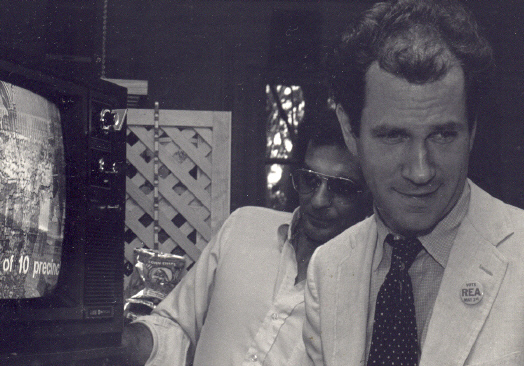
http://photos1.blogger.com/blogger/6291/212/1600/Rea84z.0.jpg
This shot, taken at Grace Place, shows my reaction to
the news that with half the votes counted I no longer
had any chance to win. 
 
In the course of my travels these days, I sometimes hear Happy Hour wags laughing off Richmond’s routine murder statistics. They scoff when I suggest that maybe there are just too many guns about; I’m told that as long as “we” stay out of “their” neighborhood, there is little to fear.

But remembering that brave Gilpin Court newspaper boy, I know that to him the sound of a drug dealer dying in the street was just as terrifying as the sound of any other human being giving up the ghost.

If he's still alive, that same boy would be older than I was when I met him. The ordeal he endured in his childhood was not unlike what children growing up in any number of the world’s bloody war zones are going through today. Plenty of them must cover their ears at night, too.

For the reader who can’t figure out how this story could eventually come to bear on their own life, then just wait … keep listening.

 -- 30 --

Wednesday, March 10, 2021

A-10 Mar. 10 Presser.

This morning at 11 a.m. the Atlantic 10 Conference held a press conference featuring the two head coaches and selected star players from the two teams set to compete in the league's championship game on Sun., Mar. 14. 

In the deciding tilt the tournament's No. 1 seed, St. Bonaventure (15-4, No. 27 NET), will face No. 2 seed, VCU (19-6, No. 35 NET). The A-10's final game of 2020/21 will be played at UD Arena in Dayton. Tip-off will be at 1 p.m. (TV: CBS).    

As one might expect in this situation, the questions were rather generic, designed to elicit easy quotes. Asked what wining the league's championship game would mean to him, VCU's sophomore guard Bones Hyland laughed and said he has played in championship games (before coming to VCU), but hasn't won one of them. "I've never cut down any nets."

Since VCU and St Bonaventure have played twice during the regular season and split those games, junior small forward Vince Williams (No. 10 pictured left) was asked what would be the likely difference this time. Williams said, "The key will be our second half performance."

Bones agreed. "We should never feel comfortable with a lead on a team like St. Bonaventure."

Head Coach Mike Rhoades  was asked what he would say to fire up his team before Sunday's game.

Rhoades said there would be no dramatic locker room speeches right before the game. "They've already heard it all. They will be ready to play." 

Then he added, "We've got to rebound."

Today the bettors' spread has the Bonnies a 2-point favorite over the Rams.  

--30 --

Bones Hyland Named A-10 Player of the Year

VCU sophomore guard Nah’Shon “Bones” Hyland (No. 5 pictured right) has been named Atlantic 10 Conference Player of the Year, the league announced Wednesday as part of its end-of-year awards. Junior forward Vince Williams Jr. (Third Team), sophomore forward Hason Ward (All-Defensive Team) and Adrian “Ace” Baldwin Jr. (All-Rookie Team) also earned postseason honors from the A-10. 


Hyland is the first Ram to win a conference Player of the Year honor since Eric Maynor captured back-to-back awards in the CAA in 2008 and 2009. Hyland, a Wilmington, Del. native, is the first VCU sophomore to win league Player of the Year since Calvin Duncan claimed the Sun Belt Conference’s top honor in 1982-83. Hyland was also named First Team All-Atlantic 10. The Rams have placed a player on the A-10’s First Team in eight of nine seasons since they joined the league in 2012-13.


The 6-foot-4 combo guard is averaging a league-best 19.4 points per game, as well as 4.7 rebounds, 2.1 assists and 2.0 steals per game. His 2.9 three-point field goals per game also leads the conference. He scored 30 more points on three occasions this season, and his three double-doubles lead the team. Hyland has scored in double figures in 22 of 23 contests this year.


Hyland’s breakout campaign helped VCU defy preseason expectations on the way to a 19-6 record and the No. 2 seed in the Atlantic 10 Conference Tournament. He poured in 30 points and grabbed 10 rebounds in the Rams’ A-10 quarterfinal win over Dayton. Hyland’s play has helped propel VCU into the A-10 Championship Game for the first time since 2017.


In addition, Williams claimed a spot on the Atlantic 10 Third Team. It’s the first All-Conference honor for Williams, who increased his scoring to 10.6 points (from 4.2) and 5.1 rebounds (from 2.8) in 2020-21. The 6-6 forward from Toledo, Ohio is also second on the team in assists with 48 and 3-pointers 41. Williams is shooting .418 (41-of-98) from long range this season.


Ward’s shot-blocking ability earned him a place on the league’s All-Defensive Team. The St. Thomas, Barbados native is averaging 2.4 blocks per game, second in the conference. He ranks ninth nationally in block percentage (12.4). The 6-9 forward has also provided 16 steals, and is averaging 6.5 points and 5.2 rebounds, while shooting .580 from the floor.


Baldwin has been named to the A-10’s All-Rookie Team. The Baltimore, Md. point guard started all 25 games for the Rams and averaged 6.8 points, 4.4 assists, 3.2 rebounds and 2.1 steals per game. His 111 assists are the second-most by a freshman in school history. In addition, Baldwin typically draws the opposing team’s best offensive player, and has provided outstanding on-ball defense to the nation’s 11th-ranked defense, according to KenPom.com.


VCU (19-6) will return to the floor on Sunday, March 14 when it meets St. Bonaventure (15-4) in the A-10 Championship Game at Dayton’s UD Arena. Tip-off is scheduled for 1 p.m. on CBS. 


-- This report's information was supplied by Chris Kowalczyk, VCU Assistant A.D.

Sunday, March 07, 2021

Rams Defense Tames Wildcats: VCU Advances to A-10 Final

Atlantic 10 Conference Semifinals


Final score: #2 VCU 64, #3 Davidson 52

Location: Richmond, Va. (Siegel Center)

Up-to-date Records: VCU 19-6, Davidson 13-8


The Short Story: In a hard-fought Atlantic 10 Conference Semifinal game VCU conjured up a balanced scoring attack and a smothering defense; it was too much for Davidson, the Wildcats couldn't match it. Second-seeded VCU's win sets up a clash with top-seeded St. Bonaventure in the A-10 Championship Game on Sun., Mar. 14 at 1 p.m. The game will be played in Dayton. (TV: CBS).


OPENING TIP

  • Defense ruled, as VCU sophomore forward Hason Ward led the Rams with four blocks, as the Rams held the Wildcats to just 30 percent (17-for-57) shooting in the game. 
  • For the second game in a row, Bones Hyland led the Rams in scoring, this time with 12 points. The sophomore guard also dished for four assists, and grabbed five rebounds. 
  • VCU freshman guard Ace Baldwin had seven assists to go with his seven points and four boards. 
  • Davidson’s Hyunjung Lee and Kellan Grady each put up 13 points to lead all scorers. 

THE DIFFERENCE

  • Both teams struggled to score in the first half. VCU shot 31 percent (9-of-29) while the Wildcats shot just 17 percent (5-of-30) from the field. 
  •  Freshman guard Jamir Watkins provided a spark for the Rams off the bench, pouring in 10 points, two assists and five rebounds. VCU benefited from 25 bench points compared to Davidson’s 10. Senior forward Corey Douglas connected on all five of his field-goal attempts on the way to 10 points and five rebounds for VCU. The Rams bench scored 25 points compared to their opponent's 10.
  • With seven seconds left in the opening period Hyland swiped the ball from Davidson’s Grant Huffman and Baldwin converted on a fast break layup that sent the Rams into the break with a 24-17 advantage.
  •  In the second half, Watkins and Douglas provided the lift that VCU needed following their early struggles from the field. They combined for 18 points off the bench in a second half that featured VCU shooting 64 percent (17-of-36) from the field. 
  • Box score.

NOTEABLE

  • VCU now advances to its sixth A-10 Championship Game (of eight possible) since it joined the league in 2012. 
  • For the second time this season VCU held an opponent to shooting 30 percent from the field or lower (North Carolina A&T, 12/09/20). 
  • Davidson scored 99 points and shot 59 percent from the field Friday night in its quarterfinal game against George Mason, but the Wildcats had no such luck Saturday.
  • St. Bonaventure and VCU split their two games during the regular season; both won their home games.
-- Game notes supplied by Chris Kowalczyk, Assistant A.D.

Saturday, March 06, 2021

Don't be evil. Smartly mask.

If the last year has taught us anything, when it comes to public policy, we the people ought to more easily recognize obvious foolishness, as well as evil, when we see them. For instance, a year ago, when Flat-Earth politicians first advocated ignoring what bona fide experts were advising, to do with the COVID-19 pandemic, it was foolish.

But what can you expect from people who don't believe in evolution? People who just don't want to believe that the radical changes in weather we're seeing are being exacerbated by mankind's persistent bad habits, especially to do with energy use? People who refuse to believe anything that puts what they like to do in a bad light?  

Eventually, to create distrust  and confusion, what some conniving politicians told us about what scientists/medial experts were advising was worse than foolish. It was designed to create more suffering. More death. 

Most notably, the war on masks has been and remains pure evil. 

Which means I'm saying we must stop thinking of the wearing of masks as a political matter, a free speech matter. And, we must no longer hesitate to condemn the politicians who are still waging a war on masks, while they claim citizens have a "right" to spread disease. 

A right to deliberately harm our neighbors? That's a load of warmed-over bullshit!

What Trump has done to discourage the wearing of masks has sickened and killed thousands of people. He knows that. So does the governor of Texas. Now, what scheming politicians are doing to mimic Trump's anti-mask policies is not just stupid. It's tantamount to poisoning a water supply. It's pretty much equal to setting off a poisonous gas bomb. 

Sixty-five days into 2021, with vaccine-driven hope on the horizon, the war on masks is pure evil. 

Don't be a chump. Don't be evil. Smartly mask. 

-- 30 --

VCU Stiff-Arms Dayton Rally

Atlantic 10 Conference Quarterfinals
Score: VCU 73, Dayton 68
Location: Richmond, Va. (Siegel Center)
Records: VCU 18-6, Dayton 14-9
 
The short story: After missing the last two games, due to injury, VCU sophomore guard Bones Hyland returned to the lineup with 30 points and 10 rebounds. In the doing, Bones led VCU past Dayton and into the Atlantic 10 Conference Tournament Semifinals.

OPENING TIP

  • Hyland scored 22 of his 30 points in the first half as VCU built an 11-point lead. The sophomore also recorded 10 rebounds, three steals and three assists. It was Hyland's third double-double of the season.
  • The Rams' steadily improving sophomore forward Hason Ward scored 10 points, grabbed five rebounds and had three blocks.
  • VCU freshman guard Ace Baldwin chipped in 10 points and two assists for the black and gold
  • Rams' senior forward Corey Douglas converted 3-of-5 from the field and finished with eight points, three blocks and a pair of steals off the bench.
  • Jalen Crutcher led Dayton with 21 points.
THE DIFFERENCE
  • VCU opened the game on an 11-1 run that as capped off by a steal and layup by Hyland.
  • The Flyers chipped away at the Rams' lead late in the first half and cut the deficit to seven with 1:44 remaining before the break. VCU responded with a 6-2 burst, punctuated by a Hyland fall-away jumper from the corner as the halftime buzzer sounded.
  • Leading 40-30 with 16:44 left in the game, the Rams went on a 15-6 run that stretched the VCU advantage to 19, the largest of the game.
  • Dayton responded with a 20-7 run of its own to climb back into the contest. The Flyers trailed by six with just under four minutes remaining.
  • Hyland and Douglas each sunk a pair of free throws to push the Rams' lead back to double digits as VCU held off the Flyers in the final minutes.
  • The Rams scored 38 points in the paint to Dayton's 22.
  • VCU forced 21 Dayton turnovers and converted those into 22 points.
NOTABLE
  • VCU returns to the A-10 semifinals for the sixth time since joining the league prior to the 2012-13 season. The Rams have won the previous five.
  • Hyland has contributed three double-doubles this season. 
  • VCU recorded double-digit steals for the fourth time this season.
  • Dayton's 21 turnovers mark a season-high for the Flyers.
  • The Rams are 14-6 all-time in A-10 Tournament games.
  • Box score   

SEMI-FINAL GAME

On Sat., Mar. 6, second-seeded VCU (18-6, No. 35 NET) will meet third-seeded Davidson (13-7, No. 72 NET), at 9 p.m. with a championship game berth on the line. The game will be carried live on TV by CBS Sports. Radio on 910 AM.

-- Game notes from Chris Kowalczyk, VCU Assistant A.D.

Friday, March 05, 2021

A Lucky Break

A Biograph Natural shooting over a hapless dupe

Note: The CBA was the Central Basketball Alliance. It lasted three seasons -- 1980-81, 1981-82 and 1982-83 -- which was probably long enough.

*

During the month of March, each year, the season for the men's basketball conference tournaments and the NCAA men’s basketball tournament is a blessing. The surprises and suspenseful moments of the games help get basketball junkies, like me, through those last tedious days of winter.

Of course, to be a junkie in full bloom one must still play the game. Since I quit playing basketball in 1994, I suppose I’ve been a junkie in recovery. Yes, I’ll always miss the way a perfectly-released jump shot felt as it left my fingertips. Nothing in my life has replaced the pure satisfaction that came from stealing the ball from an opponent, just as he stumbles over his hubris. 

Every March, as my favorite teams are eliminated and my brackets crumble, I cling to the notion that by the time of the Final Four games, the warm spring weather will have arrived ... and baseball season will already be underway. Although I enjoyed playing basketball more than baseball and softball, in my sorely missed playing days, baseball was my truly first love in sports.

The years spent covering college basketball, as a writer, helped to soothe my basketball jones. Since the improvisational aspect of basketball has always appealed to me, from a seat on press row it's fun to watch particular players who have a special knack for seizing the moment. If it's a player you've seen plenty of, sometimes, from the expression on his face, sometimes you can sense what he's about to do, sort of like it was when I played and knew my teammates' moves.  

While basketball is in some ways a finesse game, more than a power game like football -- injury-wise -- if you play enough of basketball there are some brutal truths it will inevitably serve up. And, although I’ve heard people claim that we can’t remember pain, I have not forgotten what it felt like to dislocate my right ankle on the afternoon of April 20, 1985; I was undercut finishing an out-of-control, one-on-five fast break. While I'd love to say the ball went in the basket, I don't remember that part. 

What I do remember is flopping around on the hardwood floor, like a fish out of water; literally, out of control. Take it from me, dear reader, popping your foot off the end of your leg hurts way too much to forget -- think James Caan in “Misery” (1990).

However, this story is about another injury. On March 4, 1982, my then-34-year-old nose was broken during the course of a basketball game. In that time, the Biograph Theatre, which I managed, had a men's team in a league called the Central Basketball Alliance. Other teams were sponsored by the Track, Soble’s, Hababa’s, the Jade Elephant, etc. Personnel-wise, the CBA was an off-shoot of the Fan District Softball League, with some of the same characters onboard. 

The morning after my nose was bashed in by an opponent’s upwardly thrust elbow, while I was coming down from an attempt at snatching a rebound, I went to Stuart Circle Hospital to have the damage checked.

My nose wasn’t just broken, it had been split open at the bridge in four directions. The emergency room doc used Super Glue and a butterfly clamp to put it all back together. This was before such glue had been approved for use in this country, so he asked me not to tell anyone what he had done. I expect the statute of limitations has run out.

After getting an X-ray, I was waiting around in the hospital lobby to sign some papers and my grandmother -- Emily “Villa” Collins Owen -- was wheeled by. She was stretched out on a hospital bed. As I grew up in her home and was still very close to her, it had the same panic impact as seeing one’s parent in such an abrupt context.

We spoke briefly. She said she was feeling a little weak from a cold and had decided to spend the night in the hospital. She lived just a few blocks away. Pretending to ignore my gripping sense of panic, I calmly assured Nana (pronounced Ny-nuh) I’d be back during visiting hours, to see how she was doing.

That evening I took my then-12-year-old daughter, Katey, with me to see Nana. The doctor came in her room and told us she’d be fine with a good night’s rest. Katey and I spent a half-hour making our 83-year-old Nana laugh as best she could ... feeling a little weak.

Six decades before this episode she had trained to be a nurse at that same hospital, which has now been converted into condos. Nana died later that night; it was in the wee hours of the morning. When the phone call from her doctor came, the news sent a shock-wave through my being unlike anything else, before or since. It was a kind of pain new to me. 

As that news sunk in, I came to realize that had luck not interposed a fate-changing elbow to my beak, Katey and I may not have had that last precious visit with Nana. Knowing my grandmother, I'm not at all sure she would have let anybody know she was in the hospital. At least, not right away.

Which means I have to say the palooka who elbowed me in that basketball game did me a favor. Perhaps in more ways than one.

You see, in order to keep playing in the Biograph’s games in that season, I needed to protect my nose while it healed. So, I got one of those protective aluminum nose-guards I’d seen players wear. It was a primitive version of the much improved plastic masks that came later. 

Moreover, as a kid, I saw future-NBA great Jerry West wearing such a broken-nose-protector when he was playing his college ball at West Virginia. It impressed the 12-year-old version of me to no end; I marveled at how tough and focused West was.

So, wearing what was to me a Jerry West mask, I played the rest of that CBA season -- maybe five more games. Now I have to believe that period was about the best basketball I ever played. Maybe not wanting another whack to the nose made me a little more careful. Maybe more purposeful, too, which is probably a good trait for a point guard to have.

Anyway, it was apparently just what my game had been needing. Our team didn’t lose another game that year; the Biograph Naturals won the league’s championship.

The Biograph Naturals, 1981-82 CBA champions.
 
In looking back on those weeks after my grandmother's death, I can easily see that in testing my nerve, in a fashion modeled after the way West had tested his, I was living out a boyhood dream. No doubt, some of the game's lucky breaks can only be seen and fully appreciated with a rear-view mirror perspective. 
 
-- 30 --

Thursday, March 04, 2021

Rams to Face the Steadily Improving Flyers

Sophomore guard Bones Hyland
For VCU, facing Dayton for a third time this basketball season is hardly the easy first game of a conference tournament one might expect to see served up for a second place team, a team  that finished the regular season only a half-game behind the league's top team.  

VCU fans should note that Dayton is better than they were on Jan 23, when the Rams humbled the Flyers at the Siegel Center: 66-to-43. Yes, that one was rather easy. It surprised me then to see an Anthony Grant-coached team look so lackluster. 

On Feb. 9, Dayton was much tougher on their home court, UD Arena. VCU won: 76-to-67. Since then the Flyers have only continued to improve. Now they carry themselves like a confident team. Ask Rhody. 

Dayton isn't short on talent either. And, Grant can still coach. So I hope the running Rams shoot well and steal the ball 25 times.

The Atlantic 10 tournament's third quarterfinal game will be played at the Siegel Center on Friday, March 5. It is scheduled to start at 3:30 p.m. Dayton (14-8, 9-7 A-10. NET No. 86 at this writing) will face VCU (17-6, 10-4 A-10. NET No. 36 at this writing). 

Of course, these two teams know each other well enough that they both think they've seen something to do with particular match-ups they hope to exploit. Trends? Dayton has won three of its last four games. VCU has lost two of its last three (injuries played a role in those losses).  

However, in addition to playing on its home court, VCU has another advantage that could be the difference -- Bones Hyland is the best player on either team (he might be the best player in the A-10). But that's when he's 100 percent. 

Since Bones has been hobbled by an injury that kept him on the bench for the last two regular season games, how much he is ready to go isn't known at this desk. As a friend who played for VCU a long time ago said the other day: "Ankle injuries can be fickle."

According to the university's athletic dept.: Bones (ankle/foot) is still considered to be day-to-day, but he has been practicing. And the good news is, Vince Williams (ankle) is expected to play in tomorrow's tilt. So, we'll see.

TV: NBC Sports Network, Radio: 910 AM. 

Photo: From VCU.

--30 --


Tuesday, March 02, 2021

A Brief History of Byrd Park

Note: In 2010 I found myself working with an ad hoc group of residents who lived adjacent to Byrd Park to stiff-arm what I saw as a fishy attempt to privatize/monetize a section of that public park. A Maryland-based company called "Go Ape," wanted to install a zip line ropes course and accompanying folderol using the only remaining natural (undeveloped) section of the park.

Their plan and their arrogant statements rubbed me the wrong way. Those neighbors I mentioned felt pretty much the same way. And, yes, at the time I was one of a Frisbee-golf group that regularly played on five unmarked "object" courses in Byrd Park. We've been throwing at the park's trees, poles, etc., since 1976. 

So I wrote about it to help the cause. Among the pieces I penned about the battle against that scheme were these two commentaries: "Going Ape, or Not..." and "Anywhere But Byrd Park." that ran on Richmond.com.

By the way, when push came to shove our ad hoc group was successful in fending off that bad, bad idea. (To know more about why it was wrong for Byrd Park read the two pieces linked to above.) The director of the city's parks and recreation department who had OKed Go Ape's plan got fired, too.

In that same year, during research, I used the websites of the City of Richmond and the Friends of William Byrd Park, among other online sources, to compile background information about Byrd Park's history to publish on the Fan District Hub. That 2010 piece is presented below:

In the late-1800s Byrd Park was carved out of the hilly landscape just north of the James River and set aside as public land. Following a plan the City of Richmond gradually bought up the wooded land. In this time the City’s trolley system was expanding and the Fan District was considered to be Richmond’s West End. Most of the Fan’s distinctive houses were yet to be built.

Much of the credit for the ambitious vision that eventually became Byrd Park is given to Wilfred Cutshaw, Richmond’s City Engineer from 1873 until 1907. The City constructed a new reservoir in 1874 to provide water to serve the growing population’s needs. Nine years later a new pump house was built near the river to pump water up to the reservoir (located just south of the park's tennis courts). The rather unusual building was also used as a dance hall.

Originally known as New Reservoir Park, by 1904 the name William Byrd Park was in use and what became known as Boat Lake was open. Byrd Park now consists of 274 acres of publicly-owned land, according the Friends of William Byrd Park. The City says it’s 287 acres. My money is on the Friends being right, but I could be wrong.

The last parcels of the land for the park were acquired by 1910. By 1920 Swan Lake and Shields Lake had been created by damming up a stream. Swan Lake had an island in its center. Shields Lake was a public swimming hole with a bathhouse; there were even diving boards.

In 1932 the Carillon, with a 200 foot bell tower, was dedicated as Virginia’s first memorial to the veterans of World War I.

In 1955 Dogwood Dell was constructed. Since 1956 The City has presented its summertime “Festival of Arts” at that 2,400-seat amphitheater.

In the mid-‘70s the Downtown Expressway gobbled up approximately 12.6 of the park’s most northern acres. The baseball field took a hit. The lake with the fountain, Boat Lake, was reduced in size to allow for the new highway. The ghost of Wilfred Cutshaw may have done a rotation, but at least the expressway was designed to be a boon to the entire community.

The story of how Byrd Park came to be what it is today is interesting. The land was acquired in a time when visionary public officials could resist hopping aboard every blue-sky development scheme’s bandwagon. And, when significant changes have been made, sometimes there was much public discussion over it before ground was broken. That was true for the Carillon. Apparently, it took 10 years to get it done.

After watching Ken Burns’ documentary about the creation of America’s national parks, “The National Parks: America’s Best Idea,” it became clear to me that if those natural wonders hadn’t been set aside as public property when it was done, most of those splendid acres would not be open-to-the-public parks today.

The same goes for Byrd Park. Now we are the stewards of that publicly-owned land the good Mr. Cutshaw saved for us ... and our children ... and our grandchildren.  

-- 30 --

-- Words and photo by F.T. Rea

Monday, March 01, 2021

The Dogtown Hero

Ted Williams

Fiction by F.T. Rea

June 3, 1959: A lean boy with sandy hair and blue-gray eyes, 11-year-old Roscoe Swift lived in a nine-room stucco house with his mother's parents. The 40-year-old house was on a country road in Dogtown, south of Richmond proper.

Roscoe's grandfather was a retired architect. His grandmother still taught children to play the piano. Their yard had two apple trees, a cherry tree, a plum tree and three grape vines in it.   

His mother lived in her studio apartment over a garage that accommodated two cars and his grandfather's seldom used workshop. It was about 30 yards from the house. She was a sometime freelance commercial artist who preferred to work at night and sleep in the day. No one referred to her drinking ways as "alcoholism." When the weather didn't suit her she wouldn't venture outside what she called her "carriage house."

Everybody else called it a "garage." There were spells when Roscoe wouldn’t see his mother for the better part of a week. 

When Roscoe was two years old his mother and father had split up. With them it was kaput. His father went back in the Army and subsequently died in a helicopter crash somewhere in Korea. Since his mother refused to talk about his father -- she had destroyed all photographs of him right after their separation -- the boy's blurry picture of the dead man had been pulled out of the air.

When his mother wasn't within earshot his grandmother would sometimes say, "Your dad had a wonderful smile." His grandfather had told him his father had been a "pretty damn good outfielder" when he was Army, which had frequently gotten him preferential treatment from the brass.

Two or three times Roscoe had heard his grandfather say with a chuckle, "Don't know much about what else your father did during the war, but he played on the same baseball field with some pros."

When he imagined his father, rather than in a military uniform, Roscoe usually saw him in a Depression Era baseball uniform, like what he'd seen Lou Gehrig and Dizzy Dean wearing in newsreels.

For as long as he could remember Roscoe had been in training to be a hero. It wasn’t something he talked about much, but it was usually close to the heart of his striving. 

He was a strong reader and had already inhaled many a biography and adventure story about heroic figures. To steel his nerves he had tested himself with daredevil stunts. He wasn't one to back down from a fistfight. At camp the summer before he had won a National Rifle Association Sharpshooter patch, which he kept with other treasures in a cigar box, hidden where nobody would find it.

On this day the most significant test of Roscoe's mettle had arrived: he was playing the biggest baseball game of his career. Remembering the lucky Ted Williams baseball card he’d slipped into his back pocket before he’d left for school, Roscoe looked at the cloudless blue sky and smiled ever so slightly.

Mostly, school was easy for Roscoe. He took pride in being able to turn in a paper first and get every question right. His difficulties in school stemmed from his class clown inclinations and his quick temper. Good grades in conduct weren't a given.

He liked reading about history and he enjoyed drawing, especially cartoons. But Roscoe hated being indoors in good weather. Baseball was what mattered most to him. During baseball season, using the box scores in the morning newspaper, he routinely calculated the up-to-date batting averages of his favorite Major League players before he went to school.

Two of the fifth-grade classes had finished the season tied, forcing a playoff game to decide the championship. Following lunch, all four fifth-grade classes at Gittes Creek Elementary had been given the afternoon to watch the two teams settle the issue. Which was a treat, because all the previous games had been played during recess.

Students with no taste for baseball had the option of watching a black and white 16mm documentary film about Jamestown's 350th anniversary. Thus, there was a pretty good crowd for the title game.

With one out, Roscoe's side was two runs down. As he took his practice swings, he reminded himself of the situation -- bottom of the last inning, men on first and third. "No grounder," he whispered to himself. He knocked red dust off his canvas sneakers with the bat ... as if they were baseball spikes. Girls from the two classes in the championship game were acting as cheerleaders. No one could remember that ever happening before, but it suited Roscoe just fine.

A group of some 20 men, fathers, uncles and a couple of former minor league ballplayers who lived in the surrounding neighborhood were there. Acting as fans, they stood along the first base line. One of them coached the Gittes Creek Drug Store's Little League team.

In 1959 baseball was still unquestionably America's National Pastime. In Dogtown even fifth-grade baseball in the last week of school was important.

Swift stood in the batter's box on the first base side of home-plate. Originally trained as a right-hander, he had decided that if Ted Williams -- the best hitter in the game -- batted left-handed that was good enough for him. Besides, to Roscoe, for some reason a good southpaw swing looked better. He’d been practicing batting left-handed for a couple of months in neighborhood pickup games. Finally, the switch had to be tested in a situation with something more on the line.

Standing crouched and barely touching first base, Roscoe’s best friend on the team, Bake, cheered him on. "Pick out a good one. Hit your pitch, Number 9."

Even though the boys weren't wearing uniforms with numbers on them, during games most of the starters on Roscoe's team called one another by the numbers they would be wearing. Since Bake's favorite player was Willie Mays, he was called Number 24.   

However, a couple of Roscoe's teammates were imploring him from the bench to bat right-handed, like usual, since everything was at stake. Butterflies the size of eagles disquieted Roscoe's stomach, but he had made up his mind to take the chance.

Stepping out of the box, the Roscoe took three slow and deliberate practice swings. He looked at the crowd standing along the third base line. The cheerleaders for his side were chanting, "Ros-coe, Ros-coe, he's our man. If he can't do it, nobody can!"

His grandfather, who had taken the afternoon off for the first time in Roscoe's memory, stood in the shade of an ancient oak tree with the other men. Peering under the flat brim of his straw hat Rocsoe's first baseball coach stoically watched the action, as only he could.

The other team's cheerleaders and classmates booed and hooted at Roscoe from the third base line. He dug in and did his best to put them out of his mind. However, there was a particular girl with a strawberry-blonde ponytail and lively blue-green eyes cheering for the other team. Her name was Susie and he never failed to notice her.

The best thing to say to Susie never came to mind when she was near. Sometimes she made him feel short of breath. So Roscoe watched her from a distance ... frequently with a sense of longing that baffled him. Although Susie was calling for his team to lose, he was sure glad she was there.

Back in the box, Roscoe shifted most of his weight to his back foot and turned his front foot thirty degrees toward first base. Relaxing his hands, he jutted his chin out and squinted like he was aiming a 22 rifle.

The pitcher threw the first pitch outside and in the dirt. It got by the catcher. But the ground rules didn't allow stealing bases, so the guys on base stayed where they were. Sure the next pitch would be across the plate, Roscoe leaned back and prepared to cut the ball in half.

With the infielders behind him chattering like magpies, the hurler went into his stretch and fired the ball. Roscoe liked the pitch and took a big roundhouse swing.

Whoosh!

He nearly lost his balance as the sudden explosion of laughter from his opponents and their classmates pierced Roscoe's armor of concentration. Nonetheless, he didn't look at anyone on either baseline. He knew he'd shut his eyes as he'd swung the bat.

Roscoe felt his cheeks flush as he pulled his baseball cap's brim down on his brow. Again, he relaxed his wrists and fingers.

"It only takes one to hit it!" Bellowed his grandfather through cupped hands.

Roscoe leaned away from the pitcher, to put more weight on his back foot. He remembered to take a deep breath, which he let out slowly as the pitcher confidently cut loose with another fastball. Swinging from his heels, Roscoe rolled his wrists just exactly as his weight shifted toward the pitch. The batter tagged the ball sweetly.

Cah-rack!

The ball left the infield with dispatch. After clearing the leaping second baseman's glove by two feet it took a sharp nosedive and evenly split the closing distance between the right and center fielders. The pair frantically chased the top-spinning hardball down the grassy slope.

The utter perfection of the bat’s perfectly timed kiss on the horsehide's sweetest spot resonated through his body. The sudden furor Roscoe heard seemed like it was far away. He ran like a monster was chasing him. As he made his turn toward third base the ball plopped into the trickle of a creek that bordered the schoolyard. Rounding third, he caught up with Bake.

"Slow down, man," Bake advised over his shoulder with a sarcastic chuckle. "Those goons haven't even found it yet."

Roscoe's euphoric classmates were jumping around wildly. His grandfather beamed as he waved his hat back and forth over his head. Teammates, suddenly champions, were pounding him on his back as he crossed home plate.

Meanwhile, Roscoe's capacity to comprehend the intensity of the moment was red-lining. He looked at Susie on the quiet side of the field. The way her head tilted to the side, the position of her limbs, something about her stance, or gesture, made him feel disoriented. It was as though he was viewing the event from a number of different angles, simultaneously. He felt both inside and outside the scenario.

Roscoe's mind raced as everything seemed to be moving in slow motion. Straining to pull all the elements together, to grasp all he was sensing, he heard an explosion.

Boom!

Then he felt a strange calm. All he surveyed seemed vivid and in its place.

As Roscoe crossed home plate, it occurred to him that he hadn’t loped around the bases, a la Teddy Ballgame. Maybe he could have, but he'd been far too excited to feign nonchalance. More importantly, Roscoe had remembered to not tip his cap. If the batting king and ace fighter pilot of the Korean War, Ted Williams, never tipped his cap to the public on his home run trot -- which he never did -- that was good enough for Roscoe, too.

Roscoe felt like he was soaring, somewhere up above all of his dark doubts. He was in a place where heroes don't have have to tip their caps to anyone. Meanwhile, Susie had vanished. Roscoe soon realized no one else had heard the explosion. That made no sense to him. 

Nonetheless, as he joined the celebration with his teammates, he felt like the best hitter on that ballfield. Who could say different? Roscoe hadn't known a feeling could be that good.

*

Note: "The Dogtown Hero" is part of a series of stories called "Detached."