Wednesday, April 11, 2007

Eyes that would follow the viewer

With SLANT coming back from its hibernation some readers may want to enhance the pleasure of reading the upcoming May issue by wearing a brand new SLANT T-shirt. Not to worry ... here’s what you need to know to make that dream come true:This is the art for the first SLANT T-shirt to be available to the T-shirt-loving public since the early-‘90s. The oil painting was done in the mid-‘90s for a SLANT calendar. My goal for that piece was to figure out how to paint eyes that would follow the viewer, no matter where he stood. We’ve all seen those paintings where the eyes seem to do that.

It was an interesting challenge and it took a lot of testing and slight changes, but I was satisfied with the result. Click here to go to F.T. Rea’s Inkbites to learn how to own a T-shirt bearing the art above.

Bush seen as anxious and irrelevant

Georgie Anne Geyer’s “President Keeps Low Profile in Days of High Anxiety” tells the story of an isolated president who isn’t showing his face in DeeCee these days.

“George W. is the man who isn’t there this spring in Washington. Oh, you can easily glimpse him on TV, his increasingly troubled visage close to obsessive as he repeats the same old message that we will win in Iraq and then.... But it is becoming increasingly clear that no one pays attention to the Texan with the destructive ambitions anymore -- and that the nation’s view of Iraq has undergone a massive and important transformation.

“Anecdotally, I happen to be a member of the journalists’ club the Gridiron, which puts on a satiric dinner show of American politicos every spring. Because the presence and speeches of American presidents are a staple of the dinner, it is usually a matter of considerable voiced disappointment, and indignation, when one does not attend.

“President Bush did not come this year, yet in weeks of rehearsals, I heard not a single word about his decision. It mattered that Vice President Cheney, considered the real power broker, came and spoke -- and he did -- but the president was irrelevant...”

Click here to read the whole piece.

VCU signs two all-state guards

Coming off of its 28-7 season (a school record for wins), today Virginia Commonwealth University announced the signing of a pair of guards to next year’s recruiting class. Brandon Rozzell from Richmond (Highland Springs HS) and Ed Nixon from St. Petersburg, Fla. have signed national letters of intent.

“We are very excited about the addition of Brandon Rozzell and Ed Nixon to our program,” VCU head coach Anthony Grant said. “These young men are great additions to an outstanding 2006-07 recruiting class. Both are very outstanding basketball players and possess very good character and work ethic. They are proven winners.”

Rozzell, 6-2, led Highland Springs to the Virginia AAA state title. He was named AAA state player of the year. Rozzell averaged 20.6 points, 4.0 rebounds, 3.6 assists and 2.3 steals. “Brandon provides us athleticism, skill and competitiveness at the combo guard position,” said Grant.

Nixon, 6-3, who led Lakewood HS to the Florida 5A state championship game, was named first team all-state. Along the way he averaged 17.8 points, 4.8 assists, 4.2 steals and 5.0 rebounds per game. “Ed will be one of the more athletic wing players in our region,” Grant said, “he possesses size and skill to be outstanding in our system and our style of play.”

During the early signing period in November VCU signed four Florida players: Joey Rodriguez (5-10 guard, first team all-state); Lance Kearse (6-6 forward, second team all-state); Larry Sanders (6-9 forward, second team all-state); Myk Brown (6-4 guard). Grant has also already signed center/forward Kirill Pischalnikov, 6-8, a transfer from Russia who will have three years of eligibility. Thus, VCU has seven new players coming in next year.

At the conclusion of his first season as head coach at VCU Grant was named as the Colonial Athletic Association’s Coach of the Year. In postseason play the Rams won the CAA tournament in Richmond, then went on to pick up their first NCAA tournament victory in 22 years when they defeated Duke (79-77) in Buffalo.

Richmond Zine Fest

Here’s some information about an upcoming event that should be of interest to those with a taste for alternative media. Written by Peter Szijarto, this notice appears on The Camel’s web site.

"The Richmond Zine Fest, to be held on Saturday, April 28th will be the first ever in the city in 13 years. A zine fest is being held in hopes of creating a network amongst current zine writers and distro owners in Richmond and Virginia (plus the Southern/Mid-Atlantic regions) and raising awareness and encouraging the creation of zines, independent press, and other D.I.Y. endeavors in Richmond. Forty zine writers and distros will be vending at the zine fest, which will be held at two venues on the 1600 block of West Broad Street.

"The Firehouse Theatre (1609 West Broad Street) and The Camel (1621 West Broad Street, a new community space and restaurant). The majority of the zine writers vending are from Richmond and Virginia, although there are several vendors who are from the Mid-Atlantic region, as well as New York, and the West Coast..."

Click here to read more about the Richmond Zine Fest

(Hat-tip to Snoopy at River City Rapids.)

Tuesday, April 10, 2007

Apologies a la carte

Today is no different than any other day. Once again the landscape is littered with lame demands from the deeply offended for apologies, which, however contrived, inevitably become news stories.

The surest way to create a news event out of thin air is to call upon a politician to apologize. The second surest way seems to be to call upon a talking head, even if the professional talker is mostly a comedian, to apologize. Then the story goes through its predictable cycle.

The most recent such scandal has been the Don Imus imbroglio which has earned him a two-week suspension from CBS Radio and MSNBC. But it won’t be long before another brouhaha will erupt over a wisecrack from another high-profile celebrity and it will supplant Imus’ lowbrow attempt at humor, to create another tidal wave of demands for an apology.

It usually goes something like this:

The Demander: Sir, I demand an apology. When you said, “war is hell,” you demeaned every single young American in uniform today, particularly those serving on the Iraqi battlefield of this nation’s War on Terror. You were saying they’ve gone to hell, which is to say they do not deserve to go to heaven. Who are you to judge?

The Offender: What in heaven’s name are you talking about? “War is hell,” is a quote from General William Tecumseh Sherman.

The Demander: That’s your opinion.

The Offender: OK. I regret accidentally offending anyone who agrees with you, if it is actually true that they were offended.

The Demander: If? I demand you apologize for issuing an insulting apology, and I also call upon you to apologize to Maria Shriver Schwarzenegger.

The Offender: What’s she got to do with this?

The Demander: When you say “war is hell” it has to remind her of the assassin Lee Harvey Oswald, because that was the title of the war movie he slipped into a Dallas theater to see, after he alone shot President Kennedy. Why do you hate poor Maria and the rest of the Kennedy family?

The Offender: How about I just hate Arnold Schwarzenegger’s movies?

The Demander: Your un-apology apologies reek of sarcasm, which is outrageously disrespectful of our troops in Iraq, and brave veterans such as President Bush.

The Offender: Does saying, “war is the h-word,” make it any better? How about “war is heck?”

The Demander: The hymn “Onward Christian Soldiers” should convince you that saying war is hell, while we are engaged in righteous war against heathen terrorists is tantamount to blasphemous treason.

The Offender: How about I say “war is so dangerous it can be hell-like?”

The Demander: You’d be emboldening the enemy.

The Offender: To hell with the enemy!

The Demander: Better.

Monday, April 09, 2007

Kool-Aid fast lane

Watching the story of the bizarre poison Kool-Aid deaths in Jonesville on a PBS American Experience program tonight reminded me of where and when I first heard the mind-boggling news of that tragedy.

It was past midnight in the wee hours of Nov. 19, 1978. I was driving my yellow Volvo wagon south on Interstate 95. My wife and daughter had both fallen asleep. We were somewhere between Woodbridge and Fredericksburg and up ahead on the road I saw headlights approaching in the distance. The lights seemed to be on my side of the highway but I figured it was an illusion.

It wasn’t.

The car coming at me must have been doing 100 miles-an-hour down the center of the highway. The only other cars in sight were in my rear view mirror. With no time to muddle over the problem I picked a side and steered right. The car passed in a blur. In the mirror I saw the mystery car heading toward the headlights behind me. There were no collisions, then it was over like nothing had happened.

Except for the radio the whole crisis happened without a sound. My passengers didn’t stir. Seconds later I heard a wire service report coming in -- it was the first news about Jonestown. To say it was an unbelievable story doesn‘t do the moment justice. Hundreds of people from San Francisco had committed suicide in a religious community in the tropics?

Could that be true?

It was all way too spooky to go on driving without waking up the sleeping girls, who probably would rather have stayed unaware of it all. The sense of absurdity in the Volvo was palpable.

Sunday, April 08, 2007

Monument Ave. Easter Parade

The annual Easter Parade took place on Monument Avenue this afternoon. It was a bright, crisp day in the Fan District, and as is the custom that had thousands of people milling around on a quarter-mile, closed-to-motor-traffic stretch of Richmond’s most famous street to take in the sights. But this parade is a participatory event. So, the lookers were also the lookees. Funny hats, fancy outfits and costumes and were plentiful, which made this ritual -- as always -- a paradise for people-watchers:
There was dancing in the street.

The Taters were harmonizing.

The accompanist appeared on the balcony.

Sami and Kevin made the best of the day.

Big Daddy was on the job.

Hats were judged on a platform in front of the Lee Monument.

Amplified gospel music filled the spring air in the Fan District.

Since there were almost as many dogs on hand as people, dogs in costumes were judged, too.

For lots of old friends who ran into one another on Monument Avenue the citizens parade became a reunion.

Photos by SLANT. Click on any picture to enlarge it.

Saturday, April 07, 2007

James River Film Festival

The notice below came in from the Richmond Moving Image Coop’s James Parrish, about the 14th annual James River Film Festival, which will take place at various locations in Richmond throughout the upcoming week (April 9-15).

“We’ve got another great lineup this year featuring Chuck Statler, the godfather of the music video, with two jam-packed programs featuring ground-breaking music videos for Devo, Elvis Costello, Pere Ubu, Tiny Tim and many others; Jeff Krulik, filmmaker and lover of all things wacky, strange, quirky, and eccentric with a double feature screening of his cult classic "Heavy Metal Parking Lot" and his latest, "The Legend of Merv Conn" about the D.C.-based accordionist extraordinaire Merv Conn; Toronto-based King of Super 8 John Porter, our 2007 JRFF filmmaker-in-residence, will present a screening of his work, do some film-busking on the street and lead a filmmaking workshop; locally-based but internationally renowned filmmaker David Williams with a work-in-progress screening of his latest film project, Kawashima's Curve; and VCU professor Laura Browder screening her first film (as writer/producer) Gone to Texas: The Lives of Forrest Carter.

“Plus, we’ve got a program dedicated to remembering the lives of artists/friends who passed away recently -- Richmonders Dika Newlin and Bryan Harvey and past RMIC-featured filmmakers Diane Bonder and Helen Hill; John Porter’s workshop Fifty Dollars: The Super 8 Budget; the Virginia Production Alliance’s panel discussion on low-budget independent filmmaking; a screening of films by the finalists in our annual juried competition for short films; a screening of American Hardcore, with a bonus slide show presentation by Richmond-based photographer Thurston Howes featuring his photos of the Richmond punk scene of that decade; a screening of past JRFF guest Charles Burnett's newly remastered (and for the first time distributed) independent classic Killer of Sheep; a program of short films by students at the Maggie L. Walker Governor's School for the Arts and much, much more!

“[Click here to] visit RMIC for a complete schedule, including show dates/times, locations, and descriptions. Many of events are free -- all are a deal, especially considering the filmmakers themselves will be on hand to introduce their programs and answer questions afterward.”

Grant staying at VCU

Anthony Grant is staying at VCU, the Richmond Times-Dispatch reports. Which comes as good news to the still-celebrating fans of the Blue-Devils-beating Rams.

Yes, the same Rams who play a stylish brand of hoops, designed by first-year head coach Grant (pictured right), with a trapping defense that is a thing of beauty. Grant’s coaching allowed a team perhaps greater than the sum of its parts to show a prime time March Madness TV audience that tournament basketball games are still contests between teams, not necessarily platforms for dueling NBA prospects.

Grant has a recruiting class coming in that has been given high marks by the most outspoken avid Rams fans/boosters I know, basketball junkies who sometimes know it all. Now they can breathe a sign of relief. Billy Donovan is staying put at Florida and Grant says he’s happy to be here.

Grant is a wonder, he earned his raise. In 20 years of covering college basketball I’ve not seen a more talented and focused basketball coach. So, I fully expect he will coach a Final Four team in the next few years.

But where?

*

Update: Speaking of Grant, the message below from Phil Stanton, VCU’s sports information director, came in today:

"The VCU SportsCenter is set to host a panel of influential members of the sports field, headlined by Washington Redskins quarterback Jason Campbell and VCU men’s basketball head coach Anthony Grant. The event, which is free and open to the public, will be held April 17 at 7 p.m. in the Alltel Pavilion at the Stuart C. Siegel Center.

"'This is an unbelievable opportunity for every young athlete to have a chance to hear in person about the journey to success of great athletes and people,'
VCU SportsCenter Director Dr. Richard Sander said. 'These are athletes and coaches who have great stories and are people who young athletes can learn great lessons. As a parent I would want my child to witness these individuals.'

"Other panelists will include local Varina High School football star and current San Francisco 49er Michael Robinson along with Randolph-Macon College three-time All-American Megan Silva. Rounding out the panel will be Virginia’s standout point-guard Sean Singletary, VCU baseball alum and former member of the Boston Red Sox organization Brian Marshall, former VCU track and field All-American Tankia Brown, along with U.S. Olympic gold medalist and recently hired VCU women’s soccer co-head coach Tiffany Roberts Sahaydak.

"In his first year as the head coach at VCU, Grant made quite an impression – collecting a CAA regular season title, the program’s third CAA Tournament crown, a school-record 28 wins, and a coach-of-year selection. Most notably, Grant led the Rams to their first NCAA Tournament win in more than 20 years, a stunning upset of sixth-seeded Duke in the first round.

"The VCU SportsCenter-sponsored event will allow the speakers an opportunity to share their own individual athletic stories and accomplishments, while providing the young athletes in attendance guidance on their own future endeavors. A question-and-answer session will follow the presentation. For more information please contact the VCU SportsCenter office at (804) 828-7821."
Photo: SLANT

Friday, April 06, 2007

Cool's Stretch

Note: An earlier version of this piece was published by STYLE Weekly in 2002. In part, this piece is about an adolescent boy’s yearning to be both cool and popular. Moreover, it attempts to shed some light on what was the nature of true cool, when being true to your school was important to a certain breed of cat.

Cool’s Stretch
by F.T. Rea

The prototype was assembled during a lull in seventh grade shop class. After tying some 15 rubber bands together to make a chain, a collaborator held one end of the contraption as I stepped back to stretch it out for a test. Squinting to sight along the taut line to take proper aim, finally, I let go.

The whole thing gathered itself and shot past the holder. The released tip smartly struck a target several feet beyond the holder. While the satisfaction I felt was a rush, the encouragement from the boys who witnessed that launching felt transforming.

Through a pleasant sequence of trial-and-error experiments, it was soon determined how to best maximize distance and accuracy. Once guys across the room were getting popped with the bitter end of my brainchild -- dubbed The Stretch -- the spitballs that routinely flew around classrooms in 1960 at Albert H. Hill Junior High -- were strictly old news.

The following morning, uncharacteristically, I appeared on the schoolyard an hour before the first bell. Inside a brown paper bag I had with me an updated version of the previous day’s invention. This one was some 60 links long -- the Big Stretch.

Once it was tested on the schoolyard, demonstrating its amazing new range, boys were soon shoving one another aside just to act as holders. Most of the time I did the shooting. Occasionally, one of the guys from my inner circle was permitted to be the shooter. As the wonder whizzed by it made such a splendid noise that just standing close by the holder was a thrill, too. On the asphalt playground behind the yellow brick school building an enthusiastic throng cheered each flight.

The Big Stretch went on to make an appearance at an afternoon football game, where its operators established to the delight of the audience that cheerleaders on the sideline at a football game could be zapped on their bouncing butts with impunity from more than 25 yards away. After a couple of days of demonstrations around the neighborhood and at Willow Lawn shopping center, again, I significantly lengthened the chain of rubber bands.

But the new version -- about 100 rubber bands long -- proved too heavy for its own good. It was not as accurate or powerful as the previous model. Then came the morning a couple of beefy ninth-grade football players weren’t content with taking a single turn with the new Big Stretch. Although there was a line behind them they demanded another go.

Surrounded by seventh-grade devotees of the Big Stretch, I stood my ground and refused. But my fair-weather-friend entourage was useless in a pinch. Faced with no good options, I fled with my claim-to-fame in hand. In short order I was cornered and pounded until the determined thieves got the loot they wanted. They fooled around for a while trying to hit their buddies with it. Eventually, several rubber bands broke and the Big Stretch was literally pulled to pieces and scattered.

By then my nose had stopped bleeding, so I gathered my dignity and shrugged off the whole affair, as best I could. I choose not to make another version of the Big Stretch. A couple of other kids copied it, but nobody seemed to care. Just as abruptly as it gotten underway, the connected-rubber-band craze ran out of gas at Hill School.

It was over.

At that time the slang meaning of “cool” had an underground cachet which has been stretched out of shape since. We’re told the concept of cool, and the term itself, seeped out of the early bebop scene in Manhattan in the ‘40s. That may be, but to me the same delightful sense of spontaneity and understated defiance seems abundantly evident in forms of expression that predate the Dizzy Gillespie/Thelonious Monk era at Minton’s, on 118th Street.

Wasn’t that Round Table scene at the Algonquin Hotel, back in the ‘20s, something akin to cool? If Dorothy Parker wasn’t cool, who the hell was? And, in the decades that preceded the advent of bebop jazz, surely modern art -- with its cubism, surrealism, constructivism, and so forth -- was laying down some of the rules for what became known as cool.

Cool’s zenith had probably been passed by the time I became enamored with the Beats, via national magazines. Widespread exposure and cool were more or less incompatible. Significantly, cool -- with its ability to be flippant and profound in the same gesture -- rose and fell without the encouragement of the ruling class. Underdogs invented cool out of thin air. It was a style that was beyond what money could buy.

The artful grasping of a moment’s unique truth was cool. However, just as the one-time-only perfect notes blown in a jam session can’t be duplicated, authentic cool was difficult to harness; even more difficult to mass-produce.

By the ‘70s, the mobs of Hippies attuned to stadium Rock ‘n’ Roll shrugged nothing off. Cool was probably too subtle for them to appreciate. The Disco craze ignored cool. Punk Rockers searched for it in all the wrong places, then caught a buzz and gave up.

Eventually, in targeting self-absorbed Baby Boomers as a market, Madison Avenue promoted everything under the sun -- including schmaltz, and worse -- as cool. The expression subsequently lost its moorings and dissolved into the soup of mainstream vernacular. Time tends to stretch slang expressions thin as they are assimilated; pronunciations and definitions come and go.

Now people say, “ku-ul,” simply to express ordinary approval of routine things.

The process of becoming cool, then popular, pulled the Big Stretch to pieces. Once the experimental aspect of it was over it got old, like any worn out joke. Then it began to play as just another showoff gimmick, which was something less-than-cool, even to seventh-graders a long time ago.

Bottom line: Cool was illusive by its nature; fresh could be cool. Stale was usually uncool. Being a copycat was never cool.

-- 30 --

Thursday, April 05, 2007

The Cheaters

As baseball season has just begun, my grandfather has been brought to mind. Fifty years ago he was taking me to baseball games at Parker Field, where I saw the Richmond Virginians, affectionately known as the “V’s,” play their International League rivals.

The photograph of him below was shot in 1916 when he was in the Richmond Light Infantry Blues, who were stationed in Brownsville, Texas. He was part of a contingent assigned to protect the border, because Mexican revolutionary/bandit Pancho Villa had been crossing over to raid small towns. Later the Blues were thrown into WWI in France. The story under the old photo is about my grandfather, F.W. Owen (1893-1968), the best story teller I‘ve ever known. The Cheaters
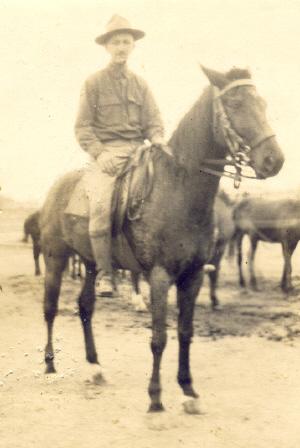
by F. T. Rea

Having devoted countless hours to competitive sports and games of all sorts, nothing in that realm is quite as galling to this grizzled scribbler as the cheater’s averted eye of denial, or the practiced tones of his shameless spiel.

In the middle of a pick-up basketball game, or a friendly Frisbee-golf round, too often, my barbed outspokenness over what I have perceived as deliberate cheating has ruffled feathers. Alas, it's my nature. I can't help it any more than a watchful blue jay can resist dive-bombing an alley cat.

The reader might wonder about whether I'm overcompensating for dishonest aspects of myself, or if I could be dwelling on memories of feeling cheated out of something dear.

OK, fair enough, I don't deny any of that. Still, truth be told, it mostly goes back to a particular afternoon's mischief gone wrong.

*

A blue-collar architect with the Chesapeake & Ohio Railway for decades, my maternal grandfather, Frank Wingo Owen was a natural entertainer. Blessed with a resonant baritone/bass voice, he began singing professionally in his teens and continued performing, as a soloist and with barbershop quartets, into his mid-60s.

Shortly after his retirement, at 65, the lifelong grip on good health he had enjoyed failed; an infection he picked up during a routine hernia surgery at a VA hospital nearly killed him. It left him with no sense of touch in his extremities. Once he got some of his strength back, he found comfort in returning to his role as umpire of the baseball games played in his yard by the neighborhood's boys. He couldn't stand up behind home plate, anymore, but he did alright sitting in the shade of the plum tree, some 25 feet away.

This was the summer he taught me, along with a few of my friends, the fundamentals of poker. To learn the game we didn’t play for real money. Each player got so many poker chips. If his chips ran out, he became a spectator.

The poker professor said he’d never let us beat him, claiming he owed it to the game itself to win if he could, which he always did. Woven throughout his lessons on betting strategy were stories about poker hands and football games from his cavalry days, serving with the Richmond Blues during World War I.

As likely as not, the stories he told would end up underlining points he saw as standards: He challenged us to expose the true coward at the heart of every bully. "Punch him in the nose," he'd chuckle, "and even if you get whipped he'll never bother you again." In team sports, the success of the team trumped all else. Moreover, withholding one’s best effort in any game, no matter the score, was beyond the pale.

Such lazy afternoons came and went so easily that summer there was no way then, at 11, I could have appreciated how precious they would seem looking back on them.

On the other hand, there were occasions he would make it tough on me. Especially when he spotted a boy breaking the yard's rules or playing dirty. It was more than a little embarrassing when he would wave his cane and bellow his rulings. For flagrant violations, or protesting his call too much, he barred the guilty boy from the yard for a day or two.

F. W. Owen’s hard-edged opinions about fair play, and looking directly in the eye at whatever comes along, were not particularly modern. Nor were they always easy for know-it-all adolescent boys to swallow.

Predictably, the day came when a plot was hatched. We decided to see if artful subterfuge could beat him at poker just once. The conspirators practiced in secret for hours, passing cards under the table with bare feet and developing signals. It was accepted that we would not get away with it for long, but to pull it off for a few hands would be pure fun.

Following baseball, with the post-game watermelon consumed, I fetched the cards and chips. Then the four card sharks moved in to put the caper in play.

To our amazement, the plan went off smoothly. After hands of what we saw as sly tricks we went blatant, expecting/needing to get caught, so we could gloat over having tricked the great master. Later, as he told the boys' favorite story -- the one about a Spanish women who bit him on the arm at a train station in France -- one-eyed jacks tucked between dirty toes were being passed under the table.

Then the joy began to drain out of the adventure rapidly. With semi-secret gestures I called the ruse off. A couple of hands were played with no shenanigans but he ran out of chips, anyway.

Head bowed, he sighed, “Today I can’t win for loosing; you boys are just too good for me.” Utterly dependent on his cane for balance he slowly walked into the shadows toward the back porch. It was agonizing.

The game was over; we were no longer pranksters. We were cheaters.

As he carefully negotiated the steps, my last chance to save the day came and went without a syllable out of me to set the record straight. It was hard to believe that he hadn’t seen what we were doing, but my guilt burned so deeply I didn't wonder enough about that, then.

*

My grandfather didn’t play poker with us again. He went on umpiring, and telling his salty stories afterwards over watermelon. We tried playing poker the same way without him, but it didn’t work; the value the chips had magically represented was gone. The boys had outgrown poker without real money on the line.

Although I thought about that afternoon's shame many times before he died nine years later, neither of us ever mentioned it. For my part, when I tried to bring it up, to clear the air, the words always stuck in my throat.

Eventually, I grew to become as intolerant of petty cheating as he was in his day, maybe even more so. And, as it was for him, the blue jay has always been my favorite bird.

-- 30 --

A media day look at the R-Braves

The Richmond Braves open their International League season today in Buffalo. Click here to read my piece on the 2007 R-Braves on Richmond.com.

“...Brundage remains somewhat of a sports legend in his home state of Oregon. In high school he made all-state in football, basketball and baseball. On the practice field, the 42-year-old Brundage looked like a man who still wanted to play the game, rather than sit in the dugout and manage. As a nine-year minor league manager in the Seattle Mariners system, his overall record was 653-605.

“The field itself looked marvelous. Braves general manager Bruce Baldwin was happy to go on record regarding its condition: ‘It’s in the best shape I’ve seen it in, ever. That’s due to Gerry Huppmann [the manager of field maintenance].’

“As the players tossed baseballs back and forth and then took fielding practice, in the stands among the fans the watchful eye of Andrew J. Tutka, Sr. scanned the familiar scene. Tutka has taken in a lot of Braves baseball during his 21 years as a box seat customer at The Diamond. Hey, since he turns 91 next month, Tutka has seen a lot of baseball, period.”
Photo: F.T. Rea

Wednesday, April 04, 2007

More on SLANT's comeback

Yo! There’s news: My little Fan District-based magazine is coming back. Yep, I’m going to take time away from laughing at the poor Republicans, trying desperately to hose down each week’s new scandal, to crank SLANT’s press up, once again.Same as it ever was, SLANT is to be distributed throughout the Fan District, Carytown and Museum area, plus a few selected bars outside the center of the city, to discerning readers who enjoy offbeat sarcasm directed at people in high places. Although the new SLANT will look like previous incarnations, there will differences, too. Naturally, the upcoming May 2007 issue will have a few short pieces, a little politics, a few laughs, etc. But with the new format most of the ‘zine’s space will be devoted to the telling of one feature story.

Our first such feature presentation will be a quirky yarn with colorful characters, “The Fan District Softball League Story (1975-94).”

The unorthodox league bubbled up out of the pop culture ooze of the summer of 1973. WGOE, the daytime AM radio station that owned the hippie listening audience in town, inadvertently set it in motion when its promotional softball team of DJs and a few ringers, the ‘Nads, set up and played games against impromptu teams representing a few regular advertisers on the station, mostly bars.

As time wore on real teams began to jell and the Baby Boomer crowds swelled. By 1975 the FDSL had elected its first commissioner, Van “Hook” Shepherd. The championship was won by Cassell’s Upholstery when it beat the Bamboo Cafe in a one-game playoff.
The 1976 J.W. Rayle team and friends

Other teams in that initial year of play with a published schedule were: the Back Door, Sea Dream Leather, Uptop Sub Shop and WGOE. 1976 saw new teams form, such as the Biograph, Hababas, J.W. Rayle, deTreville and the Rainbow Inn. There was usually a keg of free beer on hand, which made the games into well-attended affairs where the distaff side of the generation was well represented.

SLANT’s history of the FDSL will include anecdotes, quotes, standings, Hall of Fame info, photos, cartoons, and lots more. The only place such a story will be seen is in the pages of SLANT.

Note: SLANT’s exclusive feature for its June issue will be the amazing tale of Color Radio (1982-84), Richmond’s wildest station, ever. Eclectic roster of volunteer DJs ... studio over Plan 9 in Carytown ... sounds from punk to funk, rock to Bach ... absolutely no filter.

For more information about SLANT, and the details about advertising click here

Rayle team photo credit: Artie Probst

Five Favorite Dishes

My five favorite dishes that I enjoyed regularly at once-popular, but now long-gone Richmond eateries, are listed below, in alphabetical order:

1. The Capri’s “Sal Special” (1970s to early-80s)

2. Grace Place’s “Open-Faced Munster/Tomato/Sprouts Sandwich” (late 1970s to early-’90s).

3. Mad King Ludwigs’ “Cornish Hen” (late-1970s to mid-’80s)

4. Texas-Wisconsin Border Cafe’s “Softshell Crab Sandwich” (mid-1980 to’early’90s)

5. The original Village Restaurant’s “Submarine Sandwich” (late-‘1960s to 1980)

Tuesday, April 03, 2007

The post-NCAA coaching moves start

Today fans of the VCU basketball program are holding their breath, waiting to see what the two-time national champion Florida Gators’ head coach Billy Donovan is going to do next. Will Donovan leave Gainesville to coach the Wildcats in Lexington, Kentucky? According to scuttlebutt, if he does that might well mean the Rams’ first-year head coach Anthony Grant would get an offer to replace Donovan at Florida.

Grant served as Donovan’s assistant at Florida for 10 years, before coming to VCU a year ago to replace Jeff Capel, who had moved on to coach at Oklahoma. So, the folks down that way know Grant well.

A reminder of how fast things can change in NCAA basketball is offered here, John Beilein is apparently leaving West Virginia to fill the coaching opening at Michigan. Click here to read the story of the former Richmond Spiders coach, who seems to be heading for Ann Arbor after five years in Morgantown.

“...Media reports linked Beilein with the Wolverines just days after he led the Mountaineers to the National Invitation Tournament championship. It will cost Michigan $2.5 million to buy out Beilein at West Virginia, plus perhaps about $1 million a season in a multiyear contract. Beilein’s West Virginia teams made deep runs in the NCAA tournament the previous two seasons. Despite graduating their top four scorers from a year ago, the Mountaineers went 27-9, including a 78-73 win over Clemson in the NIT title game on Thursday.”

Fresh RVA Blog Carnival

The newest edition of the volunteer-run RVA Blog Carnival can be found at Social Memory Complex, the host for this week. For a smorgasbord of selected posts on various topics from a splendid variety of Richmond blogs click here. Who knows? You may find something new to like

Monday, April 02, 2007

SLANT to return

While it may still have a way to go to tie the Michael Jordan record for comebacks, SLANT is coming back, again.

To begin with SLANT was a project to help fight off a sudden depression. In April of 1985 your narrator dislocated an ankle playing basketball, which totally pulled the rug from under his lifestyle. Right away, I lost my part-time job, which paid the rent.

A few months of living alone on crutches taught me some new lessons, and it finally sat me down long enough to put together the first issue of a magazine concept that had been rattling around in my mind for a long time. I actually designed my first thing of that sort when I was about 10 -- it was a comic strip sports section filled with drawings and stories of an assortment of cartoon animals as players.

After designing many a Biograph Theatre program as its manager (1972-83), I couldn’t quit making little newsletters and handbills just because the original purpose for them was gone, when I quit the job. Over the next year-and-a-half, writing movie reviews for STYLE Weekly and the local PBS radio station, and serving as the art director for Throttle, I began to plan my own publication.

After two 16-page issues in 1985, and a hiatus, SLANT began its longest continuous run on April 1, 1986, as a handbill stapled to utility poles. SLANT evolved and survived for nine years in spite of the odds in the real world against what was such an off-the-wall, warmed-over from underground comix periodical. During its run the format ranged from handbill to newsletter to tabloid. Always SLANT looked at life as seen from the cultural epicenter of Richmond, the Fan District.

In March 1994 SLANT’s readers were told the magazine would shut down and return after a spell. Although I was fresh out of ideas I thought that meant a few months, but I got busy with other things ... among them writing for other publishers.

The 32-page Unvarnished Nostalgia edition of SLANT was published out of the blue in December 2001. After which, SLANT in one form or another was published sporadically over the next four years. Also, SLANTblog began in the fall of 2003.

Now, riding this year’s springtime mania, I’m taking time away from laughing at the Republicans trying desperately to hose down each week’s new scandal, before the damage spreads, to crank SLANT’s press up again. Although the fresh new SLANT will look somewhat like its previous incarnations, this time there will some differences.

This first issue will have a few short pieces on this and that, much as SLANT has always run, but with the new format most of the space will be devoted to the telling of one feature story. For the May 2007 issue, SLANT will present the “The Story of the Fan District Softball League (1975-94).”

The freewheeling FDSL -- with members such as the Back Door, Bamboo Cafe, Biograph Theatre, Buddy’s, Bug Haus, Hababas, Jade Elephant, J.W. Rayle, Joe’s Inn, Sea Dream Leather, Uptop Sub Shop, WGOE, and then their was a team that called itself Arnold’s Pinheads, etc. -- was the only organized yet independent softball league in the Richmond area in those days that governed itself, made its own schedule, cut its own deal with the umpires, etc.

Its story will be told in a way that captures the flavor of that time, but, of course, I’ll use some restraint. So don’t anybody worry about this thing getting people sued or fired. Using my records from “The Sports Fan,” a FDSL newsletter I published in the late-‘70s and early-‘80s and the archives of SLANT, I actually have plenty of softball material and stats to pick over and characterize. It is stories such as this one you will never see in mainstream periodicals.

To flesh this new piece out a bit, I’ll be presenting a few recently gathered quotes from some of the most memorable clowns, all-stars and role players from the 20 years of Fan League history.

The feature for the June issue of SLANT is expected to be the story of Richmond’s most underground radio station ever, Color Radio (Channel 36 on Continental Cablevision). The threads of its almost-too-wild to-believe story (1982-84) lead through WDCE and eventually to WRIR.

SLANTblog will soon have news about a totally new online communication project to serve the Fan District with which SLANT is about to become associated. Stay tuned for updates ...

Horse ride through RVA on Fool's Day

Frisbee-golf wizard Larry Rohr in Byrd Park

Writing with a whimsical air veteran scribe Bill McKelway documents a group’s horseback ride through town on the warm afternoon of April Fool’s Day. The group was the Friends of the Richmond Mounted Squad. Their 14th annual ride benefited the City of Richmond’s mounted patrol. See below for an excerpt of McKelway’s piece for the Richmond Times-Dispatch (which mentions my friend and fellow Frisbee-golfer Larry Rohr). Click here to read “Horse ride raises funds, puzzlement.”

“...Richmond’s mounted police are a familiar sight. But dozens of horses moving through the city herdlike is something else.

“‘Some of the people acted like they'd never seen a horse before,’ said 14-year-old rider Alex Burgess, from very un-Richmond-like King William County, after the four-hour trip.

“‘Is this part of the 10K?’ wondered a Fan District resident yesterday behind William Fox Elementary School as distant flashing lights from police cruisers signaled the arrival of some amorphous delegation from the east. And there was this from sidewalk stroller Bill Pahnelas: ‘I thought it was a hostage situation.’

“At the Carillon, Larry Rohr and his band of Frisbee golfers, a Sunday fixture there since 1975, looked up from their tossing to see the horses pass. ‘It’s a lovely site,’ said Rohr, who carried a satchel of 13 Frisbees. ‘We see them every year.’”
Photo: SLANT