Thursday, January 06, 2022

The Dogtown Hero

Ted Williams

Fiction by F.T. Rea

June 3, 1959: A lean boy with sandy hair and blue-gray eyes, 11-year-old Roscoe Swift lived in a nine-room stucco house with his mother's parents. The 40-year-old house was on a country road in Dogtown, south of Richmond proper.

Roscoe's grandfather was a semi-retired architect. His grandmother still taught children to play the piano. Their yard had two apple trees, a cherry tree, a plum tree and three grape vines in it.   

His mother lived in her studio apartment over a garage that accommodated two cars and his grandfather's seldom used workshop. It was about 30 yards from the house. She was a sometime freelance commercial artist who preferred to work at night and sleep in the day. No one referred to her drinking ways as "alcoholism." When the weather didn't suit her she wouldn't venture outside what she called her "carriage house."

Everybody else called it a "garage." There were spells when Roscoe wouldn’t see his mother for the better part of a week. 

When Roscoe was two years old his mother and father had split up. With them it was kaput. His father went back in the Army and subsequently died in a helicopter crash somewhere in Korea. Since his mother refused to talk about his father -- she had destroyed all photographs of him right after their separation -- the boy's blurry picture of the dead man had been pulled out of the air.

When his mother wasn't within earshot his grandmother would sometimes say, "Your dad had a wonderful smile." His grandfather had told him his father had been a "pretty damn good outfielder" when he was Army, which had frequently gotten him preferential treatment from the brass.

Two or three times Roscoe had heard his grandfather say with a chuckle, "Don't know much about what else your father did during the war, but he played on the same baseball field with some pros."

When he imagined his father, rather than in a military uniform, Roscoe usually saw him in a Depression Era baseball uniform, like what he'd seen Lou Gehrig and Dizzy Dean wearing in newsreels.

For as long as he could remember Roscoe had been in training to be a hero. It wasn’t something he talked about much, but it was usually close to the heart of his striving. 

He was a strong reader and had already inhaled many a biography and adventure story about heroic figures. To steel his nerves he had tested himself with daredevil stunts. He wasn't one to back down from a fistfight. At camp the summer before he had won a National Rifle Association Sharpshooter patch, which he kept with other treasures in a cigar box, hidden where nobody would find it.

On this day the most significant test of Roscoe's mettle had arrived: he was playing the biggest baseball game of his career. Remembering the lucky Ted Williams baseball card he’d slipped into his back pocket before he’d left for school, Roscoe looked at the cloudless blue sky and smiled ever so slightly.

Mostly, school was easy for Roscoe. He took pride in being able to turn in a paper first and get every question right. His difficulties in school stemmed from his class clown inclinations and his quick temper. Good grades in conduct weren't a given.

He liked reading about history and he enjoyed drawing, especially cartoons. But Roscoe hated being indoors in good weather. Baseball was what mattered most to him. During baseball season, using the box scores in the morning newspaper, he routinely calculated the up-to-date batting averages of his favorite Major League players before he went to school.

Two of the fifth-grade classes had finished the season tied, forcing a playoff game to decide the championship. Following lunch, all four fifth-grade classes at Gittes Creek Elementary had been given the afternoon to watch the two teams settle the issue. Which was a treat, because all the previous games had been played during recess.

Students with no taste for baseball had the option of watching a black and white 16mm documentary film about Jamestown's 350th anniversary. Thus, there was a pretty good crowd for the title game.

With one out, Roscoe's side was two runs down. As he took his practice swings, he reminded himself of the situation -- bottom of the last inning, men on first and third. "No grounder," he whispered to himself. He knocked red dust off his canvas sneakers with the bat ... as if they were baseball spikes. Girls from the two classes in the championship game were acting as cheerleaders. No one could remember that ever happening before, but it suited Roscoe just fine.

A group of some 20 men, fathers, uncles and a couple of former minor league ballplayers who lived in the surrounding neighborhood were there. Acting as fans, they stood along the first base line. One of them coached the Gittes Creek Drug Store's Little League team.

In 1959 baseball was still unquestionably America's National Pastime. In Dogtown even fifth-grade baseball in the last week of school was important.

Swift stood in the batter's box on the first base side of home-plate. Originally trained as a right-hander, he had decided that if Ted Williams -- the best hitter in the game -- batted left-handed that was good enough for him. Besides, to Roscoe, for some reason a good southpaw swing looked better. He’d been practicing batting left-handed for a couple of months in neighborhood pickup games. Finally, the switch had to be tested in a situation with something more on the line.

Standing crouched and barely touching first base, Roscoe’s best friend on the team, Bake, cheered him on. "Pick out a good one. Hit your pitch, Number 9."

Even though the boys weren't wearing uniforms with numbers on them, during games most of the starters on Roscoe's team called one another by the numbers they would be wearing. Since Bake's favorite player was Willie Mays, he was called Number 24.   

However, a couple of Roscoe's teammates were imploring him from the bench to bat right-handed, like usual, since everything was at stake. Butterflies the size of eagles disquieted Roscoe's stomach, but he had made up his mind to take the chance.

Stepping out of the box, the Roscoe took three slow and deliberate practice swings. He looked at the crowd standing along the third base line. The cheerleaders for his side were chanting, "Ros-coe, Ros-coe, he's our man. If he can't do it, nobody can!"

His grandfather, who had taken the afternoon off, stood in the shade of an ancient oak tree with the other men. Peering under the flat brim of his straw hat Rocsoe's first baseball coach stoically watched the action, as only he could.

The other team's cheerleaders and classmates booed and hooted at Roscoe from the third base line. He dug in and did his best to put them out of his mind. However, there was a particular girl with a strawberry-blonde ponytail and lively blue-green eyes cheering for the other team. Her name was Susie and he never failed to notice her.

The best thing to say to Susie never came to mind when she was near. Sometimes she made him feel short of breath. So Roscoe watched her from a distance ... frequently with a sense of longing that baffled him. Although Susie was calling for his team to lose, he was sure glad she was there.

Back in the box, Roscoe shifted most of his weight to his back foot and turned his front foot thirty degrees toward first base. Relaxing his hands, he jutted his chin out and squinted like he was aiming a 22 rifle.

The pitcher threw the first pitch outside and in the dirt. It got by the catcher. But the ground rules didn't allow stealing bases, so the guys on base stayed where they were. Sure the next pitch would be across the plate, Roscoe leaned back and prepared to cut the ball in half.

With the infielders behind him chattering like magpies, the hurler went into his stretch and fired the ball. Roscoe liked the pitch and took a big roundhouse swing.

Whoosh!

He nearly lost his balance as the sudden explosion of laughter from his opponents and their classmates pierced Roscoe's armor of concentration. Nonetheless, he didn't look at anyone on either baseline. He knew he'd shut his eyes as he'd swung the bat.

Roscoe felt his cheeks flush as he pulled his baseball cap's brim down on his brow. Again, he relaxed his wrists and fingers.

"It only takes one to hit it!" Bellowed his grandfather through cupped hands.

Roscoe leaned away from the pitcher, to put more weight on his back foot. He remembered to take a deep breath, which he let out slowly as the pitcher confidently cut loose with another fastball. Swinging from his heels, Roscoe rolled his wrists just exactly as his weight shifted toward the pitch. The batter tagged the ball sweetly.

Cah-rack!

The ball left the infield with dispatch. After clearing the leaping second baseman's glove by two feet it took a sharp nosedive and evenly split the closing distance between the right and center fielders. The pair frantically chased the top-spinning hardball down the grassy slope.

The utter perfection of the bat’s perfectly timed kiss on the horsehide's sweetest spot resonated through his body. The sudden furor Roscoe heard seemed like it was far away. He ran like a monster was chasing him. As he made his turn toward third base the ball plopped into the trickle of a creek that bordered the schoolyard. Rounding third, he caught up with Bake.

"Slow down, man," Bake advised over his shoulder with a sarcastic chuckle. "Those goons haven't even found it yet."

Roscoe's euphoric classmates were jumping around wildly. His grandfather beamed as he waved his hat back and forth over his head. Teammates, suddenly champions, were pounding him on his back as he crossed home plate.

Meanwhile, Roscoe's capacity to comprehend the intensity of the moment was red-lining. He looked at Susie on the quiet side of the field. The way her head tilted to the side, the position of her limbs, something about her stance, or gesture, made him feel disoriented. It was as though he was viewing the event from a number of different angles, simultaneously. He felt both inside and outside the scenario.

Roscoe's mind raced as everything seemed to be moving in slow motion. Straining to pull all the elements together, to grasp all he was sensing, he heard an explosion.

Boom!

Then he felt a strange calm. All his eyes  surveyed seemed extra vivid and in its place.

When Roscoe crossed home plate, it occurred to him that he hadn’t loped around the bases, a la Teddy Ballgame. Maybe he would have, but he'd been far too excited to feign nonchalance. More importantly, Roscoe had remembered to not tip his cap. If the batting king and ace fighter pilot of the Korean War, Ted Williams, never tipped his cap to the public on his home run trot -- which he never did -- without question that was good enough for Roscoe, too.
 
Roscoe felt like he was soaring, somewhere up above all of his dark doubts. He was in a place where heroes don't have have to tip their caps to anyone. Meanwhile, Susie had vanished.

As he joined the celebration with his teammates, he was thinking he might be seen as the best hitter on that ballfield ... at least that day. Maybe even Susie thought so. He hadn't expected feeling genuinely confident could be so pleasant; Roscoe smiled. 

After a couple of conversations, he realized no one else had heard the explosion. That made no sense to him. An imaginary bomb?

*

Note: "The Dogtown Hero" is part of a series of stories called "Detached."


Rams Edge Flyers in Dayton

Final Score: VCU 53, Dayton 52

Location: Dayton, Ohio (UD Arena)

Current Records: VCU 8-4 (1-0 Atlantic 10), Dayton 8-6 (0-1)


Wednesday night VCU's sophomore point guard, Ace Baldwin Jr., sank a 3-point shot with 6.6 seconds on the clock. That clutch basket scored the game's last points; it gave the Rams the win. This tilt was the Atlantic 10 Conference opener for both teams.


The information below was provided by Chris Kowalczyk, VCU Assistant A.D.

OPENING TIP

·      Baldwin finished with 12 points and seven assists in the contest. He connected on 5-of-11 from the field, including 2-of-5 from beyond the arc

·      Senior forward Vince Williams Jr. recorded his first career double-double with 13 points and 11 rebounds for the Black and Gold

·      Junior forward Hason Ward added four points, five rebounds and a pair of blocked shots for the defensive-minded Rams

·      Toumani Camara led all scorers with 16 points for Dayton


THE DIFFERENCE

·      Dayton took a 52-50 lead on a pair of R.J. Blakney free throws with less than 25 seconds left. Coming out of a timeout, Baldwin looked left to Williams, who had been knocked to the floor on the play, and pulled up for the game-winner just left of the top of the arc. Blakney had a late look on a floater in the lane on the final play of the game, but it clanged off the rim, and the Rams secured the rebound as time expired

·      Baldwin initially gave VCU a 50-48 lead with 2:49 left on another pull-up 3-pointer from the top of the arc. Camara answered with 1:24 to tie the game and set the stage for a thrilling finish

·      VCU forced 15 turnovers and held the Flyers to 39-percent (15-of-39) shooting in the game, including 3-of-15 from beyond the 3-point arc

           ·      The Rams outrebounded Dayton 34-31

NOTABLE

·      VCU has won a season-high five straight games·     

·      VCU has defeated Dayton four straight times, including two straight at UD Arena

·      The Rams were coming off a 21-day break due to COVID-19 protocols that cost them four games. VCU was without the services of senior forward Levi Stockard III, junior forward Jimmy Nichols Jr. and freshman guard Jayden Nunn

NEXT UP

VCU will stay on the road and take on La Salle in Philadelphia, Pa. on Saturday, Jan. 8 at 2 p.m. at Tom Gola Arena. That game will be broadcast on USA Network.

Tuesday, January 04, 2022

Recollections in High Contrast: Donald Cooper Gets His

Snow brings back memories. When we see the way snow makes the world around us resemble a high contrast black and white photograph, we can't help but connect to when we saw that distinctive look before. It's a look we don't see every year in Richmond, Virginia. 

That look helps us remember when a happy puppy first encountered snow. Likewise, we remember snowball fights and the raised-glass revelry in crowded Fan District bars. And, we remember particular people we associate with yesteryear's snowy landscapes.

In the winter of 1958-59 I had just turned 11. My dog, Buster, was probably six or seven months old when he saw his first snow. He was a white mutt; he looked like he was part Spitz but somewhat bigger. 

Watching Buster rooting in the snow, barking at it, rolling in it, was too funny. He seemed to absolutely love the smell, the taste and the  feel of snow.

*

Maybe the best snowball shot I ever made was in the early '80s on West Grace Street. Rebby Sharp and I were across the street from the Biograph Theatre, ducked down behind some parked cars. It was after dark but I can't say how late it was. A snowfall was underway and it was sticking. Rebby and I were battling some friends, who were hunkered down behind parked cars in front of Don's Hot Nuts, next door to the Biograph, the cinema I managed in those days.

Rebby and her band, the Orthotonics, used to practice sometimes in the theater's large auditorium during off-hours. Some fans of Rebby's music and art might not know it, but she was a fairly decent athlete; she pitched for the Biograph's women's softball team had a good throwing arm.

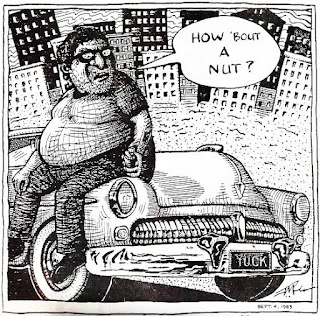
When some snowballs thumped off of Donald Cooper's peculiar, bright green candy business storefront, he came out on his porch to command the snowball fighters to stop and scram. As everyone associated with the Biograph knew Cooper (depicted in my illustration) to be an utter pest and the worst next-door neighbor in the world, Rebby and I had no need for a plan ... by instinct we knew what to do.

Rebby threw first. My throw left a split second later. Both were superbly well put shots. When Cooper extended his hand to block Rebby's accurate incoming snowball, it shattered to shower him. Then, my righteous throw -- a frozen rope! -- hit him square in the face ... boom!

Cooper wisely quit his surly stance and retired for the night.

*

The best rides in the snow I remember were at Libby Hill Park. In the late-'70s and early-'80s I spent a lot of time up there. Played Frisbee-golf in that park quite a bit back then. And, there were a few heavy snows in that same time period, which drew thrill-riders to what was then called the Slide of Death.

Rather than sleds, we rode inflated inner tubes from the top of a series of hills in the radically sloped park down to Main Street below, next to Poe's Pub. When the snow was right those tubes went airborne at least a couple of times; the fast ride could be quite exhilarating.

There was a particular time that stands out. Dennison Macdonald, then a highly visible neighborhood denizen (he died in 1984), had hosed down the first 20 yards, or so, of the run, so it would freeze in the frigid air and make the track as slick and quick as greased lightning.

Eventually, that night, the run to the bottom got so fast you had to be drunk to be foolish enough to take the risk of riding. Which wasn't a problem for those of us in the group standing in the snow, grouped around a fire-barrel and passing a bottle of Bushmills around between rides.

At that time Chuck Wrenn lived across the street from the launching point of the old Slide of Death. Not long ago he and I got to reminiscing about that same night. The sight of Duck Baker threatening to ride a big shaggy dog down the chute was still hilarious. For whatever reason, the silly dog happily went along with the gag each time Duck hoisted him up and pretended ... well, I guess you had to be there. 

Please note, Duck never really rode the dog down the hill. And, I don't think the dog was drunk. Anyway, for Chuck and me, conjuring up that comic scene, once again, had us laughing almost as hard as it did originally.

Of course, to fully appreciate Slide of Death stories you probably should be standing around a fire barrel in snow up to mid-calf ... drinking Irish whiskey. If you like, substituting Jameson is perfectly acceptable.

-- 30 --

Richmond's Bloody Interregnum


A ballot box was stolen from this building 
152 years ago. Now it houses Gallery 5.

When I hear about stubborn politicians rejecting the verifiable truth and refusing to compromise with their opponents, it brings to mind what tragedy can flow from such failures in leadership. Such foolishness can lead to the chaos that we saw in the streets of Charlottesville on August 12, 2017. When such foolishness is harnessed and directed by power mad politicians it can spawn what we saw during the insurrection riot at the Capitol in Washington, D.C., on January 6, 2021. 

Moreover, these days, when we hear blustery politicians and perpetually angry activists fuming about “second amendment solutions,” it should remind us that civilized people who were living in what were supposed to be democracies have sometimes lost their moorings. In its long history Richmonders have witnessed so-called "solutions" of that ilk turn bloody.

What follows is a brief glance at the story of an instance that prompted a feud to take root. It's a scary example of what can happen when partisans lose confidence in the results of elections and shrug off court rulings. The Bloody Interregnum of 1870-71 was the name that stuck to the politics-gone-wrong squabble over whether George Chahoon or Henry K. Ellyson was the lawful mayor of Richmond. 

When the five-year military occupation of Virginia that followed the Civil War ended, on January 26, 1870, Gov. Gilbert C. Walker promptly appointed a new City Council for Richmond. That body in turn selected Henry K. Ellyson, publisher of The Dispatch — forerunner to today’s Richmond Times-Dispatch — as the city’s new mayor.

However, George Chahoon, who had served as Richmond's mayor during the last two years of Reconstruction in Virginia, refused to recognize the validity of the process. Although the transplanted New Yorker had a considerable following around town, he was seen by Ellyson’s determined backers as a usurper of a sort. After all, hadn't Chahoon served at the pleasure of the military overlords?

When the followers of both men dug in their heels and chose not to back off, something had to give. Well, the city itself fractured. As positions solidified, the split became a chasm. Two separate city governments were created by the process. 

There were two separate police departments, two City Halls, etc. Brawls in public became commonplace as the supporters of both "mayors " sought to press their case on every street corner. Chaos, with gun-play aplenty, ensued.

Notably, in spite of the fact that Richmond served as the capital of the Confederacy during most of the Civil War, the city was not without its Union sympathizers. In fact, Richmond was quite divided on the topic of secession leading up to the war. Thus, during and after the Civil War there were substantial elements present that could have been characterized as pro-Union, or at least anti-secession.

Like the USA’s 2000 presidential election, in 1870 the impasse eventually found its way into court. On April 27, the Virginia Supreme Court of Appeals met on the third floor of Virginia's Capitol building, to hear arguments from the two camps. To see the spectacle firsthand, anxious citizens shouldered their way onto the balcony. However, under all the weight the balcony suddenly collapsed and crashed onto the hapless spectators below. 

Widely known as The Capitol Disaster, when the smoke cleared the tragedy left 62 people dead and 251 injured. Two days later, the court reconvened at City Hall. In due time, a verdict favorable to Ellyson was returned. A month later, a citywide election took place. But no clear winner emerged from that exercise, either. 

This time the contentiousness stemmed from the disappearance of a ballot box from a precinct friendly to Chahoon. Same as ever, both sides went on trading accusations. Although Ellyson was certified as the winner by the election board, he declined to serve, because he thought the election results were still tainted, therefore inconclusive. The battle raged on.

Eventually Chahoon just left town, perhaps in some part to avoid facing the consequences of several felony indictments — supposedly of a nonpolitical nature — that had been heaped upon him. For his part, Ellyson grew weary of the struggle and finally withdrew from the contest.

The impasse was broken on July 1, 1871, with the election of Anthony Keily as the one and only mayor of the exhausted city of Richmond. Nonetheless, some of the actions of those who were most caught up in the 17 months of the "interregnum" left stains that perpetuated grudges in Richmond for generations to come.

As a child growing up in Richmond, I heard adventure tales from my grandfather about this bizarre time. He claimed his salty old Uncle George, who was a sheriff (somewhere), among other things, told him that most men in Richmond carried guns on the street in those wild days, much like what we’ve seen in countless western movies. Formal duels and spontaneous gunfights were not unusual in Richmond in that time. 

The Bloody Interregnum was a storm driven by factions of ruthless, hardheaded people. The truth stopped mattering. Blinded by crazy desires to win, at any cost, neither tribe was willing to compromise or recognize the validity of any authority outside of itself.  

During that reckless spell of 17 months too many folks in Richmond followed hot-headed trouble-makers willing to risk losing everything, just to get their way. Those trouble-makers surely have their counterparts today. 

-- 30 --

Monday, January 03, 2022

Biograph Times: Part One: The First Year

 by F.T. Rea 

Over 200 Titles in Year No. 1

Note: About six weeks before its opening gala (on Feb. 11, 1972) this wide-angle view of The Biograph Theatre was captured by a Richmond News Leader photographer. It was snapped late in 1971, shortly before the new building at 814 W. Grace St. received its distinctive buttercup yellow paint-job.

*

In early July of 1971, on what I remember as a bright morning, I went to a construction site on the north side of the 800 block of West Grace Street. At that time, the site was mostly just a big hole in the orange dirt between two old brick houses.

A friend had tipped me off that she’d been told the owners of the movie house set to rise from that red dirt were looking for a manager who knew something about movies and could write about them. She also said they were hoping to hire a local guy. Chasing the sparkle of that opportunity I met David Levy at the construction site.

Levy was the Harvard-trained attorney who managed the Biograph Theatre at 2819 "M" Street in Washington. D.C. He was one of a group of five men who, in 1967, had opened Georgetown’s Biograph in a building that had housed a car dealership.

Although no one in the group had any experience in show biz, they were hip young movie lovers whose timing had been impeccable. They caught a pop culture wave. The golden age of repertory cinema was happening and those original partners were living in what was the perfect town for their venture; it wasn't the first repertory/art house cinema in that town and right away the Biograph Theatre in D.C. did well at the box office.

With their continued success on "M" Street to encourage them, a few years later the same five, plus one, were looking to expand. In Richmond’s Fan District they thought they had discovered just the right neighborhood for a second repertory-style cinema using a split weeks and double features style of programming. In this sort of calendar house programming one usually adheres to a published schedule. So, if a movie draws well, instead of holding it over you simply bring it back soon. 

Although the ambitious partners really didn't know much about Richmond, the six partners knew Virginia Commonwealth University had a big art school. A pair of local players, energy magnate Morgan Massey and real estate deal-maker Graham “Squirrel” Pembroke, acquired the land. They agreed to build a cinder block building to house a single-auditorium cinema just a stone’s throw from VCU’s academic campus for the entrepreneurs from D.C. to rent. The "boys in D.C." had to pay for the projection booth equipment, the turnstile (we used tokens, rather than tickets) and the seats, some 515 of them.

At the time I met Levy I was working for a radio station, WRNL, so I gave him tapes of some humorous radio commercials I had made for what had been successful promotions. About 10 weeks after that first meeting with Levy, after a few subsequent meetings, I was offered the manager’s position for the new Biograph, still under construction. Can't recall all that much about that day, except I was told I had beaten out a lot of competition. 

Oddly, what I do remember clearly is a brief flash of me sitting in my living room with Levy and Alan Rubin (also a partner), trying to be nonchalant, so as to not to reveal how thrilled I was at getting that offer. At 23-years-old, I could hardly have imagined a better job for me existed, at least not in the Fan District. 

This opportunity came to me three years after Richmond Professional Institute and the Medical College of Virginia merged to become VCU in 1968. In the fall of 1971 there weren't many signs of the dramatic impact the new university would come to have on Richmond. 

Although a couple of film societies were thriving on VCU's campus in those days, other than local film critic Carole Kass' History of Motion Pictures class, the school itself was offering little in the way of classes about cinema history or filmmaking. There were a few VCU professors who occasionally showed artsy short films in their classes. Mostly, independent and foreign features didn’t come to Richmond. So, in 1971, the talk about the Biograph Theatre being built on Grace Street was great news to local film buffs. Generally, it was seen as a good sign the neighborhood's nightlife scene was becoming more cosmopolitan.  

Levy and I got along well right away. We became friends who trusted one another. He and his partners were all about 10 years my senior.

My manager’s job lasted until the summer of 1983 when I resigned. Four yeayears. rs later, owing to unpaid rent, the Biograph Theatre's building was seized by Pembroke. It remained locked up and dark for years. The building's story after its Biograph times is for someone else to tell. A hundred miles to the north, the Biograph on M Street closed in 1996. David Levy died in 2004. Lenny Poryles, a second of those original Georgetown-based bosses, died in 2018.

Most recently there was a noodles eatery in the building that once housed the precious repertory cinema I managed for 139 months. That restaurant folded and apparently no enterprise is currently underway at that address. For what it's worth, now the former Biograph is oldest building on the 800 block of West Grace Street. 

*

On Friday, February 11, 1972, the Biograph adventure got off the ground that night with a gem of a party. I learned something about the theater magic that day, when I saw the unfinished business that was all over the lobby that afternoon, evolve into a well-run event that evening. In the lobby the dry champagne flowed steadily, as the tuxedo-wearers and colorfully outfitted hippies mingled smoothly. 

A trendy art show was hanging on the walls. The local press was all over what was seen as an important event for that bohemian commercial strip. The feature we presented to over 300 invited guests was a delightful French war-mocking comedy — “King of Hearts” (1966); Genevieve Bujold was dazzling opposite the droll Alan Bates. The six owners were there for the first-ever Biograph party in Richmond. That was the only occasion they were all there at the same time.

Following splashy news stories about the party trumpeting the Biograph's arrival, the next night we opened for business with a cool double feature: “King of Hearts“ was paired with “A Thousand Clowns“ (1965). Every show sold out.

Other than the projectionist, Howard Powers -- who was supplied by the local operators union -- I had hired the theater's opening night's staff: The cashiers were Cathy Chapman and Susan Eskey. The ushers were Bernie Hall and Chuck Wrenn. A few weeks later Chuck was promoted to assistant manager and Susan Kuney was hired as a third cashier. 


The Biograph’s printed schedule, Program No. 1, was heavy on documentaries. It featured the work of Emile de Antonio and D.A. Pennebaker, among others. Also on that program, which had no particular theme, were several titles by popular European directors, including Michaelangelo Antonioni, Costa-Gavras, Federico Fellini, and Roman Polanski.

Like the first one, which offered mostly double features, each of the next several programs covered about six weeks. At this point Alan Rubin, one of the partners who worked in the Georgetown office, did the mechanical art for those programs, just as he had been doing for the D.C. Biograph. In the initial months Levy and Rubin made most of the programming decisions, with me, of course, throwing in my two-cents worth. In the years to come my duties expanded.

In reading everything I could find about which movies were well-respected and popular in art houses, especially in New York and San Francisco, it was easy to gather that the in-crowd viewed most of Hollywood’s then-current product as either laughingly naive or hopelessly corrupted by the system. As it was, the fashion of the day elevated certain foreign movies, selected American classics, a few films from the underground scene, etc., to a level above most of their more accessible Hollywood counterparts. 

In 1972 perhaps the most admired group of foreign films were those considered to be part of the French New Wave, which began as the '50s ended, with the early features made by Louis Malle, François Truffaut and Jean-Luc Godard. What my first year on the job eventually taught me was how few people in Richmond really cared all that much about seeing such films.

After the opening flurry of interest in the new movie theater, with long lines to nearly every show, it was surprising to me when the crowds shrank dramatically in the months that followed. Among the things that disappointment showed me was how important the publicity running up to the Biograph's opening had been.

As VCU students had been a substantial portion of the theater’s initial crowd the slump was chalked off to warm weather, exams and then summer vacation. In that context the first summer of operation was opened to experimentation aimed at drawing more customers from beyond the immediate neighborhood. That gave me an opportunity to do more with a project my bosses had put me in charge of developing, Friday and Saturday midnight shows -- using radio in particular to promote them.

By trial and error I learned quickly that movies that lent themselves to attention-getting promotion performed better at the box office. Early midnight show successes were “Night of the Living Dead” (1968), “Yellow Submarine” (1968), “Mad Dogs and Englishmen” (1971), and an underground twin bill of “Chafed Elbows” (1967) and “Scorpio Rising” (1964). Most of the failures have been forgotten.

With significant input from Chuck, the theater’s assistant manager, quirky non-traditional ad campaigns were designed in-house. We learned there were two essential elements to midnight show promotions: 1. Wacky radio spots had to be created and run on WGOE, a popular AM station aimed directly at the hippie listening audience. 2. I made distinctive handbills that were posted on utility poles, bulletin boards and in shop windows in high-traffic locations. A sense of humor in promoting helped.   

Dave DeWitt produced the radio commercials. We happily shared the copy-writing chore. In his studio, Dave and I frequently collaborated on the making of those spots. We agreed that an ample supply of cold Pabst Blue Ribbons and whatnot also helped. Most of the time we went for levity, cheap laughs were all the budget could handle. Dave had a classic announcer's baritone voice and he was quite masterful at physically crafting radio commercials. He was even more of a nitpicker for perfection than I was, so we made a good team. I learned a lot from this time. 

*

On September 13, 1972, a George McGovern-for-president benefit was staged at the Biograph. Former Gov. Doug Wilder, then a state senator, spoke. We showed "Millhouse" (1971), a documentary that put President Richard Nixon in a bad light.

Yes, I was warned that taking sides in politics was dead wrong for a show business entity in Richmond. Taking the liberal side only made it worse. But the two most active partners who were my bosses, Levy and Rubin, who was a geologist turned artist, were delighted with the notion of doing the benefit. They were used to doing much the same up there. So with the full backing of the boys in D.C. I never hesitated to reveal my left-leaning stances on anything political.  

Also in September “Performance” (1970), a somewhat overwrought but well-crafted musical melodrama -- starring Mick Jagger -- packed the house at midnight three weekends in a row. Then a campy, docu-drama called “Reefer Madness” (1936) sold out four consecutive weekends.

The midnight shows were going over like gangbusters. To follow “Reefer Madness” what was then a little-known X-rated comedy, “Deep Throat” (1972), was booked as a midnight show. By then the Georgetown Biograph was experimenting with playing naughty midnight shows. In Richmond, we had played a handful of films that had earned an X-rating, they had been more artsy than they were vulgar. This was our first step across the line to hardcore porn.

*

As “Deep Throat” ran only an hour, master prankster Luis Buñuel’s surrealistic classic short film (16 minutes), “Un Chien Andalou” (1929), was added to the bill, just for grins. It should be noted that like "Deep Throat," Buñuel’s first film, was also called totally obscene in its day. Still, this may have been the only time that particular pair of outlaw flicks ever shared a billing ... anywhere.

A few weeks after “Deep Throat” began playing in Richmond, a judge in Manhattan ruled it was obscene. Suddenly the national media became fascinated with it. The star of "Deep Throat," Linda Lovelace, appeared on network TV talk shows. Watching Johnny Carson pussyfoot around the premise of her celebrated “talent” made for some giggly moments.

Eventually, to be sure of getting in to see this midnight show, patrons began showing up as much as an hour before show time. Standing in line on the brick sidewalk for the spicy midnight show frequently turned into a party. There were nights the line resembled a tailgating scene at a pro football game. A determined band of Jesus Freaks took to standing across the street to issue bullhorn-amplified warnings of hellfire to the patrons waiting in the midnight show line that stretched west on Grace Street. It only added to the scene.

Playing for 17 consecutive weekends, at midnight only, “Deep Throat” grossed over $30,000. That was more dough than the entire production budget of what was America’s first skin-flick blockbuster.

The midnight show’s grosses conveniently made up for the disappointing performance of an eight-week program of venerable European classics at regular hours. It included ten titles by the celebrated Swedish director, Ingmar Bergman. The same package of art house workhorses played extremely well up in Georgetown, underlining what was becoming a painfully underestimated contrast in the two markets.

On the theater's first anniversary I made a list of all the titles we had presented. A few noteworthy shorts films were on the list, such as Chris Marker's "La Jetée" (1962), but I omitted most shorts. The list, which I had printed as a flyer to hand out, was over 200 titles long.

In 52 weeks, to establish what we were, the Biograph had presented over 200 different films, some in a couple of runs. Split weeks with doubles features, plus midnight shows, chewed up a lot of product. By the end of the first year Levy, Rubin and I knew we needed to make some changes in our programming.

The Fan District was not becoming Georgetown and in spite of what some folks were predicting, maybe it never would. To be successful in Richmond we realized we had to do more to cultivate the audience here to appreciate the sort of films we loved and most wanted to present. And, in the meantime, we had to figure out how to avoid losing money.

To start, maybe fewer old Bergman flicks.

*

Here's a small sample of that first year's avalanche of sweet double features. In this case I chose to put 12 double features on the list, because that's typically what was on one of the Biograph's calendar style programs.

Feb. 12-14, 1972: 
“King of Hearts” (1966): Color. Directed by Philippe de Broca. Cast: Alan Bates, Geneviève Bujold, Pierre Brasseur. Note: The first movie to play at the Biograph was a zany French comedy, set amid the harsh but crazy realities of too much World War I.
“A Thousand Clowns” (1965): B&W. Directed by Fred Coe. Cast: Jason Robards, Barbara Harris, Martin Balsam. Note: A social worker investigates the rules-bending circumstances in which a boy lives with his iconoclastic uncle, an unemployed writer.

Feb. 21-23, 1972:
“Z”  (1969): Color. Directed by Costa-Gavras. Cast: Yves Montand, Jean-Louis Trintignant, Irene Papas. Note: A political assassination’s cover-up in Greece spawns a compelling based-on-truth whodunit, with sudden plot twists, all told at a furious pace.
"The Battle of Algiers" (1966): B&W. Directed by Gillo Pontecorvo. Note: This account of the cruel tactics employed by both warring sides during the Algerian revolution is part documentary, part staged suspenseful recreation. Unforgettable.

Mar. 17-20, 1972: 
“Gimme Shelter” (1970): Color. Directed by Albert Maysles and David Maysles.  Performers: The Rolling Stones, the Jefferson Airplane, the Grateful Dead, Tina Turner and more. Note: A documentary with much concert footage and one murder.
“T.A.M.I. Show” (1964): B&W. Directed by Steve Binder. Performers: the Rolling Stones, the Beach Boys, the Supremes, James Brown, Marvin Gaye, Smokey Robinson and the Miracles, Lesley Gore and more appear in concert footage.

Apr. 12-13, 1972:
"Bell Du Jour" (1967): Color. Director: Luis Buñuel. Cast: Catherine Deneuve, Jean Sorel, Michel Piccoli. Note: Beautiful Severine loves her successful husband. With him she’s frigid. Her kinky fantasies lead her to the oldest profession … only by day.
"A Man and a Woman" (1966): Color. Director: Claude Lelouche. Cast: Anouk Aimée, Jean-Louis Trintignant. Note: A widower and a widow meet by chance at their childrens' boarding school. As they struggle to deal with their attraction to one another, neither has gotten over their loss.  

June 1-7, 1972: 
“McCabe & Mrs. Miller” (1969): Color. Directed by Robert Altman. Cast: Warren Beatty, Julie Christie. Note: With Altman, the routine gambling, prostitution and power struggles in the Old West take on a different sort of look. More grit. Less glory. All random.
"Klute" (1971): Color. Directed by Alan J. Pakula. Cast: Jane Fonda, Donald Sutherland, Roy Scheider. Note: Fonda grabbed a Best Actress Oscar for her convincing portrayal of a damaged prostitute who helps a dogged private detective solve a complicated missing person case.

June 14-18, 1972:
“Putney Swope” (1969): Both B&W and color. Directed by Robert Downey Sr. Cast: Stan Gottlieb, Allen Garfield, Archie Russell. Note: This strange but hilarious send-up of Madison Avenue was Downey’s effort to crossover from underground to legit. Probably his most accessible work.
"Trash" (1970): Color. Director: Paul Morrissey. Cast: Joe Dallesandro, Holly Woodlawn. Note: It was billed as "Andy Warhol's Trash," as he was credited with being the producer of Morrissey's series of undergroundish films. This one reveals the down-and-out urban lifestyle of an oddball couple.

June 29-July 2, 1972: 
"Dr. Strangelove or: How I Learned to Stop Worrying and Love the Bomb" (1964): B&W. Directed by Stanley Kubrick. Cast: Peter Sellers, George C. Scott, Sterling Hayden, Slim Pickens. Note: This nuke-mocking black comedy raised eyebrows at the height of the Cold War. Still a laugh riot.
 “M.A.S.H.” (1970): Color. Directed by Robert Altman. Cast: Donald Sutherland, Elliott Gould, Sally Kellerman. Note: This cynical comedy about doctoring too close to the pointless battles of the Korean War is much funnier than the long-running TV show that followed it.

Sept. 21-24, 1972:
"Citizen Kane" (1941): B&W. Directed by Orson Welles. Cast: Orson Welles, Joseph Cotten, Dorothy Comingore. Note: The meaning of a powerful, lonely man’s last word enlarges into a mystery. Flashbacks reveal a large life driven by lusts and obsessions. As American as it gets. 
"The Magnificent Ambersons" (1942): B&W. Directed by Orson Welles. Cast: Tim Holt, Joseph Cotten, Dolores Costello, Anne Baxter. Note. This truncated-by-the studio version of what the indulgent director intended follows the meandering story of a prominent family's fortunes.  

Oct. 9-11, 1972:
“The Third Man” (1949): B&W. Directed by Carol Reed. Cast: Joseph Cotten, Orson Welles, Alida Valli. Note: This elegant film noir mystery, set in crumbling post-war Vienna, is pleasing to the eye and stylishly cynical. Hey, no heroes here, but great music. 
"Breathless" (1960): B&W. Directed by Jean-Luc Godard. Cast: Jean-Paul Belmondo, Jean Seberg. Note: An opportunistic thief on the lam becomes irresistible to a pretty American journalism student in Paris. Uh-oh, the guy is dangerous. How long can living in the moment last?

Nov. 17-19, 1972:
“Duck Soup” (1933): B&W. Directed by Leo McCarey. Cast: The Four Marx Brothers (Groucho, Harpo, Chico and Zeppo), Margaret Dumont. Note: With Rufus T. Firefly as dictator of Freedonia and flush from a fat loan from Mrs. Teasdale, what could hilariously go wrong? How about war?
"Horse Feathers" (1932): B&W. Directed by Norman McLeod. Cast: The Four Marx Brothers, Thelma Todd. Note: The Biograph's secret password that opened doors was "swordfish." The scene that spawned that tradition is in this gag-filled send-up of on-campus life and football.

Dec. 7-10, 1972: 
“The Producers” (1968): Color. Directed by Mel Brooks. Cast: Zero Mostel, Gene Wilder, Kenneth Mars, Dick Shawn. Note: Brooks’ first feature film laughed at Nazis with what was a fresh audacity. Mostel and Wilder are so funny it ought to be illegal.
“The Graduate (1967): Color. Directed by Mike Nichols. Cast: Anne Bancroft, Dustin Hoffman, Katherine Ross. Note: The mores of upper middle class life in the '60s are laid bare, as a recent college graduate's idleness leads to an affair with the beautiful, but wrong older woman.

Jan. 25-28, 1973:
"The Conformist" (1971): Color. Directed by Bernardo Bertolucci. Cast: Jean-Louis Trintignant, Stefania Sandrelli, Gastone Moschin. Note: A visually stunning look at fascist Italy, with Mussolini in power and old class distinctions melting away. Betrayal is in the air.
 “The Garden of the Finzi-Continis” (1971): Color. Directed by Vittorio De Sica. Cast: Dominique Sanda, Lino Capolicchio, Fabio Testi. Note: With WWII approaching, why did wealthy, well educated Jews stay too long in Germany and Italy? This film provides some answers.
 
-- 30 --

VCU to Retire Graham's No. 21

Note: Soon Treveon Graham’s No. 21 will be hanging from the rafters of the Siegel Center, along with five others already there. During halftime of the VCU Rams’ game vs. the St. Joe's Hawks, on Jan. 22, the jersey of Graham will be officially be retired in a brief ceremony. Graham is the all-time second-leading scorer in the program's history.

The info below was supplied by Chris Kowalczyk, VCU Assistant A.D.:

Treveon Graham poured in 1,882 points and guided the Rams to four consecutive NCAA Tournaments from 2011-15. A two-time First Team All-Atlantic 10 Conference selection, Graham led the Rams to a pair of conference championships during his career.


A 6-foot-5 forward, Graham was named MVP of the 2015 Atlantic 10 Conference Tournament when he averaged 17.3 points and 9.8 rebounds over four days to lead the Rams to the title. Graham provided 20 points, 13 rebounds and four assists in the Championship Game against Dayton that season.


In a VCU career chock full of memorable moments, Graham is also known for his long, game-winning, 3-pointer in a victory over 25th-ranked Virginia on Nov. 12, 2013, the first meeting between the two programs in 15 years. A native of Rythken, Md., Graham averaged 13.4 points and 5.7 rebounds per game for the Rams in 140 career games.


He went on to spend four seasons in the NBA, including stints with the Charlotte Hornets, Brooklyn Nets, Minnesota Timberwolves and Atlanta Hawks.


Graham will become the sixth VCU men’s player to see his jersey retired. He will join an exclusive club that includes Gerald Henderson (No. 22), Calvin Duncan (No. 5), Kendrick Warren (No. 23), Eric Maynor (No. 3) and former teammate Bradford Burgess (No. 20).

Friday, December 31, 2021

The Strange Case of Gus the Cat

Note: In an effort to be funny in an off-beat way, I wrote this piece in 2000. As it happened, the people quoted were told the scenario and then given the freedom to write their own lines, in character. 

It was a lot of fun brainstorming and assembling piece. It was first published by Richmond.com. My thanks still goes out to the editor, Richard Foster, who had the nerve to run this difficult-to-categorize story. 

*

Though cynical people like to say, “All cats are gray in the dark,” the difference between this and that counts with me. Thus, if for no other purpose than to satisfy my own curiosity, I set out to find the truth about Gus, the gray and white cat that had long presided over lower Carytown from his plush basket in a bookstore display window facing the street.

https://blogger.googleusercontent.com/img/b/R29vZ2xl/AVvXsEjXm9teqkGYgGIxBSLEbnL80sxkptmLO4ZSGYfxJLPeiuE_m0YWma7T4naPZBskpb91oLLOXXeWtJmUp-DV32hrvg2ghDcZcqkXPvI4Bfrie5QIlXWpSMBsttWiZPQI3AASfPNU0Q/s1600/gusstacywarner.jpg
This photo of Gus was shot by
Stacy Warner for Richmond.com.

The mystery began in the course of a casual conversation about re-makes of old movies. Film aficionado Ted Salins, a regular among the society of conversationalists who gather at the tables on the sidewalk in front of Coffee & Co., tossed out that the cat living next door in Carytown Books is not the “original” Gus.

Since I’ve known Salins, a writer/filmmaker/house-painter, for a long time, I suspected his charge was a setup for a weak joke. To give him room to operate I asked, “So, this Gus is an impostor?”

“Just like Lassie, several cats have played the role of Gus over the years,” Salins said matter-of-factly.

Until that moment it hadn’t occurred to me that Gus, someone else’s cat, had slowly become important to me over the years. In the past I’ve been told that he’s over 15, maybe pushing 20. Who can say what that is in cat years? He still has a few teeth left.

“You see, in ‘91, I had lost my beloved Skinkywinkydinky in a separation,” Salins continued, as if he was revealing a dark conspiracy. “When I first saw Gus, I took to him, because he reminded me of Skinky. That Gus wouldn't let you touch him. But, this Gus…”

“Ted, this is absolutely the most off-the-wall nonsense you’ve come up with yet,” I accused.

“The place has changed hands a few times since then,” Salins smugly offered. “The problem is each owner falls in love with the cat and keeps it. But since Gus has become an institution in Carytown, each set of new owners has to find another cat that looks like Gus. The switch is made at night in order to preserve the secret. I’ve seen it.”

Before I could say “horsefeathers,” another member of the Carytown intelligentsia, who had just walked up, spoke: “Salins, as usual you’re all wet,” said artist Jay Bohannan. “That is not only the same cat, but Gus is, let’s see, yes, he’s nearly 70. That particular cat is probably the oldest cat this side of the island of Lamu.”

I laughed at Bohannan’s crack and excused myself from the table to let them hash it out. The two of them have been arguing good-naturedly since their VCU art school days in the early ‘70s.

Walking toward my car, Ted’s suggestion of a fraud having been perpetrated on the public bothered me. I felt certain that if somebody had actually installed a faux Gus in the bookstore it would have been all over the street the next day. As I tried to imagine people spiriting nearly identical cats in and out of the back door, in the dead of night, the matter wouldn’t rest.

So I turned around and went into Carytown Books. The shop’s manager, Kelly Justice, who has worked there for six years under three editions of ownership, scoffed at Salins’ charge.

“Anyone who knows Ted, knows he’s a nitwit,” said Ms. Justice with a wry smile. “More likely than not, this is an attempt to raise funds for another one of his documentaries.”

When I told her about Bohannan’s equally outrageous suggestion that Gus was almost a septuagenarian, Justice laughed out loud. “Perhaps Jay and Ted are both trying to hitch their wagons to Gus’ star,” she suggested playfully.

Back outside, Salins and Bohannan were both gone. So I walked east on the block to Bygones, the collectable clothing and memorabilia store known for its artful window displays. Since Maynee Cayton, the shop’s proprietor, is an unofficial historian for the neighborhood, I decided to see what she knew about Gus.

Cayton, who has been at that location for 16 years, said she had some pictures of the block from the ’30s and ‘40s, but she didn’t think she had any shots of a bookstore cat. However, she did remember that when she was a child she saw a gray and white cat in the window of what was then the Beacon Bookstore.

“It was in the late ’60s, I think it was 1967,” she said, raising an eyebrow. “And I’d say it was a young cat. Either way, I can’t believe the feline impersonator story, so maybe it was Gus.”

The next day, Bohannan called on the phone to tell me he had something I needed to see right away. He was mysterious about it and wouldn’t explain what he was talking about, except to say that it was proof of his claim about Gus the Cat.

Unable to let it go, I told him I’d stop by his place to see what proof he had.

Bohannan’s apartment, located between Carytown and the Virginia Museum of Fine Arts, was an escape from the modern world altogether. It’s furnished in a pleasant mix of practical artifacts and curiosities from yesteryear. The heavy black telephone on his desk was almost as old as Jay. Next to the desk was a turn-of-the-century gramophone. Bohannan, himself, dressed like a character who just stepped out of a Depression-era RKO film, reached into a dog-eared manila folder and pulled out a photograph. When I asked him where he had gotten the picture, purportedly from about 1930, he shrugged.

In such a setting, his evidence of Gus’ longevity took on an eerie authenticity. Sitting in one of Bohannan’s ancient oak chairs, surrounded by his own paintings of scenes from Virginia’s past, I thought I could see the cat he claimed was depicted in the storefront’s window. Why, it even looked like Gus.

Jay told me I could keep the photo, it was just a Xerox copy. What a scoop!

Later, when I looked at the grainy picture at home, I could hardly even see a cat. The next day, back in Carytown, I spoke with several people who hang out or work in the neighborhood. A few actually thought Bohannan’s bizarre contention could be true. Others agreed with Salins.

One man, who refused to be quoted with attribution, said he was sure the original Gus was an orange cat. A woman looked up from her crossword puzzle to note that Bohannan's evidence was at least as good as what she'd seen on the Loch Ness Monster.

Then the whole group of chatty know-it-alls went off on the general topic of conspiracy theories and hoaxes. At the next table a woman in a straw hat started sketching the sidewalk scene.

A few days later, I saw Ted Salins holding court in front of the coffee shop. I told him what Kelly had said about his claim and I showed him Jay’s so-called proof that Gus is ancient.

“The next thing you’re going to tell me is Shakespeare actually wrote all those plays," Ted said mockingly. "Look, it’s not the same cat. Live with it. This Gus is a ringer, maybe three years old.”

Turning around, I looked through the storefront’s glass at good old Gus in his usual spot. He looked comfortable with a new electric heater under the blanket in his basket. It dawned on me that there was a time when Gus used to avoid me, as well. Now he seems happy for me to pet him, briefly.

Pulled back into the spell of the mystery, I wondered, had Gus changed or had I? Gus stared back at me and blinked. Like one of his favorite authors, J. D. Salinger, Gus wasn’t talking.

Gus was smiling as only a cat can; a smile that suggests equal parts of wisdom-of-the-ages and dumb-as-a-bag-of-hammers. One obvious truth about Gus the Cat was that he had grown quite accustomed to having a public.


*

Note: On June 19, 2001 a cat alleged to have been the authentic Gus the Cat was found dead in Carytown Books; he was estimated by the bookstore's spokesperson to have been about 18 years old.


The Night the Earth Stood Still

Note: In December of 1999 the editor at Richmond.com, Richard Foster, asked me to do something with the much-in-the-news Y2K scare. He was happy to let me play with it. The gig had me filing the story a few days before New Year’s Day, to be published on January 3rd. This is what I came up with.

The Night the Earth Stood Still
F. T. Rea
Richmond.com
Monday, January 03, 2000


To Whom It May Concern: Greetings from the waning hours of 1999 in Richmond, Virginia, USA. And, in case it matters, on Earth.

Sitting at a table outside of Puddn'Heads Coffee House on an Indian Summer morning in November, I read a Y2K paranoia article with smug satisfaction as I consumed my daily dose of black coffee.

When I noticed a woman walk by with a mischievous Jack Russell Terrier at her side, I paused to think - who actually believed that anything significant was going to happen just because another page of the Christian calendar was about to be removed and tossed into the cosmic trash bin of time?

The woman looked a bit like Patricia Neal, which brought to mind "The Day the Earth Stood Still," the 1951 sci-fi classic that anticipated a modern society's panic from the sudden loss of all electricity.

Alas, that was only a few weeks ago. A few weeks ago, when I felt so unconcerned about Y2K bugs.

Now my nonchalance about this Y2K business has evolved into something else. Tonight, sitting at my keyboard on Dec. 16, I've started to get spooked by contemplating what's actually going to go down when zillions of pulsing gizmos sense that we have crossed the border between 1999 and 2000.

While I am anything but knowledgeable about matters pertaining to computers and the Internet, the fact is I use them both all the time. Frankly, I don't like to think about a world without word processing and e-mail.

At this point, I don't even know whether my computer will be of any use to me once we cross the great divide. I've been told on some good authority, there is a chance my old 486 may just seize up.

Of course that's a practical fear. Being a writer, I'm naturally concerned about my livelihood.

What is this I'm reading? You ask.

It's days after Y2K. We all know by now that (pick one) a) the Earth has been reduced to a still-glowing fireball; or b) it was all a big bore and we'll never fall victim to mass-hysteria again.

Well, reader, you're one up on me. The real problem looming as I type these words is that I have no idea that modern civilization isn't going to melt down over this splendidly ironic glitch in the system. I'm still weeks behind you, still left to wonder if the lights really will go out at midnight, Jan. 1, 2000. Still left to wonder if it's possible that our whole deal could go down the drain.

So think of this piece as a quaint time capsule beamed into the future - January, 2000.

Despite my Y2K blues, however, I believe that this article will almost certainly appear online as scheduled. I fully expect that you are sitting in front of your monitor reading this on richmond.com.

Then the laugh will be on all the people who admitted they were preparing for all manner of catastrophe. And, I suppose to some extent that will mean me. Fine. I'll be laughing then too.

I hope.

Nonetheless as I sit here, sipping on a bitter Pale Ale, I have no trouble imagining that roving bands of thugs could be out the first night without electricity. Looters could come out of the woodwork. If our toilets won't flush, our phones don't work, and all forms of mass communication are kaput, people could wig out big time.

Then, anything from the familiar post-apocalyptic menu could happen. Yes, I admit it - I'm getting a little worried.

In fact, I'm not at all sure when, or even if, anyone is actually going to read this. It has already occurred to me that maybe the only real point to my writing these paragraphs is to keep my squirmy consciousness occupied.

For that matter, every time a wordsmith plies his trade there is some leap of faith involved: Yes, it will be published. And yes, someone will read it.

Fetching yet another perfectly chilled ale, it just struck me that, for all I know, the entire power grid has gone down hard by the time you're supposed to be reading this.

And you, my dear reader, you could be someone who has stumbled across this material decades into the future. You could be an archeologist studying the artifacts of what remains of civilization circa 1999.

Or, perhaps you are reading this less than a month into the new millennium.

You are huddled in a icy bunker. Your generator-powered PC's monitor is providing the only light for you to pry open the precious can of beans you found in a pile of rubble.

And, with good reason you are reading this little essay with one eye peeled on the only doorway. Your revolver, as always, is at your side. You still have three bullets left.

You could even be the last human being alive. On the other hand, maybe you are not human at all. You could be from ...

Maybe everything is still, frozen timelessly in place.

OK, calm down.

If that is the case, there still could be one last chance. I know it sounds silly, but try saying the following phrase aloud: "Klaatu Barada Nikto."*

How could it hurt?

"Klaatu Barada Nikto!"

From 1999, this is F. T. Rea, over and out ...

Note: *The key line from "The Day the Earth Stood Still" that commanded the all-powerful robot Gort to switch the world's machines back on.

Wednesday, December 29, 2021

Highlights: 48 Years of Promoting Live Music Events

John Henley's 2019 photo of a grizzled promoter on

Harrison St., with his trusty staple gun in hand. 

The last live music show I produced/promoted was staged at the Bijou's space in Downtown Richmond (304 E. Broad St.) on Feb. 11, 2017. The Big Guys performed and they did a fine job. It was a show to celebrate the 45th anniversary of the opening night party at the Biograph Theatre. Naturally, a few short films were also presented. 

That 2017 show also capped off my effort to help establish the Bijou Film Center. After nearly five years of my focusing on that endeavor, I came to see that I had done all I could for the Bijou. It was time for me to turn the page and leave the establishing of the Bijou to younger guys. Accordingly, upon thanking the party's attendees and the band, I announced my retirement. As I remember it, after expenses, that well-attended show brought in close to $1,000 net for the Bijou. 

That anniversary party book-ended my association with promoting live music events in my hometown, which began in 1969/70, when I worked for about six months as a bartender at the Bearded Brothers at 2053 W. Broad St. Although I didn't book the bands (the owner, Fred Awad managed that), I did create handbills and newspaper ads, etc. to promote shows at that venue. And, I also designed a logo for Natural Wildlife, the house band. Souvenirs of the promotional art from those days are long gone.

Why was I drawn to getting involved with the promotion and presentation of rock 'n' roll music? 

Well, in that time I was fascinated with show business and popular culture, in general. Then, too, maybe growing up in the home of my (maternal) grandparents left a mark on me. While they had steady day jobs, they were both also excellent musicians. She was a nurse/pianist; he was a blue collar architect/vocalist. As far as my own musicianship -- or lack of it -- is concerned, I don't remember ever considering playing in a band. Whatever time I might have spent on learning to play an instrument properly was devoted to playing sports. 

However, I have tortured a few chromatic harmonicas over the years, playing along with canned music. Only rarely did I ever play a harmonica in collaboration with musicians.   


Yet, between 1969 and 2017, I spent many an hour promoting live music shows. Some of the most fun times I've had, associated with live music promotions, were connected to the events Chuck Wrenn and I put together and promoted, acting  as Lit Fuse Productions. The first of those Lit Fuse shows was presented on my Floyd Avenue front porch in 1978. Chuck's band played (see handbill).

Note: When I was assembling a staff for the new Biograph Theatre, back in January of 1972, Chuck was the first person I hired. So our history of working together as a team, with a million laughs! began nearly 50 years ago. 

*

Following a couple of impromptu parties at the Biograph in the '70s, with bands playing in the lobby, it was in late-December of 1979 that Chuck Wrenn, Mike Garrett and I cooked up a scheme for a new year's party at the theater, after-hours, to bring in the '80s. Mike's band, Single Bullet Theory played. Chuck built the temporary stage in front of the cinema's larger screen. We promoted the event by word-of-mouth only. I think we charged one dollar admission (which was probably spent on beer). Only familiar faces were admitted. This was one of those Biograph parties when we covered the windows facing Grace Street entirely with newsprint. 

Lit Fuse staged new year's parties the next two years, as well. Bringing in 1981 was done at the Clubhouse in Shockoe Bottom. For 1982 it returned to the Biograph. Posters for both events are seen below.  

The other old flyers posted below represent a few of my other live-music-related souvenirs that managed to survive the decades of changes of my address over the years.


--  30 --